Restaurant kitchen towels
Bar mops, glass cloths and side towels for working kitchens.
- Weight (GSM)
- 180 - 280
- Composition
- 55 percent linen / 45 percent combed cotton
- Construction
- Plain or basket weave; stripe yarn-dyed
- Standard size
- 40x60 (glass cloth), 50x70 (bar mop), 70x140 (kitchen bar)
Restaurant kitchen towels lead the toughest laundry life of any towel in commercial production: coffee, oil, wine, sauce, hot industrial wash, repeated bleach exposure. They are the lowest-margin product in our catalogue and one of the most demanding to engineer correctly. Most restaurant operators end up buying cheap and replacing constantly; better engineering at slightly higher unit cost almost always wins on total cost over twelve months.
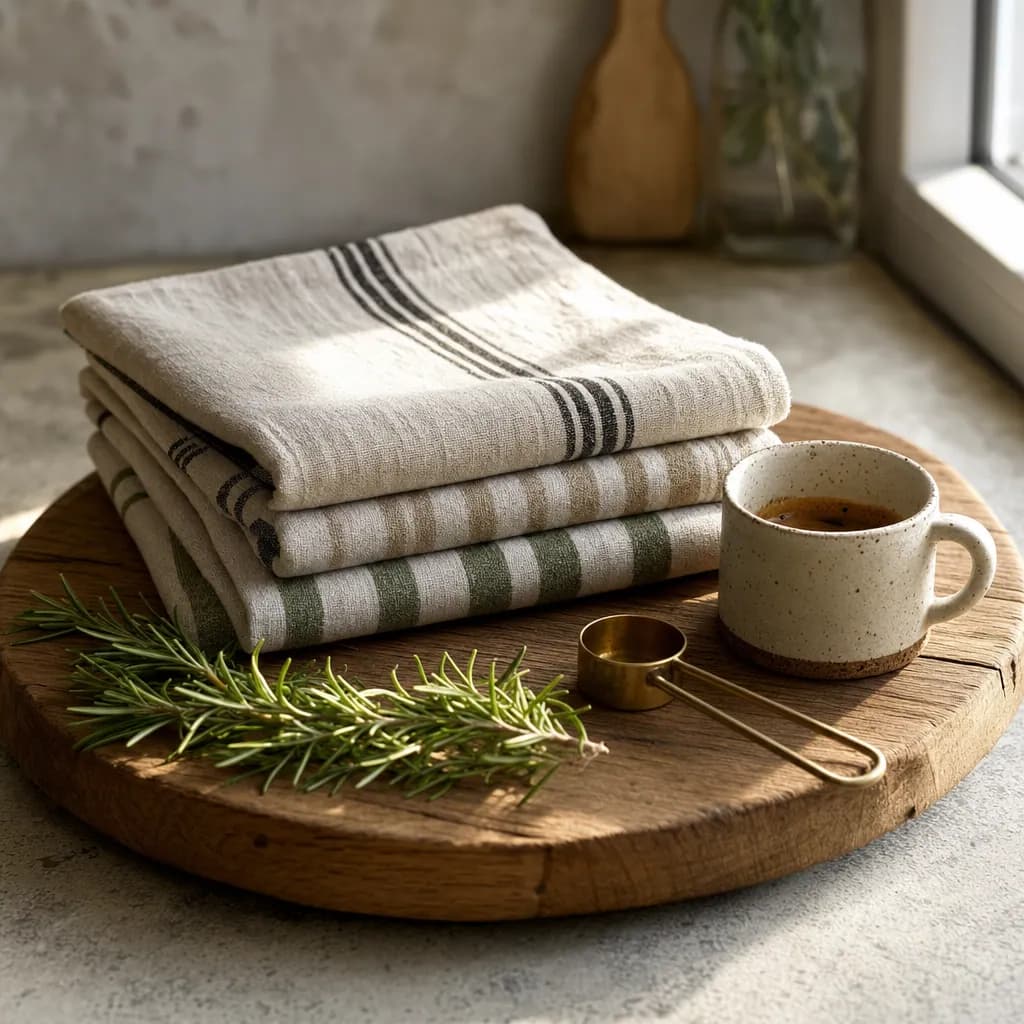
The Plait & Mill solution is a linen-cotton blend (55/45 standard) stripe-yarn-dyed to mask stains, hemstitched against fraying, and triple-stone-washed for immediate drape. The towel arrives soft on day one rather than after twenty washes. It is the spec we ship to Michelin-starred restaurants and high-volume bar groups across Europe and Asia.
The numbers, plainly.
- Weight (GSM)
- 180 - 280
- Composition
- 55 percent linen / 45 percent combed cotton
- Construction
- Plain or basket weave; stripe yarn-dyed
- Standard size
- 40x60 (glass cloth), 50x70 (bar mop), 70x140 (kitchen bar)
- Edge
- Hemstitch against fraying
- Finishing
- Triple stone-washed for immediate drape
- MOQ
- 500 pieces per design
- Lead time
- Sample 10-14 days; bulk 25-40 days
- Price band
- USD 3.20 - 6.80 per piece FOB Ningbo
Best for: Working restaurant kitchens where the towel earns its keep through hundreds of wash cycles.
Typical buyers.
- 01
Open-kitchen restaurants and Michelin venues
- 02
Bar and cafe groups
- 03
Cooking schools and culinary institutes
- 04
Hotel restaurant and banquet operations
- 05
Home retail kitchen brands
Quick answers.
What towels are used in restaurant kitchens?+
Two distinct cloths: a heavy linen-cotton bar mop (180-220 GSM) for surface wipe-down and general service, and a lighter pure-linen glass cloth (140-180 GSM) for stemware and polished plates. Both are stripe-yarn-dyed to mask stains and hemstitched against fraying.
What kitchen towels do chefs use?+
Working chefs use heavy linen-cotton blend cloths at roughly 200 GSM in a 50x70 cm size, deep stripe-dyed in navy, charcoal or oxblood so stains read as part of the pattern. The cloth is tucked into the apron string at the waist and used for everything from wiping bowls to picking up hot handles.
What is the difference between a bar mop and a kitchen towel?+
A bar mop is heavier (180-220 GSM) and built for soaking up large spills behind the bar or on the service line. A kitchen towel (or tea towel) is lighter (140-180 GSM) and built for drying glassware, plates, and hands. The bar mop is the workhorse - 70-80 percent of restaurant towel volume.
How are restaurant kitchen towels different from home kitchen towels?+
Restaurant towels are built to a different duty cycle. Higher linen percentage for lower lint on glassware, heavier weight (180-220 GSM versus 140-160 GSM retail), denser hemstitching, pre-washed finishing for day-one drape, and stain-masking stripe yarn-dyeing. Retail towels prioritise visual design and softness on the rack; restaurant towels prioritise survival through 300+ hot industrial washes.
Cross-references.
Send us your spec.
We reply in one business day.
Volume, size, GSM, logo technique, target landed price, target ship date. Whatever you have. We respond with a working price and a sample schedule within 24 hours.
- [email protected]
- Phone · WhatsApp · WeChat
- +86 13205717266
- Address
- No. 88 Textile Road
Yiwu, Zhejiang 322000
China - Hours
- Mon-Sat · 09:00-18:00 GMT+8
English · Mandarin · French · Spanish