Beach Towel OEM Business Continuity Planning for Malaysia
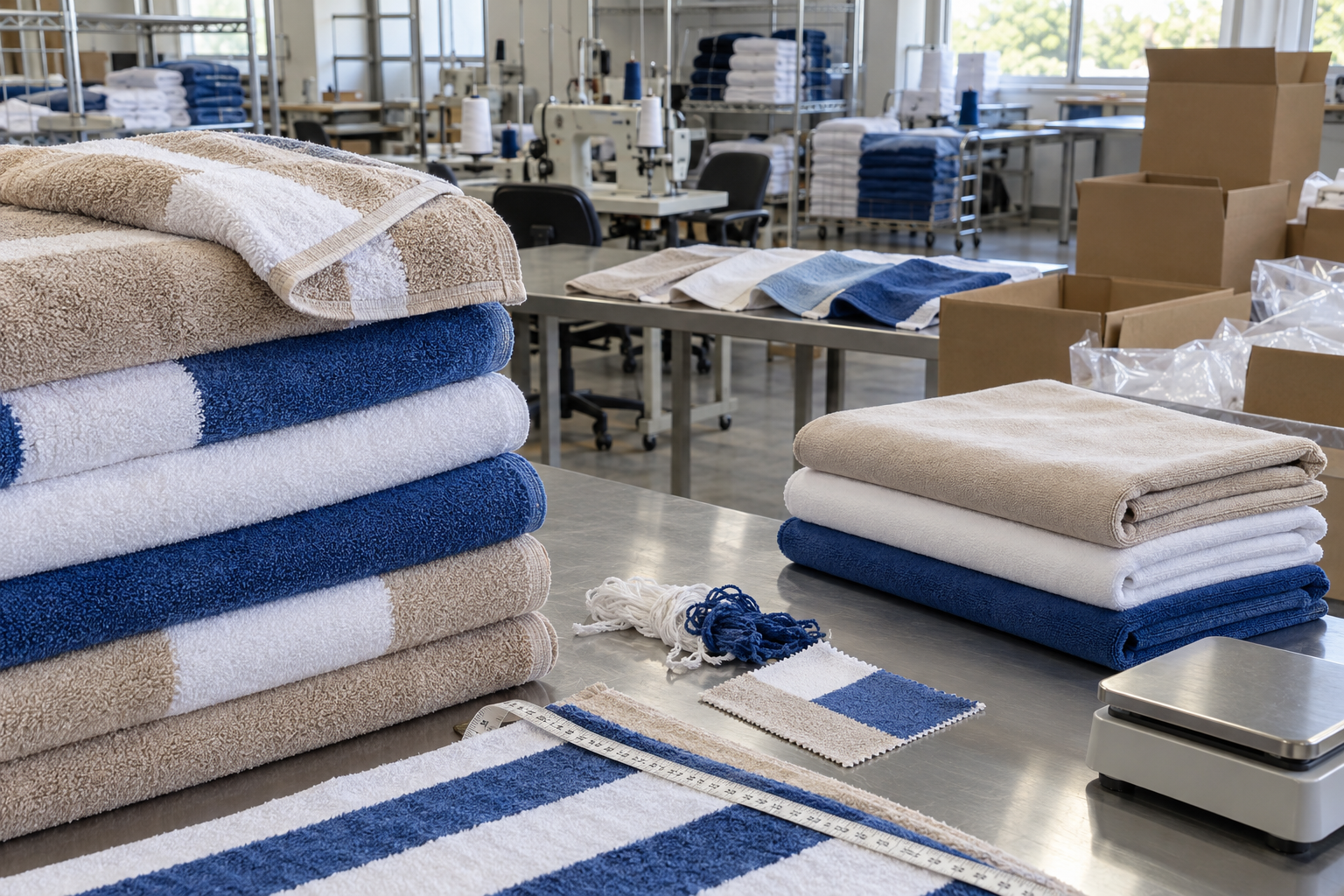
Malaysian buyers placing a beach towel OEM order should decide business continuity planning before they book capacity. Qualify two to three factories, put about 60-80 percent of program volume on the primary, and place the remaining volume on backups that have already made the same towel. That volume band is OEM beach towel manufacturing guidance from Towelscc. The unit is percent of program volume. The excerpt used here shows no publication date and no Malaysia-specific sample. (Towelscc dual-source guidance) A single source is a catastrophic risk if fire, financial collapse, or a COVID-style disruption stops that factory. (Towelscc dual-source guidance)
For a Malaysia program, continuity means the approved beach towel still ships when the primary line slips: same construction, color, size, packing, and documents. Hotels already lose linens and amenities when supply breaks, unless they diversify suppliers, hold safety stock, write vendor continuity clauses, and keep alternate-sourcing playbooks as part of ISO 22301 business continuity planning. (Hospitality continuity note) Those points are a buying checklist for beach towel manufacturing. They are not proof that a factory is certified.
This note covers only that manufacturing continuity task for buyers in Malaysia.
Why Malaysia programs need beach towel OEM business continuity planning
Malaysia is the market this procurement note addresses. Resort, retail, hotel, and promotion buyers often tie beach towel deliveries to a short selling window. The sources do not state Malaysia port times, storage climate limits, or a national towel standard, so none of those are treated as facts here.
The sourced failure is simple. If one factory holds the whole order, fire, insolvency, or a pandemic-style shutdown can stop shipment. (Towelscc dual-source guidance) Hospitality operators then see linen shortages. (Hospitality continuity note) A beach towel program fails in the same pattern: a missed container, a substituted cloth, or an empty fixture during the weeks the goods were meant to sell.
Business continuity planning, for this product, is a set of order controls rather than a slogan. Name the primary and the backups before the purchase order. Write the volume split in pieces. Carry QC checkpoints with the SKU so a second plant can be judged on the same rules. Define packing and documents the backup can repeat. Decide whether safety stock exists for the critical SKUs, who holds it, and who pays for it.
One towel manufacturer, Cloud Textile, says it plans capacity around beach towel SKU mix, seasonal peaks, replenishment cycles, and QC checkpoints, and that it uses predictable planning plus export-ready packaging and documentation to reduce sourcing risk. (Cloud Textile planning note) That is that company's published method. It is not a claim about every mill, and it is not a Plait & Mill production record.
Manufacturing continuity: volume split, backup suppliers, and failure modes
Towelscc tells OEM beach towel buyers to keep relationships with two to three suppliers, let the primary handle 60-80 percent of volume, and let backups cover the rest. Scope is OEM beach towel manufacturing. No as-of date, survey size, or country split appears in the excerpt, so the band is guidance to test in a contract, not a measured share of Malaysia imports. (Towelscc dual-source guidance)
The complement of that band is 20-40 percent of program volume sitting on backups. That complement is arithmetic from the same Towelscc range, same scope, and same missing date. It is not a second study.
Example calculation to verify in the supplier quote, not a market figure. Assume a Malaysia contract year of 120,000 beach towels. At a 70 percent primary share, the primary is booked for 84,000 pieces and the backups share 36,000 pieces. Two equal backups would each hold 18,000 pieces. Confirm every quantity against real forecasts and against each factory's written capacity. Do not cite 120,000, 70 percent, 84,000, 36,000, or 18,000 as published industry data.
The 60-80 percent choice is a trade-off. Moving toward 80 percent usually concentrates dye lots and can simplify cost. It also means a primary outage leaves only the smaller backup share already placed. Moving toward 60 percent raises coordination and can increase shade differences, but more of the year's pieces already sit with alternates. Compare the unit-price gap with the cost of missing the selling window in Malaysia before the split is locked.
A backup that has never cut the approved size, yarn, construction, hem, or print is not a recovery path. A pre-production sample and a capacity figure in pieces per week are required from each named factory. The sources do not publish those weekly rates.
Write only the disruption types the sources name: fire or similar site loss, financial collapse, and COVID-style operating disruption. (Towelscc dual-source guidance) Add the downstream effect those events create for linen users when stock and alternates are missing. (Hospitality continuity note) Ask which of those events the quotation actually covers.
What ISO 22301 covers and what a towel factory must still prove
ISO 22301 is the business continuity management standard named in the hospitality source. The same summary lists mitigations used with that planning: diversified and local suppliers, safety stock of critical items, vendor continuity clauses, and alternate-sourcing playbooks. (Hospitality continuity note)
Keep three layers apart.
The standard's requirement, where an organization truly runs ISO 22301, is a management system for continuing critical activities after disruption. The excerpt does not quote clauses, recovery-time numbers, or audit scores. Do not invent them. A certificate counts only if a current document is read in the supplier's legal name, with scope and expiry. Nothing in these sources shows that Plait & Mill, or any mill discussed here, holds that certificate.
The hospitality practice in the BCESG summary is operational: more than one supplier, some of them closer to the point of use, stock of critical items, contract language, and a written alternate-source playbook. That practice responds to linen and amenity shortages. It is not a beach towel construction standard.
The factory practice in the Cloud Textile note is planning language: SKU mix, peaks, replenishment, QC checkpoints, packaging, and export documents. (Cloud Textile planning note) Company practice is not the same thing as a certified system.
For a Malaysia purchase order, a short vendor continuity clause is more useful than an unread manual. The sources support having the clause. They do not set a notice period. The buyer sets the number of days in the RFQ and accepts only a written answer.
Example assumption for safety stock, to verify in the quote. The hospitality source supports safety stock of critical items and gives no quantity. Assume four weeks of peak issue on the top size and color only. If peak issue is 2,000 pieces per week, four weeks equals 8,000 pieces. Check that arithmetic against actual issue, storage, and who owns the goods. It is not a regulation in Malaysia and not a quantity stated by the sources.
Local, in the hospitality note, means a nearer alternate when the main supplier fails. For a buyer in Malaysia, locality is whatever origin, mode, and transit time the quotation states. The excerpts name neither a Malaysian factory nor a transit-day figure.
Production planning signals that reduce sourcing risk
Prevention sits inside business continuity planning. Cloud Textile describes predictable production planning, consistent quality, and export-ready packaging and documentation aimed at lower sourcing risk, with capacity planned around beach towel SKU mix, seasonal peaks, replenishment cycles, and QC checkpoints for program buying. (Cloud Textile planning note)
Turn those four signals into RFQ questions. An answer is not proof until it is checked.
SKU mix decides how hard continuity will be. Many sizes, colors, and trims mean more changeovers and more recipes that only the primary may hold. List the SKUs that must survive a primary outage, and list the SKUs that can wait. Put the critical list on the purchase order.
Seasonal peaks are when a one-factory plan breaks. Name the months goods are needed in Malaysia. Require pieces per week from the primary and from each backup in those months. The sources contain no Malaysia peak calendar. The calendar comes from the buyer. The rates come from the factories.
Replenishment cycles are the repeat orders after the first bulk. State whether each backup stays warm with a small running quantity or stays idle until a trigger. A backup that has not run the cloth for a long gap is a new development job. It will not recover a peak-week failure on the original lead time.
QC checkpoints should be named at base cloth, after dye or print, after cut-and-sew, and at packing. The continuity point is identical accept and reject rules at every factory. Otherwise the recovery lot can meet the piece count and miss the hand-feel, shade, or shrinkage that was approved. The sources give no numeric GSM, shrinkage, or color-difference limits. Specify the method and tolerance to be used, and make every factory quote to that sheet.
Export packing and documents matter on the recovery shipment. Define carton contents and the paper set before a crisis so the second factory is not designing documents at the dock. Defining the list does not create a certification.
The measurable trade-off is cost versus fragility. A live backup, matched QC, and a documented pack raise sample cost, staff time, and sometimes unit price. A price-only award tends to select the plan with no tested alternate. Buyers who can miss a season may accept that risk. Buyers who cannot should price the tested alternate and show the cost difference in the approval note.
Buyer decision table for beach towel manufacturing continuity
Use each row to specify, compare, verify, approve, or order. If a cell has no number from the sources, the row tells the buyer to set the number in the RFQ.
| Decision | Specify in the RFQ | Compare across factories | Verify before approval or order |
|---|---|---|---|
| Supplier count | Two to three named factories for the OEM beach towel program (Towelscc) | A split panel versus one factory | Legal names, plant addresses, and who controls the backup |
| Volume split | Primary share as a percent of pieces, tested against the cited 60-80 percent band | Unit price and shade risk nearer 60 percent versus nearer 80 percent | Written pieces per week that cover the awarded share |
| Backup share | The remaining 20-40 percent of pieces, as the complement of that same band | One backup versus two backups | Each backup's confirmed piece capacity |
| Failure trigger | Fire, financial failure, and broad shutdown, as named in the OEM guidance | Which events shift volume | Clause text and notice period in days |
| Critical SKUs | Construction, size, color, and pack that must be recoverable | Which SKUs each backup has sampled | One approved spec sheet used by every plant |
| Safety stock | Piece count and weeks of cover for critical SKUs only | Buyer warehouse versus factory-held goods | Location, title to the goods, and carrying-cost owner |
| QC gates | Same checkpoints and tolerances at primary and backup | In-house checks versus outside lab pages | A completed sample report from each plant on the buyer's sheet |
| Continuity clause | Vendor clause and alternate-source playbook (BCESG) | Price and lead-time rules if volume moves | Signed language, not a sales brochure |
| Planning signals | SKU mix, peak months, replenishment cadence, and QC points (Cloud Textile) | How each plant loads the stated peak | A capacity note tied to the SKU list |
If a factory offers a split outside 60-80 percent of pieces, record the reason in pieces and state how many pieces would stop if that factory stopped. The band is cited guidance, not a Malaysia legal limit.
RFQ Checklist
- Ask the supplier to name two or three factories for this beach towel OEM program and to state the primary share as a percent of pieces, with the cited 60-80 percent band used only as a comparison point.
- Require the manufacturer to confirm backup capacity in pieces per week on the same size, construction, colorway, and packing as the primary, and to mark any SKU not yet sampled.
- Specify the trigger events that move volume, the notice period in days, and whether unit price or lead time can change when a backup ships the recovery lot.
- Specify safety stock as a piece count and as weeks of cover for critical SKUs only, and state whether those pieces sit in the buyer warehouse or at the factory.
- Ask the supplier to list QC checkpoints from base cloth through dye or print, cut-and-sew, and packing, and to apply the same accept and reject rules at every factory.
- Require the manufacturer to attach the packing specification and the document list for both primary and backup shipments, and to withhold any certification claim that a current certificate does not support.
- Compare peak-month capacity in pieces per week with the months goods are needed in Malaysia, and do not approve a plan that covers only the primary peak.
- Verify that a vendor continuity clause and a short alternate-source playbook are part of the quotation before the purchase order is approved.
- Ask the supplier to separate day-to-day factory practice from any ISO 22301 statement, and to send a current certificate only when the legal entity and scope match the plant that will make the towels.
How the figures were derived, and what to verify
Vincent Xi, Editorial Author at Plait & Mill (https://plaitandmill.com/authors/vincent-xi/), prepared this buying note from the published sources cited above. It reports no personal factory inspection, laboratory test, client name, or customer outcome.
The factory-facing claims use two source contexts. Towelscc covers single-source failure and a two-to-three supplier setup in which the primary handles 60-80 percent of volume for OEM beach towel manufacturing. (Towelscc dual-source guidance) Cloud Textile covers planning by beach towel SKU mix, seasonal peaks, replenishment cycles, and QC checkpoints, plus export-ready packaging and documentation. (Cloud Textile planning note) The continuity context is the BCESG hospitality note: linen and amenity shortages, diversified and local suppliers, safety stock, vendor continuity clauses, alternate-sourcing playbooks, and ISO 22301 business continuity planning. (Hospitality continuity note)
Sourced figures are only the supplier count (two to three factories) and the primary share (60-80 percent of program volume), both from that Towelscc statement, with no as-of date in the excerpt. The 20-40 percent backup share is the arithmetic complement of the same band. These example calculations are assumptions to replace with a supplier quote: a 120,000-piece Malaysia contract year; a 70 percent primary case equal to 84,000 pieces, leaving 36,000 pieces on backups; 18,000 pieces on each of two equal backups; and safety stock of 2,000 pieces per week for four weeks, equal to 8,000 pieces.
The excerpts do not audit any plant and do not state price, lead time, dimensions, fiber, GSM, or lab limits. They show no current ISO 22301 certificate for Plait & Mill or the cited companies. They do not state Malaysia customs, duty, or climate-storage rules. Hospitality linen notes are not a beach towel process specification, and Cloud Textile's account is not a Plait & Mill capability. Before awarding a Malaysia beach towel OEM order, check the legal entity, plant address, backup commitment, pieces per week, approved samples, tolerances, document samples, and the signed continuity clause.
Discuss Your Requirements
Review our manufacturing capabilities, then share your specifications for a supplier-fit review.