Beach Towel OEM Product Development Capability for United Arab Emirates Buyers
By Vincent Xi, Editorial Author, Plait & Mill
United Arab Emirates hospitality, retail, and promo buyers should judge beach towel OEM product development capability by whether a mill can freeze a manufacturing specification and repeat it on the next lot. Lock fiber, construction, GSM, finished size, color standard, decoration method, hem, and label pack in a tech pack, then require a physically approved pre-production sample (PPS) before bulk fabric is cut. One cited OEM/ODM page describes material engineering, craft guidance, sampling approvals, QC checkpoints, and channel-ready packaging, with specs covering GSM, size, finish, and tolerances (Cloud Textile OEM/ODM services). Those gates belong in the RFQ; unit price without them is not a comparable offer.
This briefing is for United Arab Emirates B2B buyers specifying manufacturing programs in the beach-towel product family. It does not transfer another mill's published MOQ, plant area, capacity, sample days, or certificate names onto a different supplier, and it does not treat manufacturing origin as the sales market. Every exact figure below is either attributed to a named public page or labeled as an example calculation or assumption to verify on the supplier quote.
How the data was derived. Process steps and commercial examples were extracted from three public OEM/ODM pages that describe private-label or custom beach towel development: spec coverage and PPS locks; a sequenced OEM/ODM path with factory-stated plant area, sample days, and capacity; and specification-to-order terms with MOQ and lead-time figures. Arithmetic GSM-to-mass figures use stated centimetre dimensions and assumed grams per square metre. Those pages are source context only. They are not Plait & Mill production records, test reports, certificates, or factory-visit notes.
Limits and what to verify. Third-party factories publish their own MOQ, sample days, plant area, annual capacity, and scheme names. Those claims can change and do not prove that a different mill can match them. This briefing does not invent United Arab Emirates statutory label text, duty, or VAT. Confirm the live quotation, original test reports tied to the production quality, valid certificate PDFs (scheme, producing site, scope, expiry), piece weight versus GSM, and carton marks for the United Arab Emirates consignee before approving bulk.
Claim-to-source map for this briefing
| Published item | Unit and figure | Scope | As-of context | Source |
|---|---|---|---|---|
| Spec coverage and PPS before bulk | GSM, size, finish, tolerances; cotton, microfiber, bamboo/eco, recycled RPET; printed, jacquard, or embroidered methods | Cloud Textile public OEM/ODM description | Live public page, not a dated audit file | Cloud Textile OEM/ODM services |
| 7-step OEM/ODM path, sample days, plant area, stated annual capacity, scheme names | 7 calendar-day samples; 50,000 m²; 18 million pieces/year; BSCI, Sedex, and Oeko-Tex names | Qingdao Inside self-description | Live public page, not a dated audit file | customized beach towel solution |
| Spec-to-order terms and scheme names | MOQ starting at 50 pcs; 7-day samples; 20-day bulk; GRS and Sedex names | Galink Ltd stated terms | Live public page, not a dated lab report | Galink custom beach towels |
| Face-fabric mass vs GSM | 90 cm × 180 cm = 1.62 m²; 400 g/m² → 648 g; 500 g/m² → 810 g; 162 g/piece = 162 kg/1,000 pieces | Example calculation only | Arithmetic illustration; verify on the mill consumption sheet | No mill quote; see calculation section |
What beach towel OEM product development capability covers
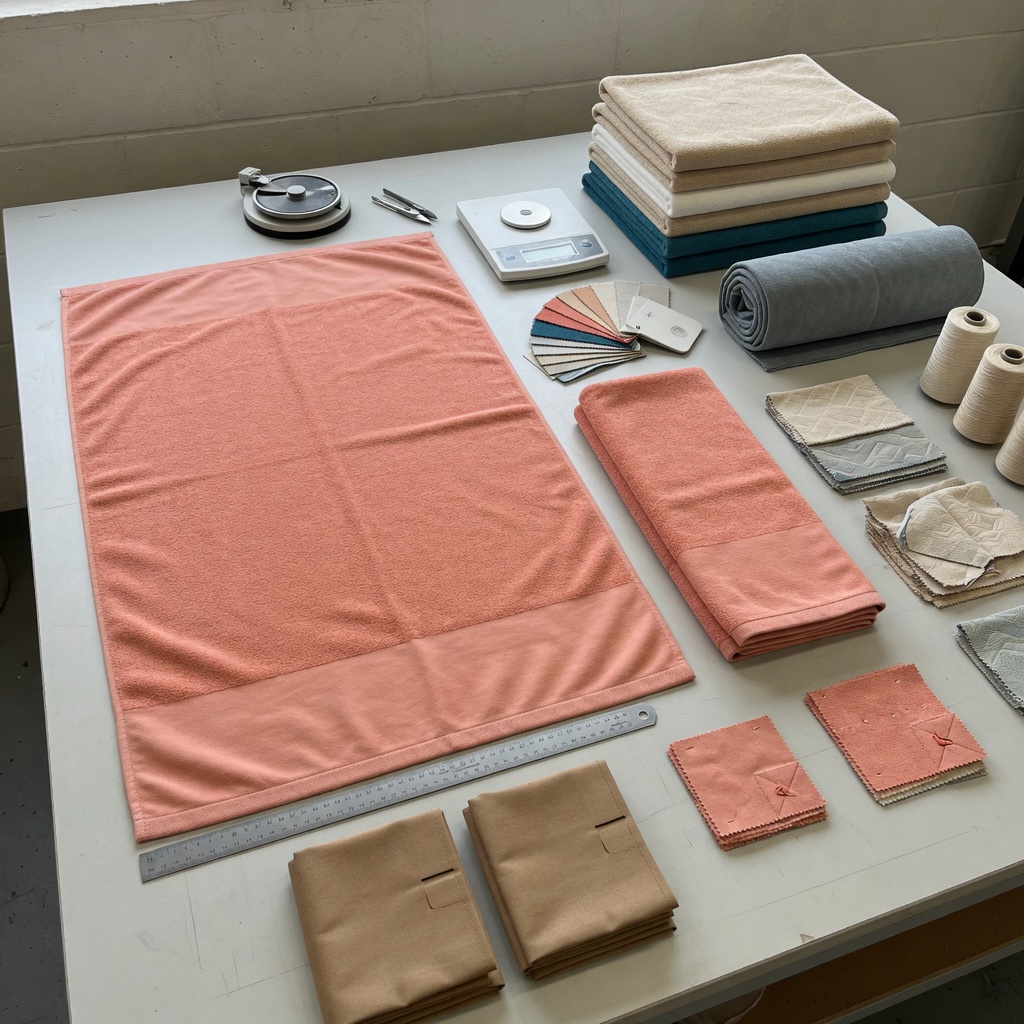
OEM product development capability for a beach towel is the mill's ability to convert a brand brief into a repeatable manufacturing specification. It is not the same as stocking a promotional SKU. Inspect six workstreams:
- Material engineering — fiber, yarn, pile or suede face, and GSM matched to the stated end use.
- Construction and size — finished dimensions after wash, hem type, corners, loops, and piece weight for freight.
- Decoration engineering — print, jacquard, or embroidery, and what each does to handfeel and durability.
- Sampling locks — lab dips, strike-offs, proto, and PPS with written comments.
- Packaging and identification — private labels, care/content copy, inner packs, and export cartons marked for the buyer's United Arab Emirates receiving process.
- QC and lot control — in-line and final checkpoints, shade banding, measurement tolerances, and which documents travel with the shipment.
Cloud Textile's public OEM/ODM page maps those workstreams and locks pre-production samples before bulk for cotton, microfiber, bamboo/eco, or recycled RPET, using printed, jacquard, or embroidered methods, with specs covering GSM, size, finish, and tolerances (OEM/ODM services). That is a map of the work, not evidence that every mill performs it.
Qingdao Inside's public page describes a 7-step OEM/ODM process (pattern design, cotton velour or microfiber, printing, custom sizes, private labels, sewing, packaging) and states BSCI, Sedex, and Oeko-Tex names, 7-day samples, 50,000 m² factory area, and 18 million pieces/year. Plant area (square metres), capacity (pieces per year), and sample days are that factory's published claims. Scope: self-description. As-of: the live public page, not a dated audit file (customized beach towel solution).
Galink Ltd's public page states production to buyer specifications for fabric weight, dimensions, color, print, finishing, and packaging, with MOQ starting at 50 pcs, 7-day samples, and 20-day bulk, covering cotton velour, microfiber, and sand-free programs via sublimation, screen print, and embroidery, and names GRS and Sedex. Treat 50 pieces, 7 days, and 20 days as that page's published commercial example; re-confirm on the live quote (Galink custom beach towels).
For a United Arab Emirates buyer, the test is whether the mill can run this sequence against this tech pack and still hit shade, size, and handfeel on bulk—not whether a website lists the steps.
Engineering GSM, materials, and decoration from a tech pack
The first measurable trade-off is mass versus performance versus freight. GSM is fabric areal density in grams per square metre. It is not finished towel weight, because hems, labels, shrinkage, and process loss change mass.
Example calculation (verify on the mill consumption sheet). A 90 cm × 180 cm finished rectangle is 1.62 m². At 400 g/m², face fabric mass is 1.62 × 400 = 648 g before hems, shrinkage, and cutting waste. At 500 g/m² the same face is 810 g. The 162 g difference per piece is 162 kg of fabric mass per 1,000 pieces, which changes handfeel and chargeable freight weight. Do not use this example as a price; require the mill's marker, GSM, and finished-weight tolerance. Units: centimetres, square metres, grams per square metre, grams per piece, kilograms per 1,000 pieces. Scope: illustration only. As-of: arithmetic example, not a quoted BOM.
Material families listed on the cited OEM beach towel pages, and the development questions they create:
- Cotton velour / terry — listed on the Qingdao Inside and Galink pages. Lock yarn, pile height, reverse construction, and shrinkage after a named wash method.
- Microfiber — listed on Cloud Textile, Qingdao Inside, and Galink pages. Lock construction (split microfiber vs woven suede) and edge finish. Galink's page also names sand-free programs; do not accept a sand-release claim without a test method the mill will repeat on bulk.
- Bamboo/eco blends — listed on the Cloud Textile OEM/ODM page. Not a spec until the composition string is locked for the label. Do not treat a marketing word such as bamboo as the legal fiber name.
- Recycled PET (RPET) — Cloud Textile lists recycled RPET; Galink names GRS. Ask whether recycled content is in the ground fabric, thread, or only the polybag, and whether the PO needs a transaction certificate for the actual lot.
Decoration is the second trade-off. Cloud Textile lists printed, jacquard, or embroidered methods; Galink lists sublimation, screen print, and embroidery; Qingdao Inside lists printing techniques inside a 7-step path. Freeze one method per SKU:
- Sublimation fits photographic all-over print on polyester/microfiber. Cotton will not take the same process.
- Screen / pigment / reactive fits simpler art on cotton; pigment can change handfeel and wash-down.
- Jacquard puts the logo in the weave; setup and minimums differ from surface print.
- Embroidery suits small crests; stitch density can crush pile and leave hoop marks.
Mixing sublimation artwork onto a cotton velour brief is a common spec error. Color needs a physical approved dip plus a named light and a tolerance the mill can instrument. Ask whether bulk will be judged against the PPS under a named illuminant such as D65 (example illuminant to specify, not a claim that any mill has already tested local sunlight).
Size belongs in centimetres, with plus/minus, and with a statement of whether dimensions are after wash. Example sizes, not catalog SKUs: a 160 × 80 cm towel and a 180 × 90 cm towel are different cutting, folding, and carton programs. Do not leave adult beach towel as the only size callout.
Sampling and PPS locks before bulk cut
Sampling is where development capability is proven. A 7-day sample line on a public page is that factory's commercial claim, not a universal SLA. Galink Ltd publishes 7-day samples, 20-day bulk, and MOQ starting at 50 pcs (units: calendar days; pieces; scope: that company's stated terms; as-of: the live page, not a dated lab report) (Galink). Qingdao Inside publishes 7-day samples with a 7-step OEM/ODM process (unit: calendar days; scope: that company's self-description; as-of: the live public page) (Qingdao Inside).
A buyer-side ladder that maps to those published steps:
- Proto — construction, GSM, and hem, using closest quality if custom yarn is not yet dyed.
- Lab dip / yarn dye — body color lock.
- Strike-off or jacquard proof — placement, bleed, logo size.
- Photo / salesman sample — internal review only, unless the PO writes that it is the production standard.
- PPS — intended construction, intended labels, intended stitch, on the intended line when possible. This is the lock Cloud Textile's copy refers to as pre-production samples before bulk (Cloud Textile).
Approvals should be written, dated, and photo-annotated (hem width, GSM re-check, shade, registration). A chat photo is not a manufacturing control. Do not cut bulk fabric until the PPS form has zero open issues.
Packaging is part of development. Lock brand-label position; care and fiber-content copy supplied by the buyer's compliance owner (this briefing does not invent United Arab Emirates statutory label text); hangtag and barcode if the channel uses them; fold and band; polybag if used; export carton size, pieces per carton, and marks (PO, SKU, United Arab Emirates consignee). Channel-ready packaging appears in Cloud Textile's OEM/ODM description; freeze a packing BOM so PPS and bulk match.
Lead-time trade-off: 7-day sampling only holds if artwork, color, GSM, and size are already frozen. A 20-day bulk window (Galink, as published) will not hold if PPS comments change the weave, screen, or label. Restart the calendar when the spec changes.
QC checkpoints versus certificate names
Keep three layers separate:
- A standard's requirement — what a named scheme actually covers.
- A factory's stated practice — they say they check GSM, size, and sewing.
- A current document — PDF, scope, expiry, and producing-site name matching the invoice mill.
Qingdao Inside's page names BSCI, Sedex, and Oeko-Tex. Galink's page names GRS and Sedex. Those are factory-published names. They are not treated here as current, site-specific, or transferable, and they are not Plait & Mill certificates. If the PO needs a scheme, request the file and match the site. A scheme name is not a substitute for inspectable GSM, size, and shade gates.
QC gates that belong in the development file:
- Incoming yarn or greige: fiber and yarn identity.
- After dyeing: shade vs approved dip; colorfastness to washing with the method ID on the report.
- After print or jacquard: registration, cracks, backside strike.
- After sewing: hem width, open seams, loop security, dimensions vs tolerance.
- Finished goods: piece weight or GSM on a defined sample plan, appearance, odor; needle detection only if the channel requires it.
- Packing: correct label, fold, count, carton marks.
Cloud Textile lists QC checkpoints as part of OEM/ODM. The buyer still needs an AQL (or other sampling plan) on the PO. If no plan is stated, good quality is not inspectable.
Tighter shade and measurement tolerances raise rejection risk and unit cost; looser tolerances speed bulk and increase reorder drift. For a multi-site United Arab Emirates hospitality or retail program, shade banding across reorders is usually costlier than a higher first-lot price—treat that as a buying rule, not a lab result.
Do not treat sand-free, quick-dry, or luxury as QC gates unless a test method is named and run on the production quality. If the mill cannot run the test, do not put the claim on the hangtag.
How United Arab Emirates buyers should compare manufacturing programs
United Arab Emirates buyers should compare OEM product development capability on documents, not adjectives. Manufacturing origin is not the sales market; the receiving buyer in this briefing is in the United Arab Emirates.
Compare mills against the same frozen brief: same size, GSM, fiber, decoration, and label pack; same sample ladder and who pays failed rounds; same QC plan; same Incoterm and carton spec so landed cost is comparable.
Landed-cost detail this briefing can support without inventing duty or VAT rates: piece weight and carton volume drive freight; GSM and size drive piece weight (see the 400 vs 500 g/m² example). Request kg and CBM on the quote. Do not use an unpublished tariff here; have the buyer's broker classify the actual fiber.
If the program's stated end use includes pool chemicals, sunscreen, or abrasive sand, write those conditions into the RFQ as questions and require any related test method on the PPS. That is a specification request, not evidence that a mill has tested local conditions, and it is not a substitute for buyer-supplied care and content copy.
Qingdao Inside's published 50,000 m² area and 18 million-piece stated annual capacity, and Galink's published 50-piece MOQ, show why scale and flexibility are different offers. A 50-piece MOQ can de-risk a first amenity or promo run; it may not win unit cost at an example 20,000-piece bulk (assumption: verify the live quote). Stated plant capacity does not prove the mill will prioritize a small development queue. Ask for a named development owner, a critical-path calendar, and the rule if PPS fails.
Approve bulk only with a pack that includes signed tech pack and PPS photos, bill of materials, test reports tied to the production quality, certificate files if the PO requires them, and carton marks using United Arab Emirates consignee data the buyer supplies.
Buyer decision table
Every row is a specify, compare, verify, approve, or order action for beach towel OEM product development.
| Decision | Why it matters in development | Language to put in the RFQ | Verify before bulk cut |
|---|---|---|---|
| Fiber and construction | Fiber family changes print method, dry time, and label copy | State fiber %, yarn, terry vs velour vs suede, and print/jacquard/embroidery method | BOM vs PPS; label copy matches BOM |
| GSM and finished size | Mass, opacity, drape, and freight; after-wash size vs cut size | Target GSM __ g/m² ± __; finished size __ cm × __ cm after wash, ± __ cm | Re-measure PPS; piece weight vs example calc |
| Color standard | Reorder shade drift across United Arab Emirates outlets | Approve lab dip; bulk vs PPS under named illuminant (example: D65) | Instrument report or signed visual |
| Decoration method | Artwork fidelity vs handfeel vs setup | One method per SKU; placement drawing in mm | Signed strike-off or jacquard proof |
| Hem, corners, loops | First failure points in hospitality or retail handling | Hem type and width mm; corner reinforcement; loop yes/no | PPS pull on loop; measure hem |
| Private label and care copy | Channel-ready pack; buyer supplies legal text | Buyer-supplied label pack and care/content copy; position map | PPS uses production labels unless waived |
| Sample ladder | Published 7-day sample claims only work on frozen specs | Proto → dip/strike-off → PPS; PPS lock before cutting | Signed PPS form with zero open issues |
| MOQ and lead time | 50 pcs / 7-day / 20-day are one factory's published example | MOQ by colorway; calendars after written PPS approval | Quote vs PO; what restarts the clock |
| QC plan | Checkpoints are not inspectable without a plan | In-line and final checkpoints; AQL __; GSM/size/shade sample size | Protocol on PO; mill vs third-party inspector |
| Certificates | Website names are not current site documents | If required: scheme, producing site, scope, expiry PDF | PDF site name matches invoice mill |
| Packing and marks | Mixed SKUs and crushed folds at United Arab Emirates receiving | Fold diagram; pieces/carton; carton size cm; PO, SKU, consignee | Carton spec on PPS packing |
| Freight mass | GSM and size change kg and CBM | kg per packing unit and CBM/carton; Incoterm __ | Packing list vs quote |
RFQ checklist for OEM beach towel development
Send this file with the tech pack. Each item is something to specify, compare, verify, approve, or order.
- Program identity: brand, season, United Arab Emirates receiving entity, in-use date, and channel (hospitality amenity, retail, or promo).
- Construction spec: fiber %, terry vs velour vs microfiber suede, GSM target and tolerance (g/m²), pile height if relevant, finished size in cm (after-wash or cut stated).
- Artwork and color: placement in millimetres from edges, color count, forbidden methods, physical color standard or named reference, light source, and whether each colorway has its own MOQ.
- Decoration method: sublimation, screen, jacquard, or embroidery—one primary method per SKU—with cotton vs polyester compatibility stated.
- Sewing and trims: hem type and width (mm), stitch, corner reinforcement, hanging loop yes/no, brand label, care/content copy from the buyer's compliance owner, hangtag, barcode if used.
- Packing BOM: fold, band, polybag, inner pack, export carton dimensions (cm), pieces per carton, marks including United Arab Emirates consignee fields the buyer will provide.
- Sample ladder: paid vs free rounds; who pays failed PPS; bulk fabric not cut until written PPS approval.
- Commercial terms to interrogate: if a mill quotes near 50 pcs MOQ, 7-day sample, or 20-day bulk, ask how many colorways and which fabrics are in stock, and what voids the date. Those figures are published by Galink Ltd as that factory's terms (Galink).
- QC plan: AQL or equivalent, measurement chart, shade-band rule, needle detection only if the channel requires it, mill-final vs third-party inspection.
- Tests: reports with PPS and with bulk (composition; colorfastness to washing). Add chlorine or crocking only if the ticket will claim it. Name the method; do not accept a logo without a report.
- Certificates only if the PO needs them: scheme, producing-site match, scope, expiry. Treat BSCI, Sedex, Oeko-Tex, and GRS as document requests named on Qingdao Inside and Galink public pages—still verify the PDF (Qingdao Inside; Galink).
- Path, quote, and change control: named development contact and bulk line; factory-stated 50,000 m² and 18 million annual capacity on the Qingdao Inside page do not replace a calendar for this PO; unit price by colorway, sample and setup fees, kg and CBM, Incoterm, payment, validity date; use the example 90 × 180 cm at 400 g/m² ≈ 648 g face mass before hems as a plausibility check on quoted piece weight—verify on the consumption sheet; how a GSM, size, or artwork change re-prices and restarts sampling; next United Arab Emirates shipment must match the sealed PPS.
Source context. Cloud Textile is used for the development sequence (materials, crafts, PPS, QC, packing) and spec coverage (GSM, size, finish, fiber families, print/jacquard/embroidery). Qingdao Inside is used for a published 7-step OEM/ODM path, 7-day samples, certificate names, 50,000 m² plant area, and 18 million-piece stated annual capacity. Galink Ltd is used for specification-to-order terms, GRS/Sedex names, 50-piece MOQ, 7-day samples, and 20-day bulk. Method: extract those public units and steps, then convert them into RFQ language for United Arab Emirates B2B buyers. No factory visit, lab test, or first-person use claim is made. Verify current quotes, PPS against the tech pack, piece weight versus GSM, certificate PDFs, and packing for the United Arab Emirates consignee before bulk.
Discuss Your Requirements
Review our manufacturing capabilities, then share your specifications for a supplier-fit review.