Beach Towel Sourcing Business Continuity Planning for European Procurement
By Vincent Xi, Editorial Author (Author Profile)
European procurement teams should integrate beach towel sourcing business continuity planning into the request for quotation (RFQ), supplier scorecard, and supply contract before a mill, dye house, or freight corridor halts. Business contingency planning in procurement requires preparing for supplier, logistics, system, or operational disruptions before they occur, systematically verifying whether a critical supplier can maintain deliveries, recover within an agreed window, or provide pre-qualified alternative capacity. That validation belongs directly in RFQ specifications, vendor qualification audits, and binding contract schedules (Business Contingency Planning in Procurement).
For commercial buyers in Europe—including resort chains, hotel groups, retail brands, and commercial laundry rental pools—the core operational question is whether specified beach towel stock arrives on schedule if a primary manufacturing line shuts down. A 2026 industry guide on importing custom towels from China notes that the custom towel manufacturing sector shuts down for 3-4 weeks around Chinese New Year and advises buyers to place custom towel orders at least 3 months before the holiday period (7 Critical Risks of Importing Custom Towels from China). Tourism and soft-goods continuity frameworks further recommend maintaining primary and alternate manufacturing sources, contractual escalation triggers when on-time-in-full (OTIF) delivery drops, and localized buffer stock at strategic distribution hubs for critical soft goods (Risk, Resilience and Disruptors).
Vincent Xi, Editorial Author (https://plaitandmill.com/authors/vincent-xi/), prepared this editorial evaluation. The author basis includes no factory visits, laboratory testing, proprietary certifications, or named client outcomes, and none is claimed. References to overseas manufacturing origins reflect published supply-market evidence and do not constitute sales-market destinations. The exclusive target sales market evaluated is Europe.
Business continuity planning for European beach towel procurement
Commercial beach towels destined for a European season present distinct supply-chain vulnerabilities: terry toweling is bulky to freight, color matching across yarn-dyed or piece-dyed lots is strict, and retail shelf dates or summer hotel opening schedules cannot shift. When a production delay strikes, a missed dye lot or unapproved fabric substitution cannot simply be accepted at destination docks. Proactive continuity planning provides the contractual and quality-control structure to safeguard inventory.
Before contract award, European procurement managers must apply verifiable document tests. The primary mill must provide signed commitments confirming it can produce the approved towel specification through scheduled annual shutdowns, or a pre-qualified secondary mill must be fully approved on dimensions, weight, yarn construction, pantone shade, and carton packaging. Localized buffer stock held at European distribution hubs should be calculated to bridge verified production and transit gaps. Supplier recovery times must be documented as contractual service level agreements rather than informal assurances. This structure aligns with established procurement contingency methodology (Business Contingency Planning in Procurement) and soft-goods resilience strategies requiring multi-source qualification and performance-based volume reallocations (Risk, Resilience and Disruptors).
European regulatory compliance is not uniform across borders. A product regulation enforceable in the European Union does not automatically apply in the United Kingdom, and shipments destined for European Economic Area (EEA) states require destination-specific customs, chemical, and product-safety documentation. Sourcing teams must consult their compliance counsel regarding REACH chemical regulations under EU law, UK textile safety requirements under UK law, and individual member-state packaging mandates. Furthermore, this analysis does not claim ISO 22301 or other business continuity certifications for any specific supplier; internal contingency practices must be verified against current third-party audit documentation.
Published manufacturing data differentiates between planned and unplanned disruptions: while scheduled sector shutdowns occur predictably each year, sudden environmental inspections can halt wet-processing and dyeing facilities overnight (7 Critical Risks of Importing Custom Towels from China). A business continuity plan focusing solely on holiday dates remains incomplete for colored beach towels. Sourcing packages must document weaving, dyeing, shearing, sewing, and packaging lead times alongside verified secondary dye houses capable of executing approved formulas.
Measurable trade-offs before the award
Implementing continuity safeguards introduces quantifiable commercial trade-offs that buyers must evaluate against downtime risk:
- Secondary Sourcing Costs vs. Availability: Contracting an alternate mill requires duplicate lab-dip approvals and tech-pack onboarding, often carrying higher unit prices on smaller allocation shares.
- Buffer Inventory Carrying Cost vs. Stockout Exposure: Storing finished terry toweling in European warehouses incurs warehousing fees and requires strict climate control to prevent humidity absorption and crushing. However, stockouts during peak summer hospitality or retail cycles cause permanent revenue loss.
- Early Purchase Order Placement vs. Trend Agility: Finalizing purchase orders months in advance mitigates holiday bottlenecks but restricts late adjustments to color palettes or seasonal volume forecasts.
To evaluate these trade-offs, procurement teams must use sourced operational metrics alongside clearly defined planning assumptions:
- Sector Shutdown Duration (3-4 weeks): Unit: weeks. Scope: custom towel manufacturing sector during the Chinese New Year period, as published in a January 2026 custom towel sourcing analysis. This represents an industry-wide closure period, not an operational metric for an individual mill, and correlates with documented post-holiday labor turnover and quality variances (7 Critical Risks of Importing Custom Towels from China).
- Order Placement Lead Time (At least 3 months): Unit: months. Scope: advance purchase-order placement lead time required for custom towel production ahead of major holiday shutdowns, published in January 2026 to mitigate seasonal shipment delays (7 Critical Risks of Importing Custom Towels from China). This is an operational guideline, not an EU, EEA, or UK legal regulation.
- Continuity Framework Benchmarks: Sourced tourism operational resilience guidance establishes qualitative operational requirements—including dual-sourcing structures, substitution rules, OTIF failure escalation, and regional soft-goods buffers—without prescribing a universal buffer percentage or fixed towel quantity (Risk, Resilience and Disruptors).
Illustrative Planning Calculations (Assumptions to Verify in Supplier Quotes)
- Buffer Stock Sizing Example: Assume a European regional distribution hub fulfills an illustrative baseline of 500 finished beach towels per week, with a quoted replenishment lead time of 10 weeks from purchase order to dock arrival. Total safety cover equals 5,000 towels (500 towels/week × 10 weeks). If ocean freight or customs delays extend lead time to 14 weeks, required buffer cover expands to 7,000 towels (500 towels/week × 14 weeks). Unit: finished beach towels. Scope: single hypothetical European distribution hub. Status: planning model to be replaced with verified buyer sales forecasts and supplier-quoted shipping windows.
- Secondary Capacity Sizing Example: Assume an illustrative baseline demand of 2,000 beach towels per week and an operational shutdown of 4 weeks (reflecting the upper limit of the sourced 3-4 week closure window), generating an 8,000-towel production deficit. If an alternate mill is contracted with surge capacity of 1,000 towels per week, it requires 8 weeks to clear that 8,000-towel backlog (8,000 towels ÷ 1,000 towels/week). Consequently, a secondary supplier cannot eliminate a short-term supply hole unless paired with existing hub inventory. Unit: finished towels and weeks. Scope: capacity shortfall comparison model. Status: example calculation to verify against formal vendor capacity audits.
- Contractual OTIF Metric Example: If a procurement contract sets an illustrative benchmark of 95 percent on-time-in-full delivery evaluated across four consecutive shipments, this threshold represents an example contractual parameter. Unit: percentage of compliant orders. Scope: illustrative vendor agreement clause. Status: commercial assumption to confirm with vendor legal counsel before execution.
Holiday shutdowns, dye-house stops, and European lead times
Custom terry beach towel production operates through a linked sequential process: spinning, beam warping, jacquard or dobby weaving, reactive or vat dyeing, loop shearing, automated or manual hemming, inspection, and polybag packaging. Because the custom towel sector closes for 3-4 weeks during Chinese New Year and dye houses face unannounced environmental suspensions (7 Critical Risks of Importing Custom Towels from China), European buyers must build schedules backward from the designated receiving facility.
- Establish In-Warehouse Delivery Dates: Anchor the master schedule to the mandatory in-warehouse delivery date at the specific European distribution hub (e.g., Rotterdam, Hamburg, or Felixstowe), rather than accepting ex-works (EXW) or free-on-board (FOB) readiness dates as milestones.
- Isolate Transit and Customs Durations: Deduct carrier-committed ocean or rail transit times, adding country-specific clearance buffers for UK HMRC or EU/EEA customs points.
- Map Production Stages to Supplier Calendars: Deduct contracted production durations divided by weaving, dyeing, and finishing. Overlay the manufacturer's verified factory holiday calendar. When dyeing windows overlap with regional shutdowns, enforce the 3-month advance placement rule or route yarn to a pre-approved secondary dye facility.
- Audit Post-Holiday Restart Lots: Industry evidence documents quality dips immediately following extended shutdowns due to temporary labor turnover (7 Critical Risks of Importing Custom Towels from China). European buyers should mandate pre-shipment inspections on the initial production lot post-restart, evaluating dimensional stability, pile loop pull resistance, hem stitch density, and colorfastness under recognized standards such as ISO 105 before release (to be verified against the testing laboratory's accredited scope).
Dual sourcing without changing the beach towel specification
Listing an alternate supplier on paper without technical alignment creates false security. Effective soft-goods continuity requires primary and alternate facilities to produce completely interchangeable products (Risk, Resilience and Disruptors).
To maintain product interchangeability across multiple mills without compromising European brand or guest standards:
- Standardize Technical Dimensions: Specify precise dimensions (e.g., 90 × 180 cm or 100 × 200 cm, to be verified against the buyer's product line sheet) and state allowable manufacturing tolerances (e.g., ±2% length/width as an illustrative manufacturing parameter) in the RFQ technical pack.
- Harmonize Weight and Yarn Construction: Define total area weight in grams per square meter (GSM, e.g., an illustrative 450 GSM or 500 GSM), specifying pile yarn count (e.g., 20/2 ring-spun cotton) and ground weave yarn parameters so tactile hand feel remains indistinguishable.
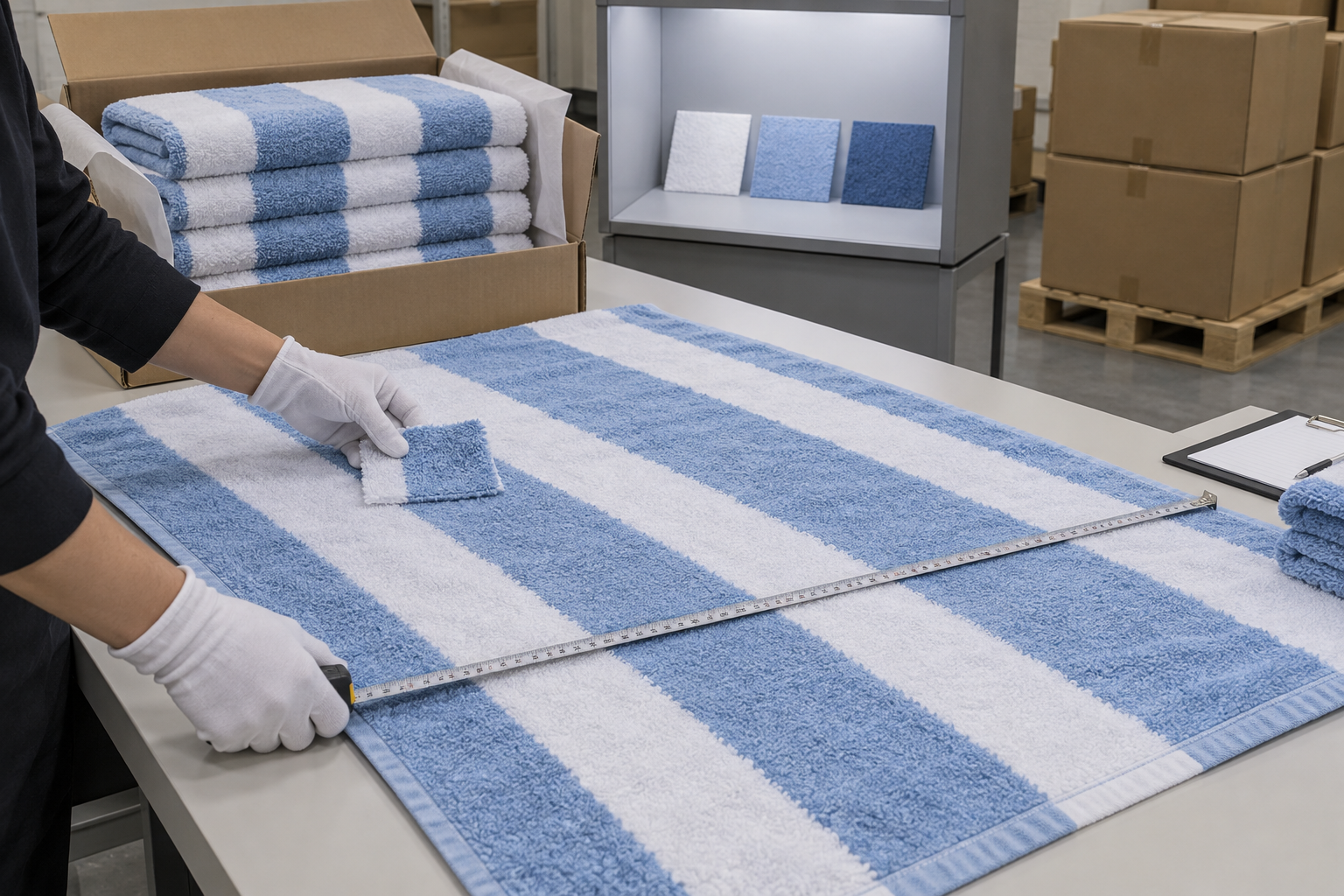
- Standardize Dyeing and Shade Standards: Provide physical master lab dips or digital spectrophotometer Delta-E color tolerances (e.g., an illustrative Delta-E < 1.0 against master swatch) for both primary and secondary suppliers.
- Enforce Packaging and Labeling Parity: Ensure both suppliers use identical carton dimensions, polybag venting, barcode formatting (EAN-13), and destination labeling compliant with destination market regulations in the UK, EEA, or EU.
- Define Contractual Shift Mechanisms: Contractually define the threshold that triggers volume redistribution. If the primary supplier fails agreed OTIF parameters over two rolling shipments (an illustrative review window to confirm in the supplier contract), the buyer must retain the unilateral contractual right to shift committed volume to the secondary mill at predetermined pricing (Business Contingency Planning in Procurement).
Buyer decision table
Use this decision matrix during sourcing reviews to evaluate supplier contingency proposals before contract finalization. Every example figure must be reconciled with binding quotes.
| Procurement Strategy | Commercial & Operational Trade-offs | Required Supplier Verification | Risk Exposure if Skipped |
|---|---|---|---|
| Single Mill, Zero Buffer | Lowest unit purchase price; zero secondary tooling or carrying cost; highest stockout risk | Signed factory production schedule; documented wet-processing subcontractor list; guaranteed lead-time schedule | 3-4 week seasonal sector closures or sudden dye-house environmental shutdowns cause unrecoverable season stockouts (towel import guide) |
| Single Mill with European Hub Buffer | Balances single-mill volume pricing against regional warehouse carrying and moisture-control costs | Audited weekly European demand forecast; supplier replenishment transit times; humidity-controlled warehouse SLA | Buffer depletion occurs if disruption exceeds stored weeks of cover; illustrative safety stocks fail under real delays |
| Dual-Source Allocation (e.g., 70/30 Split) | Higher blended unit price; duplicate lab dips and QC onboarding; rapid volume recovery | Pre-approved technical specifications across both mills; audited surge capacity in towels/week; signed split agreements | Secondary mill can supply initial sample runs but lacks machine capacity to absorb emergency surge orders |
| Contractual OTIF Escalation Clause | Requires active supplier scorecards and administrative tracking; provides contractual remedies | Written OTIF formula, measurement periods, and legally enforceable remedies signed by both suppliers | Disruption escalations stall in legal negotiation; source guidance supports escalation but sets no universal OTIF percentage (tourism playbook) |
| Advance Order Placement (≥3 Months) | Mitigates holiday production queues; reduces seasonal flexibility for late colorway adjustments | Purchase order dates aligned against mill holiday schedules; confirmed vessel booking cut-offs | Missing the 3-month placement window pushes production into peak holiday backlogs, triggering delivery defaults |
| Mandatory Restart-Lot Audit | Adds formal pre-shipment inspection step; protects brand reputation against post-holiday defects | Formal inspection protocol for initial post-holiday production batch; defined pass/fail defect parameters | Documented post-closure labor turnover results in high defect rates, seam failures, and color variations (towel import guide) |
| Destination-Specific European Logistics | Accurate freight rates and clean customs clearance; requires distinct shipping paperwork by lane | Disaggregated transit and customs quotes for designated UK, EU, or EEA member-state ports | Assuming a single transit time or import procedure across all European countries causes customs holds and demurrage |
RFQ Checklist
- Ask the supplier to attach a dated production calendar for weaving, dyeing, cutting, and packing, including start and restart dates for any Chinese New Year closure, and to state whether those dates sit inside the 3-4 week sector range in the 2026 custom-towel import guidance.
- Require the manufacturer to quote production time and main-carriage transit in weeks to the named European distribution center, to identify the EU, EEA, or UK destination on the draft purchase order, and to name any dye house that an environmental inspection can stop.
- Specify beach towel fiber composition, terry construction, nominal dimensions, weight basis, hem finishing, shade-approval method, and packaging tolerances, requiring identical values from each alternate mill before dual-source approval.
- Ask the supplier to state in writing the binding order-placement deadline that safeguards the European warehouse delivery date, reflecting the source guidance that custom towel orders require at least 3 months of lead time prior to holiday closures.
- Require the manufacturer to state surge capacity in finished beach towels per week for both primary and secondary production lines, verified against buyer demand forecasts during an illustrative 3-4 week primary stoppage.
- Specify the contractual on-time-in-full (OTIF) threshold, measurement window, and enforceable remedies—such as immediate volume reallocation, split expedited airfreight costs, or buffer stock release—and replace any illustrative 95 percent figure before signing.
- Ask the supplier to define restart-lot inspection protocols for the first shipment produced after a holiday stoppage or environmental dye-house stoppage, detailing acceptance criteria for shade matching, dimensions, and fabric weight.
- Require the supplier to confirm binding program volumes and replace every example planning quantity—such as illustrative scenarios of 500 or 2,000 beach towels per week—with verified demand figures before freezing the RFQ.
- Require the supplier to document buffer inventory ownership, destination hub locations in the EU, EEA, or UK, terry moisture-protection measures, and carrying-cost allocation directly in the contract.
- Specify total delivered cost comparison criteria across primary and alternate quotes for the specific European destination lane, factoring in secondary shade approvals and freight splits before award approval.
Evidence method and limits
Methodology and Data Derivation
The procurement recommendations in this guide are derived from three public commercial frameworks, not internal manufacturing trials or digital keyword search metrics:
- Procurement Contingency Methodology: Establishes standard buyer operating procedures for RFQs, vendor qualifications, and binding supply agreements: identifying potential supplier, logistics, and operational failure modes prior to contracting, and verifying vendor recovery times or qualified backup alternatives (Business Contingency Planning in Procurement).
- Custom Towel Manufacturing Evidence: Provides empirical production parameters from custom textile sourcing analysis, including the 3-4 week sector shutdown during Chinese New Year, sudden environmental dye-house closures, quality variations during production restarts, and the 3-month advance purchase-order placement standard (7 Critical Risks of Importing Custom Towels from China).
- Tourism Soft-Goods Resilience Principles: Contributes multi-source qualification structures, substitution rules, OTIF performance management, and regional buffer inventory concepts for commercial hospitality soft goods (Risk, Resilience and Disruptors).
All specific volumetric scenarios (e.g., 500 or 2,000 towels/week) and contractual benchmarks (e.g., 95% OTIF) are explicitly designated as illustrative calculation models and do not represent supplier-quoted parameters.
Limitations and Verification Requirements
- Scope of Sourced Figures: The 3-4 week shutdown range and 3-month ordering lead time reflect broad custom towel sector conditions rather than the audited capability of an individual mill. Sourcing teams must verify specific factory operating dates on purchase-order acknowledgments.
- Standards and Certifications: No business continuity certificate (such as ISO 22301) is claimed or implied for any vendor. General operational planning does not constitute formal certification.
- Jurisdictional Differences: Regulatory and customs standards across the European Union, the EEA, and the United Kingdom differ regarding chemical restrictions (REACH), product labeling, and customs clearance procedures; they must not be treated as interchangeable.
- Absence of First-Person Claims: This analysis includes no first-person factory audits, laboratory evaluations, or proprietary client data; claims requiring direct physical inspection are omitted.
European procurement managers must maintain signed supplier calendars, secondary technical specifications, and executed performance remedies in the permanent contract file, updating them annually upon publication of vendor holiday schedules.
Discuss Your Requirements
Review our manufacturing capabilities, then share your specifications for a supplier-fit review.