Beach Towel Sourcing Product Development Capability for Europe
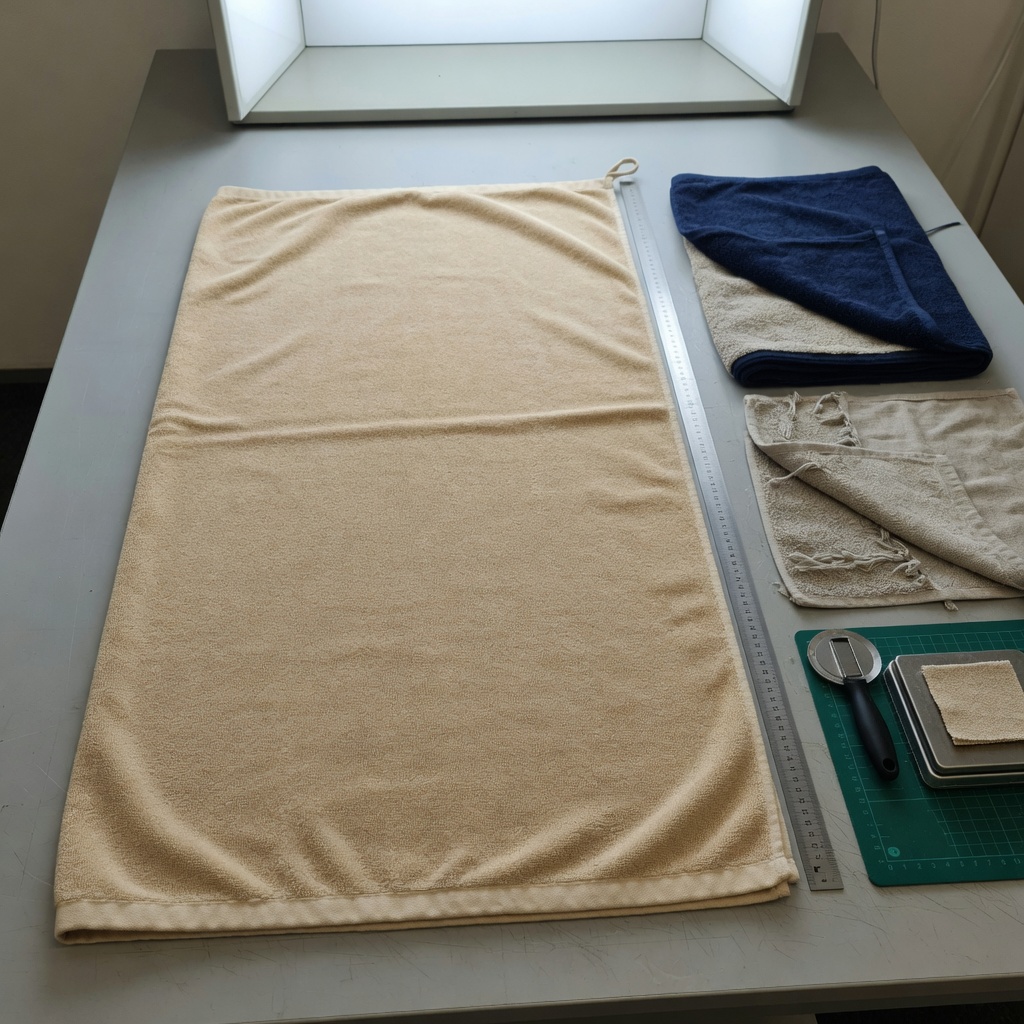
Do not award a beach-towel program for Europe until the mill can show beach towel sourcing product development capability as three gates: a locked tech pack, a retained pre-production (PP) sample, and a chemical-plus-labelling file scoped to the named first-placement market. A logo on a stock quality is a different procurement object. Before any purchase order, lock fibre type and legal fibre name, yarn and construction, GSM, finished size after a defined wash, hem and hanging-loop details, coloration method, colourfastness relevant to beach use, packed presentation, and the document set for that market: an EU member state, an EEA state, Great Britain, or Northern Ireland. Brochure capacity and MOQ lines are starting points only. They do not replace those gates.
This page is a buyer-side aid for beach towel procurement in Europe. It sets measurable trade-offs, a scoring table, and an RFQ checklist. It does not qualify a factory, set a price, or report a mill tour or lab campaign. Vincent Xi, Editorial Author at Plait & Mill, prepared the note for European B2B teams (author profile). No personal production history, client outcome, or in-house test result is claimed.
What beach towel sourcing product development capability covers in Europe
In this category, product development capability is the mill’s ability to turn a commercial brief into a repeatable article. A B2B manufacturer-services overview describes that work as fabric selection, prototyping and sampling, custom design and private-label branding (embroidery, printing, or jacquard), then packaging and export support so the buyer keeps control of specification, quality, and timeline (Circetowel). That sequence is process language from an undated commercial page. It is not a qualification of that site, and it is not a claim about Plait & Mill.
For placement in Europe, control means the mill can engineer pile, ground, and hems to a stated size and mass after a named wash; select cotton, cotton-rich blends, viscose (including bamboo-origin viscose, legal fibre name viscose), or microfiber and document label percentages for the first-placement market; match colour on velour, dobby, or jacquard, not only on paper; plan reactive, pigment, or sublimation print, embroidery, or yarn-dyed/jacquard motifs with seawater, rubbing, and wash risk in the test plan; issue a bill of materials, process route, and inspection plan that another informed mill could reproduce; and hold a signed sample as the bulk standard, including a shade band if the retailer requires one.
If the supplier cannot show that sequence, the program is stock-towel decoration. That can still be a valid promotional buy. It is not engineered product development.
Specification engineering: size, GSM, fibre, and construction
Write the tech pack before asking for a unit price. Vague “soft cotton” or unstated GSM language produces samples that cannot be compared.
Finished size. Common commercial asks include 70 × 140 cm, 90 × 180 cm, and 100 × 200 cm. Those centimetre values are specification choices, not an inventory list from this publisher. State whether the dimension is cut size, sewn size, or size after a defined wash. Require the mill to declare the measurement method (flat, with or without tension) and a numeric tolerance—for example ±2 cm on length, as an assumption to replace with the retailer standard if tighter.
Mass per area. GSM is grams per square metre of the fabric, not a packed retail claim. Name the test method in the RFQ (ISO 3801 is a common woven-fabric mass-per-area method; confirm the current edition). If the retailer uses a conditioning protocol such as ISO 139, name it. Under ISO 139 the standard atmosphere is 20 °C and 65 % relative humidity; use the current edition’s tolerances.
Example calculation to verify in the supplier quote (not a lab result): a 90 cm × 180 cm face is 1.62 m²; at 450 g/m² that is 729 g of fabric mass before hem-fold consumption, hanging loops, print add-on, and moisture. Ask for both fabric GSM and conditioned finished piece weight. If the quote uses commercial mass with official regain, require the regain standard to be named; cotton is often 8.5 % in those commercial-mass systems—treat 8.5 % as a convention to verify in the quote, not as a measured result from this publisher. Do not mix conditioned weight, commercial mass, and packed retail weight in one spec cell.
Fibre. Cotton velour is a core beach-towel construction; microfiber and low-sand weaves are separate articles with different print routes and care claims. Fibre names placed on the EU market must follow Regulation (EU) No 1007/2011. EEA placement often tracks EU textile labelling through the EEA Agreement, but the importer of record should confirm the named destination state. Great Britain uses a separate GB regime, including the Textile Products (Labelling and Fibre Composition) Regulations 2012 as applicable in GB; Northern Ireland needs an explicit UK/EU placement decision. Do not print “100% cotton” from a mill email if the ground includes polyester binder or decorative yarn. Bamboo-origin viscose remains viscose under the EU fibre-name list unless counsel agrees another listed name applies.
Construction and coloration. Specify single-sided velour versus dobby versus jacquard, hem width, corner type, and hanging-loop fibre and stitch. Reactive print on cotton, sublimation on polyester-rich microfiber, embroidery, and jacquard are not interchangeable. A custom-beach-towel buyer guide groups the work as product-type selection (including cotton velour and microfiber), size and GSM, artwork and print method, then sampling and packing (AB Textile). Use that undated manufacturing-origin sequence as a buying-order check, not as legal advice for Europe or a factory audit.
Measurable trade-off: higher cotton GSM usually increases drape, carton weight, freight cost per dozen, and dry time. Microfiber reduces mass and dry time but typically requires polyester labelling, different pilling and colourfastness tests, and sublimation rather than reactive dye.
Sampling, PP samples, and the approval calendar
Treat sampling as a paid engineering gate, not a free extra on the unit price. The same manufacturing-origin buyer guide states sampling in 5–10 days and production lead times of 15–30 days. Those undated figures are calendar days as presented by that page, not a measured Plait & Mill lead time, and they omit buyer artwork delays, peak-season weaving queues, and third-party chemical testing. Restate them in the RFQ as calendar days from complete inputs, and split “lab dip / strike-off,” “first construction sample,” and “PP sample from bulk yarn and bulk coloration equipment.”
Ask for, in order:
- Lab dips or yarn-dye lots against a stated illuminant (D65 is common in retail; confirm with the brand manual).
- Print strike-off or woven trial on the actual towel quality, not on paper or a different GSM.
- A construction sample with the commercial hem and loop.
- A washed sample if shrinkage or washed handfeel must be proven. Name the wash procedure (ISO 6330 is a common domestic washing reference; name the cycle, temperature, and drying method) and the dimensional-change method if required (ISO 5077 is a common reference).
- A PP sample cut from bulk materials, packed as the export carton will be packed.
Approval language should be binary: bulk colour, handfeel, size, and mass must match the signed PP sample within stated tolerances. A photo is not a retained physical standard in the buyer’s office in Europe.
One OEM manufacturer page states MOQ from 100 pcs, a 5,000 m² factory, and 7.2 million pieces of annual capacity, and lists management and social-audit marks (Towelscc). Treat every one of those numbers as a seller claim as of that undated page. 100 pcs may apply only to selected print methods or stock grounds; 5,000 m² is a plant-area claim, not proof of beach-towel finishing capacity; 7.2 million pieces per year does not prove that this quality sits in that mix. Request MOQ by colourway, size, and print method in writing, plus a line plan for the article.
Chemical, labelling, and packing rules in the EU, EEA, and UK
Put the first-placement country on the RFQ. Do not copy a “worldwide compliance” sentence into a purchase order for Europe. Rules are not uniform across the EU, the EEA, Great Britain, and Northern Ireland.
Chemicals. Articles placed on the EU market remain subject to REACH (Regulation (EC) No 1907/2006), including Annex XVII restrictions relevant to the article and, where it applies, the duty to communicate Substances of Very High Concern present above 0.1 % weight by weight under REACH Article 33. Map Annex XVII entries with counsel for this SKU; do not assume a clothing-only restriction list automatically covers or excludes a beach towel. The United Kingdom operates UK REACH for Great Britain; an EU REACH file is not automatically valid for GB, or the reverse. The EU candidate list and the UK REACH candidate list are separate lists. EEA states generally apply REACH via the EEA framework; still name the country of first placement.
OEKO-TEX STANDARD 100, where offered, is a voluntary third-party product certification. It is not a substitute for REACH, and a certificate is evidence only if it is current, names the right product class, and covers the colourways actually shipped. Brands commonly specify STANDARD 100 product class II for skin-contact beach towels; print the class on the RFQ and read it on the PDF annex—this publisher did not verify a default class. ISO 9001 speaks to a quality-management system, not to seawater colourfastness. BSCI and Sedex are social-audit ecosystems, not product-safety marks. A manufacturer page may list those marks together. Store the PDF, scope, site, colourway coverage, and expiry—not a webpage badge.
Fibre labelling and marketing claims. EU fibre-composition labelling follows Regulation (EU) No 1007/2011. GB fibre labelling is a separate legal file. Care symbols are a separate matter; if the brand prints them, align them with the standard the retailer uses (ISO 3758 is the usual reference) and with actual wash tests. “Sand-free,” “quick-dry,” or environmental claims are advertising claims that need substantiation and must not be confused with legal fibre names.
General product safety. Consumer beach towels placed on the EU market fall under the General Product Safety Regulation (EU) 2023/988, applicable from 13 December 2024, which addresses product safety, economic-operator duties, and traceability but does not set a GSM. Great Britain has a separate general product safety framework; do not treat GPSR (EU) 2023/988 as the GB instrument. Northern Ireland needs a dedicated placement analysis and must not inherit an EU or GB file by silence.
Packaging and national add-ons. Polybags, header cards, and cartons trigger packaging extended-producer-responsibility rules that are national, not pan-European. German packaging registration, French sorting-information marks, and other member-state EPR schemes are not interchangeable. UK packaging EPR is a separate regime from EU member-state schemes. EEA packing marks differ again. Specify who is the producer of record in each destination country, and put label languages, SKU identification, and carton marks into the tech pack.
None of the above is legal advice. Name the first-placement country and require test reports against the buyer’s protocol, not against an unnamed “export standard.”
How to score OEM/ODM development for beach towel procurement in Europe
Score artefacts, not adjectives. Every row below is something the buyer can specify, compare, verify, approve, or refuse.
| Capability to score | What the buyer specifies | Evidence to request | Placement implication in Europe | Walk-away check |
|---|---|---|---|---|
| Fibre and GSM | Fibre %, GSM (g/m²), finished piece weight (g), method (e.g. ISO 3801), conditioning (e.g. ISO 139 at 20 °C / 65 % RH if named) | BOM and conditioned weight record | Legal names must match EU 1007/2011 or the GB file as applicable | Reject if legal label ≠ BOM |
| Size and shrinkage | Finished size (cm), wash (e.g. ISO 6330), dimensional method (e.g. ISO 5077), tolerance | Before/after-wash measurements | Post-wash length drives complaints | Reject out-of-tolerance post-wash size |
| Coloration | Reactive / pigment / sublimation / yarn-dye / jacquard / embroidery | Strike-off on production quality | Seawater and crocking matter for beach use | Reject paper proofs as bulk standard |
| Colour approval | Physical or Pantone reference, illuminant, shade band | Lab dip plus production shade band | Retail lighting in Europe is not mill lighting | No bulk dye lot without a signed band |
| Colourfastness | Named methods and grades (e.g. ISO 105-E02 seawater, ISO 105-X12 rubbing, named wash) | Reports on production quality and colourways | Beach use ≠ wardrobe-wash claim | Missing method or grade fails |
| Chemical file | Buyer RSL, REACH/UK REACH scope, any claimed marks (e.g. OEKO-TEX STANDARD 100 class) | Test report plus certificate PDF (scope, site, colourways, expiry) | Separate EU/UK REACH and SVHC lists; GPSR operator duties for EU placement from 13 December 2024 | A webpage badge is not a document |
| Social / QMS | Retailer audit (if any); ISO 9001 (if any) | Full report for the producing site | Retailer codes may exceed mill marketing | Expired or wrong-site audit fails |
| Sampling path | Lab dip, construction sample, PP sample, packed sample | Calendar from complete artwork; who pays | Restate any 5–10 day claim from a defined start | Missing PP sample blocks the PO |
| MOQ | Units per colour, size, and print setup | Written MOQ table | 100 pcs is a seller claim to re-quote by method | PO cannot add unquoted colourways |
| Capacity | Delivery date under a named Incoterms® rule | Line plan for this article | Restate any 15–30 day bulk claim from PP approval; labs and peak season extra unless stated | 7.2 million pcs/year is not this SKU’s slot |
| Packing / EPR | Fold, polybag, carton qty, marks, languages | Pack photo, dieline, producer of record | EU, EEA, and UK packing rules are not one file | Unassigned producer of record is a no-ship |
Walk-away rule for procurement in Europe: do not issue a purchase order if the PP sample is missing, if the legal fibre label does not match the bill of materials, or if the chemical, labelling, and packing file is not scoped to a named EU member state, EEA state, Great Britain, or Northern Ireland.
RFQ checklist for European beach towel programs
Use each line to specify, compare, verify, approve, or order. Delete a line that does not apply; do not add decorative lines.
- State first placement: named EU member state, named EEA state, Great Britain, and/or Northern Ireland. Do not use “Europe” as the only market field.
- If dual placement (for example one EU member state plus Great Britain), require separate chemical, labelling, and economic-operator files; do not assume mutual recognition.
- Name the article: beach towel; construction (cotton velour, dobby, jacquard, microfiber, other); channel (retail, hospitality, promotion).
- Lock sizes in centimetres, measurement method, and tolerance; state pre-wash versus post-wash.
- Lock GSM (g/m²) and finished piece weight (g); name weighing method and condition as an assumption to confirm in the quote (e.g. ISO 3801; ISO 139 at 20 °C / 65 % RH if used).
- Lock fibre composition with the percentages that will appear on the legal label for the named placement.
- Specify hem construction, corner type, hanging-loop material and stitch, plus coloration (colour count, print area, placement, bleed, and file type).
- Specify colour references, the illuminant used for approval, and whether a production shade band is required.
- Require colourfastness relevant to beach use against named ISO or retailer methods, with numeric pass grades (for example ISO 105-E02, ISO 105-X12, and the named wash method).
- Require dimensional-change tests. Name the wash procedure (for example ISO 6330) and the dimensional method (for example ISO 5077).
- Attach the restricted-substance list. If OEKO-TEX STANDARD 100 is a brand requirement, specify product class and colourway coverage, and store certificate number, scope, site, colourways, and expiry as PDFs.
- Name the laboratory for RSL and colourfastness reports.
- State sample types and due dates: lab dip, strike-off, construction sample, washed sample, PP sample, packed photo.
- Restate sample lead time in calendar days from complete inputs; do not paste “5–10 days” without a start event.
- Restate bulk lead time in calendar days from written PP approval; do not paste “15–30 days” unless lab tests are included on that path.
- State MOQ per colourway, per size, and per print setup, and whether 100 pcs (if offered) applies to this quality.
- State the Incoterms® rule, port, carton quantities, palletisation, and inner-pack fold.
- Name the EU GPSR economic operator for EU placement and the GB duty-holder for Great Britain. Do not assign one person as both by default.
- Name who files packaging EPR in each destination country, including UK packaging EPR if GB or NI packing is in scope as applicable.
- Require a metal-contamination or needle-detection policy if the downstream retailer demands it, plus AQL and a defect list (oil, dye spots, hem skips, shade-lot mix, short size, odour, foreign fibre).
- Require retention of the signed PP sample at the mill and at the buyer’s office in Europe until the last shipment of the season plus a stated number of months.
- Require a written process route (yarn mill, greige, dye house, print shop, sewing, packing) and change control: any change needs a new PP sample.
- Require carton marks and fibre-label languages for the named destination state(s).
- Ask for a line-plan capacity statement for this SKU, not only a plant-wide annual piece count such as 7.2 million pieces/year.
- Require a bill of materials that another informed mill could reproduce, including pile/ground yarns and hem thread.
- If dual EU/GB placement is planned, run separate SVHC/candidate-list checks; 0.1 % w/w is the REACH Article 33 communication threshold on the EU side—confirm the live UK duty separately.
Evidence method and what to verify before you order
Source contexts. Process language is taken from a B2B towel-manufacturer services article (Circetowel) and from a custom-beach-towel buyer guide covering types, GSM, artwork, sampling, and packing (AB Textile). Commercial claims on MOQ, floor area, annual pieces, and listed marks are taken from one OEM manufacturer page (Towelscc). Legal instruments named above are public EU, EEA-relevant, GB, or Northern Ireland placement rules. They are cited as law names and dates, not as a finding that any mill complies.
How the figures were derived. Sample windows of 5–10 days and bulk windows of 15–30 days are transcribed from the undated AB Textile guide. MOQ from 100 pcs, 5,000 m² factory area, and 7.2 million pieces/year are transcribed from the undated Towelscc seller claim. The 90 × 180 cm / 450 g/m² / 729 g mass is an example calculation (1.62 m² × 450 g/m²) to check against a quote. ISO 139’s 20 °C / 65 % RH atmosphere, the 0.1 % w/w SVHC threshold in REACH Article 33, and GPSR (EU) 2023/988 applicability from 13 December 2024 come from those instruments; confirm the current consolidated text. Cotton 8.5 % official regain is a commercial-mass convention to verify in the quote, not a laboratory result.
Limitations. The commercial pages are undated marketing or advisory content, not audit reports. MOQ, lead time, and capacity move with season, yarn, and subcontract print shops. Certificates expire and may exclude colourways. EU, EEA, Great Britain, and Northern Ireland rules diverge on labelling, chemicals, product safety, and packaging EPR; one report may not cover dual EU/GB placement. Named ISO methods are specification tools, not proof that any mill runs them or holds a certificate. This publisher did not test towels or audit the cited mills. Verify every number on the live quotation, the current certificate PDF, and counsel for the first-placement country.
Vincent Xi is the named Editorial Author for this page (https://plaitandmill.com/authors/vincent-xi/). The byline does not imply mill employment, laboratory accreditation, or a personal production history.
Discuss Your Requirements
Review our manufacturing capabilities, then share your specifications for a supplier-fit review.