Beach Towel Sourcing Production Scalability Planning for Canada
By Vincent Xi, Editorial Author, Plait & Mill
For Canadian B2B buyers, beach towel sourcing production scalability planning is a capacity-reservation problem, not a sample-room exercise. Award a mill only when four items are in writing: a SKU-mix map showing which beach towels share warps, dye lots, and finishing lines; a dated snapshot of free capacity for the intended ship month; a bulk shade and GSM standard that later purchase orders must match; and named QC documents that will be repeated at replenishment. Before the first purchase order, freeze SKU mix, GSM and construction, print or embroidery complexity, packing configuration, peak-season windows for Canada sell-in, and the inspection evidence later lots must meet. Those inputs decide whether a factory can move from a test quantity to a container program without resetting dye lots, calendars, or inspection criteria.
This page is for Canadian procurement teams comparing custom beach towel programs. It uses publicly described OEM planning language and one regional industry report. It does not claim factory visits, client outcomes, mill employment, or first-person production testing. Work in this order: freeze SKU families, collect comparable capacity data, separate sample days from bulk days, convert quality language into named documents, lock packaging and forecast rules, score mills on the decision table, then issue the RFQ checklist. Do not award on a catalogue lead time.
Production scalability planning: map SKU mix before you reserve capacity
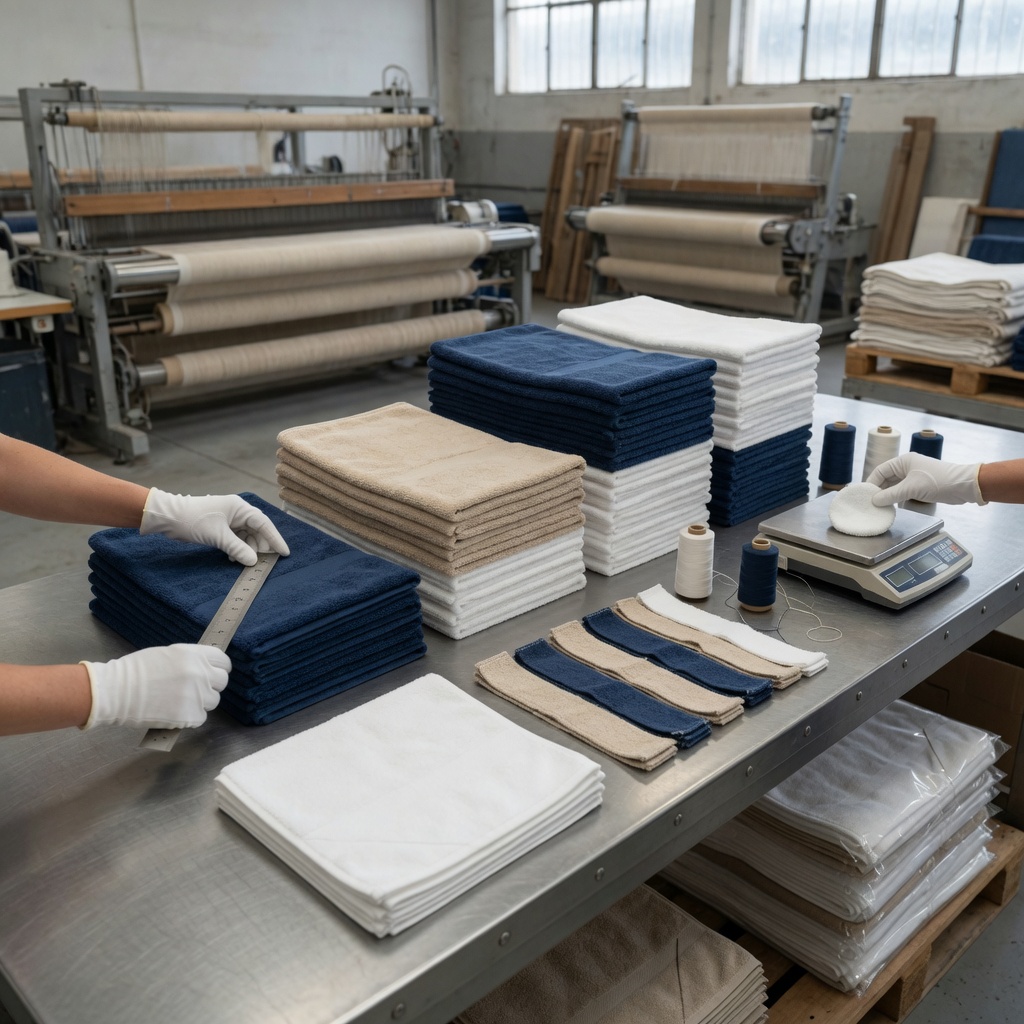
Production scalability planning starts with the SKU list, not the container count. A mill that can run a single solid-colour terry program at high volume may not hold the same calendar when the same buyer adds yarn-dyed stripes, sublimation prints, embroidery, contrast binding, and retail polybags in one delivery window. One OEM about page states that production capacity planning is designed around beach towel SKU mix, craft complexity, packaging requirements, and delivery window so first orders and replenishment stay on a predictable timeline (Cloud Textile about page). Scope: that company’s published about-page planning language; as-of: date not stated on the page. Use that wording as a planning prompt, not as a certified capacity letter and not as a Plait & Mill capability.
Ask the mill to score each SKU on the steps that actually consume capacity: yarn dyeing versus piece dyeing, jacquard or dobby versus plain terry, print strike-offs, embroidery or appliqué, special hems, and multi-piece gift sets. Group SKUs into capacity families that can share warps, dye lots, and finishing lines. If the mill cannot produce that map, treat any quoted monthly output as a single-SKU number and do not use it for a mixed beach towel program.
If the Canadian program specifies bilingual care labels, hangtags, or carton marks, treat those as packaging SKUs with their own artwork freeze dates. Label copy is a buyer specification to confirm with the importer of record; this page does not state a legal labeling formula, a bilingual word count, or a packaging statute.
Craft complexity also changes first-article risk. A solid 400–600 GSM terry beach towel is an example range to confirm on the supplier quote, not a sourced industry standard and not a test result. That construction can often share a greige and finishing route if the mill says so in writing. A printed velour beach towel with a pantone-critical logo usually needs extra strike-off loops, shade-band approval, and a tighter leftover-yarn policy. Put those loops on the critical path before asking for a bulk ship date, and treat them as process-risk questions rather than proven cycle times.
Capacity, MOQ, and lead-time trade-offs for Canadian beach towel programs
Published OEM figures show how wide a single mill’s advertised scale range can be, and why a Canadian buyer must separate that mill’s site copy from an industry benchmark. One custom beach towel manufacturer states that its 5,000 m² factory produces 7.2 million towels annually across multiple product lines, with private-label orders described from 100 pcs to bulk wholesale shipments of 100,000+ pcs, samples in 7–10 days, and bulk production in 15–30 days (Towels.cc manufacturer page). Scope: that company’s published site copy, not beach-towel-only capacity and not a Canada-wide benchmark; units: square metres of plant, towels per year, pieces per order, and calendar days; as-of: date not stated on the page, so treat the numbers as supplier-claimed and reconfirm in writing against the current capacity calendar.
Those numbers are a comparison template, not Plait & Mill capabilities. A 100-piece test order, if still offered, can validate hand-feel, hem quality, and print registration, but it does not prove the mill can hold the same shade and GSM at a later replenishment quantity. A 20,000-piece replenishment figure in this page is an example planning quantity to replace with the program volume, not a sourced MOQ. A 100,000-piece quote may hide SKU-mix constraints: the mill may need the volume concentrated in few colourways to hit the stated 15–30 day bulk window on that page.
Regional cluster data helps explain why some mills advertise short conversion times. A People’s Daily English report on Gaoyang county, described in that article as China’s towel capital, states that the county has more than 4,200 enterprises covering the chain from spinning to logistics in a 30-minute supply-chain circle, with an 89 percent local supporting rate; that a towel can go from cotton yarn to finished product in 3 hours; and that one out of every three towels in China comes from Gaoyang (People’s Daily English, URL path date 30 June 2026). Scope: Gaoyang county as reported in that article, not a named mill serving Canada; units: enterprise count, minutes in the reported supply-chain circle, percent local supporting rate, hours from yarn to finished towel, and share of China towel output; as-of: the date shown in the cited article’s URL path (30 June 2026). Cluster density can shorten greige and accessory lead time only if the contracted mill actually buys inside that circle on the relevant lots. It does not shorten origin inland haul, ocean transit to Canada, destination destuff time, or any inspection hold.
Price these trade-offs as separate lines:
- Lower MOQ versus dye-lot continuity. A 100-piece first order, if used, may consume a lab dip or leftover yarn that cannot be repeated. Require a bulk yarn reservation rule if replenishment must match.
- Short sample days versus bulk calendar. A 7–10 day sample claim on the cited manufacturer page does not reserve finishing slots for peak beach-towel demand.
- Plant throughput versus SKU complexity. Annual towel counts that mix bath, hotel, and beach lines overstate capacity available to a printed beach-towel family.
- Factory conversion hours versus landed time. A 3-hour local conversion claim in the cited cluster article, if still accurate for that county on that day, sits inside mill-gate time. Canadian landed-cost lines still include inland origin haul, origin port cut-off, ocean or air, destuffing, and any inspection hold.
Ask for a written capacity model: monthly finishing metres or dozen-equivalent by construction, already-booked load for the next two peak months, the SKU mix assumed in any 15–30 day bulk claim, the date of the snapshot, and whether quoted beach-towel capacity is shared with other towel categories in the same finishing month. If the mill cannot show booked versus free capacity, treat the lead time as a sales estimate and do not reserve it.
QC checkpoints and documentation that scale with volume
Scalable beach towel production fails when inspection criteria stay in the sample room and never become in-process limits that later lots must meet. Require three layers, each with a keep-or-kill rule the buyer can audit from Canada through photos, retained swatches, and third-party reports if used. These checkpoints are buyer specifications for the RFQ, not mill certifications and not Plait & Mill lab results.
Incoming: yarn lot tickets, greige GSM and width, dyestuff lot, and print-base fabric if applicable. Record moisture regain if cotton terry will be sold by weight. Reject mixed yarn lots that the mill cannot trace into finished dozens.
In-process: pile height or velour shear, GSM after finishing (state bone-dry or conditioned method on the RFQ), bow and skew, hem width, corner reinforcement, and print or embroidery placement from a defined origin point. For printed beach towels, freeze a shade band and a maximum bulk-versus-standard colour difference as a numeric limit the buyer names and the mill accepts. For yarn-dyed jacquard, freeze a stitch or pick count so later replenishment cannot silently change the design.
Final: dozen completeness, size tolerance, residual shrinkage after the buyer’s stated wash method, colourfastness to washing and rubbing at the buyer’s stated test method, metal detection if the mill offers it, packing list versus carton marks, and a photo record of first and last cartons. One OEM quality narrative emphasizes consistent quality plus export-ready packaging and documentation to reduce sourcing risk (Cloud Textile about page). Scope: that page’s quality-and-packaging wording; as-of: date not stated on the page. Convert that narrative into named documents: pre-production sample sign-off, in-line inspection report, final AQL report, packing list, and carton photo set. Do not treat a marketing quality paragraph as a certificate.
AQL and test methods belong in the purchase order. If the buyer needs a specific ISO, ASTM, or AATCC method, name the method and the pass limit on the RFQ. Distinguishing the standard’s requirement from the mill’s own practice matters: a mill may follow an internal GSM check that is not the same as a named test method. Never assume a mill is certified unless a current certificate number, scope, and expiry are on file. This page does not claim any mill certification.
A sample that passes hand-feel is not replenishment evidence. Stop the award path if the mill cannot name the documents, retainers, and test methods that will be repeated on later lots.
Forecasting, packaging, and landed-cost inputs to lock before the RFQ
Replenishment speed is mostly a forecasting and SKU-freeze problem. Ask whether the mill will hold greige, dyed yarn, or finished goods against a quarterly forecast, and what cancellation or take-or-pay rule applies. A mill that publishes 15–30 day bulk production still needs yarn, finishing, and a vessel cut-off. If the program’s Canada sell-in peaks in late spring, freeze artwork and colourways early enough that dye lots are not competing with other exporters’ summer programs.
Packaging is capacity. Individual polybags, header cards, UPC/EAN stickers, care labels, inner assortments, and master-carton printing all consume finishing labour and can bottleneck a line that is otherwise free on the loom. Specify on the RFQ:
- Folded dimensions and units per polybag
- Care-label language and fibre-content format the importer of record will actually apply
- Carton burst or ECT requirement if used, plus a maximum carton mass in kilograms for Canadian warehouse handling (example constraint to set with the 3PL and verify in the quote; this page does not publish a kilogram limit)
- Pallet versus floor-load preference at the Canadian destination
Landed-cost planning should stay evidence-based. This page does not publish duty rates, HS classifications, or import rulings. Have the importer of record classify the towel construction (cotton terry, velour, microfiber, printed, and similar constructions as applicable), confirm whether any preferential origin claim is supportable, and model ocean versus air only after the mill’s ex-works or FOB calendar is dated. Keep mill-gate lead time, origin port cut-off, and destination destuff as separate lines. The cluster yarn-to-finished conversion time cited above, even if accurate in that article for that county, does not replace those Canada-landed lines (People’s Daily English, URL path date 30 June 2026).
If the program will replenish from Canada-held safety stock, state whether the mill ships a solid colourway per carton or mixed SKUs. Mixed cartons can reduce store-level handling but increase origin packing time and error rate. Solid cartons scale cleaner when the forecast is SKU-accurate.
Decision table: first order versus replenishment scalability
| Planning factor | Test / first order (specify and verify) | Replenishment / container program (specify and verify) | Buyer approval gate |
|---|---|---|---|
| Quantity and SKU mix | Name pieces per colourway; keep SKU count low enough to isolate GSM, hem, and print faults | Name pieces per colourway and the maximum SKUs that may share one dye lot or finishing run | Reject quotes that give one MOQ for an undefined mix |
| Capacity reservation | Confirm sample-line versus bulk-line; do not treat 7–10 day sample claims as bulk slots (Towels.cc manufacturer page) | Written free capacity for the ship month, including already-booked load and any shared bath/hotel finishing | Require a dated capacity letter, not a catalogue lead time |
| Yarn and shade | Lab dip plus sealed bulk standard; record yarn lot | Same yarn spec, leftover policy, and shade band for later POs | No replenishment PO until bulk standard is physically retained |
| Lead time | Sample days and first-bulk days stated separately, with holiday blackouts | Production days plus origin inland plus vessel; peak-season adder if any | Split mill-gate from Canada-landed dates on the PO |
| Packaging | Confirm whether specified bilingual labels and retail packs are in the sample | Artwork freeze date, carton marks, units per carton, max carton mass | Packaging SKU list signed with the pre-production sample |
| QC evidence | Incoming greige/yarn checks and first-article report | In-line plus final AQL, named test methods, and carton photo set | Payment milestone tied to named reports |
| Forecast / call-off | Optional; do not over-forecast a test | Quarterly forecast, freeze windows, and take-or-pay or cancellation rule | Legal review of reservation terms before capacity is blocked |
| Canada logistics | Courier sample path and commercial-entry treatment for the first lot | Incoterm, destination CFS/warehouse, and who files import entries | Importer of record named before cargo is booked |
| Kill switch | Undated sample calendar only; no SKU-process map | Cannot show booked versus free finishing load for the ship month | Do not award |
Each row is a specification the buyer can put in an RFQ, compare across mills, verify on a call or audit packet, approve in a pre-production meeting, and restate on the PO.
RFQ checklist for production scalability planning
- List every beach towel SKU with construction, GSM target and tolerance, size, fibre content, pile or velour type, hem type, and any print/embroidery placement drawing.
- State first-order quantity and 12-month replenishment scenario in pieces per colourway, including the seasonal peak month for Canada sell-in. Treat 12 months as a planning horizon to specify, not as a sourced demand figure.
- Require the mill to map each SKU to process steps and to identify which SKUs cannot share a warp, dye lot, or finishing line.
- Ask for plant data in comparable units: finishing capacity per month, current booked load, whether beach-towel capacity is shared with other towel categories that month, and the SKU mix assumed in any 15–30 day bulk claim, with the date of the capacity snapshot (Towels.cc manufacturer page).
- Separate sample lead time, first-bulk lead time, and repeat-order lead time; require holiday and peak-season blackout dates.
- Define MOQ per colourway, per print, and per packing variant, not only per style.
- Specify yarn reservation, leftover yarn use, and whether replenishment must match the bulk shade band.
- Freeze packaging: care-label copy owner, hangtag, polybag, UPC, inner pack, master carton marks, and carton mass limit.
- Name incoming, in-process, and final QC checks, including GSM method, shrinkage method, colourfastness methods, and AQL level.
- Require retained standards: sealed towel, shade band, and approved carton photos stored for the life of the program.
- Ask whether quarterly forecasts can reserve capacity, what deposit or take-or-pay applies, and how unused reserved greige is charged.
- State Incoterm, origin port, and that the Canadian importer of record will confirm classification and any origin documentation; do not accept a mill’s informal duty comment as advice.
- Request export documents the buyer will actually use: commercial invoice, packing list, packing declaration if needed, and test reports tied to the shipped lots.
- Require a written exception process: who may approve a shade, GSM, or packing deviation, and whether that deviation is allowed on replenishment.
- Set payment milestones against named gates: pre-production approval, in-line pass, final inspection pass, and on-board or FOB handover.
Evidence, method, and what to verify before you award
Source contexts used for this page: (1) OEM manufacturer pages that describe capacity planning around SKU mix and that publish plant size, annual towel output, MOQ bands, and sample versus bulk days (Cloud Textile about page; Towels.cc manufacturer page); (2) a regional industry article on Gaoyang’s towel cluster, enterprise count, local supporting rate, yarn-to-finished conversion time, and share of China towel output (People’s Daily English, URL path date 30 June 2026).
Concrete data points transcribed from those pages:
- Plant area 5,000 m². Unit: square metres. Scope: that manufacturer’s published factory figure. As-of: date not stated on the page. Source: Towels.cc manufacturer page. Verify on the current quote.
- Output 7.2 million towels annually across multiple product lines. Unit: towels per year. Scope: that company’s published site copy, not beach-towel-only and not a Canada benchmark. As-of: date not stated on the page. Source: Towels.cc manufacturer page.
- Order band from 100 pcs to 100,000+ pcs; samples 7–10 days; bulk production 15–30 days. Units: pieces per order and calendar days. Scope: that company’s published private-label/wholesale copy. As-of: date not stated on the page. Source: Towels.cc manufacturer page.
- More than 4,200 enterprises; 30-minute supply-chain circle; 89 percent local supporting rate; 3 hours from cotton yarn to finished product; one of every three towels in China. Units: enterprise count, minutes, percent, hours, and share of China towel output. Scope: Gaoyang county as reported in the cited article, not a named export mill. As-of: URL path date 30 June 2026. Source: People’s Daily English.
Example assumptions to replace on the quote, not sourced measurements: 400–600 GSM as a solid terry range; 20,000 pieces as a replenishment illustration; carton kilogram limits to set with the Canadian 3PL.
Method: editorial comparison of those public claims against the buyer tasks of specifying SKU mix, reserving capacity, setting QC evidence, and planning replenishment for Canadian procurement. Numbers are transcribed from the cited pages with their units and scopes. No mill was audited for this article. No Plait & Mill factory capability, price, certification, or customer result is claimed. No search-demand, CPC, difficulty, traffic, or ranking metric is stated for the primary topic.
Limitations / what to verify: supplier page figures may be outdated, mix bath and beach towels, or assume simple constructions. The 7.2 million towels per year, 5,000 m², 100 pcs, 100,000+ pcs, 7–10 day sample, and 15–30 day bulk figures are that mill’s published claims, date not stated on the page. Cluster statistics (more than 4,200 enterprises, 89 percent local supporting rate, 3 hours yarn to finished, one of every three towels in China) are as reported in the cited article and are not a substitute for a named factory’s current booking calendar. Canadian labeling copy, classification, duty, and import practice must be confirmed by the importer of record and qualified counsel. Any GSM, size, AQL, or test limit in an RFQ should be treated as a buyer specification or an example to replace with the program’s actual standard. Award only after a dated capacity letter, retained bulk standard, and named QC documents are in hand.
Vincent Xi is the named Editorial Author for this page. The article does not attribute factory-floor experience, mill employment, or first-person testing to the author. Buyers should use the decision table and RFQ checklist to compare mills on production scalability planning for beach towel programs destined for Canada, then verify every number on the supplier’s current quote.
Discuss Your Requirements
Review our manufacturing capabilities, then share your specifications for a supplier-fit review.