Beach Towel Wholesale Supplier Communication Workflow Review for United States Buyers
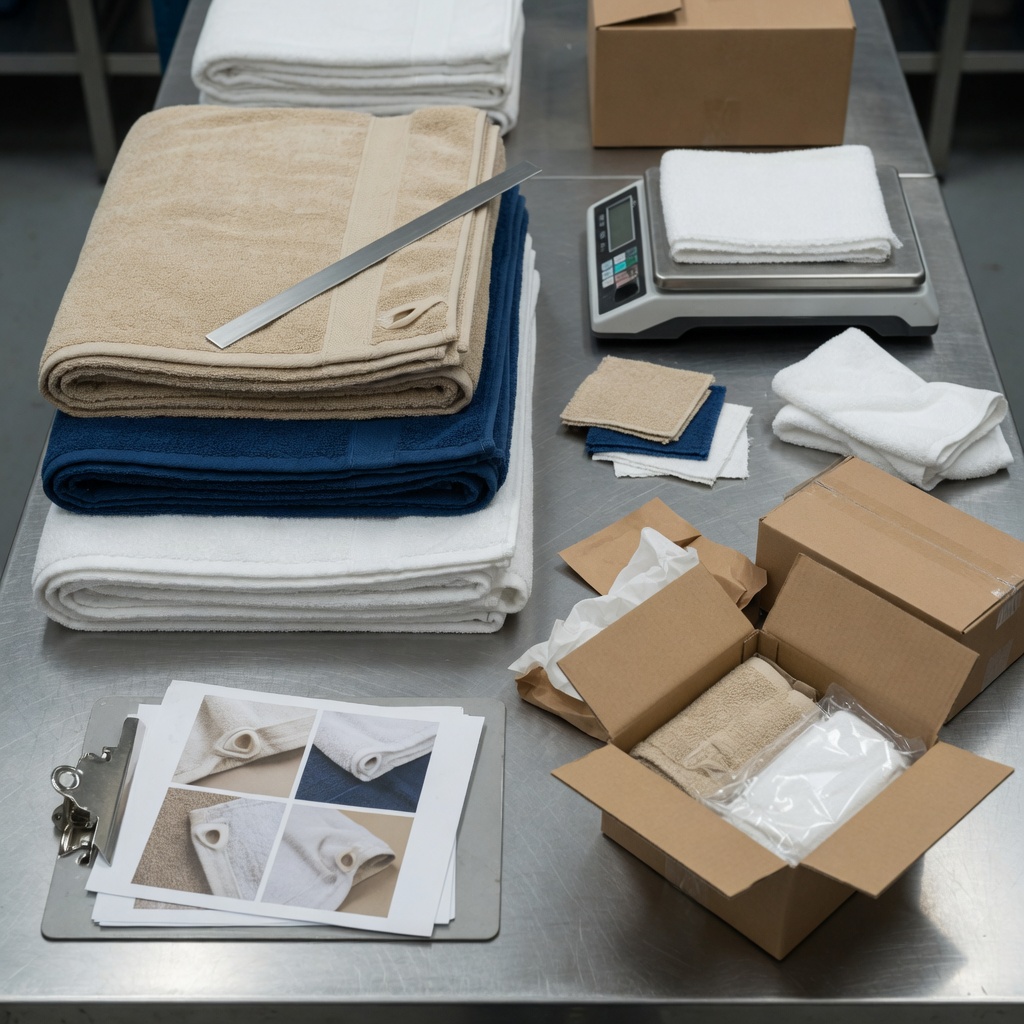
United States buyers should treat a beach towel wholesale supplier communication workflow review as a buying gate, not a courtesy check. Do not award a wholesale supply program until the quotation itself carries timed recaps, a named owner, proof gates, production-hold notices, United States label mock-ups, and a complete shipment file set. The review is pass/fail: inquiry handling, quotation recaps, artwork proofs, production updates, quality-hold notices, and shipping documents must arrive on a stated English-language service level under one accountable owner.
Do not buy on first-reply speed. Score the post-deposit path, where shade, size, hem, hanging-loop, or care-label errors become work-in-process.
Public custom-order pages describe a path from inquiry (quantity, customization, timeline, and requested documents) through quotation, design-proof approval, contract and deposit, production, quality control, tracked shipping, balance payment, and after-sales support from a dedicated customer team (Custom Beach Towel Order Process). A separate manufacturer page claims inquiry replies within 12 hours (unit: elapsed hours as stated; scope: that manufacturer’s public OEM/ODM sales page, not an audited mill service level; as-of: the public page used for this editorial review; source: Towelscc) and dedicated account managers above a stated piece threshold on the same page. Those figures are comparison anchors, not audited mill performance. Convert them into RFQ clauses before placing wholesale supply.
This article is prepared by Vincent Xi, Editorial Author for Plait & Mill (author profile). It does not claim factory visits, personal production management, or named customer results.
Communication Workflow Review Criteria for Beach Towel Wholesale Supply
Beach towels are specification-heavy. Finished size, mass per area, yarn and pile, hem, decoration method, color standard, packing, and United States-facing labels all change cost and calendar. If those items live only in chat fragments, the purchase order will not match bulk goods. Award only if the supplier can:
- Restate the buyer’s spec pack without dropping units (inches or centimeters, grams per square meter, piece count, carton count).
- Time-stamp each approval so cutting, dyeing, printing, or sewing does not start on an unapproved proof.
- Route construction, packing, and label questions to a person who can answer them, not only a first-line salesperson.
- Notify the buyer in writing when a dye lot, mill date, carton mark, or label line changes.
- Put the communication matrix on the order confirmation so the workflow is contractual.
If any of those five items is missing from the quotation, do not deposit. A missing recap, unnamed owner, unsigned proof freeze, silent production interval, or “labels later” clause is a workflow defect, not a paperwork preference.
A wholesaler-oriented guide treats communication as a core selection quality, including B2B inquiry replies within hours, dedicated account managers for technical advice, production updates and after-sales follow-up, and 7x24-hour English-language service as that company’s stated practice (unit: hours of coverage as written on that page; scope: that wholesaler’s stated service description, not an industry rule and not a certification; as-of: the public page used for this editorial review; source: 7 Qualities to Look for in a Towel Wholesaler). In the RFQ, replace “hours” and “7x24” with a clock definition (business hours, time zone, calendar days versus working days) and a backup contact.
A fast first reply often comes from sales chat, while the expensive failures happen after deposit. Score first-response time and in-production response time as separate controls. A dedicated manager that starts only above a large piece count can also leave a United States test order on a shared inbox.
Use the eight rows in the decision table as gated controls. If a control is missing from the quotation, do not deposit.
Buyer Decision Table: Score Communication Before You Award
| Communication control | Why it matters for United States beach towel wholesale supply | Require in writing | Red flag | How to verify before purchase order |
|---|---|---|---|---|
| RFQ recap service level | Stops quotes on the wrong size, mass per area, or print method | Acknowledge plus full spec recap with units and time zone | Price-only reply | Send a detailed RFQ and score whether every unit reappears |
| Named account owner | Prevents lost label and carton-mark decisions at handoff | Name, backup, coverage hours, English capability | Unnamed “sales team” | Hold a call with the named owner before deposit |
| Proof-approval gate | Bulk print or embroidery cannot start on a chat “OK” | Written pre-production approval form, file list, and freeze rule | Production booked before signed proof | Withhold deposit until the proof protocol is attached |
| Production update cadence | In-hands dates depend on work-in-process visibility | Weekly written status: step, quantity, risk, photos | No updates after deposit | Run a pilot SKU with a required mid-production photo pack |
| QC hold and disposition | Shade and size defects scale across multi-thousand-piece runs | Hold-notice timing, photo standard, rework rules | Packed goods presented as finished fact | Request an anonymized sample hold notice and disposition path |
| Label and origin pack | United States receiving and retail identity rules | Label mock-up, origin line, carton marks versus invoice | “Labels later” | Approve PDF or physical mock-ups with the pre-production sample |
| Shipment document set | Landed cost and delivery need matching paperwork | Invoice, packing list, tracking, carton specification as one package | Quantity or mass mismatches across documents | Pre-agree templates on a one-SKU trial |
| Escalation path | Seasonal programs cannot wait on a silent inbox | Second contact and maximum silence in business hours | Single personal chat thread only | Test escalation with a non-urgent written question |
Each row is a buying action: specify the control, compare suppliers on evidence, verify on a trial, approve the protocol, then order. The table is a buyer-side scoring tool, not a claim that any cited mill already operates this matrix.
Stage-by-Stage Communication in a Custom Beach Towel B2B Order
Use published custom-order sequences as a list of message types, then force each type onto a channel, owner, and artifact.
Inquiry. The buyer states quantity, customization (size, mass per area, print or embroidery placement, hem, hanging loop), target in-hands date, Incoterms, and documents required for United States receiving and labeling. The supplier should reply with a recap, not only a unit price.
Quotation. The quote should list unit price, minimum order quantity, sample cost, sample lead time, bulk lead time, payment terms, and exclusions (artwork, extra labels, special packing, freight). One process page places a 30–50% deposit after confirmation and 30–50 days of production in the same sequence (units: percent of order value for the deposit; days of production as stated on that page for that company’s described custom beach towel flow—not a United States import average; scope: that public process page; as-of: the public page used for this review; source: Custom Beach Towel Order Process). Clarify whether the day count starts at deposit receipt, at pre-production sample approval, or at greige allocation, and whether days are calendar or working days.
Design proof. Name who may approve (buyer art versus merchandising), file type, color standard, finished dimensions on a towel template, proof revision rounds, and whether hem, hanging loop, and care-label placement are visible on the proof. Freeze the approved file with a version ID. Do not allow cutting, dyeing, printing, or sewing on an unfrozen file.
Order confirmation. Freeze SKU, quantity, packing, carton marks, and the communication matrix: primary email, escalation path, and weekly update cadence.
Deposit. Example commercial term to verify in the supplier quote: 30–50% of order value before production, with the balance against copy documents or before loading, as described on the same process page (unit: percent of order value; scope: that public process page’s described flow, not a default for every mill; as-of: the public page used for this review; source: Custom Beach Towel Order Process). Deposit only after the recap, named owner, proof protocol, and label mock-up schedule are attached.
Production updates. Require a weekly written status: process step, quantity completed, next gate, and any risk to the agreed ex-works or FOB date.
Quality control. State how inspection results are communicated, whether photos are lot-tagged, who may stop packing, and how a fail is dispositioned (rework, sort, or new dye lot) before packing.
Shipping and after-sales. Tracking, packing list, commercial invoice, and carton-mark photos should move as one set. After-sales ownership should be named so United States receiving teams do not open a new inquiry thread for shortages.
A second manufacturer page compresses sample and bulk clocks differently: OEM/ODM sample windows of 7–10 days and bulk production of 15–30 days, with 24/7 dedicated sales support, inquiry responses within 12 hours via email, WhatsApp, and live chat, and dedicated account managers for orders above 5,000 pieces (units: 7–10 and 15–30 are days as stated by that manufacturer—confirm calendar versus working days and clock start; 12 hours is elapsed inquiry-response time as claimed; 24/7 is coverage as claimed, not a certified capability; 5,000 is pieces, not SKUs or dollars; scope: that manufacturer’s public page; as-of: the public manufacturer page used for this review; source: Towelscc). The gap between a 15–30 day bulk claim and a 30–50 day bulk claim is why the purchase order must define “production start” and “production finish.” Faster quoted days that exclude proof wait time, dye-lot approval, or packing are not faster deliveries.
Response Time, Account Ownership, and Channel Discipline
Score four communication objects separately.
First-response time. Supplier-stated examples include replies within hours on the wholesaler guide and within 12 hours on the manufacturer page cited above (unit: hours as stated on each page; scope: those companies’ public service claims, not audited mill performance; as-of: the public pages used for this editorial review; sources: 7 Qualities to Look for in a Towel Wholesaler and Towelscc). For United States programs, specify the clock in the RFQ. Example service-level wording to verify in the supplier quote, not a published mill average: acknowledge within a stated number of business hours, 09:00–18:00 Eastern Time, with a complete spec recap within one business day. Hours without a time zone are not a service level.
Ongoing coverage. 7x24-hour English-language service is a company-stated practice on the wholesaler guide, not a standard requirement and not a certificate (unit: hours of coverage as written on that page; scope: that wholesaler’s stated service description; as-of: the public page used for this editorial review; source: 7 Qualities to Look for in a Towel Wholesaler). Seasonal United States retail and hospitality beach towel programs only benefit from after-hours coverage if production and logistics staff can act on a hold, not if a generic inbox auto-replies.
Dedicated account managers. One manufacturer states dedicated account managers for orders above 5,000 pieces (unit: pieces; scope: that manufacturer’s stated threshold; as-of: public page used for this review; source: Towelscc). A United States buyer running a smaller wholesale test must ask who owns QC photos, booking, and claims below that threshold. Require a named owner and a backup, not “the sales team.”
Channel discipline. Chat is useful for speed and harmful for approvals. Specifications, price, and sign-offs should live in email or a shared folder; chat should only flag that a file was sent. A chat “OK” is not proof approval.
Red flags during review:
- A price with no restated size, mass per area, or decoration method.
- Proofs that crop the hem, hanging loop, or care-label seat.
- Silence between deposit and “goods ready,” with no work-in-process photos.
- A new contact appearing at booking with no handoff note.
- Refusal to put response times, update cadence, and escalation names on the quotation.
United States Specification, Labeling, Landed-Cost, and Delivery Communication
The communication workflow exists so the beach towel that was quoted is the beach towel that lands in the United States.
Specifications. Every written recap should include finished size (inches as the primary unit for United States programs, with a metric equivalent), mass per area (grams per square meter or ounces per square yard, one system primary), fiber content, construction, color method, size and mass tolerances, and packing (pieces per inner pack, inners per carton, carton exterior dimensions, gross mass). If a supplier switches units mid-thread, stop and issue a controlled spec sheet with a version ID.
Labeling. United States textile goods generally require fiber content, country of origin, and the identity of the manufacturer, importer, or dealer, plus care instructions where the Care Labeling Rule applies. This article does not interpret current Federal Trade Commission or U.S. Customs and Border Protection text. The operational communication requirement is: the supplier confirms in writing who creates the sewn-in label and hangtag, which language appears, whether an RN or identity line is used, and that carton marks match the commercial invoice. Ask for a label mock-up in the same proof cycle as the print strike-off. Distinguish a regulatory requirement (origin and fiber identification under applicable United States rules) from a mill’s own label template. Do not treat a marketing page as proof of legal compliance. Do not deposit on “labels later.”
Landed cost. Communication should itemize Incoterms, carton cubic measure, pieces per carton, and whether any freight figure is spot or validity-dated. Example calculation to verify in the supplier quote, not a market freight rate: if a carton holds 20 pieces and the purchase order is 5,000 pieces, carton count is 250 (units: pieces per carton and piece-count order quantity; scope: packing-plan arithmetic only; as-of: buyer assumption for the RFQ; source: example calculation, not a cited mill pack). Freight, insurance, and duty then apply to that packing plan. If inner packs or carton dimensions change after the freight quote, landed-cost communication has failed. Manufacturer sample or bulk production days are not ocean or air transit times.
Delivery. United States receiving needs a documented handoff: agreed ex-works or FOB date, estimated departure, and the person who sends the on-board notice, packing list, and invoice. Write the calendar as art-approval date plus production days plus booking buffer. A “30-day production” message that ignored proof wait time is a communication failure, not a logistics failure.
Issue resolution. Require a hold notice within a stated number of business hours when inspection finds shade variation, size outside tolerance, or wet-processing delay. The notice should include photos, quantity affected, and a proposed disposition for buyer approval before further packing.
RFQ Checklist for Beach Towel Wholesale Supply
Issue these items in the RFQ for beach towel wholesale supply. Each line is something the buyer can specify, compare, verify, approve, or order against.
- Restate finished towel size in inches and centimeters, mass per area, fiber percentages, construction, hem type, hanging loop, decoration method, and size/mass tolerances in the first quotation.
- State inquiry response time in hours, the time zone used (use Eastern Time as the United States program clock unless another zone is agreed), and whether weekends are included; confirm whether the same clock applies after deposit.
- Name the account owner and backup for production updates, QC photos, booking, and claims; state any piece-count threshold for a dedicated manager. One manufacturer page uses 5,000 pieces (unit: pieces; scope: that page’s stated threshold; as-of: public page used for this review; source: Towelscc)—ask who owns a United States test order below that count.
- Identify channels: which decisions must be emailed; which may be messaged; where artwork, label, and packing files are stored; prohibit chat-only approvals.
- Define sample lead time in calendar or working days and clock start (art receipt versus payment). Treat a published 7–10 day sample window as a supplier-stated example to confirm for the quoted construction (unit: days as stated; scope: that manufacturer’s OEM/ODM sample claim; as-of: public page used for this review; source: Towelscc).
- Define bulk production the same way. Reconcile a 15–30 day claim against a 30–50 day claim by listing included steps (weaving or greige, dyeing, sewing, printing, packing) and the definitions of production start and production finish (units: days as stated on each page; scope: those companies’ described custom beach towel flows, not a United States average; as-of: public pages used for this review; sources: Towelscc and Custom Beach Towel Order Process).
- State deposit as a percent of order value and list documents issued at deposit; treat 30–50% as a supplier-stated example to verify, not a default (unit: percent of order value; scope: that process page’s described flow; as-of: public page used for this review; source: Custom Beach Towel Order Process).
- Attach a weekly work-in-process template: date, purchase order, SKU, step, quantity passed, quantity held, risk to FOB date, and photo set.
- Specify QC photo requirements (full towel, hem, hanging loop, label, color versus standard, carton interior) and the business-hour deadline for a hold notice; name who may stop packing.
- Provide a United States label mock-up schedule: fiber, origin, care, identity line, language, placement on the towel, and carton-mark match to the invoice.
- List Incoterms, inner/outer pack counts, carton exterior dimensions, gross kilograms or pounds, cubic measure, and the person who issues the commercial invoice and packing list as one document set.
- State how shortages, shade lots, late bookings, and substitutions are communicated and who may approve them before packing or loading.
- Confirm English-language coverage hours without treating a marketing “24/7” sentence as a certified capability; request the current internal policy if after-hours coverage is material to the order, including United States holiday silence rules.
- Identify the buyer-side and supplier-side approvers for artwork, lab dip or strike-off, pre-production sample, and shipping marks; state allowed proof revision rounds and the freeze/version-ID rule.
- Require the communication matrix, recap SLA, and escalation names to appear in the order confirmation so the workflow is part of the contract, not a side chat.
- Require English invoice and packing-list templates to be pre-agreed on a one-SKU trial, with piece count, net/gross mass, and carton count matching the packing plan used for landed-cost math.
- Require a written rule that a change to inner pack, carton dimensions, dye lot, or label copy after freight quoting triggers a new landed-cost recap before packing continues.
Source Context, Methodology, and What to Verify
Source context 1. A custom beach towel B2B order-process page outlines inquiry content, quotation, design-proof approval, contract, deposit, production, quality control, tracked shipping, balance payment, and dedicated after-sales support, and states a 30–50% deposit and a 30–50 day production window (cottonbeachtowel.com).
Source context 2. An OEM/ODM manufacturer page states 24/7 dedicated sales support, inquiry responses within 12 hours on email, WhatsApp, and live chat, dedicated account managers for orders above 5,000 pieces, sample lead times of 7–10 days, and bulk production of 15–30 days (towels.cc). A third public guide, used as supporting communication context, describes hours-scale replies, dedicated account managers, and 7x24-hour English-language service as that wholesaler’s stated practice (hedetowel.com).
Methodology. This communication workflow review is an editorial synthesis of those publicly described B2B process and service claims, mapped to United States wholesale tasks: specification recap, labeling mock-up, landed-cost documents, delivery notices, and RFQ clauses. No factory audit, laboratory test, mystery shop, or ranking was performed. Exact numbers are used only as supplier-stated examples with units, scope, and a verify-in-quote instruction, or as labeled example calculations. Vincent Xi is named as Editorial Author; this page does not add credentials, years of experience, or first-person production stories beyond that byline.
Limitations. Marketing pages can overstate coverage hours and under-specify whether days are working days. Two cited sources give different bulk production ranges; neither is a United States industry average. Response-time claims may exclude peak season, new custom prints, or buyers below a piece threshold. None of the cited pages is a legal opinion on current FTC care labeling, textile fiber identification, or CBP origin marking—confirm those rules with official text and counsel. Freight, duty, and inland delivery are not included in mill production days. Do not infer ISO, OEKO-TEX, or any other certification from a communication service level; request a current document if a claim is material to the purchase order. Reconfirm every numeric term against the quotation date, Incoterms, and SKU list for the actual beach towel wholesale supply program.
Use the decision table and RFQ checklist to specify, compare, verify, approve, and order. Keep the communication protocol attached to the beach towel purchase order so United States receiving, labeling, and landed-cost files match the goods that were quoted.
Discuss Your Requirements
Review our manufacturing capabilities, then share your specifications for a supplier-fit review.