Hotel Towel Sourcing Digital Integration Readiness for Procurement in Australia
By Vincent Xi, Editorial Author
```json { "@context": "https://schema.org", "@type": "Article", "headline": "Hotel Towel Sourcing Digital Integration Readiness for Procurement in Australia", "author": { "@type": "Person", "name": "Vincent Xi", "jobTitle": "Editorial Author", "url": "https://plaitandmill.com/authors/vincent-xi/" } } ```
Buyers in Australia who run hotel towel procurement for hotels, resorts, and commercial laundries should write hotel towel sourcing digital integration readiness into the purchase order. It is not a software project that starts after cartons land. If mill colour and mass data, unique item identification, and inventory files cannot move into laundry, PAR, and purchasing systems, shade lots and unexplained losses will keep resetting the order cycle.
Award only when three connections are specified in the RFQ and proven on a pre-production hotel towel: mill process data later lots can repeat; carton or item IDs the laundry can scan without a parallel spreadsheet; and commercial files the buyer’s procurement or inventory platform can ingest. Do not award on a sample fold and a verbal claim that the mill is “digital.”
This brief is for B2B procurement in Australia of the hotel-towel product family. It is a comparison-and-RFQ note, not a complete hotel-linen guide and not an import manual. Labelling, laundry chemistry, and inbound documents still have to be confirmed with the supplier and the buyer’s receiving process. The public sources used here do not define Australian statutory labelling text.
What digital integration readiness means for hotel towel procurement in Australia
Digital integration readiness, for this product family, is the ability to place a hotel towel program on contract with those three connections specified, tested, and owned.
Award if the mill returns a signed pre-production towel, a sample lot file that imports into the hotel or group template, and—when RFID is in scope—a wash-and-read result on the actual hem construction.
Hold if terry quality is acceptable but shade, GSM, lot IDs, or tags still live in photos, PDFs, or a supplier portal login.
Reject a digital-readiness claim if the supplier cannot name the colour method, the mass method, the file fields, and the identification method as RFQ lines.
For a property or group in Australia, the question is narrow: will this towel SKU, this mill lot file, and this tag or barcode map into the laundry count, the storeroom PAR, and the next purchase requisition?
An Eliya Linen industry overview reports digital procurement platforms at 38% of industry volume, data “middle platforms” associated with 92% demand-forecasting accuracy, and 72% of chain hotels using real-time inventory monitoring (units: percent of industry volume, percent forecast accuracy, and percent of chain-hotel adoption, as published on that page; industry-overview scope; geography and measurement date/as-of are not stated in the source excerpt). Treat those figures as publisher-reported industry context, not as a guarantee that any one hotel-towel contract in Australia will hit the same percentages. Digital transformation of the hotel supplies industry
Mill colour, GSM, and lot files to lock in the RFQ
Hotel towel shade and hand feel fail in procurement when a second dye lot does not match the approved sample and there is no electronic record of how the first lot was made. Hanbi Hotelsupplies describes a mill digital path that uses spectrophotometer colour formulas, GSM sensors stated to control weight within ±3%, real-time camera defect detection, and data from dyeing through packaging for traceability. Unveiling the precise digital journey behind a hotel towel
Use that page as an example of the kind of process control to ask for, not as a certified result for every mill and not as a Plait & Mill factory claim.
Translate those mill claims into RFQ fields:
- Colour. Ask whether the mill holds a spectrophotometer formula (illuminant, observer, and pass/fail delta-E or equivalent) and whether later lots must match that formula or only a visual swatch. “Zero difference across batches” is a supplier-described goal on the Hanbi page; it is not an independently dated lab certificate in the materials used for this article. Require a retained lab dip, a numeric formula ID, and a written rule for what happens if the formula changes.
- GSM / mass. GSM is mass per unit area, stated in g/m². A mill that cites sensors controlling weight within ±3% is describing a percentage tolerance around a target GSM (unit: percent of target mass per unit area; scope: mill production control as stated on that Hanbi page; instrument, conditioning atmosphere, and audit date/as-of are not given in the excerpt). The buyer still has to state the target GSM, whether mass is measured conditioned or as-packed, and whether ±3% is acceptable or too wide for the brand standard. Example calculation to verify in the supplier quote, not a sourced product spec: a 600 g/m² target with a ±3% mill window is 582–618 g/m²; write the buyer’s binding limit on the PO.
- Defects. Real-time camera detection only helps procurement if reject codes survive into the packing list and the quality file. Ask for the defect taxonomy, the sampling plan, and how many days of images or logs are retained.
- Traceability. Lot, dye, finish, and carton IDs must appear in a structured file (CSV, EDI, or API), not only on a paper ticket inside a polybag. Full-traceability language on a mill marketing page is not the same as a field map a warehouse can import.
The same Eliya overview states that some digitally managed production cycles are reduced to 3 days with lower defects, and that AI is associated with cutting costs 12–15% (units: cycle time in days; cost reduction as a percent; scope: as published on that industry-overview page; process scope, country, and date/as-of are not stated in the excerpt). Those numbers are useful as questions (“What is your confirmed production cycle for this GSM and colourway, in days, from colour approval to ex-works?”) and poor as assumed inbound lead time to Australia. Ocean freight, colour approval, and inspection still sit outside a mill’s internal cycle claim.
RFID and barcode fields that make hotel towels countable
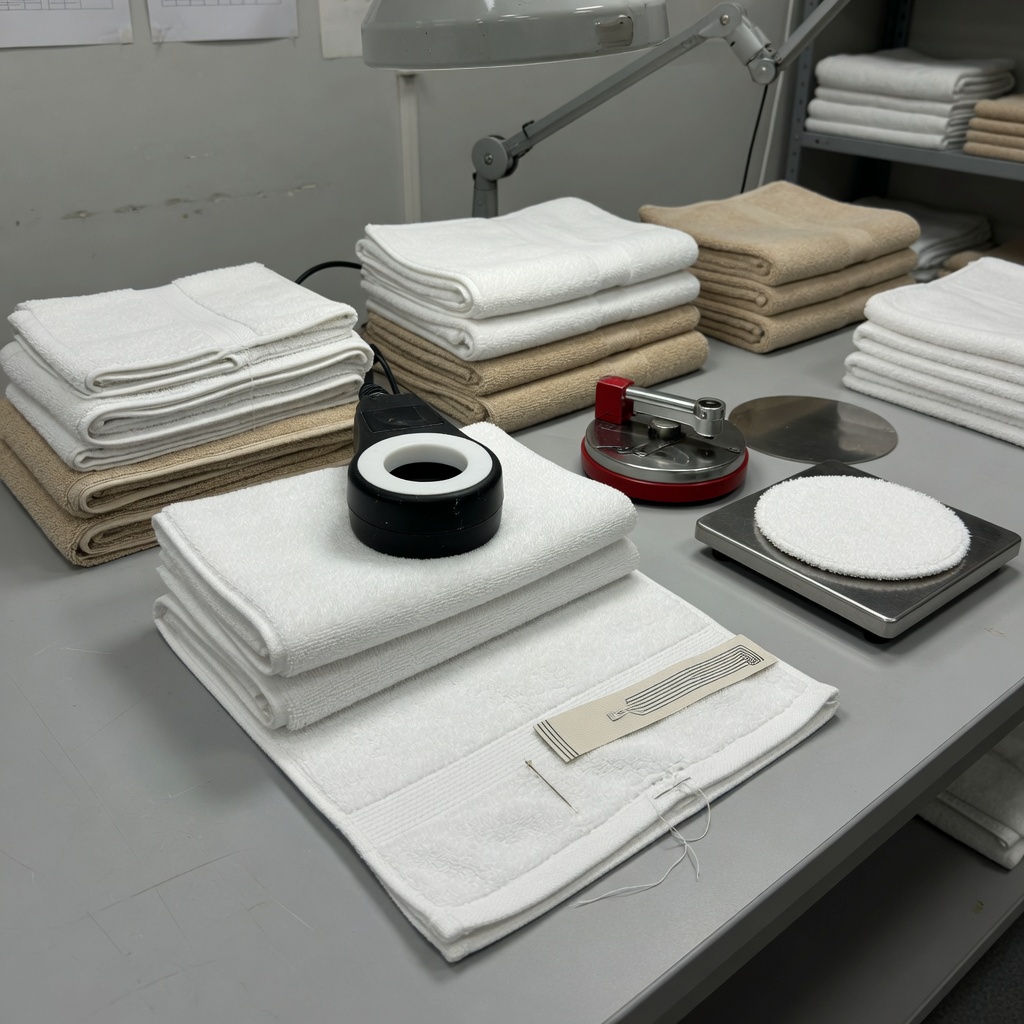
Process data from the mill does not, by itself, stop towels leaving a pool deck uncounted. HID Global describes RFID for pool and beach towels using embedded tags and readers at key points, with inventory visibility, usage and wash analytics, loss-prevention alerts, and predictive PAR insights, and states that such programs can help reduce 15–30% annual linen losses (unit: percent reduction in annual linen losses, as published; scope: hospitality pool/beach towel programs as described in that blog; not a property audit in Australia and not a dated multi-hotel study in the excerpt). Rethinking pool and beach towel management with RFID
For procurement, RFID is a specification bundle, not a logo on a mill slide:
- Tag type and frequency named by the supplier (do not assume one inlay fits bath, hand, face, pool, and beach towels).
- Placement (hem, sewn-in pouch, or heat-seal) and whether the tag can be felt on a face towel or pillow-side bath towel.
- Rated wash/dry/finish cycles and chemistry limits (chlorine, ozone, high-pH, tunnel finish).
- Read points the hotel or laundry will actually install (soiled-linen chute, washer/tunnel exit, issue counter, pool gate).
- Data payload (unique item ID, SKU, size, colour, install date) and the software that will own it.
HID’s published case is pool and beach towel management. Room bath towels add guest-comfort and ironer/folder constraints that must be tested on the actual SKU.
Barcode-only programs can still be digitally ready at carton or dozen level. They will not give item-level wash counts or loss alerts. That is a trade-off, not a failure, if the hotel only needs SKU-level replenishment.
Example replacement model to verify with hotel actuals, not a sourced Australian benchmark and not an HID loss-rate figure: if a pool store of 1,000 towels records 200 replacements in 12 months, that is a 20% annual replacement rate. Price the RFID or barcode option against the property’s own count. Use HID’s published 15–30% reduction range only as a scenario to test after readers and software are in place, labelled as a published reduction range from that RFID article, not as the hotel’s baseline loss rate.
Measurable trade-offs when you specify digital-ready hotel towels
Every extra data field and every embedded tag has a cost, a failure mode, and a verification step. Use the table for award decisions, not marketing comparison.
| Decision field | What to specify | Compare | Verify before award | Order / run implication |
|---|---|---|---|---|
| Colour control | Formula ID, illuminant, numeric pass/fail (or stated visual method) | Spectrophotometer lot match vs visual-only | Lab dip + mill report on pre-production lot | Re-approve if dye or finish changes |
| GSM / mass | Target GSM in g/m², ±% tolerance, conditioned vs packed | Mill sensor claim (e.g. ±3% as published by Hanbi) vs brand limit | Cut-and-weigh on retained pre-production pieces | State units (g/m²) on PO and packing list |
| Defect data | Camera or manual AQL, reject codes, log retention days | In-line digital vs end-of-line only | Sample log + physical inspection of the same cartons | Codes must appear on carton files |
| Lot traceability | Dye, finish, carton, SKU, piece count in a test file | API/EDI vs spreadsheet vs PDF | Import the test file into the hotel or group template | No importable file, no digital integration readiness |
| Item ID | None / barcode carton / RFID item | Pool-deck loss risk vs guest-facing hand feel | Wash and read test on the actual hem construction | HID-cited 15–30% loss reduction is a published range to test, not a PO guarantee |
| Inventory feed | Issue, wash count, on-hand, PAR | Portal only vs ERP/laundry system | Buyer-set trial feed (example window: 30–90 days — confirm in the RFQ) | Eliya-cited 92% forecast accuracy is industry-reported, not SKU-specific |
| Cycle time | Days from colour approval to ex-works for the ordered quantity | Mill “3-day” digital-cycle claims vs inspection calendar | Written capacity slot for the GSM and colourway | Do not treat mill cycle as inbound time to Australia |
| Unit cost vs loss | Piece price, tag price, reader/software cost | Lower piece price vs countable stock | 12-month replacement and repurchase model using hotel counts | Model as an assumption to verify with hotel actuals |
Price the following explicitly before award:
- Tighter GSM and colour data reduce shade complaints and weight shortfalls, but they add mill instrumentation, retained samples, and possible lot-hold time. A ±3% GSM window may be acceptable for a utility bath towel and too wide for a specified luxury GSM.
- RFID can support the 15–30% annual linen-loss reduction range described by HID for pool and beach programs, at the cost of tag price, insertion labour, laundry-process limits, and reader/software integration. If readers are not installed at the points where towels leave the property, the tag is only a sewn-in cost.
- Platform forecasting (Eliya’s published 92% accuracy and 72% real-time monitoring among chain hotels) depends on clean historical issue and wash data. A new hotel in Australia with no baseline cannot buy that accuracy as a towel attribute.
- Shorter mill cycles (Eliya’s published 3-day figure) do not cancel inspection, documentation, or freight. Award on confirmed ex-works dates for the actual order quantity.
- Cost-reduction percentages (Eliya’s published 12–15% associated with AI in that industry article) are not a hotel-towel unit-price formula. Ask for a priced SKU with and without tags, with and without lot-level data files.
Receiving files for hotel towel programs landing in Australia
Keep the product and RFQ decision primary. Name the receiving country because the invoice, packing list, and fibre/care labels must match how the hotel or laundry in Australia will accept goods. The three public sources used for this article do not set Australian labelling wording, duty treatment, or quarantine rules. Do not copy a mill’s export carton mark as if it were a completed compliance pack.
Ask for:
- A packing list that repeats SKU, size, colour, GSM target, piece count, carton count, and lot IDs in the same field names as the electronic file.
- Fibre content and care information in the form the brand and laundry already use, then confirm it with the supplier against the destination’s current labelling practice.
- Whether RFID or barcodes will still be readable after the hotel’s actual wash formula, including any outsourced commercial laundry in Australia.
- Who owns exception handling when a lot file fails import (supplier resend within a stated number of business days, or the lot is not released to floors).
- A sample file before production, with dummy but realistic rows, that opens in the buyer’s template without renamed columns. Example columns to map, not a sourced mill schema:
sku,size_cm,colourway,gsm_target,dye_lot,finish_lot,carton_id,piece_count,ship_date,item_id.
Do not widen the RFQ into a multi-country sales pitch. Manufacturing origin is a supply fact; it is not a second sales market in this brief.
RFQ checklist for hotel towel sourcing digital integration readiness
Use this list to specify, compare, verify, approve, or order. Every item should appear as a line in the RFQ or it will not be enforceable.
- SKU identity. State hotel towel type (bath, hand, face, pool, beach), finished size in centimetres, target GSM in g/m², fibre, weave/terry type, colourway name, and pantone or lab-dip reference.
- Order shape. State first-ship quantity, remaining quantity, call-off method, and whether mixed dye lots may share one carton.
- Colour method. Require spectrophotometer formula ID or an explicit visual-only method; name illuminant and pass/fail rule; require retained dips for the life of the contract.
- Mass tolerance. Require target GSM and allowed ±%; state whether mill sensor logs (including any ±3% mill claim) are supporting evidence only and that cut-and-weigh on pre-production is binding.
- Defect and AQL file. Name inspection level, reject codes, and whether in-line camera logs will be supplied with the shipment file.
- Lot traceability map. List mandatory fields (dye lot, finish lot, carton ID, inner pack, piece count, SKU) and the file type (CSV/EDI/API). Require a sample file before production.
- Item identification. Choose none, carton barcode, or item-level RFID; if RFID, specify inlay type, frequency, placement drawing, and rated wash cycles. Do not assume pool-towel RFID construction is acceptable on a face towel.
- Read and wash test. Require a pre-production wash and read test in chemistry comparable to the hotel or laundry’s formula. Record read rate as a percentage of pieces, with sample size stated. Example calculation to confirm in the RFQ, not a sourced pass mark: 48 readable tags / 50 washed pieces = 96% on a 50-piece set; the buyer still sets sample size and threshold.
- Software landing zone. Name the inventory, PMS, or laundry system that must ingest IDs and lot files; require a field-mapping table; reject “portal login only” if the hotel needs ERP data.
- Forecast inputs. If the supplier offers demand planning, list the exact inputs (historical issues, wash counts, events, PAR). Treat published 92% forecast-accuracy figures as industry-reported, not as a contracted KPI, unless the supplier will warrant a measured accuracy on this account.
- Loss and PAR model. Ask the supplier to price the RFID or barcode option separately. Build a 12-month repurchase model using the hotel’s own replacement history; use HID’s 15–30% annual linen-loss reduction range only as a scenario to test, labelled as a published reduction range from that RFID article, not as the property’s baseline loss rate.
- Production calendar. Require days from colour approval to ex-works for the ordered quantity and GSM; do not accept a generic 3-day digital-cycle claim as the ship date.
- Cost split. Separate terry piece price, tagging/insertion, data-file setup, and any reader or software the mill does not provide.
- Change control. State that a colour, GSM, tag, or mill change needs written re-approval and a new pre-production file.
- Australian receiving pack. Require commercial invoice and packing list that match the electronic file; require the supplier to confirm fibre/care and origin documents with the buyer’s receiving SOP. Do not treat this article as a substitute for current import advice.
- Approval gate. No bulk production until the pre-production towel, the test data file, and (if specified) the wash/read test are signed. Name the approver role (procurement, laundry, rooms).
- Evidence pack. Ask for the mill’s current process-control description, any third-party test reports the mill already holds, and the date of those documents. Do not infer certification from a marketing page.
Method, source context, and what to verify
Author note. This article is written by Vincent Xi, Editorial Author at Plait & Mill. It is an editorial comparison of published process and industry pages against typical hotel-towel RFQ fields. It does not claim mill employment, factory visits, laboratory testing, named hotel customers, or first-person laundry trials. Approved author page: https://plaitandmill.com/authors/vincent-xi/.
Source contexts (two or more). (1) Hanbi Hotelsupplies’ page on a digital mill journey for hotel towels, used for colour-formula, GSM-sensor, camera-defect, and traceability language. (2) Eliya Linen’s hotel-supplies digital-transformation overview, used for published industry figures on digital procurement share, forecast accuracy, chain-hotel inventory monitoring, cycle time, and cost-reduction percentages. (3) HID Global’s RFID pool and beach towel management article, used for tag-and-reader architecture and the published 15–30% annual linen-loss reduction range.
How the data were derived. Figures were taken as reported on those pages and mapped to RFQ fields a buyer can specify or test. No unpublished mill audits were added. Where a number lacked a measurement date or country in the available excerpt, that gap is stated next to the number. Example calculations (GSM windows, read-rate percentages, 12-month replacement counts) are labelled as assumptions to verify in the supplier quote or against hotel actuals.
Limitations / what to verify before you order. Publisher pages are not current certificates. “Zero difference” colour language is a mill description, not a dated independent result. GSM ±3% is a mill control claim, not the buyer’s specification until it is written on the PO with units and method. 38%, 92%, 72%, 12–15%, 3 days, and 15–30% are as reported by the cited pages; they are not hotel-towel benchmarks for Australia and are not Plait & Mill performance claims. RFID results depend on tag construction, laundry chemistry, reader placement, and software, and HID’s published reduction range is framed around pool and beach towels. Australian labelling, freight, and import documents are not defined by these sources and must be confirmed outside this brief. Re-run wash/read tests on the contracted SKU; do not approve from a mill video or a generic inlay datasheet alone.
If a supplier cannot produce a sample lot file, a stated GSM and colour method, and (when RFID is in scope) a wash/read result on the actual towel, the program is not ready for digital integration, regardless of how the mill describes its factory software.
Discuss Your Requirements
Review our manufacturing capabilities, then share your specifications for a supplier-fit review.