Hotel Towel Wholesale Supplier Quality Control Inspection for United Arab Emirates Buyers
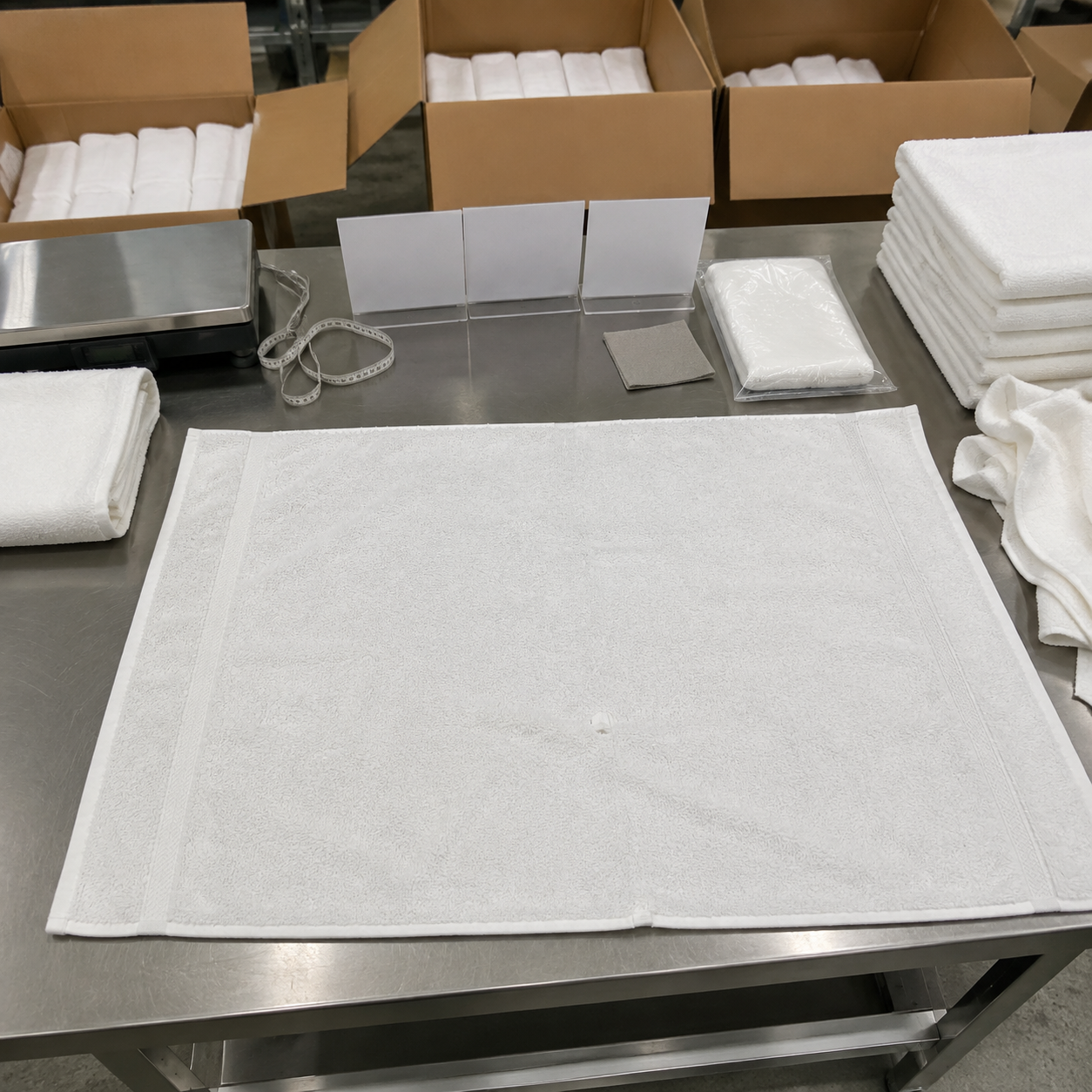
By Vincent Xi - Editorial Author
For a United Arab Emirates hotel buyer, a hotel towel wholesale supplier quality control inspection should answer a narrow question: does the identified production lot match the RFQ and purchase order closely enough for written shipment release? Supplier qualification is an earlier decision; approving a bidder or development sample does not itself release bulk goods.
Issue every bidder with the same controlled SKU specification, inspection protocol, evidence requirements, delivery scope, and remedy terms. Require deviations to be listed in the quotation rather than discovered after production. The resulting comparison should show which supplier can support the specified towel, traceable inspection evidence, and an enforceable response to nonconformity.
United Arab Emirates Hotel Towel Quality Control Inspection Release Gate
| Decision | Evidence condition | Buyer action |
|---|---|---|
| Advance the bidder | Contracting entity, production location, outsourced processes, controlled specification, sample procedure, commercial scope, and remedy terms are disclosed | Permit sampling or production only under the recorded conditions |
| Hold the order | Specification fields, methods, traceability, delivery scope, reports, or deviation decisions remain unresolved | Request the missing evidence or revised terms before approval |
| Release the identified lot | Lot identity, quantity reconciliation, inspection results, required reports, packaging, and accepted deviations satisfy the purchase-order rules | Issue written release through the authority named in the purchase order |
| Require correction or apply the agreed remedy | Unauthorized substitution, failed buyer-selected criteria, unacceptable defects, quantity mismatch, packaging error, or missing mandatory evidence remains open | Apply the agreed sorting, rework, retest, replacement, credit, rejection, delay, and cost-responsibility terms |
The purchase order should identify who may approve production, accept a deviation, release a shipment, and close corrective action. Production completion, supplier-operated QC, or inspector attendance should not be treated as buyer release unless the agreed contract expressly gives it that effect.
Evidence Basis and Source Boundaries
This revision retains only the source contexts supplied with the draft. The cited pages provide topics for supplier questions and RFQ controls; they do not verify a bidder, production site, SKU, certificate, test result, or shipment.
| Supplied source | Retained source context | RFQ use | Evidence boundary |
|---|---|---|---|
| Circe Towel supplier evaluation guide | Frames reliability, consistency, inventory depth, product range, manufacturing capacity, after-sales support, and lead time as supplier-evaluation topics | Request the legal entity, production site, capacity basis, stock status, continuity plan, quality contact, complaint route, and lead-time basis in comparable fields | The page does not establish that a proposed bidder has the stated capacity, inventory, controls, or lot conformity |
| Business Analyst Learnings supplier comparison | Discusses recurring-order GSM consistency, minimum order quantities, lead time, defect rates, and volume-price tiers | Require SKU-level minimum quantities, lead-time assumptions, piece-level measurement evidence, buyer-defined defects, and clearly scoped price breaks | The discussion is not a supplier audit, quotation, test report, or acceptance rule for the proposed order |
| Hede Towel supplier-question page | Organizes supplier questions around material purchasing, production processes, dyeing, packaging, logistics, quality checks, and test reports | Convert each applicable process topic into a disclosure, evidence request, inspection point, or contractual responsibility | The question structure does not prove that a bidder operates a stated control or that a report is traceable to the ordered lot |
Lock the Hotel Towel Specification Before Comparing Quotes
Create one controlled specification for each hotel towel SKU in the RFQ. Treat these as buyer-selected requirements, not assumed supplier or product attributes:
- Product identity: SKU, hotel use, color, order quantity, permitted quantity variance, and prohibited substitutions.
- Material declaration: Fiber composition, yarn description, pile and ground construction, and evidence required for any material-content claim.
- Finished dimensions: Measurement locations, border treatment, conditioning method, nominal dimensions, and tolerance.
- Mass controls: Nominal GSM, expected conditioned mass per finished piece, calculation method, and permitted piece-to-piece and carton-to-carton variation.
- Construction: Weave, pile character, border design, hem type, stitching, edge alignment, and rules for joins or repairs.
- Color and finish: Approved shade or whiteness reference, dye-lot separation, finishing requirements, and permitted visible variation.
- Performance checks: Buyer-agreed laundering, drying, dimensional-change, color-transfer, water-pickup, lint, appearance, and seam-integrity methods and limits.
- Packing: Fold, pack count, assortment, moisture protection, carton construction, and buyer-approved markings.
Do not use nominal GSM as the sole award criterion. Reconcile GSM and finished dimensions with expected conditioned piece mass, then assess the other buyer-selected construction and performance requirements under stated methods.
A reference sample should support the written specification rather than replace it. Record its identifier, approval date, controlled attributes, accepted deviations, and retained buyer and supplier references. Add each approved deviation to the controlled specification before bulk production.
Practical RFQ Checklist for Hotel Towel Quality Control Inspection
Attach this checklist to the RFQ and require the supplier to mark every item as Confirmed, Deviation, or Not offered. Each response should identify the relevant quote section, attachment, or proposed alternative. Treat a blank response as unresolved and do not award or release the order while a mandatory item remains open.
RFQ identity and quote basis
- [ ] The buyer has entered the RFQ identifier, issue date, response deadline, contracting entity, required quotation currency, quote-validity requirement, and named United Arab Emirates delivery point.
- [ ] Each SKU row states the product type, hotel use, color, order quantity, permitted quantity variance, and prohibited substitutions.
- [ ] The supplier has identified its legal contracting entity, production location, relevant outsourced processes, quality contact, and complaint contact.
- [ ] The supplier has stated the minimum quantity, production lead-time assumptions, dispatch window, price-break basis, and stock or made-to-order status for each SKU.
Product specification and approval evidence
- [ ] The supplier has responded to the requested fiber declaration, yarn description, construction, nominal dimensions, GSM, expected conditioned piece mass, color, finish, hems, borders, and packing requirements.
- [ ] Every proposed technical or commercial deviation is listed in a controlled deviation register rather than embedded only in sales correspondence.
- [ ] The reference-sample procedure identifies who prepares, approves, labels, retains, and controls the sample and how an approved change updates the written specification.
- [ ] Proposed reports and current documents identify their holder, site, product or process scope, validity where applicable, and relationship to the quoted SKU.
Inspection, traceability, and release
- [ ] The inspection plan defines the production lot, lot identifier, unit of inspection, carton and piece selection authority, sample-selection method, and access conditions.
- [ ] Each buyer-selected check states the specimen preparation, conditioning, equipment, measurement locations, method, calculation, rounding, reporting format, and contractual limit.
- [ ] The defect list defines applicable workmanship, shade, contamination, construction, quantity, and packing defects and assigns the agreed disposition for failed results.
- [ ] The supplier has confirmed that raw piece-level findings, photographs, quantity reconciliation, carton identifiers, and report-to-lot traceability will be available before release.
- [ ] The purchase order identifies who may approve production, accept a deviation, release the identified shipment, require reinspection, and close corrective action.
Commercial scope and remedies
- [ ] The quotation separates included and excluded product, customization, sampling, inspection, testing, packaging, correction, reinspection, transport-related, and delivery charges.
- [ ] The quotation uses the buyer's named delivery point and responsibility basis and identifies the proposed shipment information and documents without presenting unverified UAE requirements as established obligations.
- [ ] Sorting, rework, retest, replacement, credit, rejection, delay, notice, and associated cost responsibilities are stated before award.
- [ ] The responsible UAE importer, customs adviser, or competent authority will verify the current documentation, labeling, import, and government-charge requirements before production or shipment release.
Quality Control Inspection Plan for the Quoted Hotel Towel Lot
| Gate | Evidence to define in the RFQ or purchase order | Decision produced |
|---|---|---|
| Supplier qualification | Contracting entity, production location, relevant outsourced processes, quality contact, complaint route, traceability proposal, and current documents for material capabilities | Whether the bidder may proceed under recorded conditions |
| Pre-production approval | Controlled specification, material declaration, color reference, reference sample, packaging layout, buyer-selected methods, production schedule, and deviation register | Whether bulk production may start |
| In-process control | Applicable production stages, lot traceability, buyer access, selection authority, reporting scope, and corrective-action process | Whether identified work may continue or must be held |
| Pre-shipment inspection | Production-lot identity, quantity, selected cartons and pieces, dimensions, conditioned mass, workmanship, color consistency, packaging, raw findings, and required reports | Whether the identified lot may ship |
| Receiving inspection | Shipment identity, received quantity, carton condition, packing-list reconciliation, and agreed receiving checks | Whether the delivered goods may enter hotel operations or require a contractual remedy |
Keep supplier-operated QC and buyer-appointed inspection as separate evidence channels. State who selects cartons and pieces, who performs each check, who may access the goods, who pays for correction and reinspection, and how conflicting results will be handled.
If a bidder proposes a certificate, request the current document showing its holder, site, product or process scope, validity, and issuer. Do not infer certification from a logo. If a standard is proposed, record its exact title, edition, applicable clauses, and method, then distinguish those requirements from the buyer's own specification and inspection rules.
Define Defects and the Contractual Decision Rule
The inspection protocol should define the production lot, unit of inspection, carton and piece selection method, sample size, and contractual acceptance rule. Product-specific defect definitions may address holes, stains, contamination, pulled or loose loops, skipped stitching, open seams, distorted borders, unauthorized repairs, shade variation, and packing errors where applicable to the controlled SKU.
For each defect class, state the disposition for a failed result and the evidence required before reinspection. Record piece-level findings and photographs against lot and carton identifiers. An observed defect rate is descriptive evidence; it is not an acceptance limit unless the purchase order expressly makes it part of the decision rule.
Example Calculations to Verify in the Supplier Quote
Every figure in this section is a hypothetical buyer RFQ assumption as of the buyer-entered RFQ issue date. Each source is the arithmetic shown from those assumptions. None is a supplier specification, measured result, product claim, or acceptance limit; every input and limit must be verified in the supplier quote and purchase order.
| Control | Example assumption, scope, as-of context, and source | Procurement use |
|---|---|---|
| GSM-to-piece-mass reconciliation | For one hypothetical bath-towel SKU as of the buyer-entered RFQ issue date, assume finished dimensions of 70 cm by 140 cm and nominal areal mass of 500 g/m^2. Source: shown arithmetic from these assumptions. The area is 0.70 m x 1.40 m = 0.98 m^2 per finished piece; expected conditioned mass is 0.98 m^2 x 500 g/m^2 = 490 g per finished piece. A hypothetical buyer tolerance of +/-5% of 490 g per finished piece equals +/-24.5 g per finished piece, producing an example range of 465.5 g to 514.5 g per finished piece. Verify all inputs and the tolerance in the supplier quote. | Check whether quoted dimensions, nominal GSM, and expected piece mass are internally consistent |
| Dimensional-change calculation | For one hypothetical specimen as of the buyer-entered RFQ issue date, assume 140.0 cm pre-wash length and 135.8 cm post-wash length after the buyer-agreed procedure. Source: shown arithmetic from these assumptions. The example change is a 4.2 cm reduction for that specimen, equal to 3.0% of its 140.0 cm pre-wash length. Verify the wash, drying, conditioning, measurement, and contractual limit in the supplier quote. | Compare evidence only when specimen preparation and calculation methods match the purchase specification |
| Water-pickup calculation | For one hypothetical specimen as of the buyer-entered RFQ issue date, assume 50.0 g conditioned dry mass and 150.0 g mass after the buyer-agreed wetting and drainage procedure. Source: shown arithmetic from these assumptions. The example pickup is 100.0 g of water for that specimen, equal to 2.0 g of water per g of conditioned dry textile. Verify the procedure and limit in the supplier quote. | Control wetting, drainage, timing, conditioning, weighing, and calculation before comparing results |
| Observed major-defect rate | For one hypothetical production-lot sample as of the buyer-entered RFQ issue date, assume 80 finished pieces inspected and 3 finished pieces with buyer-defined major defects. Source: shown arithmetic from these assumptions. The observed result is 3.75% of the 80 inspected finished pieces. Verify the lot definition, selection method, sample size, defect class, and contractual acceptance rule; 3.75% of inspected finished pieces is not presented as an acceptance limit. | Separate the observed result from the contractual release decision |
The protocol should also state conditioning, measurement locations, equipment and calibration evidence, laundering and drying, wetting and drainage, rounding, and reporting rules. Require raw piece-level results when the purchase specification applies to individual finished pieces rather than relying only on averages.
Normalize the Hotel Towel Wholesale Supply Quote
Require each supplier to respond in the same order and identify every exclusion:
- Unit-price scope and price breaks for the controlled SKU, quantity, color, construction, finish, and packing.
- Minimum quantity by SKU and color, permitted quantity variance, production lead-time basis, and dispatch window.
- Included and excluded sampling, inspection, testing, packaging, customization, correction, and reinspection costs.
- Production location, outsourced processes, proposed traceability, and responsibility for reports.
- Delivery point, responsibility basis, shipment information, and included or excluded transport-related charges.
- Notice, sorting, rework, retest, replacement, credit, rejection, delay, and associated cost-responsibility terms.
Do not compare headline unit prices until the product, evidence, packaging, delivery, and remedy scopes are aligned. Record every accepted commercial or technical deviation before award.
United Arab Emirates Documentation and Landed-Cost Controls
The supplied evidence set contains no United Arab Emirates authority source. This article therefore makes no claim about current UAE customs, tax, import, labeling, origin-document, or other mandatory requirements. Before approving production or shipment, obtain a current requirements matrix from the responsible UAE importer, customs adviser, or competent authority and assign each verified supplier deliverable in the purchase order.
For a comparable landed-cost review, ask every bidder to quote to the same named delivery point and responsibility basis. Separate included and excluded product charges, customization, inspection, testing, packaging, origin handling, transport, insurance, destination handling, clearance-related charges, applicable government charges, and final delivery. These are quote-normalization fields, not statements that a particular UAE charge or document applies.
Before shipment release, reconcile carton dimensions, pack count, net shipment weight, gross shipment weight, dispatch window, packing-list format, and proposed shipping documents. Treat each item as commercial evidence until the responsible UAE party confirms whether it is contractually or legally required.
Methodology, Evidence, and Limitations
Methodology: The supplied source contexts were mapped to supplier qualification, SKU specification, inspection, commercial comparison, and remedy decisions. Only the topics attributed in the source table were retained. The resulting controls are buyer-selected RFQ provisions, not claims that a cited page, unnamed supplier, or standard requires them. Numeric examples were derived solely from the displayed hypothetical assumptions and arithmetic.
Limitations and what to verify: No supplier quotation, controlled product specification, physical sample, facility audit, production-lot inspection, laboratory report, current certificate, shipping offer, or official UAE authority source was supplied. Before award or shipment release, verify the contracting entity, production location, outsourced processes, material declaration, specification, methods, raw results, report-to-lot traceability, certificate scope, packaging, quantities, delivery responsibilities, current UAE requirements, and contractual remedies.
About the Author
The author profile for Vincent Xi identifies him as an Editorial Author. This article does not attribute factory visits, quality inspections, laboratory tests, certifications, customer outcomes, or first-person operational experience to him.
Discuss Your Requirements
Review our manufacturing capabilities, then share your specifications for a supplier-fit review.