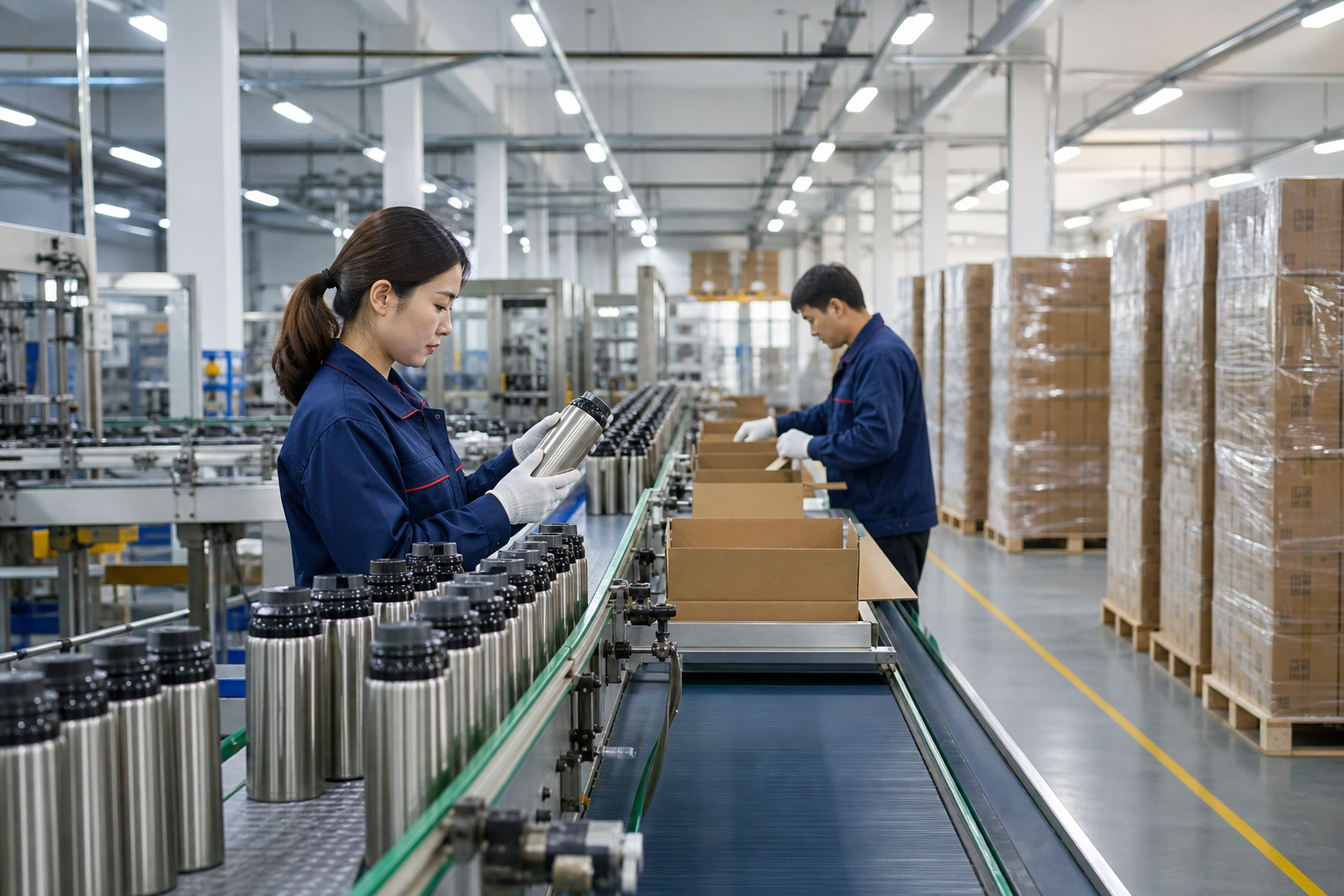
Key Takeaways
- 304 stainless steel bottle MOQ often starts at 1,000 pcs per SKU, with 20–35 day production after sample approval.
- Typical FOB China pricing for plain 500 ml bottles ranges from USD 2.10 to 4.80, depending on wall thickness, lid, and finish.
- Ask for 304 material verification, REACH compliance, and AQL inspection; do not rely on a sales sheet alone.
- Private label orders usually need 1-color logo setup, laser marking, or 4-color print, which changes tooling and unit cost.
If you are buying 304 stainless steel water bottle wholesale for retail, ecommerce, or corporate programs, the hard part is not finding a factory. The hard part is checking what is actually 304, what is just printed as 304, and which small changes add 15% or more to landed cost. We see this every week on the line. A buyer asks for one “same bottle” quote, then the lid thread, coating thickness, and carton size move the number by a lot. In Zhejiang and across China, plenty of factories can stamp a logo on a bottle. Fewer keep wall thickness within 0.3 mm, pass REACH, and ship without defects that QC pulled from the sample carton.
You need a supplier conversation that starts with grade, capacity, lid structure, coating, and test standards, not vague “premium quality” claims. That is the wrong question to ask if you want a real buying quote. A serious 304 stainless steel water bottle manufacturer should put MOQ, production lead time, and test documents on the table on day one. At BottleForge in Hangzhou, Zhejiang, our monthly output is 600,000 units, our standard MOQ is 1,000 pcs per SKU, and normal lead time is 20–35 days after sample approval. We once had a buyer flag a PO typo on capacity: 750 ml written as 780 ml. Catch it early, or the math does not work. That is the level of clarity you should expect from any 304 stainless steel water bottle supplier in China.
What 304 really means
304 stainless steel is the standard grade we run for insulated and single-wall bottles because it gives a solid balance of corrosion resistance, forming performance, and cost. It is an 18/8 alloy: about 18% chromium and 8% nickel. That mix handles water, tea, coffee, and acidic drinks without giving the line trouble. It is not magic. It is not the only option. For a 304 stainless steel drink bottle wholesale program, it is usually the right commercial pick.
What matters is proof. A real 304 stainless steel water bottle factory should show coil sourcing, material certificates, and, in our shop, salt-spray or chemical resistance test records from the lab bench. If a supplier dodges that question, the math does not work; we have seen bottles arrive with mixed grades or non-food-contact parts slipped in. Ask straight out whether the inner wall is 304 and the outer wall is 201. That split changes cost by a few RMB per unit, shifts weight, and the buyer will feel it. One PO we saw had “304 inner, 201 outer” typed as “304/304” by mistake, and QC pulled the sample before packing. In Zhejiang, that kind of cost-cutting is common. It is not always wrong, but you need the full spec before you sign.
Buy the spec, not the wording. A bottle marked “304” only means something if the supplier can show where that 304 is used and how it is tested.
Pricing, MOQ, and lead time
For 304 stainless steel water bottles wholesale, the price starts with volume, bottle build, and decoration. A plain 500 ml single-wall bottle can land at USD 2.10–2.80 FOB Ningbo or Shanghai at 1,000 pcs. A double-wall vacuum bottle with powder coating, a steel lid, and laser logo usually sits at USD 3.40–4.80 FOB. Add a gift box, silicone base, or custom handle, and you are looking at another 0.20–0.90 USD per unit. We ran one batch last quarter where the buyer flagged a 0.35 USD jump just for a matte finish, and the math still checked out.
MOQ is usually 1,000 pcs per color per SKU for standard stock molds. For a 304 stainless steel water bottle custom project with special lid parts or a new shape, 3,000–5,000 pcs is the cleaner number if you want workable pricing. Lead time is usually 20–35 days for regular orders and 35–50 days if you need new tooling, special coatings, or a large private label run. QC pulled the sample on a 2 mm lid gap before packing, so if a 304 stainless steel drinkware supplier promises 7-day mass production on a customized bottle, ask what gets skipped. Fast is possible. Only on stock molds, limited decoration, and almost no QA buffer.
- 1,000 pcs MOQ: standard bottle body + logo
- 20–35 days: typical production after sample approval
- USD 2.10–4.80 FOB: common wholesale range
- 3,000+ pcs: better pricing for custom packaging or private label
Custom options that sell
The best 304 stainless steel water bottle custom program is not the most decorated one. It is the one that fits the channel. For Amazon, we keep SKU separation clean, leave barcode space on the carton, and make sure the pack holds up in FBA drops from 76 cm. For retail, shelf impact wins. For corporate gifts, the logo has to stay readable after 500 hand washes. The decoration choice drives the result.
Laser engraving holds up on brushed steel and gives a clean premium look. Silk screen is cheaper for bold logos, but abrasion will wear it down faster; we saw one sample fail after 48 rubs on the line test pad. Heat transfer and UV printing can carry full-color artwork, but they add cost and need tighter surface prep. A serious 304 stainless steel water bottle private label order should also lock down lid color, strap material, carton print, and whether the bottle ships with an extra gasket. For a 304 stainless steel water bottle bulk program for chains or distributors, standardizing lid threads and cap parts can cut defect rate by 20% to 30% over time. We had a buyer flag a PO typo once—thread spec wrote 51 mm instead of 49 mm—and the whole replacement lot got held.
What changes unit price fastest
- Powder coating adds a separate spray line pass; plain brushed steel skips it
- Laser logo is one setup; 4-color wrap print needs more prep and more reject risk
- Vacuum insulation uses a double-wall body, so material cost jumps fast
- Custom molded lid means a new tool; stock lid keeps MOQ lower
Testing and compliance basics
If you sell into Europe or North America, compliance is not optional. We ask for food-contact declarations, REACH papers for coatings and inks, and BPA-free proof for plastic parts before the line runs. For vacuum bottles, thermal numbers need real test data, not brochure copy. A common claim is 12 hours hot and 24 hours cold. Fine. Ask the factory how it was measured: start temperature, ambient temperature, fill level, lid closed or open, and whether the bottle sat on the bench at 23°C or in a chilled room.
Your QC checklist should include AQL inspection before shipment. For most B2B orders, AQL 2.5 for major defects and 4.0 for minor defects is a workable start. We check weld consistency, inner wall finish, lid sealing, and coating adhesion at the same time. One buyer once flagged a PO typo on the carton count, and the whole shipment math had to be rechecked before loading. A 304 stainless steel water bottle manufacturer in China should send inspection photos, lab reports, and carton drop-test records without drama. In Zhejiang, the good factories treat compliance as part of production, not a sales extra. If a 304 stainless steel water bottles manufacturer cannot explain REACH, LFGB, or the gap between material testing and finished-goods testing, walk away.
Ask for batch-level QC, not a generic certificate. Good factories in China can tell you which lot was tested, when, and by whom.
Choosing the right factory partner
The gap between a trading company and a real 304 stainless steel water bottle factory shows up the moment something slips. A true factory can tell you the machine count, polishing line setup, vacuum sealing stations, and daily output without guessing. A middleman may still quote a sharp price, but when a lid supplier misses delivery, lead time blows up. We saw this with a 3,000-piece PO last spring: the buyer flagged a 2 mm lid mismatch, and the line stopped for a day. If you are sourcing in China, ask who presses the body, who molds the cap, and where final assembly happens. That simple check cuts out weak offers fast.
A dependable 304 stainless steel water bottles supplier needs to handle reorders cleanly, not just send a decent sample once. Check monthly capacity, defect handling, and spare-part continuity. At BottleForge in Hangzhou, Zhejiang, we run 600,000 units per month across drinkware lines, and that volume matters when a retail chain asks for a second PO in 12 days instead of 18. The right partner should also know export paperwork by routine: commercial invoice, packing list, HS code support, and FOB terms. If you need 304 stainless steel drinkware wholesale for multiple countries, pick a supplier that can hold the same bottle spec for 6–12 months without changing wall thickness or lid components mid-program. We’ve seen that go sideways after one supplier swapped a cap insert without telling the buyer.
One practical rule: if the factory cannot quote bottle weight, steel gauge, and carton count in a single email, the production control is too loose for a serious B2B order. QC pulled a sample at 235 g once, then the PO showed 228 g and the math did not work. Ask for the spec sheet, not a sales pitch.
How to place a better order
Start your RFQ with the numbers that move price and risk. State capacity, wall thickness, finish, logo method, packaging, destination port, and annual forecast. For 304 stainless steel drinkware custom sourcing, send product photos, target retail price, and the sales channel too: Amazon FBA, retail, or promo. Last week a buyer sent us “500ml bottle” with no cap type; QC pulled the sample, and the quote had to be redone. Ask what is included in the deal: silicone ring, gift box, desiccant, spare cap, carton strength.
If you are buying 304 stainless steel water bottles bulk, leave room for reorder variation. A 0.1 mm thickness change, a different powder-coat line, or a new carton supplier can move your margin even if the bottle looks the same on the shelf. This is why the strongest 304 stainless steel water bottles supplier relationships are built on repeatable specs, not low quotes. The math does not work if the first order is good and the second order drifts. For Europe, check packaging and product text against local language labeling. For North America, confirm barcode placement and FNSKU sticker space if you sell on Amazon. We run into this all the time.
- Give the factory one final spec sheet before sampling
- Approve a physical sample, not only photos
- Lock artwork and carton details before mass production
- Confirm inspection standard and claim handling in writing
Source your 304 stainless steel bottles now
Send your target capacity, logo method, and destination port. We’ll quote factory-level pricing, MOQ, and lead time without vague claims.
Frequently asked questions
What is a normal MOQ for 304 stainless steel water bottle wholesale orders?
For standard stock molds, 1,000 pcs per SKU is common. If you need custom colors, private label packaging, or a new lid, 3,000 pcs is a more realistic starting point. Very complex new shapes may require 5,000 pcs. A good factory in Zhejiang should tell you MOQ by component, not just by the finished bottle, because lid tooling and print setup often drive the real minimum.
How much does a 304 stainless steel water bottle cost from China?
A plain 500 ml single-wall bottle usually costs USD 2.10–2.80 FOB, while a vacuum-insulated bottle with powder coating and laser logo often runs USD 3.40–4.80 FOB. Packaging, custom lids, and gift boxes can add USD 0.20–0.90 per unit. Freight, duty, and last-mile handling are extra, so compare landed cost, not factory price only.
How do I verify the bottle is truly 304 stainless steel?
Ask for material certificates, coil traceability, and, if needed, third-party test documents. You should also clarify whether both inner and outer walls are 304 or only one side is 304. A reliable 304 stainless steel drink bottle manufacturer should explain the material structure clearly and provide lot-based QC records. If they dodge the question, treat that as a warning sign.
What compliance documents should I request for Europe and North America?
Request food-contact declarations, REACH documentation for coatings and inks, and proof that plastic parts are BPA-free. If you sell into the EU, ask whether the product has been tested under relevant food-contact migration rules. For North America, ask for general food safety documentation and any state-specific compliance your customer requires. Also confirm that the packaging supports barcode and labeling rules for your channel.
What is a realistic production lead time for custom private label bottles?
For regular custom logo orders, 20–35 days after sample approval is normal. If you need new tooling, special finishes, or a large private label rollout, plan for 35–50 days. Shipping to the US or Europe adds more time depending on sea freight schedules. A factory with 600,000 units monthly output in Zhejiang can still miss your deadline if you approve artwork late, so lock the spec before production starts.