Key Takeaways
- A practical borosilicate glass bottle wholesale MOQ is often 3,000-5,000 pcs per SKU, with 30-45 days lead time after sample approval.
- For 450-500 ml bottles, target 1.8-2.2 mm wall thickness and ask for annealing data plus thermal shock testing from 20°C to 120°C.
- Factory-direct pricing in China usually starts around USD 1.10-1.80 per piece for plain glass, before custom logo, cap, and packaging.
- For retail programs, confirm AQL 2.5/4.0 inspection, REACH compliance, and carton drop-test results before booking shipment.
If you are sourcing a borosilicate glass bottle wholesale program for a wellness brand or a sustainable retail line, the first mistake is treating glass like a commodity. It is not. Wall thickness, annealing quality, closure fit, and carton spec all move the breakage rate, complaint rate, and freight cost. We had one buyer flag a 0.8 mm wall on a 500 ml bottle after QC pulled the sample and measured it with calipers. That tiny gap turned into a costly claim.
For private label buyers, the question is simple: can the borosilicate glass bottle manufacturer hold tolerances, print your logo cleanly, pass drop and thermal shock tests, and ship on time at a MOQ that fits your forecast? A serious borosilicate glass bottle factory in China answers with numbers, not loose talk. Ask for monthly output, test standard, and lead time first. If they dodge those three, the math does not work, and we have seen that go sideways on the line.
What buyers really pay for
When you source a borosilicate glass bottle wholesale program, you are buying consistency, not just glass. A bottle can look clean in photos and still fail in distribution if the neck finish is off by 0.5 mm, the lid liner warps, or the print scratches after 12 days in transit. We have seen the buyer flag a whole carton because the cap sat crooked. A borosilicate glass bottle supplier should quote to spec, not hide behind a generic “same as sample” promise.
For a standard 450 ml clear bottle, a factory in Zhejiang might quote USD 1.10-1.80 per piece at 3,000 pcs, FOB Ningbo or Shanghai, depending on cap type, decoration, and packaging. Add USD 0.08-0.25 for one-color silk screen, more for laser engraving or 360-degree wrap print. If you need a borosilicate glass bottle with custom logo, ask whether the decoration is fired-on, UV printed, or sandblasted. Fired decoration holds up better on the line, but it adds days and money. The math does not work if someone tells you all three are the same.
Good buyers compare three things:
- Glass spec: borosilicate 3.3, wall thickness, mouth finish, weight
- Commercial spec: MOQ, lead time, packaging, FOB terms
- Compliance spec: REACH, food contact declaration, prop 65 support if needed
If a borosilicate glass bottle distributor gives you a nice catalog but no test report, that is a sales sheet, not a sourcing answer. On our QC bench, the caliper and go/no-go gauge tell the truth fast. Ask for the report first, then the brochure.
How to judge factory capability
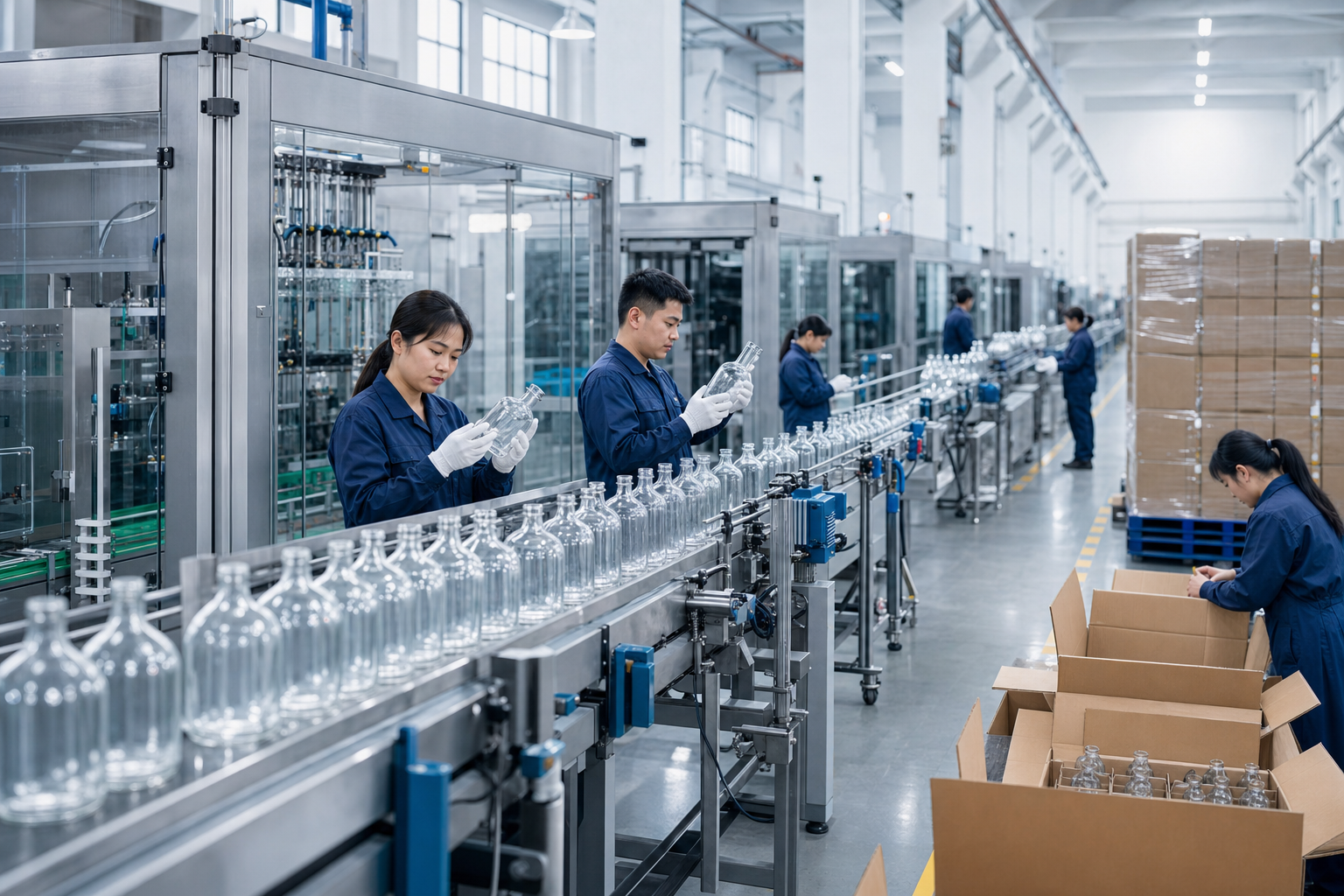
Not every borosilicate glass bottle manufacturer is ready for export retail. Some run plain glass well and fall down on decoration. Others can make custom molds but lose tolerance control across a 20,000-piece run. In Zhejiang, the better plants split forming, annealing, decoration, and packing into separate lines. That matters because thermal stress and cosmetic defects usually show up after forming, not during it.
Ask a borosilicate glass bottle factory for these numbers. We ask for them on day one.
- Monthly capacity: 300,000-800,000 pcs, depending on size
- MOQ per color or logo version: 3,000 pcs is common, 5,000 pcs for complex custom work
- Lead time: 7-15 days for samples, 30-45 days for bulk production
- Inspection standard: AQL 2.5 for critical defects, AQL 4.0 for major defects
Ask whether they are a borosilicate glass bottle oem manufacturer or only a trading company. A factory direct supplier will usually show kiln lines, annealing lehrs, and packing stations. A middleman can still work, but the price changes and so does accountability. If you need a borosilicate glass bottle factory direct relationship for a recurring SKU, ask for audit photos, business license details, and export history. We once caught a PO typo on a 500 ml bottle order: the buyer wrote 50,000 pcs but the carton mark said 5,000. The math does not work. China has plenty of capable plants; the real question is whether the supplier understands your retail shelf, not just the line.
Practical rule: if the supplier cannot explain breakage rate by carton, they are not ready for serious wholesale.
Specs that prevent breakage
Glass buyers keep asking for “stronger” bottles, but that is a vague word. In borosilicate glass bottle bulk sourcing, we look at numbers. For a 450-500 ml bottle, 1.8-2.2 mm wall thickness is a workable range for daily-use drinkware. We ran a 1.6 mm sample last month; QC pulled the sample after two chip points showed up at the shoulder in drop testing. Thinner walls can look clean on the shelf, but they push up breakage risk in transit. Heavier walls feel solid, yet the unit weight climbs fast and the freight math starts to hurt.
Shape matters just as much. A long, slim body can crack at the shoulder if the radius is too tight; we’ve seen this go sideways on a 500 ml SKU with a 4 mm shoulder radius. A wider base gives better stability on pallets and in retail displays. For lids, check gasket material, thread type, and heat resistance before you sign off. If the bottle will hold warm tea or infused water, the cap liner should take 100°C briefly without warping. For hot-fill work, ask for thermal shock testing from 20°C to 120°C, with a 95% pass target on pre-production samples. The buyer flagged it after one 8% fail rate run, and the line had to stop and reset.
Define the neck finish before tooling is cut. Neck finish controls closure fit, and closure fit controls leaks. A borosilicate glass bottle custom made for a wellness brand should be checked with calipers and go/no-go gauges, not guessed from a drawing. If the vendor says “standard cap will fit,” that is the wrong question to ask. We ship bottle and cap as one system, especially for borosilicate glass bottle customized sets with bamboo lids, stainless caps, or silicone sleeves. One PO came in with a 28/410 typo on the neck spec; that single line would have made the cap useless.
Private label and decoration choices
For a borosilicate glass bottle private label program, decoration is the shelf identity. We run silk screen printing, laser engraving on metal caps, decal firing, and full-color UV printing on the line. A 1-color logo on frosted glass usually sells better than busy artwork when the bottle sits beside premium tea, supplements, or pantry goods. Buyers like a clean face. QC pulled one sample with a 1.5 mm logo shift, and we scrapped it.
A borosilicate glass bottle with custom logo needs exact artwork size, Pantone references, and print placement before we quote. Give us the dieline, too. If you need 3 SKUs, split tooling cost from running cost on the PO, or the unit price will mislead you. We have seen buyers flag a missing setup fee after sample approval, and then the math does not work. One PO typo changed Pantone 186 C to 186 U; that bottle went back to reprint.
For borosilicate glass bottle promotional programs, packaging drives the landed cost. A kraft carton with one-color print keeps the order tight, while a rigid gift box adds USD 0.35-0.90 per set depending on the insert and finish. If you are building a borosilicate glass bottle wholesale bulk order for retail chains, ask for a 1.0 m drop test with 6-sided impact. We ship a lot of cartons, and a pretty bottle that arrives broken is still a broken carton. The outer box matters as much as the glass.
Pricing, MOQ, and hidden costs
Buyers often compare borosilicate glass bottle suppliers on unit price alone. That is the wrong question. Your landed cost changes with bottle weight, cap type, carton spec, QC charge, inland trucking, and freight mode. On a recent Zhejiang order, a 5-layer mailer box added more cost than a USD 0.10 change in the glass. We run that math every week.
Here is a normal buy sheet for a wellness brand:
- Plain bottle: USD 1.10-1.40 at 3,000 pcs
- Custom logo: add USD 0.08-0.25
- Special cap or bamboo lid: add USD 0.12-0.45
- Color box or sleeve: add USD 0.20-0.80
Ask for FOB, not just EXW. EXW leaves out loading and export handling, so the quote looks cheaper than it is. That makes comparison between borosilicate glass bottle manufacturers messy. FOB gives you a cleaner base for freight quotes and distributor planning. If you are a borosilicate glass bottle distributor or a retailer buying for 8 stores, also ask for pallet count, carton cube, and container loading rate. A line that can fit 20,000 pcs into a 20GP with tight nesting saves real money.
The cheapest borosilicate glass bottle vendor is often the one with the loosest packing standard. We have seen this go sideways. One buyer saved USD 0.06 per bottle and lost 3% in transit damage. QC pulled the sample, and the inner box was only 3 mm short on edge protection.
Testing and compliance you should request
For Europe and North America, borosilicate glass bottle wholesale sourcing needs compliance papers before production starts, not after cartons are packed. Ask for food-contact declaration, REACH support, and, where the destination needs it, a California Proposition 65 statement. If the bottle carries a silicone sleeve, bamboo lid, or coated cap, each part gets its own check. We have seen the glass pass and the closure fail customs review.
Quality documents worth asking a borosilicate glass bottle supplier for include:
- Raw material specification and borosilicate composition confirmation
- Thermal shock test report
- Drop test or carton compression test
- Incoming material QC and final inspection checklist
- ISO 9001, BSCI, or equivalent factory audit evidence
For retail channels, I tell buyers to request a pre-shipment inspection with AQL 2.5 critical, 4.0 major, 6.5 minor, unless your brand runs tighter numbers. QC pulled one sample last month and found a 1.8 mm logo shift on the sleeve, enough to trigger a rework. If you sell through Amazon or a similar marketplace, check barcode placement and FNSKU label space before packaging is locked. A borosilicate glass bottle supplier directory may show hundreds of names, but only a small group can handle export paperwork cleanly. This is the wrong question to ask: “Do you have a nice website?” Ask for the test file and the PO history.
China has deep glass production capacity, and Zhejiang is strong on export packing coordination. We run that line every week. Still, do not assume a factory can pass lab compliance and retail packaging at the same time unless they show documents, samples, and a clean carton mark; a typo on the outer carton can slow the whole shipment by 12 days versus 18 days if the buyer flags it at final review.
How to shortlist the right partner
Start with 3 to 5 borosilicate glass bottle manufacturers that already ship into your target market. Then compare response time, sample quality, and commercial clarity. A proper borosilicate glass bottle supplier answers a quote request with weight, dimensions, MOQ, lead time, packaging spec, and test scope in one message. I still see buyers get a price sheet with half the line blank. That is a red flag.
Use a simple scorecard:
- Product fit: Does the bottle size work for daily hydration, tea, or infusion? A 450 ml bottle is a different sell than a 750 ml one.
- Custom capability: Can they do borosilicate glass bottle customized color, print, and cap options? Ask for a real sample, not a mockup.
- Export readiness: Can they handle cartons, labeling, and documents? We had one buyer flag a carton typo on the PO, and that small mistake delayed loading by 2 days.
- Commercial stability: Will they keep the same spec across repeat orders? QC pulled the sample, measured the wall at 1.8 mm, and the next batch came in at 2.1 mm from a weak line.
If you need a borosilicate glass bottle buy in bulk program, ask for repeat-order price stability for 6-12 months. That is the right question for distributors and sustainable retailers who cannot reprice every month. Ask whether they can support mixed-SKU shipments from the same line, and ask how they pack the outer carton. For a borosilicate glass bottle wholesale bulk order, consolidation can cut freight and warehouse handling, but only if the factory keeps foam inserts, divider count, and drop-test results under control.
My blunt advice: choose the borosilicate glass bottle vendor who talks in tolerances, not adjectives. We run this check every week in Hangzhou. The best partners usually sound less polished and much more specific. That is what you want when the buyer wants bottles to arrive intact, clean, and ready for shelf or subscription box fulfillment.
Source custom borosilicate bottles with real factory support
Send your size, logo, and target quantity. We will quote clear specs, MOQ, lead time, and FOB pricing from Zhejiang, China.
Frequently asked questions
What is a realistic MOQ for borosilicate glass bottle wholesale orders?
For standard SKUs, 3,000-5,000 pcs per design is realistic at a real factory. If you need multiple colors, custom caps, or special packaging, expect the MOQ to move to 5,000-10,000 pcs across the program. For a plain 450 ml bottle from a borosilicate glass bottle factory in China, some suppliers can accept 1,000 pcs for sampling or a trial run, but unit cost will be noticeably higher. Always confirm whether MOQ is per mold, per color, or per print version. Those three numbers are not the same.
How much does a custom borosilicate glass bottle cost?
For a 450-500 ml bottle, factory-direct pricing in China often lands around USD 1.10-1.80 per piece at 3,000 pcs for plain clear glass. Add USD 0.08-0.25 for one-color logo printing, USD 0.12-0.45 for a special lid, and USD 0.20-0.80 for retail packaging. A borosilicate glass bottle custom made for premium wellness retail can reach USD 2.20-3.50 depending on decoration and box design. FOB terms are the cleanest way to compare quotes across suppliers.
What tests should I request before placing a bulk order?
Ask for thermal shock testing, dimensional inspection, leak testing on the closure system, and carton drop or compression tests. For export, I would also ask for REACH support, food-contact declaration, and AQL inspection records. If the bottle is for hot-fill or tea use, request a temperature delta test from 20°C to 120°C on pre-production samples. A borosilicate glass bottle manufacturer should give you test results, not just say the product is 'heat resistant.'
Can I order borosilicate glass bottle private label sets with custom packaging?
Yes, and that is usually the right move for wellness brands and sustainable retailers. A borosilicate glass bottle private label program can include one-color print, frosted finish, bamboo lid, sleeve, and branded carton. Just remember that every extra part affects MOQ, lead time, and breakage risk. If you want the best balance, keep the bottle simple and put the brand value into the box, insert, and artwork. Most factories in Zhejiang can manage this if you provide print-ready files and clear packaging dimensions.
How do I tell a real factory from a trading company?
Ask for factory address, production videos, monthly output, and a recent audit or business license. A borosilicate glass bottle factory direct partner will usually show forming, annealing, and packing lines, plus explain their inspection process. A trading company can still be useful, but they may not control lead time or defect handling. If the response only includes a price and catalog PDF, keep asking. A genuine supplier will speak in weights, tolerances, carton counts, and shipping terms.