Key Takeaways
- Typical MOQ for a borosilicate glass insulated water bottle custom order starts at 3,000-5,000 pcs per SKU.
- FOB pricing usually lands around USD 2.10-4.80 per unit depending on capacity, lid, and printing.
- Standard lead time is 25-35 days after sample approval; rush orders cut that only if packaging is simple.
- For export, ask for REACH, food-contact declaration, and an AQL 2.5 / 4.0 inspection plan.
If you are sourcing a borosilicate glass insulated water bottle wholesale program, the first mistake is treating glass as fragile and simple. It is neither. Borosilicate glass runs in a different cost bracket from soda-lime glass, and the process changes breakage rate, insulation loss, and print yield. A 0.6 mm shift in wall thickness can change your freight claim rate. For B2B buyers, that beats any pretty render.
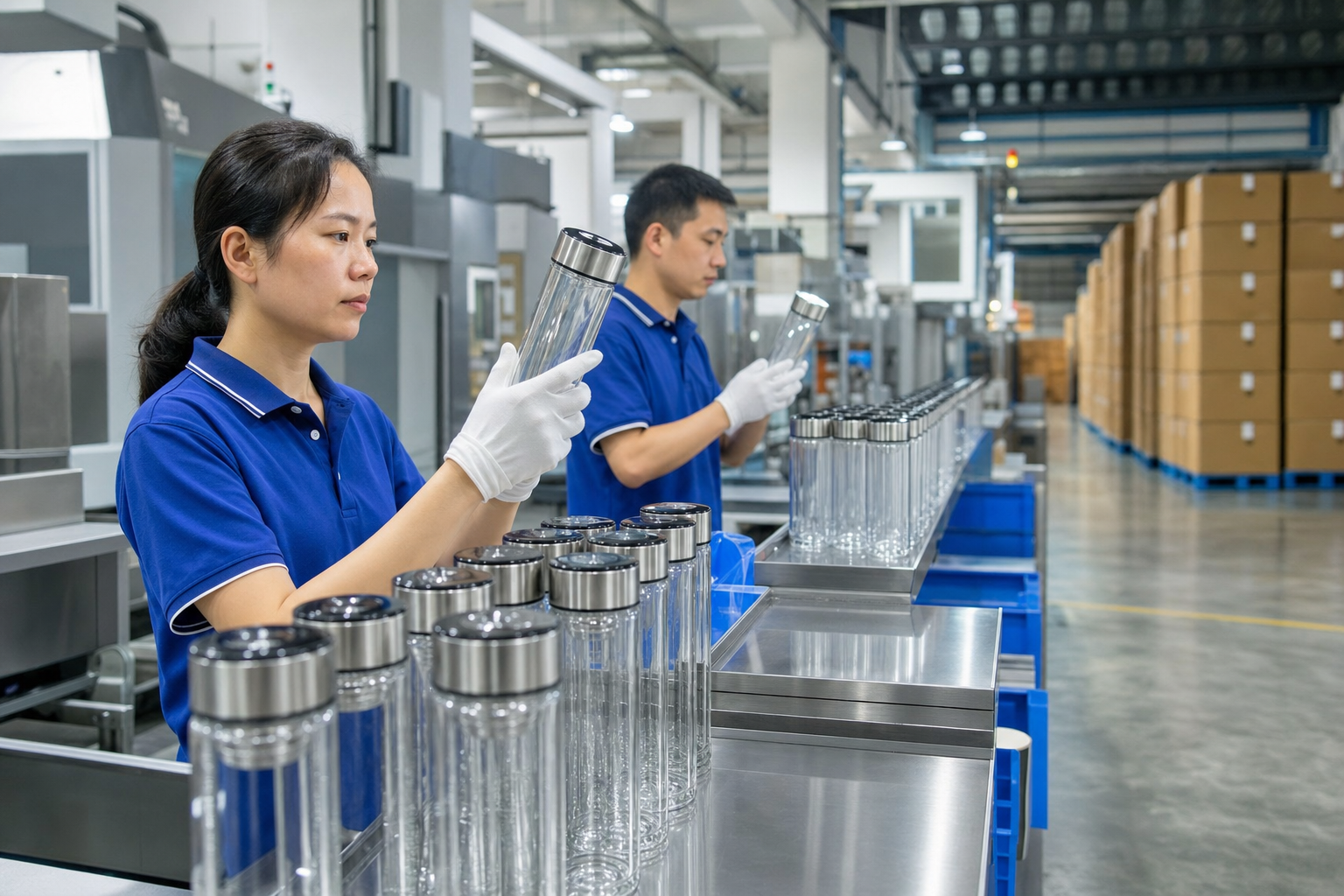
At BottleForge Industrial in Hangzhou, Zhejiang, we see the same pattern every week: brands want a borosilicate glass insulated water bottle supplier who can do private label, bulk carton packs, and export paperwork without slowing the line. Last month QC pulled a sample with a 1.8 mm neck finish that did not match the PO, and the buyer flagged it before packing. If you are comparing a borosilicate glass insulated water bottle manufacturer in China, check wall thickness, seal design, thermal test method, and MOQ first. Everything else is window dressing.
What borosilicate actually changes
Most buyers hear “borosilicate” and stop there. That misses the point. Borosilicate glass has a lower thermal expansion coefficient than ordinary soda-lime glass, so it handles hot-fill and cold-fill swings with less stress. We have run 95°C hot water, then a 5°C ice-water rinse on samples at the line; ordinary glass shows stress marks faster. In a borosilicate glass insulated water bottle, that means better thermal shock resistance, clearer glass, and a cleaner shelf look for outdoor retail and corporate gifting. It is not unbreakable. You still need proper wall thickness, a stable base, and export carton packing that can take a 1.2 meter drop.
For wholesale programs, the build usually falls into two structures: a double-wall glass body with a vacuum or air gap, or a single-wall borosilicate body paired with an insulating sleeve or lid system. The first looks more premium and supports a higher retail price. The second costs less, but the thermal claim is weaker. A buyer once asked us to quote both on the same PO, then flagged the math when the landed gap was only $0.38 after adding the sleeve and extra carton insert. That is the wrong question to ask. If you are a borosilicate glass insulated water bottle branded buyer, choose by channel. A boutique outdoor shop can sell a $16.99 retail item with more design value. Mass retail needs a lower landed cost and fewer fragile parts.
Pay attention to measurable specs. A common body thickness is 1.8 mm to 2.2 mm for the glass section, with lids molded in PP, Tritan, or stainless steel. A decent lid gasket should be silicone, 50-60 Shore A, and fit tightly enough to survive 1.2 meter drop testing in carton packaging. QC pulled the sample and checked the gasket compression at 0.4 mm with a caliper; that tells you more than a glossy catalog sheet. If your supplier cannot state those numbers, they are guessing. We have seen this go sideways when the PO typo said “1.2m” but the test plan was written as “12m.”
How wholesale pricing is built
Borosilicate glass insulated water bottle wholesale pricing is not one number. It is a stack of decisions. A 500 ml SKU with one-color silkscreen, a standard PP lid, and a color box usually sits at USD 2.10-2.90 FOB at 3,000 pcs in Zhejiang. Add stainless accents, laser engraving, or a custom mold and the quote jumps to USD 3.40-4.80 fast. We run these numbers on the line with a digital scale and a carton gauge, so the buyer can see where the cents go.
The lowest quote is usually missing something. We have seen it leave out test reports, inner cartons, drop testing, or export master cartons. The buyer flagged a PO typo on one shipment: the carton count said 24 pcs, the sample box held 12. That is why a serious borosilicate glass insulated water bottle supplier should quote by layer:
- Body cost
- Lid and gasket cost
- Decoration cost
- Packaging cost
- Testing and compliance cost
If you are buying borosilicate glass insulated water bottle bulk for Amazon or DTC fulfillment, ask for carton dimensions and unit weight before you approve samples. A 500 ml bottle at 340 g instead of 290 g can add freight cost on a 20-foot container, and the math does not work in your favor. We shipped one lot where QC pulled the sample and found a 15% weight increase after the lid switch; that was a clean stop. A 1% weight increase is easy to live with. 15% is not. That is the sort of detail a borosilicate glass insulated water bottle manufacturer in China should catch before you ask.
MOQ and lead time realities
Do not let anyone tell you MOQ is just a sales number. It sits on the line, in the screen count, carton buy, and scheduling board. For a standard borosilicate glass insulated water bottle factory in Zhejiang, MOQ for one existing model is often 3,000 pcs. For a new color lid or custom print, 5,000 pcs is the cleaner answer. If you want a unique shape, ODM or custom mold work may push it to 8,000-10,000 pcs. We had one buyer flag a PO typo on the lid color code, and the reprint cost blew past the margin in one week.
Lead time is just as blunt. Sample approval usually takes 7-10 days if you are using an existing mold. Production takes 20-30 days in normal seasons, plus 3-7 days for export packing and booking. So a normal order is 25-35 days after deposit and final artwork approval. During peak quarters, especially before Q4 retail programs, allow 40 days. A factory in China that says 15 days for a complex printed glass bottle is either overpromising or skipping QC. QC pulled the sample on one run because the logo sat 2 mm off-center; that is the kind of miss that turns into a claim.
One useful benchmark: a capable borosilicate glass insulated water bottle factory should be running at least 200,000 units per month across its glass and assembly lines to be taken seriously for volume programs. That does not mean your order needs to be huge. It means the plant has enough process discipline to handle repeat export work, not just samples. If you are sourcing from Zhejiang, ask for throughput by SKU, not a showroom photo wall. We ship from plants like this all the time, and the math does not work if a supplier cannot show where 30,000 pcs went last month.
Custom, private label, OEM, ODM
These labels get mixed up online, but procurement treats them as different jobs. Borosilicate glass insulated water bottle custom usually means you change the artwork, bottle color, lid finish, or packaging on an existing line. Borosilicate glass insulated water bottle private label means your brand sits on the item, often on a standard mold. Borosilicate glass insulated water bottle OEM means you send a spec sheet and we build to it. Borosilicate glass insulated water bottle ODM means the supplier already has a finished model and you tune it for your market. On our line, a buyer once sent a PO with "private laebl" and asked for OEM drawings in the same email. That does not work.
For most B2B brands and outdoor retailers, custom private label on an existing mold is the cleanest route. MOQ stays lower, and you avoid tooling risk. If you need a unique cap or an integrated tea infuser, OEM makes more sense. We shipped a 500 ml sample with a 2.0 mm wall and the buyer flagged the lid fit after QC pulled the sample at the bench. A borosilicate glass insulated tumbler is often the better call if the target is coffee, office carry, or cup-holder use. This is the wrong question to ask if your customer is buying for hiking.
What to confirm in a custom brief
- Capacity: 350 ml, 500 ml, or 750 ml
- Glass wall thickness: 1.8 mm, 2.0 mm, or 2.2 mm
- Logo method: silkscreen, laser, decal, or pad print
- Lid material: PP, Tritan, or 304 stainless steel
- Packaging: mailer box, color box, or 6-piece master carton
If the supplier cannot lock these points in one revision, you do not have a sourcing partner; you have a quoting desk. We run into this all the time when the buyer wants a 500 ml bottle, a 2.2 mm wall, and a 6-piece master carton, then changes the cap color after the test print. The math does not work.
Quality checks that matter
Glass drinkware fails in the same places every time: micro-cracks from forming stress, lid leakage, weak logo adhesion, and breakage in carton drop tests. A borosilicate glass insulated water bottle supplier should prove it can catch those issues before shipment. We ask for incoming inspection on raw tubes or formed bodies, in-process visual checks, and finished leakage tests. For export orders, we run an AQL plan, usually AQL 2.5 for major defects and AQL 4.0 for minor defects, unless your retail program calls for tighter control.
On compliance, the factory needs food-contact documents and export test reports for your destination market. In the EU, REACH screening is standard. For North America, buyers usually ask for FDA food-contact support and, in some channels, ASTM-related performance references. If you are selling a branded item into big-box retail, ask for carton drop test records and a lid torque or leakage test spec. We saw one lid back off after 50 cycles on the torque tester, and that order got blocked fast.
In our Hangzhou, Zhejiang line, packaging is part of quality control, not a last-minute add-on. A proper inner tray can cut in-transit breakage by more than 30% versus loose carton packing, and we have the drop-test sheets to show it. That matters on a 40HQ shipping from China to Europe or the U.S. If a buyer says the bottle is “just glass,” the math does not work; the real cost shows up in claims, rework, and a PO the line has to remake after QC pulled the sample for edge chipping.
How to source without paying for mistakes
You can source a borosilicate glass insulated water bottle wholesale program without paying for avoidable mistakes if you stop chasing the cheapest unit price. We run this kind of project every week. Start with 2 or 3 factories in China that can show current production photos, test reports, sample molds, and a real export record. Then compare landed cost, breakage risk, and shelf performance; the first quote line is usually the trap.
Use this buyer checklist:
- Confirm factory type: manufacturer, not trading-only supplier
- Request 2-3 samples with different lid options
- Ask for FOB and DDP scenarios if you need Amazon or distributor delivery
- Check logo placement against your brand guide at 1:1 size
- Verify spare parts availability for lids and silicone gaskets
If you are building a borosilicate glass insulated water bottle branded program, ask for packaging that fits the brand from day one. A carton with inserts, barcodes, and clean print can move the shelf look without touching the bottle body. If you need warehouse-ready labeling, your partner should know FNSKU, master carton labels, and pallet counts. Last month QC pulled a sample with a 2 mm logo shift, and the buyer flagged it before we ran the full order. A reliable borosilicate glass insulated water bottle manufacturer treats that as standard work, not a special favor.
When you buy glass drinkware, the lowest quote often turns into the highest landed cost after breakage, rework, and freight overruns.
In Zhejiang, the factories that survive export work know this. They are not selling a bottle. They are selling a shipment that repeats. One PO typo on carton count can cost a full day on the line, and we have seen that go sideways.
Send your bottle spec, get a factory quote
Share capacity, logo method, lid style, and target market. We will price your borosilicate glass insulated program with clear MOQ and lead time.
Frequently asked questions
What is a normal MOQ for borosilicate glass insulated water bottle wholesale orders?
For standard existing molds, 3,000 pcs per SKU is common. If you want a custom color lid, printed sleeve, or branded carton, 5,000 pcs is safer. For a new shape or true ODM development, expect 8,000-10,000 pcs because tooling, testing, and line setup must be amortized. If a supplier offers 500 pcs, check whether they are actually a stock trader, not a factory. For a Zhejiang-based export factory, a sensible MOQ should match the decoration method and packaging complexity, not just a sales promise.
How much should I budget per unit FOB China?
For a 500 ml borosilicate glass insulated water bottle wholesale order, a realistic FOB China range is USD 2.10-2.90 with a standard lid, one-color logo, and color box at around 3,000 pcs. Better lids, stainless trim, or more complex packaging can push it to USD 3.40-4.80. If you need a vacuum-style look, infuser parts, or premium branded packaging, the price rises again. Always ask for a breakdown of body, lid, decoration, and carton so you know what you are paying for.
Is borosilicate glass good for outdoor retail?
Yes, if you position it correctly. Borosilicate handles thermal shock better than ordinary glass, so it works for camp kitchen, lifestyle outdoor, and premium hydration lines. It is still glass, so you should not market it as drop-proof. For retail, use a 1.8-2.2 mm wall, a secure silicone gasket, and packaging tested for 1.2 meter drop performance. Outdoor customers usually accept a slightly higher price if the bottle looks clean, feels premium, and comes with a dependable lid.
What tests should my supplier provide before shipment?
At minimum, ask for leakage testing, visual inspection, carton drop testing, and food-contact documentation. For exports to Europe, REACH support is common. For North America, you may need FDA-related food-contact declarations depending on the channel. AQL 2.5 for major defects and AQL 4.0 for minor defects is a common inspection setup. If you sell on Amazon, also confirm barcode placement, FNSKU labeling, and master carton dimensions before shipping.
Can I get a borosilicate glass insulated water bottle private label program fast?
Yes, if you use an existing mold and keep the design changes simple. Sample approval can take 7-10 days, and production usually takes 20-30 days after deposit and artwork approval. So 25-35 days is realistic for a standard private label order from China. If you want custom tooling, special lids, or new packaging, add time. In Zhejiang, the fastest projects are the ones where the buyer confirms logo files, Pantone codes, and carton specs on the first round.