Key Takeaways
- Typical MOQ for borosilicate glass stainless steel bottle custom orders starts at 3,000 units, with 35-45 day lead time after artwork approval.
- A workable wholesale target is USD 2.80-5.20 per unit FOB China, depending on capacity, coating, and cap type.
- Borosilicate inner glass is usually 1.2-1.8 mm thick; below 1.2 mm the breakage risk rises fast during export packing.
- For retail programs, ask for AQL 2.5 major and 4.0 minor, plus REACH, LFGB, and a drop-test report before shipment.
If you are buying a borosilicate glass stainless steel bottle wholesale, the real question is not whether it looks premium. The real question is whether the build survives carton drops, warehouse stacking, and daily use without the glass liner cracking or the cap leaking. We check glass wall thickness in mm, the 304 versus 316 outer shell, the silicone ring grade, and the glass-to-steel fit on the line. One bad tolerance and the buyer flags it fast.
We run production in Zhejiang, and the request is usually the same: a clean bottle that reads like a stainless thermos but still keeps the glass contact surface. Sounds simple. Then the PO lands with 3,000 units, private label, REACH paperwork, and a 35-day lead time, and the math starts talking. A factory can make the margin work only if the MOQ, print method, and packing spec are clear from day one. QC pulled the sample last week and found a 1.2 mm gap at the shoulder on one batch, so this is the wrong question to ask if you only care about the outside look.
What this bottle actually is
A borosilicate glass stainless steel bottle is not a standard vacuum flask, and it is not a simple glass bottle with a metal sleeve. The build is a three-part job: borosilicate inner liner for clean taste and heat resistance, 304 stainless outer body for impact protection and shelf appeal, and a lid seal that actually holds pressure. If you are buying borosilicate glass stainless steel water bottle wholesale, you are buying a package of parts, not just a container. We run this structure on a few lines in Zhejiang, and the first thing QC checks is the gasket seat.
Buyers choose it for practical reasons. Borosilicate glass takes thermal shock better than soda-lime glass, so hot-fill and cold-fill use is safer. The stainless shell cuts breakage in transit and on retail shelves. We usually ship 350 ml, 500 ml, and 750 ml SKUs, with 304 stainless outer shell, PP or Tritan lid parts, and a silicone gasket built for repeated opening cycles. A real borosilicate glass stainless steel bottle factory will give you the glass wall thickness, usually 1.5 mm, instead of waving at “standard quality.” The buyer flagged it once on a PO typo—“400 ml” instead of 500 ml—and the line stopped until we fixed the spec sheet.
Typical build spec
- Inner liner: borosilicate glass, 1.2-1.8 mm wall thickness
- Outer shell: 304 stainless steel, often 0.4-0.6 mm sheet gauge
- Seal: platinum-cured or food-grade silicone
- Cap: PP, Tritan, bamboo-look, or stainless top depending on the SKU
Who should buy this format
This category fits brands and distributors that want a cleaner drinking feel than plain steel, while still needing shelf appeal and export durability. If your customer is a lifestyle retailer, yoga chain, gift supplier, or outdoor brand with premium positioning, a borosilicate glass stainless steel bottle branded program can work. We ship these for buyers who want a 500 ml SKU that photographs cleanly and still passes carton drop checks. It is a poor swap for a true vacuum thermos if the buyer expects 12-hour heat retention. We’ve seen that go sideways.
For B2B buyers, the best fit is office drinkware, wellness stores, specialty outdoor channels, and DTC bundles. The product makes sense when you need a distinctive SKU that is easy to explain and easy to shoot on a white table. A borosilicate glass stainless steel bottle private label program can return good margins if you keep decoration tight and do not chase six cap styles. On our Hangzhou line, we usually run 2-3 core colors, one logo method, and one lid family; the MOQ stays cleaner, and QC pulled the sample faster. That keeps the borosilicate glass stainless steel bottle bulk order manageable and helps repeat orders.
Practical rule: if the bottle has to survive repeated warehouse drops, choose a thicker outer shell and better carton inserts before you spend on fancy graphics.
Specs that change your cost
The wholesale price comes down to a few hard variables. If a borosilicate glass stainless steel bottle supplier cannot break them out, we assume the quote is padded or missing pieces. First is the glass. True borosilicate costs more than soda-lime, and 2.2 mm wall thickness holds up better in transit, but a sloppy forming line pushes scrap up fast. We ran a 500 ml batch last quarter; QC pulled 6 cracked samples out of 200 after cold-shock testing. The second is the outer steel. 304 stainless is the standard for export. 316 only makes sense when the buyer asks for stronger corrosion resistance and agrees to the extra cost. Third is the cap assembly. That lid sets the leak rate. The buyer flagged it twice on one PO because the silicone gasket size was written as 18 mm instead of 18.5 mm.
For a normal 500 ml borosilicate glass stainless steel water bottle wholesale program, FOB China prices usually sit around USD 2.80-3.60 for basic decoration, USD 3.60-4.50 for better finishing and tighter packing, and USD 4.50-5.20 when you add premium cap structures or branded packaging with a window insert. A borosilicate glass stainless steel bottle custom order with laser logo, one-color silk print, and color box typically needs at least 3,000 units. If you want borosilicate glass stainless steel bottle oem or borosilicate glass stainless steel bottle odm work with structural changes, expect tooling or setup charges from USD 150 to 800 depending on the cap mold and carton layout. We've seen this go sideways when a buyer asked for "same as sample" but changed the lid height by 4 mm after approval. The math doesn't work.
- MOQ: 3,000 units standard, 1,000 units only for repeat customers in limited configurations
- Lead time: 35-45 days after sample confirmation
- Monthly output: a mid-size borosilicate glass stainless steel bottle factory in China may run 120,000-180,000 units
- Packing drop test: 80 cm or 1 m, depending on channel requirements
What to check before you place PO
You can avoid a lot of trouble if you ask for the right papers before you sign off. A solid borosilicate glass stainless steel bottle manufacturer should send a spec sheet with dimensions, net weight, gross weight, wall thickness, and the capacity tolerance. We check this on the line with calipers and a gram scale, and the buyer usually spots a typo on the PO before we do. For retail or marketplace sales, ask for REACH compliance for EU-bound shipments, LFGB for food contact where needed, and a declaration for BPA-free plastic parts. If your channel is North America, you still need the same food-contact control, plus carton labels that leave space for the barcode.
Quality control needs numbers, not vague promises. Ask for incoming inspection on glass tubes, in-process sealing checks, and final random inspection against AQL 2.5 for major defects and 4.0 for minor defects. Major defects mean leakage, cracked glass, or cap misfit. Minor defects mean small print shift or light scratches outside the visible face. On one 12,000-piece order, QC pulled the sample and found a 0.8 mm cap gap; the buyer flagged it and we stopped the line. A responsible borosilicate glass stainless steel water bottle factory in China will also tell you how each unit is packed: one bottle in a molded tray or egg-crate insert, then 6 or 12 units per outer carton. If the bottle is for e-commerce, ask for ISTA-style transit protection and FNSKU-ready carton space if you sell through Amazon.
Ask these before approval
- What is the exact glass wall thickness?
- Is the outer shell 304 or 316 stainless?
- What is the leak test standard and duration?
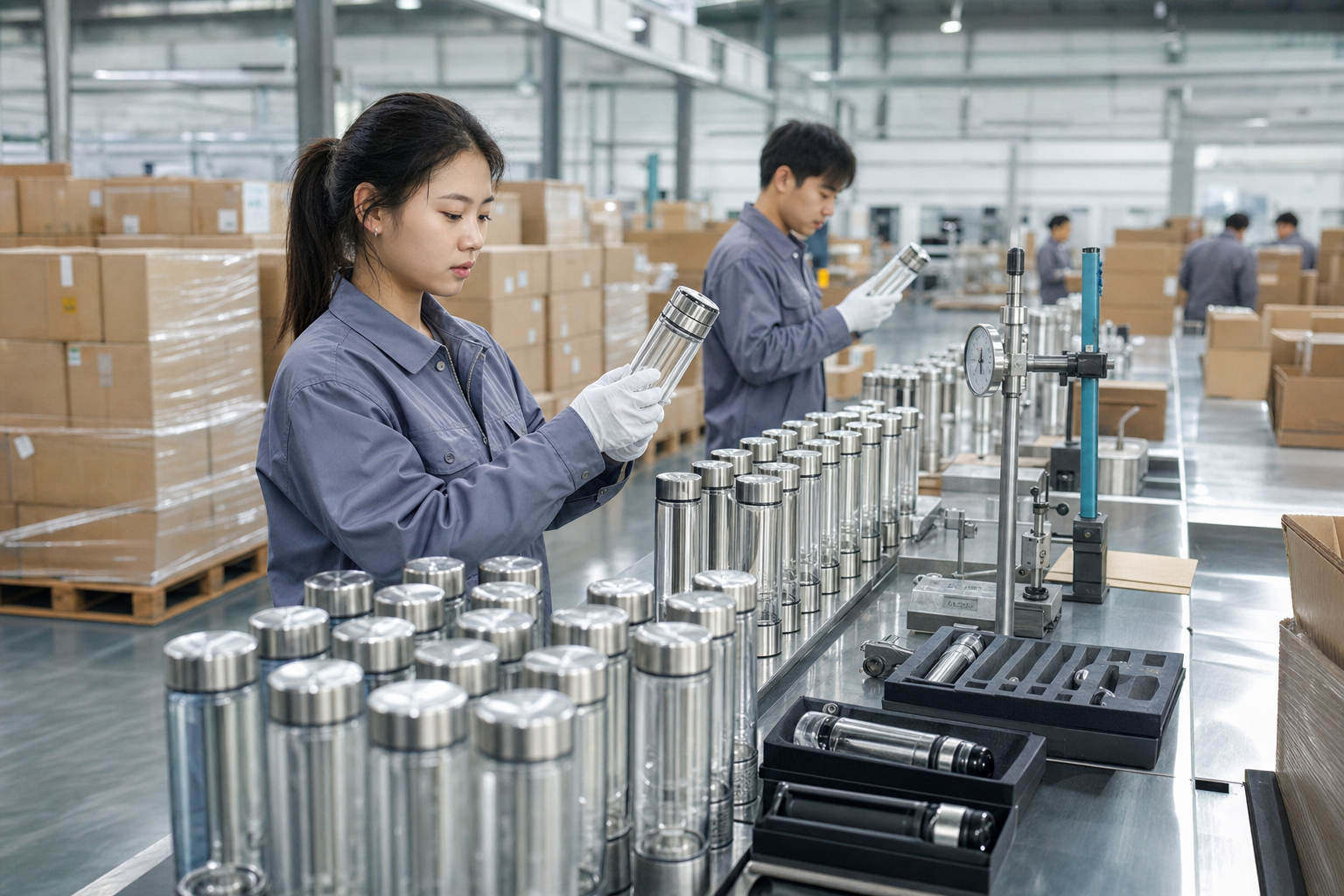
- Can you provide photos of the mass production line in Zhejiang or another China facility?
Private label and branding choices
Branding this category is simple if you keep the spec tight. The most common borosilicate glass stainless steel bottle branded option is one-color silk screen on the outer shell or cap ring, because it stays readable and the print cost is easy to control at 1,000 pcs MOQ. Laser engraving on stainless holds up well, but we check the brushed or matte finish first; if the contrast is weak, the logo disappears on the line. A borosilicate glass stainless steel bottle private label order often includes a custom color box, insert card, and barcode label. That covers most retail programs.
For higher-end outdoor retailers, a borosilicate glass stainless steel water bottle custom design can use powder coating, a debossed logo plate, or a different lid silhouette. Each extra item adds one more sample round, and we have seen a 12-day approval turn into 18 days when the buyer keeps changing the cap. On our Zhejiang line, we usually run one decorative method per SKU. If you push for three methods, the setup cost climbs faster than the shelf value. The same rule applies to borosilicate glass stainless steel bottle odm projects: keep the structure stable, then change the parts customers notice first.
If you want a borosilicate glass stainless steel bottle supplier that can handle fast replenishment, choose standard cap tooling and packing that does not shift every order. That is how you protect margin when the reorder lands at 10,000 units instead of 3,000. QC pulled the sample on a 0.3 mm print offset before shipment, and that kind of issue is easy to catch when the packaging spec stays fixed.
Common sourcing mistakes
The first mistake is treating this item like ordinary stainless drinkware. It is not. Glass breaks in a different way, and one cracked liner can cost more in service calls than a dented steel cup ever will. We have seen that on the line. The second mistake is chasing the lowest quote from a borosilicate glass stainless steel bottle supplier without asking for loss-rate data. If a supplier throws out a price that looks too good, check the glass wall thickness, carton spec, and outer shell gauge. The math does not work otherwise.
The third mistake is mixing up borosilicate glass stainless steel bottle bulk supply with true custom development. Bulk orders should stay on existing tooling and standard cartons, usually with a MOQ already set. Custom orders need extra sampling rounds, artwork corrections, and QC checkpoints, and those costs belong in the quote from day one. The fourth mistake is skipping factory verification. A real borosilicate glass stainless steel water bottle manufacturer in China should show production photos, test records, and a traceable QC flow. If you are sourcing from a borosilicate glass stainless steel bottle factory in Zhejiang, ask for video of the assembly line and the carton drop-test area; we run a 76 cm drop test on the outer carton, and the buyer flagged it only after a typo on the PO changed the pack count. For breakage reserve, 0.5%-1.0% is a normal answer, not zero.
If a supplier says every unit is perfect and no spare parts are needed, they are selling you marketing, not manufacturing reality.
Request factory quotes and sample specs today
Send your target capacity, logo method, and market. We can quote borosilicate glass stainless steel bottle custom and bulk programs from Zhejiang within 24 hours.
Frequently asked questions
What is the usual MOQ for a borosilicate glass stainless steel bottle wholesale order?
For most export programs, the MOQ is 3,000 units per design and color. If you keep the cap standard and only change the logo, some Zhejiang factories can reduce it to 1,000-2,000 units for repeat buyers, but the unit price usually rises by 8%-15%. For private label, expect a sample round first, then production after artwork sign-off. If you need multiple SKUs, count MOQ separately for each capacity, because a 350 ml bottle and a 500 ml bottle are usually treated as different setups.
How much does borosilicate glass stainless steel bottle bulk pricing usually start at?
For a 500 ml SKU FOB China, a basic borosilicate glass stainless steel bottle bulk price often starts around USD 2.80-3.60 per unit. Better cap systems, matte coating, or premium packaging can push it to USD 4.50-5.20. If you add custom molded inserts, special printing, or more complex branding, budget extra. Freight, duties, and carton labeling are separate. A serious supplier should quote based on the actual build spec, not just a rough capacity number.
Is borosilicate glass safe for hot water in export drinkware?
Yes, borosilicate glass is widely used for hot-fill and thermal-shock-sensitive applications because it handles temperature change better than ordinary glass. That said, the bottle still needs correct wall thickness, usually 1.2-1.8 mm, and a well-designed lid seal. The weak point is usually the cap or the neck fit, not the glass itself. Ask for heat and cold cycle testing, and make sure the factory has a documented leakage test before you approve mass production.
What compliance documents should I request from the factory?
For EU-bound shipments, ask for REACH-related material declarations and food-contact statements for the stainless and plastic parts. If your retail program requires it, ask for LFGB testing as well. For North America, request a full material declaration, packaging compliance details, and barcode/carton specs if you sell through marketplaces. Also ask for AQL inspection reports, product photos from final inspection, and a signed specification sheet. A trustworthy borosilicate glass stainless steel water bottle manufacturer will provide these without delay.
Can I order a borosilicate glass stainless steel bottle private label line with custom packaging?
Yes. Most private label programs use one logo method, one carton design, and one insert card or instruction sheet. That keeps setup manageable and protects your margin. Typical add-on packaging costs range from USD 0.20 to 0.60 per unit depending on print complexity and box material. If you want a borosilicate glass stainless steel bottle branded program for retail, make sure the carton has enough space for warnings, SKU codes, and barcode placement. That matters more than decorative extras.