Key Takeaways
- Typical OEM MOQ is 3,000 units per SKU, with 35-45 day lead time from sample approval
- Borosilicate glass wall thickness usually sits at 1.8-2.2 mm; Tritan body parts are often 1.5-2.0 mm
- For export, ask for REACH, LFGB, FDA, and drop/leak testing under AQL 2.5
- FOB China pricing for mixed-material bottles often lands between USD 2.35 and 5.80 depending on lid, print, and packing
If you are sourcing a borosilicate glass tritan bottle wholesale program, the product looks simple until you price it on paper. Glass looks premium. Tritan looks safe. The job is still technical: wall thickness, cap liner, print method, and drop test all affect your margin and your complaint rate. We ship these for retail, Amazon, and distributor programs, and each channel asks for a different spec set.
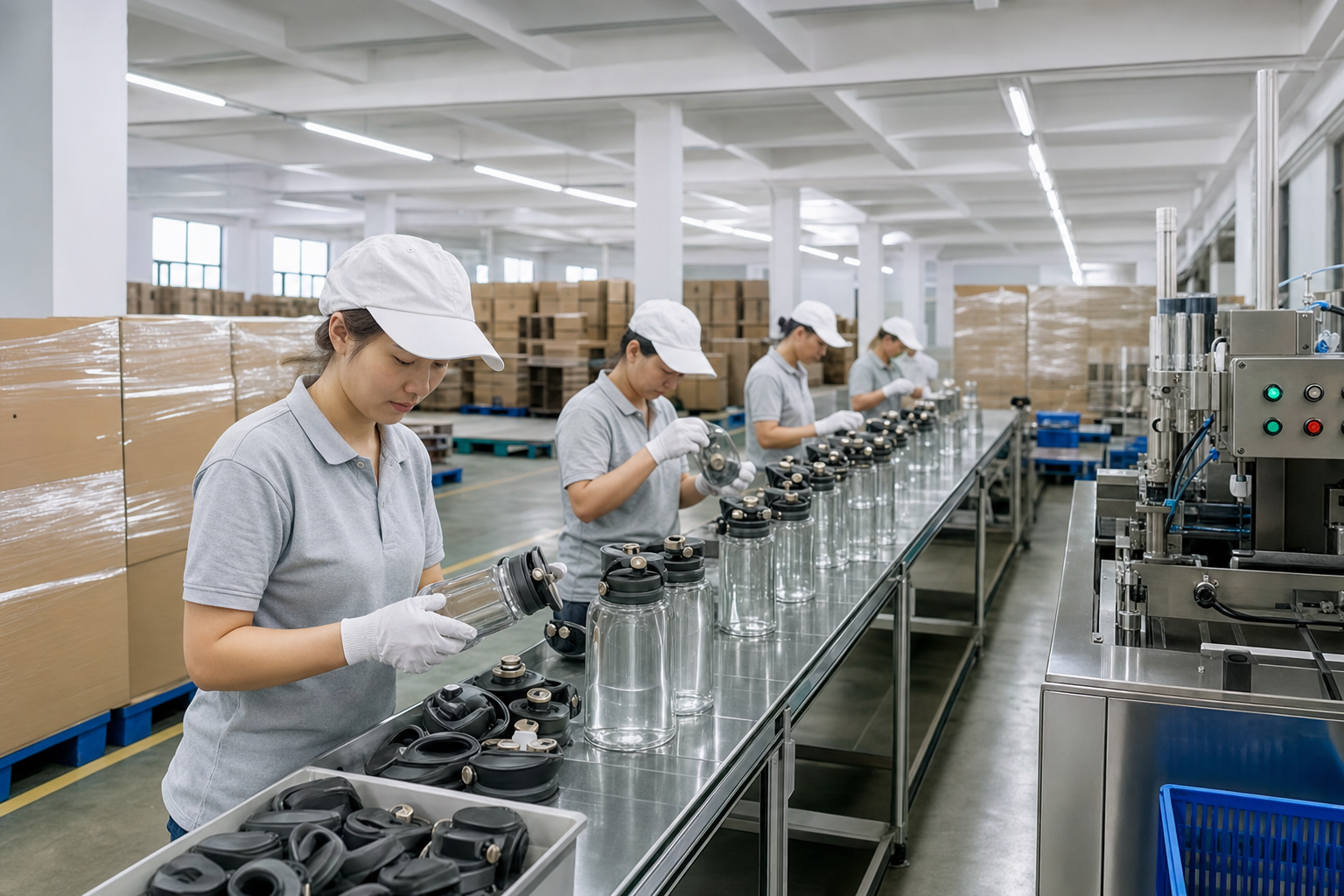
In Zhejiang, we see the same mistake week after week: buyers ask for a borosilicate glass tritan water bottle and leave out the 1.8 mm wall thickness, the silicone seal, or the test standard. Then QC pulled the sample, the buyer flagged a leak after 24 hours, and the bulk PO was dead on arrival. A serious borosilicate glass tritan bottle manufacturer should send exact data, not sales talk. At our Hangzhou factory, normal OEM runs start at 3,000 units per SKU, and lead time is 35 to 45 days after sample approval.
What you are really buying
A borosilicate glass tritan bottle is a hybrid, not a single material. The drinking chamber, liner, or infusion insert is usually borosilicate glass for heat resistance and clean taste, while Tritan goes on the outer shell, lid body, handle, or impact zone. That setup gives a premium look without asking the user to handle it like lab glass. We run this split build on the line all the time.
For a borosilicate glass tritan bottle wholesale order, the first question is structure, not branding. You need to pin down whether it is double-wall, glass inner with Tritan outer, or a glass body with a Tritan lid assembly. Get that wrong and the returns start. A 450 ml bottle with a 2.0 mm borosilicate inner wall and a 1.8 mm Tritan shell behaves nothing like a single-wall glass bottle with a Tritan cap. One buyer flagged a PO typo on the lid thread spec, and the sample failed assembly on the first fit check. Ask your borosilicate glass tritan bottle supplier for exploded drawings, not just a render.
- Borosilicate glass: thermal shock resistance and taste neutrality
- Tritan: impact resistance and lighter weight than full glass
- Hybrid design: better perceived value for private label programs
In Zhejiang, the factories that do this well keep glass forming, injection molding, and final assembly on separate control points. QC pulled the sample and checked the gasket at 0.2 mm tolerance; that small ring decides whether the cap leaks or passes. This is the wrong question to ask if you only look at the outside finish.
Specs that affect wholesale pricing
Buyers often compare quotes by unit price alone, and that gets expensive fast. A borosilicate glass tritan water bottle wholesale quote moves a lot when you change the glass grade, coating, lid mechanism, or packaging. QC pulled one sample last month with a 1.8 mm wall instead of 2.0 mm, and the buyer flagged it before we even got to print. If you want a proper borosilicate glass tritan water bottle manufacturer to quote fairly, send a spec sheet with capacity, target weight, wall thickness, and decoration method.
Here is the pricing logic we use on the line in Hangzhou. A 350-500 ml bottle with basic one-color silk screen, standard PP or Tritan lid, and brown box packing sits around USD 2.35-3.40 FOB China at 3,000 pieces. Add stainless lock parts, vacuum-like looks, or full-color transfer print, and the same project moves to USD 4.20-5.80. We had one PO with “Tratin” on the file instead of Tritan, and the buyer still expected the same lid price. That math does not work. If you want a borosilicate glass tritan bottle branded for premium retail, the lid tooling and print setup matter more than the glass itself.
| Spec | Typical range |
| Borosilicate wall thickness | 1.8-2.2 mm |
| Tritan part thickness | 1.5-2.0 mm |
| MOQ | 3,000 units/SKU |
| Lead time | 35-45 days |
For a borosilicate glass tritan bottle bulk program, every extra mold insert or custom cap color adds cost. We run a 6-cavity cap mold for repeat orders, and even a Pantone cap change can add one more day on setup. That is normal. The right move is to split one-time tooling from recurring unit price before you issue the PO.
OEM, ODM, and private label
Buyers ask for borosilicate glass tritan bottle OEM when they want control over logo placement, bottle color, pack-inserts, and sometimes the cap geometry. We see this on the line every week. ODM is different: the factory has a base model, and you change the branding, cap color, or label art without rebuilding the product from zero. Private label sits in the middle. You keep a proven body and put your brand on it, which cuts development cost and keeps the MOQ sane.
A borosilicate glass tritan bottle custom project usually goes one of three ways. Need a fast launch? Pick ODM and change only the artwork, 1 color, and the carton print. Need a retail SKU with some edge? Go OEM with limited tooling changes, like a new lid insert or a 2 mm wall-thickness tweak. Need distributor protection? Ask for a borosilicate glass tritan bottle private label model with exclusive colorways or cap molds by territory. We had a buyer push for the lowest FOB, then QC pulled the sample and found the lid leaked after 20 shakes. The math doesn't work if returns start on day one.
What to lock before sampling
- Capacity, e.g. 350 ml, 450 ml, 600 ml
- Closure type, e.g. screw cap, flip cap, straw lid
- Logo method, e.g. silk screen, laser, decal, emboss
- Packing standard, e.g. individual box, master carton, FNSKU label
If you are a borosilicate glass tritan water bottle private label buyer for Amazon or retail, lock carton dimensions before we print the pilot batch. One PO typo on the master carton can throw off the pallet plan, and we have seen freight jump 8-12% when the carton size was off by 15 mm. This is the wrong question to ask if you start with unit price only. Ask how many cartons fit per pallet, then check the drop-test result and the seal on the cap. That order saves trouble.
Testing and compliance buyers should ask for
Compliance is where experienced importers save money. A proper borosilicate glass tritan water bottle supplier should not ask you to “trust the sample.” They should send test records. For Europe and North America, ask for REACH, LFGB where relevant, and FDA food-contact declarations for every material that touches liquid. If you sell through major retail, ask for a migration report and a drop test plan. We had one buyer flag a PO typo on the material code, and the customs broker caught it before shipment.
At the factory level, we run leak tests at 100% on the assembly line and sampling inspections under AQL 2.5 for major defects. For a hybrid bottle, the critical points are gasket compression, cap torque, thread engagement, and thermal shock on the glass section. If the bottle is for hot-fill use, ask for thermal cycling between 20°C and 95°C, not a loose “heat resistant” claim. A serious borosilicate glass tritan bottle factory in China should explain failure points in plain terms. QC pulled the sample on a 1.5 mm seal gap last week, and that is the kind of detail buyers should ask for.
Do not approve production until you have the exact material declaration for every part: borosilicate glass, Tritan, PP, silicone, and any color masterbatch.
That matters because customs, retail compliance, and your own brand liability all depend on a clean file. In Zhejiang, the better factories treat compliance as engineering, not paperwork after the fact. We ship 12 days faster than a factory that waits until packing to sort documents, and the math does not work if you skip that step.
How to evaluate a factory in Zhejiang
If you want a borosilicate glass tritan bottle factory that can handle export, look past the website photos. Ask how many units they assemble each month, how many drinkware lines run on the floor, and whether printing and packing stay in-house. We run 200,000 units a month on one line set, and that changes the game. A factory with one carton room, one print shop, and one packing team is easier to control than a trader sending every part to subcontractors. That does not guarantee better quality. It does give you cleaner traceability when the buyer flags a bad label.
For buyers in Europe and North America, the real question is whether the borosilicate glass tritan bottle manufacturer can repeat the same color on the second order. We keep Pantone cards, lid samples, and print masters on file for replenishment. If your first PO is 3,000 units and the reorder jumps to 20,000, the line needs stability, not fresh ideas. We had one buyer push back because the cap shade moved by 1.5 Delta E, and QC pulled the sample before packing. Ask for factory audit documents such as BSCI or an equivalent social compliance report if your retail customer requires it.
Also ask about spare-part control. Caps, silicone rings, and straws should sit in stock for aftersales. A supplier who cannot ship replacement lids in 7-10 days is not a good partner for branded drinkware. We saw one PO with a typo on the lid code, and that cost three days on the packing table. This is the wrong question to ask: do they have spares in theory, or can they actually ship them on time?
Packaging, freight, and channel fit
Packaging changes the economics of a borosilicate glass tritan bottle wholesale order more than most buyers expect. A premium folding box with inserts can add USD 0.18-0.55 per unit, and it usually cuts breakage claims and helps the bottle sell cleaner on shelf. On one line, QC pulled three cracked pieces out of 200 after a 1.2 m drop test, then we changed the inner tray spec. If the bottle goes to Amazon, the box has to survive FNSKU labeling, drop testing, and carton handling. If it goes to wholesale clubs or distributors, pallet efficiency matters more than display appeal.
For a borosilicate glass tritan water bottle bulk shipment, I usually set carton counts to balance protection and freight. A 12-piece inner carton works for retail-ready packaging, while a 24-piece master carton cuts handling cost for distributors. Check the box size before you sign off; in North America, 5 mm in height can push you into higher volumetric weight. We had a buyer flag a PO typo on carton size once, and the freight quote jumped on the first re-rate. That is the wrong question to ask after production starts.
Buyers often ask for a borosilicate glass tritan bottle branded with foil stamping and soft-touch sleeves. It can work, but only if the final carton still loads efficiently. We ship a lot of these, and the math has to hold at 10,000 pcs, not just on one sample. The right supplier gives you landed-cost math and packaging advice, plus a carton layout that does not waste cube.
Request a factory quote with real specs
Send capacity, lid type, logo method, and target market. We will price your China program with clear MOQ, lead time, and compliance notes.
Frequently asked questions
What is the usual MOQ for a borosilicate glass tritan bottle custom order?
For most OEM programs, the realistic MOQ is 3,000 units per SKU. If you need a new cap mold, special color, or unique packaging, some borosilicate glass tritan bottle manufacturer teams in China will ask for 5,000 units to cover setup costs. For simple private label changes on an existing mold, 1,000-2,000 units may be possible, but unit price rises by 15-30%.
How much does a borosilicate glass tritan bottle wholesale order cost?
At FOB China pricing, a standard 350-500 ml hybrid bottle usually lands around USD 2.35-3.40 per unit at 3,000 pieces. Add custom lid mechanisms, high-end print, premium packing, or a more complex borosilicate glass tritan bottle oem structure, and pricing often reaches USD 4.20-5.80. Freight, duties, and last-mile costs are separate, so compare landed cost, not just factory price.
Can I use the same bottle for hot and cold drinks?
Yes, if the structure is designed for it. Borosilicate glass handles hot-fill better than standard soda-lime glass, and Tritan parts can work well for impact protection and lids. Ask your borosilicate glass tritan water bottle factory for thermal cycling data, ideally from 20°C to 95°C. Also confirm the silicone gasket and cap thread stay sealed after repeated heating, because the failure usually happens at the closure, not the glass.
What compliance documents should I request from the supplier?
For Europe and North America, ask for food-contact declarations, REACH-related material compliance, and FDA materials statements where relevant. If the product will touch food or beverages in the EU, LFGB testing is often requested by retail buyers. A credible borosilicate glass tritan water bottle supplier should also provide leak test procedures, AQL inspection records, and material declarations for borosilicate glass, Tritan, PP, and silicone parts.
How long does production take after sample approval?
A typical borosilicate glass tritan bottle bulk order takes 35-45 days after sample approval and deposit, assuming the tooling is ready. If you need new molds, add 20-30 days for development and first article sampling. For repeat orders in Zhejiang, fast-track replenishment can sometimes ship in 25-30 days if the factory has raw materials and packaging in stock.