Key Takeaways
- Borosilicate glass usually starts around 2.0 mm wall thickness and handles heat better than standard soda-lime glass.
- Typical wholesale MOQ is 3,000 pcs per SKU, with FOB China pricing often ranging from USD 1.20 to 3.80 depending on lid, sleeve, and decoration.
- For Europe and North America, ask for REACH, food-contact, and drop-test data before you approve a borosilicate glass water bottle bulk order.
- Private label programs in China usually need 15-25 days for sampling and 35-45 days for production after artwork approval.
If you are sourcing a borosilicate glass water bottle wholesale program, the first mistake is treating every glass bottle as the same part. It is not. A 2.5 mm soda-lime bottle and a 2.0 mm borosilicate bottle behave differently in thermal shock, tare weight, breakage rate, and freight cost. We ship both types, and QC pulled the sample after a drop test cracked the soda-lime piece at the shoulder. If you sell to wellness buyers or sustainable retailers, that gap shows up in returns, reviews, and margin fast.
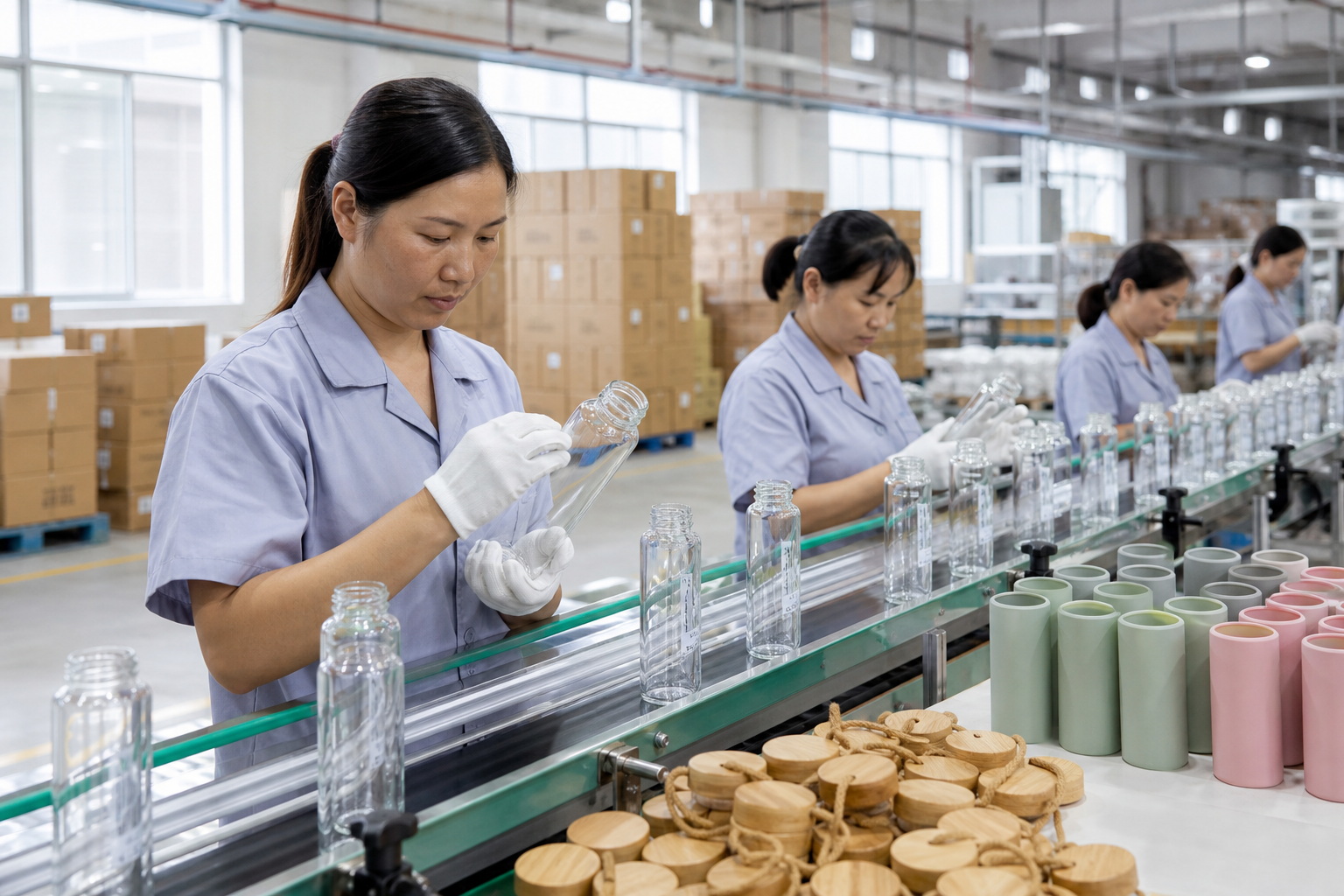
In Zhejiang, where most serious glass drinkware sourcing happens, the job is not just finding a factory that can print your logo. You need a borosilicate glass water bottle manufacturer that can hold tolerances, pass REACH and food-contact checks, and keep the line moving at scale. At BottleForge Industrial in Hangzhou, our standard wholesale runs start at 3,000 pcs per SKU, with 35-45 days lead time and output capacity of 250,000 units per month across glass and hybrid drinkware. A buyer once sent a PO with “borosilacate” and the wrong cap size; the math did not work until we fixed it. That scale matters when you need a borosilicate glass water bottle custom program that holds after the first order.
What buyers mean by borosilicate
When buyers search for borosilicate glass water bottle wholesale, they usually want three things: heat resistance, a clean taste, and a bottle that still looks retail-ready after 6 months on the shelf. Borosilicate glass uses boron trioxide in the batch, so the glass expands less under heat and shrinks less in the cold. That matters on the line. We run hot-fill checks, ice-water tests, and dishwasher cycles on sample lots, because a bottle that passes one test can still fail at the next drop. It does not make the bottle unbreakable. It just gives you more room before stress cracks show up.
For wellness brands, the appeal is simple: the bottle looks premium, and it works in daily use. A 500 ml borosilicate glass water bottle with a silicone sleeve and bamboo or PP lid can land in the USD 2.10 to 4.20 FOB range, depending on decoration and accessories. Plain glass is cheaper, but the buyer flagged breakage after a few retail returns, so sleeve requests usually come back fast. If you are working with a borosilicate glass water bottle supplier in China, ask for wall thickness, mouth finish, and tolerance, not just “high borosilicate.” We had one PO with “2.0m” typed instead of “2.0 mm,” and QC pulled the sample because the spec sheet did not match the carton label. The math does not work if you skip that check. On paper, 1.8 mm and 2.2 mm look close. On a pallet, they are not.
Choose the right bottle structure
The shape you choose hits packing cost harder than most buyers expect. A straight-wall 500 ml bottle stacks cleanly in a 3-ply export carton, while a shoulder-curve shape leaves dead space and pushes freight up. A wide-mouth borosilicate glass water bottle works better for ice cubes and brush cleaning, but the cap has to pass a 24-hour inversion test or the buyer flags leakage on day one. For retail runs, we usually quote 350 ml, 500 ml, and 750 ml. Three SKUs cover desk use, gym carry, and all-day drink service without bloating the line.
If you want a borosilicate glass water bottle branded for a wellness chain or eco store, do not look at the body alone. The lid, gasket, sleeve, carton, and insert all decide whether the order ships clean or comes back with complaints. Last month QC pulled a sample with a 0.6 mm lid gap, and the math did not work. A basic configuration could be:
- Body: 2.0 mm borosilicate glass
- Cap: bamboo, PP, or stainless outer with silicone seal
- Sleeve: 1.5 mm silicone or 0.8 mm neoprene
- Carton: 3-ply or 5-ply export box with divider
That setup looks simple, but it survives ecommerce drops and store handling better than a bare glass bottle. If you are checking borosilicate glass water bottles wholesale options, ask for assembled weight and packed carton cube. We saw a PO typo once, 500 ml written as 50 ml, and the buyer had to rework the whole shipment. Freight is where a “cheap” bottle stops being cheap.
MOQ, price, and lead time realities
Buyers often ask for the lowest quote first and the spec sheet later. Wrong order. On a borosilicate glass water bottles program, price only means something after we lock volume, decoration, and packaging. For a normal borosilicate glass water bottle bulk order from China, MOQ sits at 3,000 pcs per SKU. If you want custom-printed sleeves or a special lid, MOQ usually moves to 5,000 pcs when the accessory needs new tooling or a spot color match. We had a buyer flag a PO that said “black lid” but gave no Pantone, and the line stopped for two days while QC checked samples.
Here is a practical FOB China range from a Zhejiang factory for reference:
- Plain bottle, no sleeve: USD 1.20-1.80
- Silicone sleeve + standard lid: USD 1.85-2.90
- Private label + custom carton: USD 2.20-3.80
Sampling usually takes 7-15 days for existing molds and 15-25 days if you need new print or a custom cap. Production lead time is usually 35-45 days after sample approval and deposit. If a borosilicate glass water bottle factory says 12 days for a complex OEM order, ask which steps they are skipping. The math does not work. We run crack checks on 24 samples per lot, and if outbound inspection shows crack rates above 1.0%, the shipment gets held. A slower 40-day plan is often cheaper than replacing 300 damaged units after arrival in Europe or North America.
Decide between OEM and ODM
The difference between borosilicate glass water bottle OEM and borosilicate glass water bottle ODM is straightforward, but buyers still mix them up. OEM means you bring the shape, the brand spec, and often the carton direction. ODM means you start from a factory bottle that already runs on the line and change the logo, color, carton, and sometimes the lid. If you need speed and a lower setup cost, ODM is the cleaner first move. If your brand depends on a fixed silhouette or a lid claim, OEM is the safer route. The wrong question is “which one is cheaper?” We run both paths, and the answer depends on whether you are paying for tooling or buying time.
For a borosilicate glass water bottle private label program, ODM usually gives the best balance of cost and lead time. You can launch with a tested bottle body, then change decoration, sleeve color, and outer box without opening a new mold. That works well for retailers who want a clean SKU and do not want to fund full mold development for a first run of 3,000 pcs. If you need a borosilicate glass water bottles custom project, ask the factory who owns the mold, whether the tooling is open or exclusive, and what the replenishment lead time is after the first order. A borosilicate glass water bottle supplier in Zhejiang should answer that in plain words, not hide behind “same as sample” talk. QC pulled the sample on our bench after a 1.2 m drop test, and that is the level of detail you want before you sign off. In China, that paperwork matters when the order grows and the buyer flags a PO typo on lid color or carton size.
Test for safety and compliance
Glass is usually not the compliance headache. The trouble comes from the lid, gasket, silicone ring, print ink, and any adhesive that sits near the drinking path. For Europe, we ask for REACH compliance plus a food-contact declaration. For North America, get the exact cap, gasket, and sleeve materials in writing, then check whether the ink or glue touches the mouth area. If the bottle carries a metal lid, ask for corrosion resistance and finish consistency; matte powder-coated parts need that check on the line, and we have seen buyers miss a surface-flake issue on a 5000 pcs order.
A professional borosilicate glass water bottles supplier should be willing to provide:
- Material declaration for glass, lid, gasket, and sleeve
- Drop test results at carton and unit level
- Leak test data for at least 30 minutes inversion
- AQL inspection report, usually AQL 2.5 major and 4.0 minor
QC pulled the sample, and the lid was the first place it failed. A 0.2 mm gasket tolerance error is enough to turn a clean borosilicate glass water bottle branded project into a return pile. Ask the borosilicate glass water bottles factory for 3 to 5 gasket variants if the closure is new. That is normal sourcing discipline. Not overthinking. We once caught a PO typo on gasket thickness, and the math on the leak rate did not work.
Private label details that matter
Private label is where margin shows up, but only if the branding is locked before production starts. A borosilicate glass water bottles private label order should begin with logo placement, print size, carton copy, and barcode plan. We had a buyer flag a 2 mm logo shift on a 24 oz bottle, and the whole carton run had to be checked again. If you sell through retail or Amazon, the pack has to scan cleanly, stand up on shelf, and survive warehouse handling. For Amazon-style work, we ship FNSKU labels, suffocation warnings for polybags, and carton marks that match the receiving flow.
Decoration on a borosilicate glass water bottle custom order usually comes down to one-color silk screen, multi-color pad print, laser on stainless lids, decal firing for tougher graphics, and UV print on sleeves or cartons. Silk screen is the low-risk choice. Fine text and heavy gradients are where jobs go sideways, so talk to the borosilicate glass water bottle manufacturer before artwork gets signed off. We run a 5,000-unit test like this often: if the logo is too tight, cut it by 15% before QC pulls the sample and finds muddy edges.
Keep the branding simple if you want repeat orders. A clean 1-color logo, one Pantone sleeve, and a solid carton usually beat expensive decoration in sell-through. The buyer pushed back on this once, then reordered the same pack six weeks later.
For sustainable retailers, I usually recommend recycled-content cartons, less plastic, and a bottle presentation that feels premium without stuffing the box. We’ve seen 18 g of extra insert material turn into a freight and complaint problem, so this is the wrong place to get fancy. That is where China sourcing works: you can build a borosilicate glass water bottle branded program without blowing up landed cost.
Work with the right China factory
Not every borosilicate glass water bottle factory in China is built for export. Some run strong domestic volume but fall down on carton compression, export labels, or packing that holds up after a 1.2 m drop test. Zhejiang does give you an advantage: lids, silicone sleeves, cartons, and printing all sit close together, so we can move faster and cut 7 to 10 days from sourcing. Still, you need to qualify the factory like a buyer, not like a tourist. If the sales desk cannot show you the line, the math does not work.
Ask five blunt questions:
- What is your monthly output for glass drinkware? Give the actual number from the last 3 months.
- What is your current MOQ per color and per print? We need the real MOQ, not the sample-room answer.
- What is your normal lead time after sample approval? Tell me the days from signed sample to packed cartons.
- Can you support BSCI, REACH, and food-contact documentation? Show the files, not a promise.
- What is your outbound AQL standard and carton drop-test method? QC pulled the sample on the line, so I want the exact test spec.
At BottleForge Industrial in Hangzhou, our export workflow is set up for private label and OEM buyers who need stable reorders, not one-off samples. We ship against process, not guesswork. If your brand wants a borosilicate glass water bottles wholesale program that can scale from 3,000 to 30,000 units without changing the spec every order, choose a supplier that keeps the print registration, bottle wall thickness, and carton size locked. The buyer flagged a typo on a PO once and we fixed it before mold release. That is the level you want. In China, this separates a workable partnership from a cheap mistake.
Request your borosilicate glass sample pack today
Send your target size, lid style, and logo file. We will quote MOQ, FOB price, and lead time from our Hangzhou factory within 24 hours.
Frequently asked questions
What is a normal MOQ for borosilicate glass water bottles wholesale?
For a standard borosilicate glass water bottle wholesale order, 3,000 pcs per SKU is a common factory MOQ in China. If you add a custom lid, sleeve color, or special carton, expect 5,000 pcs for the full program. Some borosilicate glass water bottles supplier quotes may start lower for stock items, but the unit price usually rises fast below 1,000 pcs. For export buyers, 3,000 pcs is the point where pricing, packing efficiency, and quality control begin to make sense.
How much does a borosilicate glass water bottle cost FOB China?
A typical borosilicate glass water bottle FOB China price ranges from USD 1.20 to 3.80 depending on size, lid material, sleeve, and decoration. A plain bottle is cheaper, usually around USD 1.20-1.80. Add a silicone sleeve and standard lid, and you are closer to USD 1.85-2.90. If you want borosilicate glass water bottle private label packaging, custom printing, and a premium lid, budget USD 2.20-3.80. Freight, duties, and last-mile handling are separate.
Is borosilicate glass safe for hot and cold drinks?
Yes, borosilicate glass is widely used for hot and cold beverages because it has better thermal shock resistance than standard soda-lime glass. In practice, a 2.0 mm wall bottle can handle normal hot-fill and cold-fill use if the design is correct. That said, no glass bottle is impact-proof. If you move from a warm wash cycle to an ice-filled bottle too fast, or drop it onto tile, breakage can still happen. Ask your borosilicate glass water bottles manufacturer for thermal and drop-test data before shipment.
What compliance documents should I ask for?
For Europe, ask for REACH, food-contact declarations, and test reports for the lid, gasket, print, and sleeve materials. For North America, request material declarations and any relevant food-contact documentation for all parts touching the user or beverage path. If you are importing through retail or Amazon, also ask for carton markings, barcode placement, and packing list consistency. A professional borosilicate glass water bottles factory should also show AQL inspection records and carton drop-test results.
Should I choose OEM or ODM for a new wellness brand?
If you need to launch quickly and keep development cost low, ODM is usually the better fit for a wellness brand. You can choose an existing borosilicate glass water bottle custom platform and change the logo, sleeve color, cap finish, and box. If your brand has a unique shape, special insulation claim, or distinct unboxing requirement, OEM is the better route. In both cases, make sure the borosilicate glass water bottle supplier can show real samples, tooling details, and a 35-45 day production schedule.