Key Takeaways
- 304 stainless steel is the usual base material; 201 is cheaper but less corrosion-resistant and not my first choice for food-grade programs.
- A complete BPA-free claim depends on lid parts, gaskets, and coatings; a stainless body alone does not make the whole bottle compliant.
- Typical B2B MOQ in Zhejiang starts at 3,000 pcs per design, with lead time around 25-35 days after sample approval.
- For schools and hotels, double-wall bottles often cost USD 2.20-4.80 FOB China depending on capacity, finish, and accessory count.
If you buy drinkware for a brand, school, hotel, or foodservice chain, “BPA-free” is not enough. You need a bpa-free stainless steel bottle that survives a 1.2 m drop in transit, passes REACH and food-contact checks, and still leaves margin after decoration, packaging, and freight. On the line, the bottle body is usually 304 stainless steel, but the lid, gasket, straw, and paint decide whether the piece is safe and whether the buyer stops the order at QC.
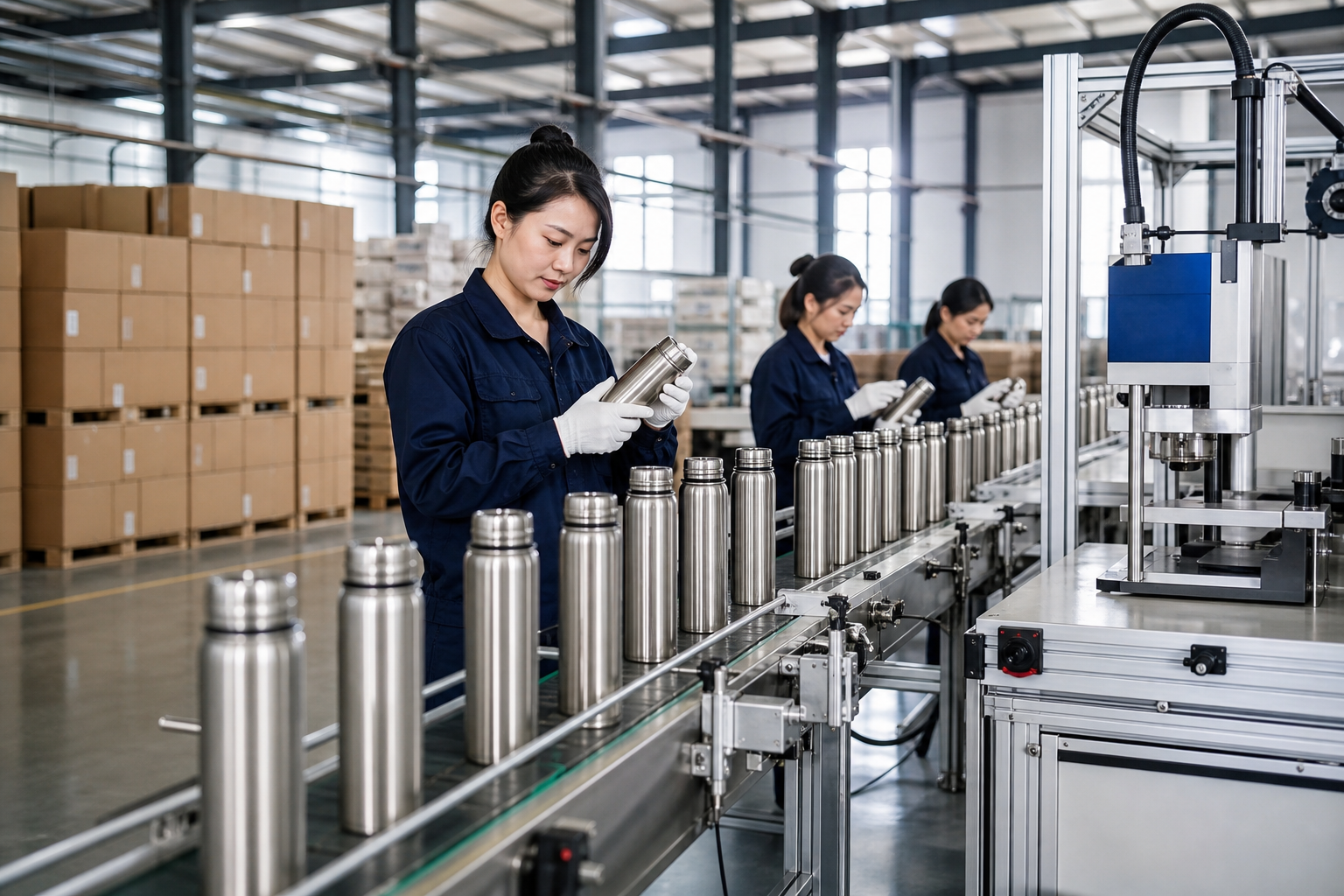
At our Zhejiang factory, we run over 300,000 units a month, and most custom jobs start at 3,000 units per SKU. 18 days vs 12 days can change the landed cost by a lot, and the lowest quote is often the wrong question. We had a PO last month with “304S” typed as “340S,” and the buyer flagged it before sampling. If you are buying a bpa-free stainless steel water bottle for retail, a bpa-free stainless steel bottle for kids, or a bpa-free stainless steel tumbler for hospitality, you need to sort out materials, testing, and MOQ before you sign off.
What BPA-free really means
“BPA-free” gets thrown around too loosely. BPA is a chemical tied to certain polycarbonate plastics and epoxy resins. A bpa-free stainless steel bottle removes that issue from the main drink-contact parts, but you still need to check every piece that touches the liquid. That means the lid insert, flip cap, gasket, straw, and any inner lining on a flask-style lid. QC pulled the sample, and the first thing we check is whether the contact parts are actually traceable by resin code.
For B2B buyers, the real question is not whether the body is stainless steel. It is whether the entire drinking system fits your market. For Europe, ask for food-contact declarations and REACH-related substance statements. For North America, ask for FDA food-contact material confirmation and, where needed, California Proposition 65 screening. If the bottle has paint, soft-touch coating, or printed graphics, ask for adhesion and migration test reports too. We had a buyer flag a PO typo once—“lid” was written as “lead”—and that small slip sent the file back for correction before the line could run.
I see the same mistake over and over: buyers chase “BPA-free” and ignore smell, taste transfer, and gasket quality. A bad silicone seal can make a bpa-free stainless steel water bottle fail in the first week. On a kids’ bottle, that turns into a complaint. On a hotel program, it becomes replacement cost. On a retail SKU, it becomes a one-star review. The math does not work if you save 2 cents on the gasket and lose the whole program.
Ask for a component list, not just a product certificate. If the factory cannot identify the resin grade of the lid and gasket, you do not have enough control.
304, 316, and 201 steel
Buyers usually hear three grades: 304, 316, and 201. For a standard bpa-free stainless steel bottle, 304 is the commercial pick we run most often. It gives solid corrosion resistance, clean forming on the deep-draw press, and a polish that stays consistent from the first sample to mass order. For coastal markets, gym bottles, or a premium SKU, 316 can justify the extra cost, usually about USD 0.25-0.60 per unit depending on size and finish. 201 is the budget option, but we only use it when the buyer accepts the tradeoff and the bottle will stay away from salty air and heavy dishwasher cycles.
Wall thickness matters just as much as grade. For most 500-750 ml double-wall bottles, the inner wall sits around 0.35-0.45 mm and the outer wall around 0.30-0.40 mm, depending on the tooling and target weight. Drop the gauge too far and the math stops working: dent marks show up, vacuum retention gets weaker, and the bottle feels cheap in hand. On a bpa-free stainless steel flask with a narrow neck, the tolerances need to be tighter because the lid seal is doing more of the work. QC pulled a sample last month at 0.32 mm, and the buyer flagged the thin shoulder right away.
When you compare suppliers in Zhejiang or elsewhere in China, do not stop at steel grade. Ask for finished weight, wall gauge, vacuum leak standard, and how many hours the line holds under vacuum before packing. We check that on the bench with a leak tester, not on a promise sheet. A good factory can give you those numbers on the spot. If they cannot, they are guessing.
Lids, seals, and safe components
The lid is where failures start. The bottle body can pass every check, but if the lid uses low-grade PP, a loose silicone ring, or weak threads, your bpa-free stainless steel bottle for schools turns into a return. We run this check at the torque bench, 0.35 N·m, before packing. Food-grade PP or Tritan-style lid parts, with platinum-cured or food-grade silicone gaskets, is the safer build. For flip lids and straw lids, check the spring, silicone valve, and soft-touch mouthpiece one by one.
For a bpa-free stainless steel water bottle for kids, I would skip complex straw mechanisms unless the buyer has a hard requirement. Fewer parts means fewer cleaning complaints and fewer breakages. QC pulled the sample apart on the line and found a straw cap with 7 parts; the buyer flagged it after one school term. Schools usually prefer wide-mouth or simple sports cap styles because they are faster to wash and easier to inspect. Hotels and restaurants usually want a cleaner look and often choose screw-top or minimalist lids for table service or room service.
If your program includes a bpa-free stainless steel bottle for hotels or a bpa-free stainless steel bottle for restaurants, ask about dishwasher resistance and lid torque. A lid that cracks after 20 wash cycles is a replacement problem, not a small defect. Check whether the cap can handle 70-80°C dishwashing water if the customer wants commercial cleaning. We had a PO with “dish washer safe” typed in the notes, but the buyer meant 75°C hot wash and the first sample warped at 68°C. Not every lid can take that heat.
- Request lid material specification: PP, Tritan, silicone, or stainless parts
- Ask for dishwasher test cycles if the product will be reused commercially
- Confirm gasket removal and reassembly for cleaning teams
Custom branding that survives use
Decoration decides whether margin and durability work together or fight each other. Laser engraving is the toughest option for a bpa-free stainless steel tumbler or bottle. We run it by removing the coating and exposing the metal surface, so the mark stays after 200 washes and the logo does not peel. It suits premium corporate gifts. Silkscreen is cheaper and fine for a simple one-color logo, but we have seen it wear after rough use in school bags and dishwashers. Powder coating gives color and grip, yet you still need to check adhesion and scratch resistance with a tape test and a steel-wool rub.
For a bpa-free stainless steel bottle for kids, bright powder-coated colors sell better than bare steel. For a hotel program, matte black, white, or brushed silver looks more expensive and less promotional. For restaurants, keep it tight: small logo, easy-to-clean finish, no extra claims. We had a buyer flag a PO once because the logo was centered 3 mm off on the proof, so the drawing matters. In China, decoration cost is often quoted separately from the bottle body, so compare the full assembled price, not just the empty shell.
Typical decoration adds USD 0.08-0.35 per unit for one-color print, and USD 0.15-0.50 for laser or multi-step branding depending on coverage area. If you need variable data, batch coding, or FNSKU labels for Amazon-style fulfillment, confirm the packing line can handle it without slowing dispatch. The line can usually do it, but the math does not work if you ask for 10,000 units in staggered cartons and expect the same ship date.
MOQ, pricing, and lead times
Let’s talk numbers, because this is where buyers lose a week. A custom bpa-free stainless steel water bottle from Zhejiang usually starts at 3,000 pcs per color or per design. If the shape is tricky, the MOQ jumps to 5,000 pcs. Sample lead time is 7-10 days when we have the mold on hand, and 18-25 days for a new sample build. Mass production is usually 25-35 days after sample approval and deposit, sea freight not included.
FOB China pricing depends on capacity and accessory count. A simple 500 ml double-wall bottle may land at USD 2.20-3.20 FOB. A vacuum-sealed bpa-free stainless steel flask with a better lid and powder coat may reach USD 3.40-5.20. For a kids’ bottle with straw parts, printing, and gift packaging, expect USD 3.00-5.50. We had a buyer flag a quote because one supplier used a lighter carton and skipped the leakage test in the line item. That is the wrong question to ask if the specs do not match.
We run monthly output above 300,000 units, and that is the first thing a serious buyer checks. QC pulled the sample, found a 1.2 mm gap on a lid fit, and the whole schedule moved. A factory can still miss your launch if the brief is sloppy. If you want a school launch in August, place the PO in May. If you want hotel stock before peak season, give yourself at least 45 days, including ocean transit and customs clearance. We ship fast when the paperwork is clean; a PO typo on the carton count can cost you a day.
What changes cost the most
The fastest way to raise unit cost is custom molds, special lids, complex surface finishes, and retail-ready packaging. Full-color gift boxes can add USD 0.25-0.80 per set. A custom silicone base can add USD 0.06-0.18. New tooling for a proprietary cap can run from USD 2,500 to more than USD 8,000, depending on complexity. We’ve seen this go sideways when a buyer asks for a low MOQ and a brand-new cap in the same PO; the math does not work.
Testing for schools, hotels, and retail
A bpa-free stainless steel bottle for schools is not judged like a promo giveaway. School buyers ask about safety, dent resistance, easy cleaning, and carton packing. We run leakage testing, drop testing from 1.2 meters, and odor checks after a hot-water soak. On the line, QC pulled the sample and checked cap torque at 0.8 N·m. For younger users, a bpa-free stainless steel bottle for kids should also pass cap retention checks so the lid does not pop off too easily.
Hotels and restaurants buy on a different logic. A bpa-free stainless steel bottle for hotels needs a clean look, low breakage, and repeatable output across 300 rooms or 800 rooms without color drift. A bpa-free stainless steel bottle for restaurants may go out for table water service or branded resale, so the finish must hold up against fingerprints and washing chemicals. We had a buyer flag a PO typo once—“matte black” on the art file, “gloss black” on the order—and the math did not work until they confirmed the spec. For both segments, ask for AQL terms. A common shipment control is AQL 2.5 for major defects and 4.0 for minor defects, and it belongs in the purchase order.
Testing standards you should know include:
- Food-contact migration or compliance statements for the target market
- Leakage testing for 24 hours at room temperature and after hot-fill
- Drop testing and cap cycle testing, especially for kids’ and school use
- Finish adhesion testing for printed or powder-coated surfaces
If your buyer wants institutional supply, ask for batch traceability. In Zhejiang, a solid factory can track raw material lot, injection batch, and packing date with a barcode system and a 7-digit lot code. That is not overkill. We have seen one bad resin batch turn into a full-container claim, and this is the wrong question to ignore.
Choosing the right bottle by channel
The right product depends on where it will be used, not just how it looks in the catalog. A bpa-free stainless steel water bottle for schools should use a simple lid, a 45 mm opening, and parts that survive rough handling in the bag drop test. A bpa-free stainless steel bottle for hotels should focus on shelf look, logo placement, and easy replacement when housekeeping loses a cap. A bpa-free stainless steel bottle for restaurants needs a finish that washes fast, stacks cleanly, and does not chip at the edge after 200 cycles on the line.
For retail and e-commerce, a bpa-free stainless steel tumbler often beats a bottle if the buyer wants commuter use, office desks, or car cup holders. For outdoor or gifting programs, a bpa-free stainless steel flask with a compact body is easier to merchandize on a 30 cm shelf. We run into the same buyer pushback here: they want one lid for all channels. That is the wrong question to ask. One family can stay visually consistent, but lid fit, gasket depth, and washability need to match the use case.
My practical advice: start with one proven body shape, one lid family, and two decoration options. Simple. That gives you enough range without blowing up SKUs. In China, every extra SKU adds carton checks, packing confusion, and more time on the counting table. If you source from Zhejiang, ask for a pilot run of 500-1,000 pcs before full rollout; QC pulled the sample and found a 2 mm print shift on one side. It is cheaper to fix that on 500 units than on 12,000 finished units.
Send your spec, get a factory quote
Share capacity, lid style, decoration, and target market. We will price your bpa-free stainless steel bottle program with realistic MOQ, lead time, and compliance support.
Frequently asked questions
Is a stainless steel bottle automatically BPA-free?
Usually the bottle body is BPA-free because stainless steel contains no BPA. But the full product is only safe if the lid, gasket, straw, and any insert parts are also BPA-free. For a custom B2B program, ask for material specs on every contact part. A common setup is 304 steel body with food-grade PP lid and silicone gasket. If you are selling in Europe or North America, request food-contact compliance documents and keep them on file for each SKU.
What MOQ should I expect for custom stainless steel drinkware?
For a custom bpa-free stainless steel bottle from a Zhejiang factory, 3,000 pcs per design or color is a realistic starting point. Simple repeat orders can sometimes go lower, but new tooling or special lids can push MOQ to 5,000 pcs. If you want multiple colors, the MOQ is often counted per color. For a school or hotel program, it is better to commit to one core color and scale later than to spread too thin across five variants.
How much does a BPA-free stainless steel bottle cost FOB China?
A simple 500 ml double-wall bottle usually lands around USD 2.20-3.20 FOB China. Better lids, powder coating, and custom packaging can raise that to USD 3.40-5.50. Kids’ models with straws and extra safety parts often cost more because of the added components and assembly time. If you compare quotes, make sure they include the same carton quantity, print method, and test requirements. Otherwise the cheaper quote is usually missing something important.
Can these bottles go in dishwashers?
Some can, but not all. The stainless body usually handles dishwashing better than the lid, print, or coating. For a hotel or restaurant program, you should ask for dishwasher-cycle testing at 70-80°C water temperatures and confirm the lid material. Silicone seals and stainless bodies are generally robust, but soft-touch coatings and some printed logos can wear early. If dishwasher resistance is critical, specify it in writing before sampling and require confirmation in the inspection standard.
What documents should I ask from the factory?
Ask for a food-contact declaration, material specification for steel and plastics, test reports for your target market, and a clear packing list. For Europe, REACH-related statements and food-contact compliance matter. For North America, FDA food-contact confirmation is common, and some buyers also request Proposition 65 screening. If you sell through Amazon or other fulfillment channels, ask the factory to apply FNSKU labels and to confirm carton dimensions and gross weight before shipment.