Key Takeaways
- For stock shapes, MOQ often starts at 500 pcs; custom color or packaging usually needs 1,000 pcs.
- 18/8 stainless at 0.6 mm to 0.7 mm wall thickness is the practical default for wholesale growler programs.
- A 30-minute inverted leak test and a 1 meter drop test should be part of your QC baseline.
- For China sourcing, expect 30-35 days for simple runs and 45-60 days for custom packaging or finishes.
A bulk growler order looks simple until you put wall thickness, closure system, coating, and packaging on the same spec sheet. A 64 oz stainless growler that passes a pub test can still fail a carton drop, dent in transit, or come back with a lid that leaks after 30 cycles. We run caliper checks on wall thickness to catch a 0.2 mm spread before it turns into a complaint. The wrong question is which sample looks best on a desk; the real question is which build survives retail, e-commerce, or a brewery program at scale.
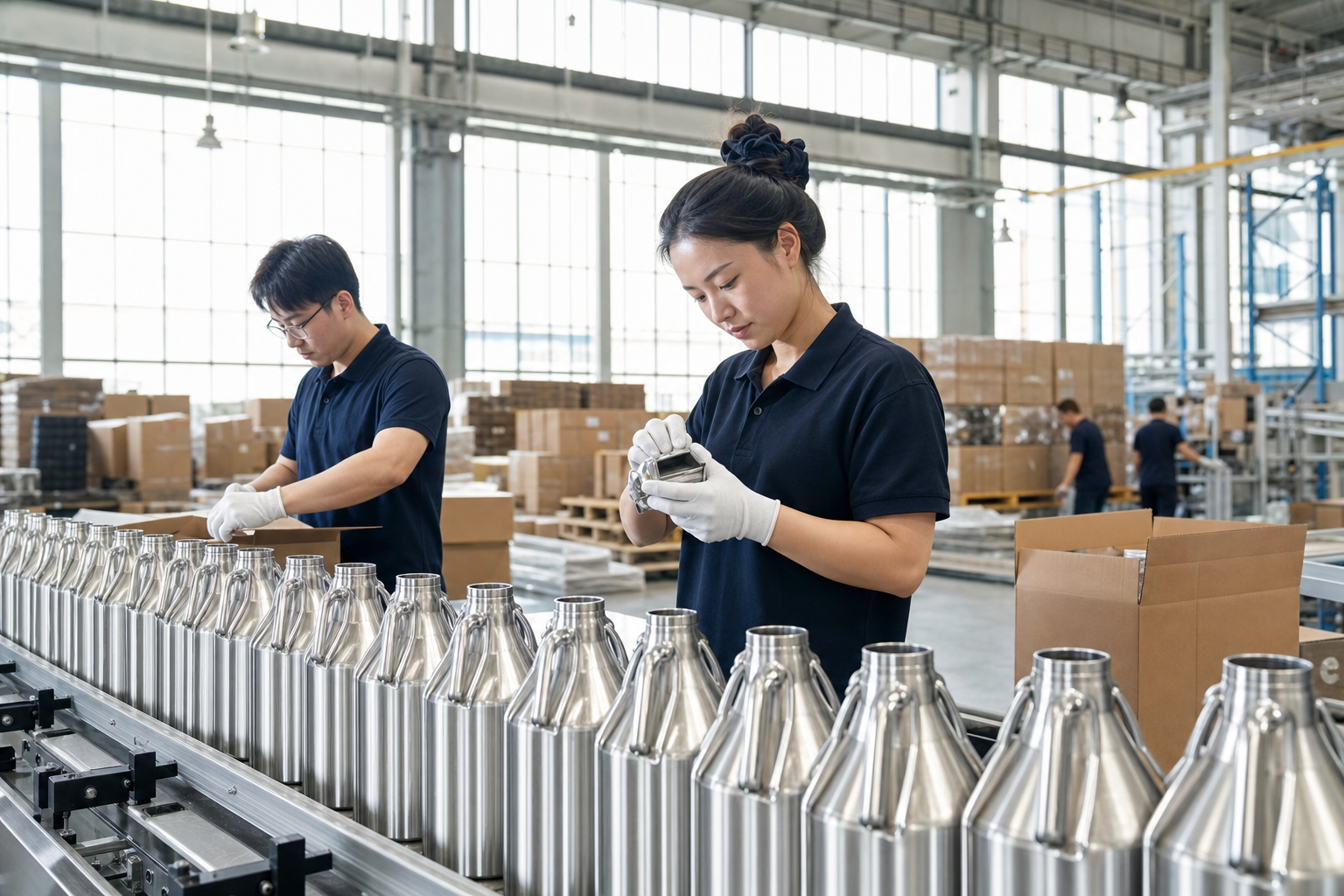
At BottleForge in Zhejiang, China, we treat growler bulk sourcing like a packaging job: material, seal, print, carton, and compliance all have to match the same target. QC pulled the sample on the line when a 2 mm liner shift showed up at the torque station, and that is the kind of miss that becomes a returns file later. A good wholesale growler can ship at 10,000 units/month, hold an AQL control plan, and still leave margin on the table. The math does not work if the lid, carton, and decoration are treated as separate buys.
What Counts As Bulk Growler
In sourcing terms, bulk growler is not a sample carton with a label on it. For stocked shapes, a China factory in Zhejiang usually quotes MOQ at 500 pcs; once you add custom powder coat, logo, or retail packaging, 1,000 pcs is the number we run. On the line, we check the cap torque with a hand torque tester before we talk price. If you are planning beer growler bulk for a brewery chain, ask for tiered pricing at 500, 1,000, 3,000, and 5,000 units. That shows whether the supplier has real output or just a decent-looking sample table.
Do not use the same brief for every drinkware bulk program. A growler wholesale order for taproom resale needs fast reorders and low damage rates; we once saw a buyer flag 2 cracked cartons in a 300-piece pilot and the whole PO stalled. A bulk canteen or canteen wholesale order for corporate gifts may care more about print area and box count than thermal performance. The right wholesale drink bottle is the one that matches the channel you sell through. That is the real test.
- 500-1,000 pcs: pilot run or first retail test
- 3,000-5,000 pcs: regional rollout or distributor order
- 10,000+ pcs: freight, carton loading, and re-order cadence matter as much as unit cost
In other words, a cheap unit price only matters if the supplier can repeat it on the second and third order. QC pulled the sample, checked the 0.8 mm wall thickness, and the math still has to work after freight, boxes, and breakage are counted.
Choose Steel And Finish
For beer growler wholesale bulk orders, steel choice is usually plain once you put samples on the bench. 18/8 stainless steel is the default we ship because it holds up against corrosion, keeps taste neutral, and clears export checks without drama. If the buyer wants a cleaner retail feel, 304 steel with a 0.6 mm or 0.7 mm wall feels solid in hand, while 0.4 mm pieces bend too easily in transit. Single-wall works for a basic growler. Double-wall vacuum only makes sense when the bottle sits beside better-looking wholesale drinkware and condensation will hurt the shelf look.
Finish is not decoration. Powder coating adds grip and hides rub marks from the line. Brushed steel looks better for bars and hospitality counters. Mirror polish is harder to keep clean, but it can support a higher shelf price if the buyer accepts the upkeep. If you also source beer tumbler wholesale or beer tumbler bulk items, keep the finish wording aligned so the program reads as one family. We have seen this go sideways when one PO called for "matte black" and the next spec said "soft black"; QC pulled the sample and the buyer flagged it before production. The same factory may also handle alcohol flask bulk or alcohol flask wholesale bulk on a related body style, but the wall thickness, cap gasket, and print method still need a fresh check.
For private label, ask for a finish sample under the same light source you will use for approval. A black matte that looks clean on a phone screen can show fingerprints after one hour of handling under a 6500K lamp. We run that check on the packing table before mass production, and it catches more complaints than a glossy render ever will. This is the wrong question to ask if the buyer wants fewer returns: the real issue is how the finish behaves after contact, not how it looks in a mockup.
Closures Decide Leak Risk
Lids drive more returns than the body. We’ve seen a bulk growler pass wall-thickness checks and still leak because the cap cross-threaded, the gasket pinched, or the torque drifted off spec. Ask for the thread standard, gasket material, and target torque in writing. On our line, we run a 30-minute inverted leak test plus a 1 meter drop test. If the supplier cannot state the method, there is no QC plan.
Common lid picks are screw caps with silicone gasket, stainless caps with PP liner, and flip-top closures for fast service. Screw caps usually win on growler wholesale runs because they pack flat and keep the unit cost down. Flip tops look better, but they add parts and more inspection points. We had a buyer flag a PO typo on closure color once, and that small miss turned into a whole rework lot. If reuse matters, ask for 50 open-close cycles with no visible gasket damage.
The cap is a consumable failure point. Price it like a component, not like an accessory.
The same rule applies to alcohol flask wholesale and alcohol flask wholesale bulk orders: once the closure loosens, the item is dead on arrival. QC pulled one sample where the liner had a 0.3 mm offset, and that was enough to create a slow seep. This is the wrong question to ask if you are only chasing lid price.
Ask For Compliance Proof
If you ship into Europe or North America, compliance is not a sales line. It decides whether cartons clear in 2 days or sit at customs for 12 days. For stainless bulk growler programs, ask for FDA food-contact declaration, LFGB where needed, REACH screening for heavy metals, and, if the factory says it runs an audited system, ISO 9001 and BSCI. We ship these files before the PO on the better jobs. They do not replace your own testing, and that is the point. They tell you whether the supplier runs a tight line or just collects PDFs.
In Zhejiang, the better factories will hand over batch traceability, QC records, and an AQL plan without drama. AQL 2.5 is common on appearance. For lids and leak checks, buyers usually push harder, and they should; we've seen that go sideways on a 500 pcs lot when the cap torque was off by 1.5 mm. If you are buying drinkware wholesale for Europe, do not skip coating and ink adhesion checks. REACH problems usually show up in the label, ink, or gasket, not in the steel body. QC pulled the sample and found a weak rub result on the print before packing.
Ask for test reports tied to the actual item number, not a generic file from another model. A report on one stainless cup does not cover your beer growler wholesale bulk design. The buyer flagged a PO typo once—304 on the drawing, 201 in the supplier file—and that one line changed the whole material check. If the supplier is vague on material grade or subcontracting, the math does not work. Keep looking.
Price And Lead Time Reality
Price only makes sense when you split it into parts. A plain single-wall growler bulk order at 1,000 pcs may land around USD 3.20-4.60 FOB China. Add powder coat, laser logo, and gift box, and the same project can move to USD 5.80-8.50. Double-wall vacuum, upgraded lid, and premium carton push it higher still. These are factory-side numbers before ocean freight, duty, and local distribution. QC pulled a sample with a 0.3 mm lid gap, and that kind of miss is why we quote by build spec, not by headline price.
Lead time follows complexity. A stocked shape with simple print can ship in 30-35 days after sample approval. Custom color, custom carton, or molded lid parts usually need 45-60 days. A Zhejiang factory with a line capacity of 10,000-20,000 units per month still slows down when artwork lands late or carton dimensions change for the third time. We run into that every week. The buyer flags the PO, the carton shrinks by 8 mm, and the line has to stop.
When you compare wholesale growler offers, ask for three things in one sheet: EXW or FOB price, packing specification, and re-order lead time. This is the wrong question to ask if you only want the lowest number. Ask for the same basis, or the math does not work. We have seen a USD 4.10 quote turn into a late shipment because the lid spec was missing and the re-order time was never written down.
Write A Better RFQ
Packaging is where a lot of bulk drinkware orders lose margin. A 64 oz growler is heavy enough to crush a weak carton, especially when the box carries a lid, spout, or other accessory. We run a 1 meter drop test on the outer carton, and if the buyer wants Amazon, the label plan has to be set before production starts so FNSKU, carton marks, and case packs do not clash. For retail, a kraft box can do the job. For distributor programs, a 3-color printed sleeve is often enough. A gift box is the wrong question unless the channel pays for it. QC pulled one sample last month because the bottom flap opened on the third drop.
For canteen and canteen wholesale programs, the same rule applies: a better box does not fix a bad fit. Product, insert, and carton have to be engineered as one set. If the order also includes beer tumbler wholesale or other drinkware, keep the carton spec consistent so the warehouse can receive mixed SKUs without mix-ups. We have seen this go sideways when one SKU used a 2 mm thinner insert and the stack collapsed at 18 layers. Buyers often ask for prettier packaging first. The math does not work if the line cannot pack it cleanly.
When you write the RFQ, list capacity, steel grade, wall thickness, lid type, logo method, carton spec, target MOQ, and target market. If you leave out one item, the factory will fill the gap with its own assumption. That is how you get a nice sample and a bad mass run. We saw a PO last quarter with “500ml” in one line and “16 oz” in the next, and the buyer flagged it only after the pre-production sample. Put the details in writing, down to the 0.5 mm wall callout and the carton test standard, and the line can quote the right thing the first time.
Request a bulk growler quote with exact specs
Send capacity, steel grade, lid style, logo method, and target market. We will quote MOQ, FOB price, and lead time without guesswork.
Frequently asked questions
What MOQ should I expect for a bulk growler?
For a stock 32 oz or 64 oz stainless shape, 500 pcs is a common starting point in China. If you want custom color, laser logo, printed carton, or a special lid, 1,000 pcs is more realistic. At 3,000 pcs, you usually get better FOB pricing because setup cost spreads out. At 5,000 pcs and above, the factory can plan steel, cartons, and labor more efficiently. If a supplier says they can do 100 pcs with custom packaging, check whether they are a trader or whether the price already includes hidden compromises.
Is stainless steel better than glass for wholesale growler orders?
For most retail and distributor programs, yes. Stainless is better for shipping, warehouse handling, and repeat use. A 0.6 mm 304 or 18/8 stainless body is less likely to break in transit than glass, and it survives Amazon-style handling far better. Glass can look premium on a shelf, but it drives higher damage rates and more protective packaging cost. If your channel is taproom resale or gift sets, glass can still work. If your channel is DTC, regional distribution, or FBA, stainless is usually the safer buy.
What documents should I ask for from a China factory?
For EU and North America, ask for FDA food-contact declaration, LFGB if the destination market needs it, REACH screening, and if the factory claims a management system, ISO 9001 or BSCI. Also ask for the actual test report number tied to your item, not a generic file. If the growler has powder coat, ink, or silicone gasket parts, request migration or heavy-metal checks on those components too. A serious factory in Zhejiang or elsewhere in China will give you batch traceability, inspection records, and an AQL plan without much hesitation.
How do I reduce leaks and returns?
Start with the lid. Specify the thread standard, gasket material, and torque target, then require a 30-minute inverted leak test and a 1 meter drop test. Ask for at least 50 open-close cycles on the closure if the product will be reused daily. Make sure the gasket material matches the beverage and cleaning routine. A lid that looks fine in a photo can still fail after shipment if the gasket is too soft or the cap is over-tightened. Most return problems in wholesale growler programs come from closure inconsistency, not from the steel body.
Can I private label a growler for Amazon FBA?
Yes, but only if you treat packaging and labeling as part of the product. Build the FNSKU plan early, confirm case pack quantity, and make the master carton survive at least a 1 meter drop test. If the bottle ships with a box, insert, or accessory, the final carton size matters because Amazon fees change with dimensions and weight. Ask the factory for carton marks, barcode placement, and polybag requirements in the quote stage. If you change the label after mass production starts, you will usually lose time and margin.