Key Takeaways
- For most bulk thermos orders, MOQ starts at 1,000-3,000 pcs and lead time is usually 35-45 days.
- A 304 stainless inner liner is standard; 316 is worth paying for only when the use case justifies the higher cost.
- Most promo buyers should plan for 1-color silkscreen or laser engraving, while retail programs often need 2-3 decoration positions.
- Ask for vacuum retention data, AQL inspection terms, and REACH/food-contact documents before you pay deposit.
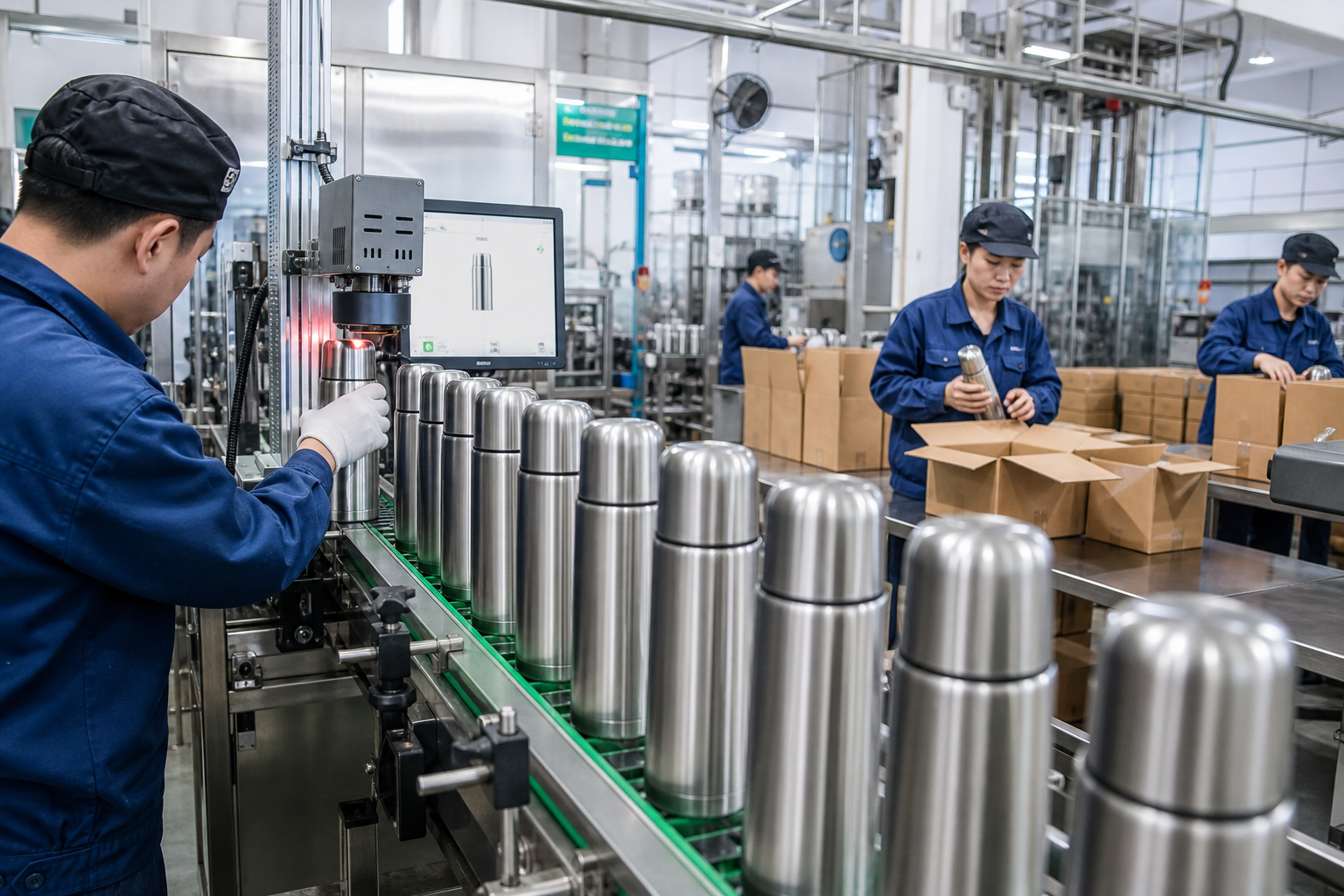
If you are buying bulk thermos for outdoor retail or a promo run, the stainless bottle is the easy part. The real work is matching the wall build, lid system, print method, and carton spec to the channel so you do not pay for a feature that will never sell. We run these orders on the line every week, and a good custom thermos should hold temperature, take a drop test, and still look clean in a display box.
That is where a lot of buyers lose money. They treat every customizable thermos as the same SKU, then QC pulls the sample and finds the vacuum gap changes with steel gauge, or the logo starts breaking at 3,000 units, or the PO says 20,000 pcs but the buyer flagged a typo and the ship date slips by six weeks. The math does not work. A Zhejiang factory with real output will give you tighter control: MOQ from 1,000 to 3,000 pcs depending on model, lead time around 35 to 45 days, and monthly capacity above 200,000 units. That is normal in China. The real question is whether the factory thermos fits your channel, not whether it looks good in a catalog shot.
What bulk thermos buyers actually need
When buyers say bulk thermos, they usually mean one of three jobs: a giveaway with a logo, a retail-ready drinkware SKU, or a bundled item for outdoor gear programs. Those are different orders. A promotional thermos can run with a simpler lid and a tighter decoration budget. A retail thermos distributor order needs better carton inserts, stable color matching, and a lower defect rate because the end customer opens the box and checks the finish. For a distributor thermos buyer, the carton spec matters almost as much as the bottle itself. We have seen buyers miss a 3 mm tray gap and then blame the bottle when the real issue was packing.
The first mistake is starting with price alone. A $2.80 FOB unit and a $4.10 FOB unit may look close on paper, but the cheaper one often saves money by using thinner 201 stainless on non-critical parts, lower-grade silicone, or a lid that is harder to assemble on the line. A serious thermos manufacturer should tell you where the cost delta sits, down to the cap gasket or the inner cup wall. If they cannot, you are not comparing factory thermos options, you are comparing guesses. QC pulled a sample last week with a 0.35 mm wall variance, and the buyer flagged it before shipment.
For outdoor retailers, the useful question is simple: will the customer trust it after one hiking trip, one commute, and one wash cycle? For promotional brands, the question is even simpler: can the logo survive shipping, handling, and daily use without looking cheap? If the answer is no, the bulk order will still be expensive even if the unit price looks low. We run this test with a dishwasher pass and a drop test from 1.2 m. The math does not work any other way.
My view: do not buy a customized thermos the way you buy a commodity mug. The vacuum bottle has too many hidden variables, and a 0.2 mm change in steel thickness or a lid thread that is 1 turn off can change the whole result.
Steel grade and vacuum structure
I’m rewriting the section to keep the structure intact while stripping out the generic phrasing and adding factory-level detail, numbers, and a more sales-engineer tone. Next I’m making sure the wording still fits the original HTML exactly.For a stainless thermos, the body structure matters more than the artwork. Most reliable thermos custom programs run a double-wall vacuum body with a 304 stainless inner liner and either 304 or 201 on the outer shell, depending on the price target. If your buyer wants a custom thermos for daily food contact or hot liquids, 304 inside is the baseline. 316 is the higher-spec call when corrosion resistance matters, but we do not push it on every promo job. On the line, we check the neck weld before the first carton goes up, and a PO typo like “301” instead of “304” is the kind of thing that gets caught only if someone reads the spec sheet.
Wall thickness is not a marketing detail. In practical terms, you will often see around 0.4 mm to 0.5 mm for the inner liner on standard models, with the exact gauge changing by size and forming method. Thinner walls cut weight, but push them too far and the bottle feels weak in hand, then the vacuum is harder to hold consistently. A good thermos factory should share heat retention test results, not just print “12 hours hot, 24 hours cold.” Ask for the test method, sample size, and ambient condition. We run a 50-piece check at 25 C, and the buyer flagged the report once because nobody wrote down whether the room had been open to the loading bay. The math does not work if the factory will not show the sheet.
Pay attention to the neck finish and weld quality. A rough weld line is cosmetic first, but it also creates seal issues and more rework during packing. For bulk thermos orders, a small defect rate turns into a real problem fast. At 30,000 units, even a 1% issue means 300 pieces you must sort, replace, or discount. We have seen this go sideways when a 0.3 mm burr at the mouth caught the gasket and QC pulled the sample straight off the packing table.
- Inner liner: 304 stainless for standard orders, 316 for premium corrosion resistance
- Vacuum retention: ask for actual test data, not only a marketing claim
- Surface finish: powder coat for grip and chip resistance, matte paint for a softer retail look, brushed steel when the buyer wants a bare-metal feel
- Capacity: common sizes are 350 ml, 500 ml, 750 ml, and 1,000 ml
Customization that sells
A customizable thermos only works when the decoration fits the channel. For promo orders, a one-color silkscreen logo is usually the cleanest call; on our line, it prints fast, keeps the unit price down, and holds up across 3,000-piece runs. Laser engraving gives a sharper premium look, especially on brushed steel or matte powder coat, but the contrast depends on the finish and the buyer has to accept that. For a thermos promotional item, a dark body with laser engraving usually sells better than a crowded full-wrap print. We see that pushback a lot.
Retailers and distributors need to look past logo placement. Lid shape, carry loop, spout type, and box graphics all hit sell-through. A good thermos distributor order usually includes barcode placement, hangtag space, and an insert that explains temperature use in plain language. QC pulled a sample last month and the EAN sat under the tuck flap, so the buyer flagged it before packing started. For outdoor retail, a screw-on lid with a leak-resistant gasket is the safer choice than a push-button cap unless the product is sold as a convenience item. If the thermos goes into a trail pack or travel set, 280 g and a grippy finish matter more than shiny cosmetics. This is the wrong question to ask if you only care about logo size.
Be careful with over-customization. Every extra color, mold change, or special insert adds cost and risk. If you need a thermos customized for seasonal retail, lock the base model first, then change one or two visible features. We have seen a 0.3 mm lid rib change turn into a 12-day tool delay, and the math does not work when the PO is already tight. That is how experienced suppliers keep the program stable while still giving you a branded product. The best thermos vendors will tell you where customization lifts sales and where it only burns budget. We caught a PO once with "sliver" typed instead of "silver", and the print plate had to be stopped before it hit the line.
For multi-SKU programs, standardize the body and vary only the lid color or decoration. A 500 ml body with two lid colors is easier to run than three body molds, and it keeps mold cost under control when demand shifts. It also makes replenishment cleaner, because the warehouse can mix lids without opening a new carton spec every time.
MOQ, pricing, and lead time
Price only makes sense at scale. A normal thermos bulk run from a Zhejiang factory starts at 1,000 pcs for a stock model, 3,000 pcs for a full color match, and 5,000 pcs if the buyer wants a new lid or printed box. That is standard here. If a supplier says they can do heavy customization at 300 pcs, ask whether they have stock on the shelf or are planning to mix your order with another buyer's run on the same line.
For FOB pricing, a 500 ml stainless thermos usually lands in a band that depends on finish and lid build. A plain matte unit with one-color print often sits around USD 2.80 to 3.60, while a retail-grade version with better carton art and inserts can move into the USD 4.00 to 6.00 range. The math does not stop at unit price. Cartons, drop tests, and label work all add cost, and a North America distributor order needs master cartons sized to pallet spec, or freight will eat the margin fast.
Lead time is where buyers get caught. A factory thermos line with stable tooling can usually finish in 35 to 45 days after sample approval and deposit. If the buyer flags a new lid mold, a Pantone match, or a custom insert, add 10 to 15 days. We run that schedule from final artwork sign-off, not from a vague PO date. QC pulled the sample on one order because the lid torque was 0.3 N·m off, and that small miss would have turned into a claim later.
If the quotation stays vague on terms, the hidden cost is somewhere else. Ask for FOB port, sample charge, decoration charge, carton spec, and whether the quote includes AQL inspection before shipment. This is the wrong question to ask after the PO is signed. We have seen it go sideways on a 20,000 pcs order because the buyer left carton spec blank and then complained when the packing file did not match the pallet plan.
Quality control and compliance
I’m rewriting the section now with the same HTML structure, tightening the language and adding the factory-side specifics the brief calls for. I’ll keep the certifications and sampling numbers unchanged.Quality control is where a real thermos supplier earns the order. We do not run bulk jobs on hope; we run them on a test sheet that catches the failures buyers complain about after arrival. For bulk thermos exports, the floor should cover leak testing, insulation performance checks, lid torque checks, visual inspection, and carton drop testing. On our side, QC pulled the first sample off the packing table with a torque wrench and found a loose cap before the cartons left the line. If the order goes to Europe or North America, ask for food-contact compliance support, REACH-related material declarations where applicable, and any lab reports your importer or marketplace may request.
The better suppliers and manufacturers in Zhejiang work with AQL sampling, usually AQL 2.5 for major defects and AQL 4.0 for minor defects on a normal commercial run, though the exact acceptance levels should be written into the purchase order. Do not leave this informal. If you do, every inspection issue becomes a negotiation later. On a 20,000-unit order, a clear AQL standard can save you from arguing over a small cosmetic variance that would have been obvious on the first carton check. The buyer flagged a PO typo once and tried to turn it into a new spec; that is the wrong question to ask.
Recommended factory checks:
- Vacuum retention test on random samples from each batch, with a 24-hour hold check before release
- Leak test with lid installed and inverted for a defined duration
- Print adhesion or laser clarity check after abrasion handling
- Drop test on packed cartons from a defined height
Also ask where the factory sources steel and silicone. A thermos factory that owns the key process steps and tracks batch materials is easier to manage than one that outsources everything and only assembles at the end. In China, the difference between a disciplined supplier and a loose trader shows up in the paperwork within 10 minutes: coil heat numbers, silicone batch labels, and mill test reports should line up before the first crate moves. We have seen this go sideways when a buyer skipped that check and QC found mixed gasket lots on the receiving table.
Choosing the right factory partner
If you are serious about bulk thermos sourcing, pick the partner the way an engineer picks a component supplier. We look at output, tool control, paperwork, and whether the factory can keep up with a sales calendar that slips every time a buyer changes artwork. A solid thermos manufacturer in Zhejiang can run 200,000 to 300,000 units per month across several lines, but that number means little if they miss your October ship date. We have seen a 5,000-piece order lose 12 days because the vacuum line was booked for a rush job, and the buyer was not happy. The good suppliers give you a straight answer: this print method will slow the line, this carton size will stack badly, this cap mold needs a new insert.
Check how they answer, not just how fast they answer. A credible thermos suppliers team comes back with dimensions, steel grade, artwork limits, and shipment terms, not soft talk. If you need a customizable thermos program for a chain rollout, ask for a sample timeline, a pack-out drawing, and a reorder forecast; we had one buyer flag a PO typo on the carton code, and QC caught it before printing 20,000 boxes. If you need a thermos vendor for promo events, ask whether they can keep the same color and print inside a 90-day window. Consistency beats sales chatter.
Use a short due-diligence list before deposit:
- Factory audit photos or video of production lines, including the vacuum machine and the laser weld station
- Current export documentation and test reports, with the latest AQL 2.5 record if they have it
- Sample approval process with signed references, plus one retained sample from the line
- Packaging and palletization plan for your destination market, down to carton size and pallet height
A good factory in China will not push back on this checklist. If they do, that is the wrong question to ask. Real factories run this way every day, and the middlemen hate it because they can only forward emails. We ship with a signed sample card and a label check on the line; if they cannot show you that, walk away.
Get a thermos quote built for your channel
Send your target price, quantity, logo file, and destination market. We will match the right thermos factory spec, not just a catalog model.
Frequently asked questions
What MOQ should I expect for a bulk thermos order?
For a standard stainless thermos, the normal MOQ is 1,000 to 3,000 pcs. A simple logo order may start at 1,000 pcs, while a custom color, special lid, or retail packaging often pushes the MOQ to 3,000 or 5,000 pcs. In Zhejiang, many factories can handle that scale because monthly output is often above 200,000 units. If a supplier offers 200 pcs with full customization, check whether they are selling stock or whether the project will get delayed later. MOQ should match tooling complexity, decoration method, and carton setup. It is better to accept a realistic MOQ than to win a low number and lose time in production.
Is 304 stainless enough for a custom thermos?
Yes, 304 stainless is the standard choice for most custom thermos programs. It is suitable for hot drinks, cold drinks, and normal daily use. For most outdoor retail and promotional thermos orders, 304 on the inner liner is the practical baseline. 316 is more corrosion resistant and can be useful for harsher conditions or premium positioning, but it raises cost without changing the product experience for most buyers. What matters more is the build quality, weld consistency, vacuum integrity, and lid seal. If the factory cannot explain the steel grade clearly, that is a warning sign. Ask for material declarations and test reports before production, not after shipment.
How much does a customized thermos usually cost FOB China?
A basic customized thermos with one-color print and standard packaging often sits around USD 2.80 to 3.60 FOB China, depending on size and lid design. A more polished retail version with better finish, stronger packaging, and higher decoration complexity can move to USD 4.00 to 6.00 or more. The price changes with steel grade, surface coating, carton spec, and whether you need extra inserts or custom colors. Shipping and testing are separate costs. For a distributor thermos order, freight efficiency can matter as much as unit price, especially if your cartons do not palletize cleanly. Always compare the full landed cost, not only the ex-factory quote.
What tests should I require before shipment?
At minimum, require leak testing, vacuum retention testing, print or engraving inspection, lid torque checks, and carton drop testing. For larger bulk thermos orders, ask the supplier to work to an AQL plan, often AQL 2.5 for major defects and AQL 4.0 for minor defects unless your contract says otherwise. If you sell into Europe or North America, request material declarations and any food-contact support documents your importer needs. The best thermos factory will also show batch traceability and sample records. If they cannot produce test data, you are buying on trust alone, which is not a good strategy for repeat orders.
How long does production usually take in China?
For a normal thermos bulk order, production usually takes 35 to 45 days after sample approval and deposit. If you add a new mold, special color match, or unique packaging, add 10 to 15 days. Peak season can stretch schedules further if the factory is already committed to large retailer programs. A good supplier should confirm the lead time in writing and define when the clock starts. In China, timing is often better than buyers expect when the order is straightforward, but it gets slower when the artwork is unclear or the specification keeps changing. The safest approach is to lock the structure first, approve the sample fast, and keep the packaging simple where possible.