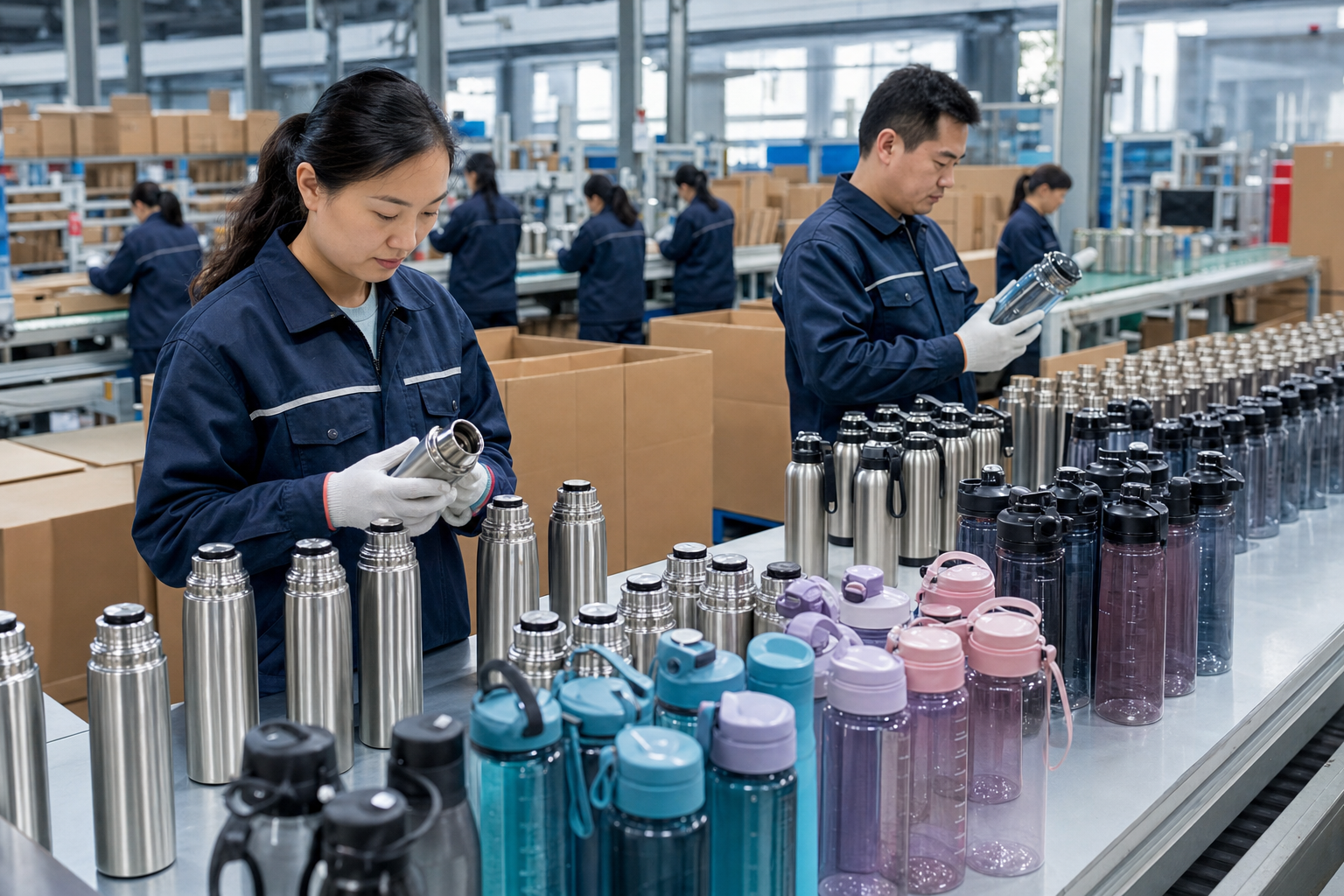
Key Takeaways
- MOQ for common stainless steel drinkware starts at 1,000 pieces per SKU; custom colors often need 3,000 pieces
- Typical FOB China pricing runs USD 0.65 for PP bottles, USD 1.20 for Tritan, and USD 2.10 to 4.80 for vacuum insulated bottles
- A good factory in Zhejiang should support AQL 2.5 general inspection and 0 critical defects on incoming and final QC
- Lead time is usually 20 to 35 days after sample approval, but printed cartons and special coatings can add 7 to 10 days
If you want to buy in bulk drinkware, finding a factory is the easy part. The real job is matching bottle type, decoration, test standard, and carton plan to your margin target. A 500 ml stainless steel bottle at USD 2.10 FOB looks cheap until you add a 1-color logo, drop-test packaging, and a shipping window that slips by 12 days.
Here in Zhejiang, we see this every week from buyers placing 3,000 to 30,000 units and asking one supplier to handle buy in bulk water bottles, buy in bulk thermos, and buy in bulk reusable water bottle orders without turning the job into a guessing game. QC pulled the sample last Friday on one 18/8 lid that missed a 0.3 mm fit check, and the buyer flagged it before the line ran the full carton pack. The math does not work with vague specs; that is where 5% to 12% gets burned on rework, extra samples, and freight waste.
Start with the product class
When you buy in bulk drinkware, do not start with “water bottle.” Start with the use case. A gym account needs a light body that survives drops on tile. A premium retail brand may need a buy in bulk stainless steel water bottle with a powder coat finish and a laser logo. A gift program might need a buy in bulk thermos bottle or buy in bulk vacuum flask with a 500 ml or 750 ml capacity and a leakproof lid.
Product class drives most of the cost. We run this every week in Hangzhou and on partner lines in Zhejiang. The same logo can land on a buy in bulk plastic water bottle at USD 0.72 FOB, a buy in bulk tritan bottle at USD 1.35 FOB, or a buy in bulk double wall bottle at USD 2.80 FOB. That gap is material, tooling, and processing. QC pulled the sample on a 1.2 mm wall because the buyer flagged a thin spot near the shoulder. If you want to buy in bulk refillable water bottle inventory for a distributor program, ask first: sports, corporate gifting, resale, or hospitality? The answer sets the lid, wall thickness, and packing format.
- Budget tier: PP or HDPE, 0.8-1.2 mm walls, MOQ 3,000
- Mainstream retail: Tritan, 2,000-3,000 MOQ, BPA-free claim supported by material spec
- Premium: 304 stainless steel, 0.4-0.5 mm liner and shell, vacuum insulated
Know the material trade-offs
If your search terms include buy in bulk stainless steel bottle, buy in bulk vacuum insulated bottle, buy in bulk thermal bottle, buy in bulk glass water bottle, or buy in bulk polypropylene bottle, you are comparing four things: dent resistance, tare weight, print finish, and what your test report actually covers. Stainless steel wins on shelf appeal and heat hold. A 304 double-wall bottle can keep hot water above 60°C for 6 to 8 hours if the vacuum stays intact and the cap seal passes a 50 kPa leak test. Tritan is lighter, clear, and far less fragile than glass. PP is the low-cost choice when the buyer wants 10,000 units and does not care about a premium feel. We had one PO where the buyer wrote “thermal botle” on the file name. QC still caught the wrong lid spec on the line.
For Europe and North America, material declarations matter. Ask for REACH-compliant declarations for coatings and seals, plus food-contact papers where they apply. For North American retail, buyers often want FDA food-contact statements even when the shipment moves through a distributor. If you buy in bulk bpa free water bottle inventory, do not accept “BPA free” as a slogan. Ask for the resin grade, the test report, and which part is covered: body, lid, straw, or gasket. We run into this all the time with caps and seals. A Zhejiang factory that exports seriously will send a material sheet and batch traceability, not a sales sentence.
Practical material fit
Buy in bulk tritan water bottle works well for school, fitness, and promo channels. Buy in bulk glass water bottle fits premium home or office sets, but breakage rates climb unless you upgrade the inner pack and outer carton. Buy in bulk canteen usually means a wide-mouth metal bottle for outdoor or utility use, so think 1.0 mm wall thickness, impact resistance, and cap torque, not fashion. We’ve seen buyers push for a glossy finish on a camp bottle, then complain when the first drop leaves a mark. That is the wrong question to ask.
MOQ, pricing, and margin math
The sample photo looks nice. The PO decides the deal. A Zhejiang factory running 400,000 units a month can take mixed orders, but each SKU still has its own MOQ on the line. For a standard logo bottle, we usually see 1,000 pieces for stainless steel and 3,000 pieces for plastic or Tritan. If the buyer wants a custom PMS color, matte coating, or embossed brand mark, 3,000 to 5,000 pieces is the normal starting point.
MOQ and unit price move together, and this is the part buyers push back on after the first quote. A buy in bulk drink bottle order at 1,000 units may land at USD 2.90 FOB, while 5,000 units can drop to USD 2.35 FOB because setup time and labor get spread out. For a buy in bulk thermos flask with vacuum integrity testing, we have seen USD 4.80 FOB at 1,000 units versus USD 3.95 FOB at 5,000. The math does not work if you force a small MOQ into a big retailer plan and expect the same gross margin; that gap can eat 8% to 15% fast.
- Sample lead time: 5 to 10 days
- Mass production: 20 to 35 days after approval
- Standard carton pack: 24 pcs or 48 pcs per master carton depending on size
- FOB planning: add 3% to 6% for prints, cartons, and color matching
Decoration changes everything
Buyers search buy in bulk water bottles and think the logo is a simple add-on. It is not. Decoration sets scratch resistance, yield, and how the buyer reads your brand on arrival. Screen printing is the low-cost route for one or two colors, usually USD 0.08 to USD 0.18 per print position at volume. Laser engraving on stainless steel runs higher, often USD 0.20 to USD 0.45 per unit, but it stays put. UV print and heat transfer give more color options, and they raise the rejection rate when the bottle is curved or powder-coated. We run this every week, and the math does not lie.
If you buy in bulk reusable water bottle stock for retail, ask for a decoration compatibility test before mass production. A powder-coated buy in bulk vacuum bottle needs adhesion testing. A clear Tritan body needs ink that survives dishwasher exposure if your market expects it. On our Zhejiang line, QC pulled the sample and ran a 24-hour abrasion check plus a 50-cycle handwash test for branded bottles sold to sports and corporate channels. One buyer once sent a PO with the logo file name typed wrong by one letter; the print was fine, the artwork was not, and we had to stop the line. If you want to buy in bulk thermos or buy in bulk thermos bottle for a premium buyer, presentation matters as much as insulation. The logo must stay clean after shipping, not just on the sample table.
Good decoration is not the logo itself. It is whether the logo still looks intentional after 60 days in a warehouse, a truck, and a retail shelf.
Test the bottle, not the brochure
Good procurement teams ask for test data before they ask for a catalog. That order saves time. For hot and cold drinkware, we run leakage, drop, insulation, and dimensional checks. The file should show AQL levels, usually AQL 2.5 for major defects and AQL 4.0 for minor defects, unless your retailer wants tighter limits. On vacuum products, ask for vacuum loss testing and hot/cold retention data from the same production run. QC pulled the sample from line 3, and the numbers changed once the cap torque was corrected.
For a buy in bulk insulated water bottle or buy in bulk double wall bottle, ask for the test method, not just the headline result. “Keeps hot for 12 hours” means little unless the factory states starting temperature, ambient temperature, fill volume, and cap type. For a buy in bulk vacuum insulated bottle, 95°C fill water tested at 20°C ambient is common. For a buy in bulk glass water bottle, ask for thermal shock and drop resistance if the bottle will ship through ecommerce. One buyer flagged a PO typo on the cap spec, and that mistake would have killed the test data. A good supplier in China should also provide food-contact compliance docs, carton drop test results, and, if needed, BSCI audit status for social compliance.
Most defects come from parts, not the bottle body. Silicone gaskets, PP lids, and straw assemblies need the same control as the main container. If the gasket tolerance is off by 0.3 mm, you get leaks even when the shell is fine. We’ve seen this go sideways on a 5000-piece order: the lid looked clean, but the caliper reading on the gasket groove was 0.3 mm loose and the return rate followed.
Choose the right shipping and packing plan
Buyers often stare at unit price and miss the freight line. That is where margin disappears. Drinkware ships as cartons, liners, and outer boxes, so the packing plan matters as much as the cup itself. We run a 40HQ load sheet before the line starts, and a lid box that grows by 5 mm can cut loading by 6% to 9% on a full container.
For Amazon or retail fulfillment, the packing spec needs to be locked before production. If you need FNSKU labels, suffocation warnings, barcode placement, or master carton marks, say it in the quotation stage. We had one buyer flag a PO that missed the barcode position by 8 mm, and QC pulled the sample off the line. If you are shipping a buy in bulk vacuum flask program into a distributor warehouse, decide whether inner boxes are required. Inner packaging adds cost, but it can cut damage claims by 20% or more. Ask for FOB and DDP as two separate quotes. FOB shows the real factory number. DDP bundles too much into one line, and the math does not work if you want clean comparisons across suppliers in Zhejiang.
For buy in bulk drinkware across channels, split the packing plan by channel. Ecommerce needs branded shippers and barcode compliance. Corporate gifting wants presentation boxes and cleaner print. Wholesale distribution wants the lowest cubic meter cost. One spec cannot do all three jobs, and we've seen that go sideways. A carton that works for a 12-pack web order can be a poor fit for a palletized warehouse run, so set the packing logic by route, not by habit.
How to brief a factory clearly
The fastest quote comes from a brief that is short, exact, and complete. If you want to buy in bulk water bottle, buy in bulk growler, buy in bulk thermos, or buy in bulk stainless steel bottle programs, send the real numbers: capacity in ml or oz, material, lid type, print method, target FOB, annual volume, destination market, and compliance list. Attach one approved sample photo with dimensions if you have it. We had a buyer send “500ml” with no space, and QC pulled the sample again because the spec sheet did not match the PO.
Factories in Zhejiang answer faster when the brief lets engineering check tooling and line capacity on the spot. A clean RFQ should include:
- Capacity: 500 ml, 750 ml, or 32 oz
- Material: 304 stainless steel, Tritan, PP, or glass
- Surface: matte, glossy, powder coat, or clear
- Logo: silk screen, laser, UV, or emboss
- Compliance: REACH, FDA food-contact, BSCI, BPA-free claim
- Order size: 1,000, 3,000, 5,000, or 10,000 units
If you are trying to buy in bulk drink bottle lines across several SKUs, keep the wording locked across every item. The same rule applies when you buy in bulk thermos bottle and buy in bulk thermal bottle variants for different markets. One missing lid detail can switch the mold, and that can add 10 to 15 days to the launch. We’ve seen that go sideways more than once. If the buyer flags “silver cap” and the drawing says “brush silver,” the line stops while we check the cap sample and the tolerance, usually 0.3 mm at the neck finish.
Request a quote for your bulk drinkware program
Send your target capacity, material, artwork, and volume. We’ll quote clear FOB pricing, MOQ, and lead time from Zhejiang without vague promises.
Frequently asked questions
What is a realistic MOQ when I buy in bulk drinkware from China?
For standard SKUs, a realistic MOQ is 1,000 pieces for stainless steel bottles and 3,000 pieces for Tritan, PP, or glass styles. If you need custom color, special coating, or new tooling, plan on 3,000 to 5,000 pieces. A Zhejiang factory with stable monthly output can usually handle 20,000 to 50,000 pieces across multiple SKUs, but each configuration still has its own setup cost. Always confirm whether MOQ applies per color, per logo, or per lid version.
How much should I budget per unit?
For FOB China, rough benchmarks are USD 0.65 to 0.95 for PP bottles, USD 1.20 to 1.80 for Tritan bottles, USD 2.10 to 4.80 for vacuum insulated stainless steel bottles, and USD 1.80 to 3.50 for basic glass bottles with sleeves. Decoration adds cost: screen print may add USD 0.08 to 0.18, laser engraving USD 0.20 to 0.45. If you need custom cartons or retail-ready inserts, add another 3% to 8%.
What quality documents should I ask for before paying deposit?
Ask for a quotation with full specs, material declaration, compliance statements, and recent QC records. For Europe, REACH-related declarations are common; for North America, food-contact statements and material specs are often requested. For vacuum products, ask for insulation test data and leak testing. If the supplier has BSCI or another social audit, request the report date and scope. A credible supplier in Zhejiang should also be comfortable with AQL 2.5 inspection terms.
How long does production take after I approve the sample?
Most standard drinkware orders take 20 to 35 days after sample approval. Simple PP or Tritan bottles can ship faster, sometimes in 15 to 25 days if the line is open and packaging is ready. Vacuum insulated bottles, custom powder coat finishes, or new molds can push lead time to 35 to 45 days. Add 5 to 10 days if your cartons need special printing or export labeling corrections.
Can I mix multiple bottle types in one order?
Yes, but only if you control the specs cleanly. You can often mix buy in bulk water bottles, buy in bulk thermos, and buy in bulk reusable water bottle styles in one purchase order, but each SKU should be treated separately for MOQ, packaging, and QC. Mixing 3 SKUs of 3,000 units each is easier than trying to force one 9,000-unit MOQ across incompatible molds. A supplier in China can consolidate freight and documentation, but production still runs by SKU.