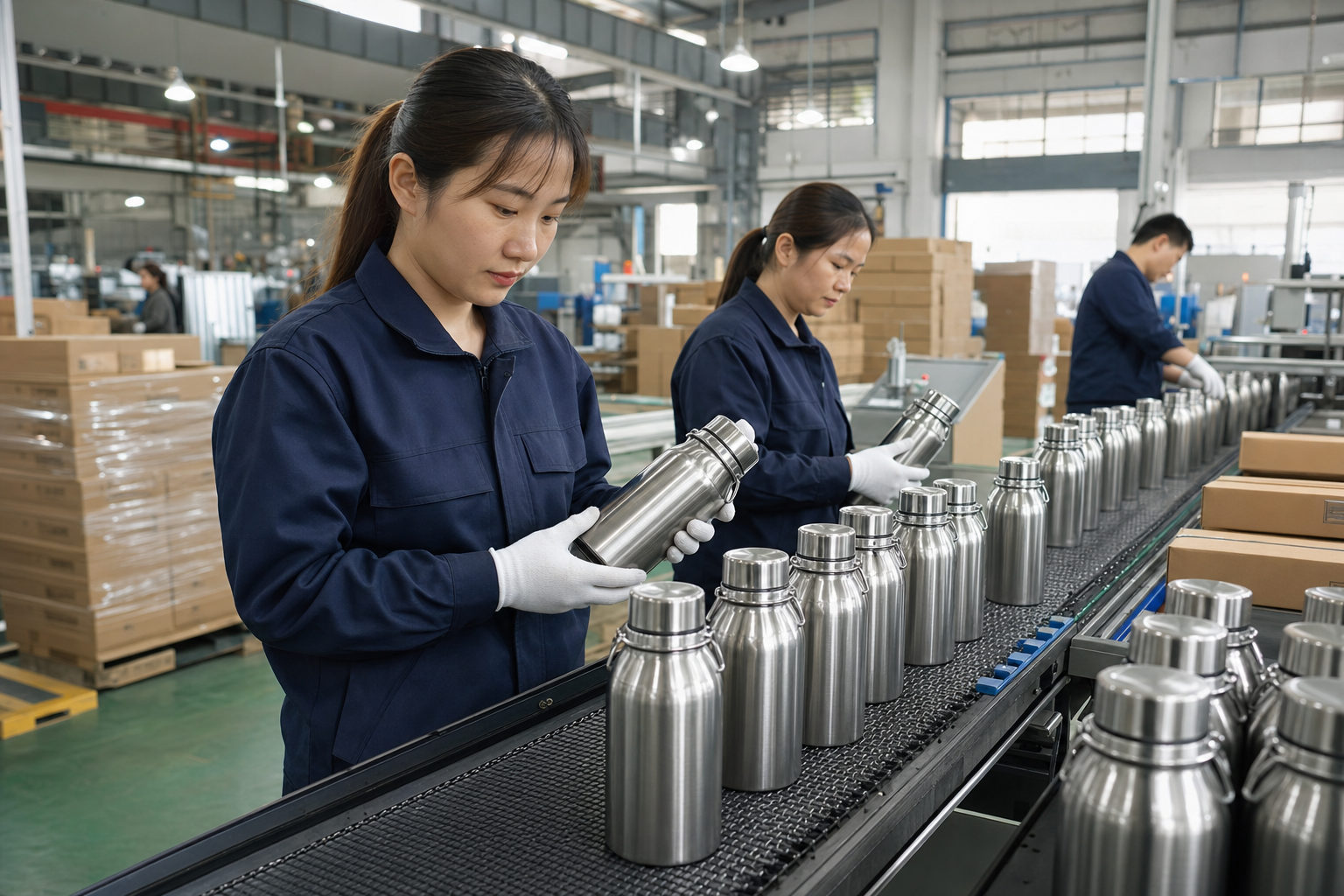
Key Takeaways
- For canteen bulk, a 0.5 mm 304 stainless body is a safer baseline than thin-wall low-grade steel.
- A realistic MOQ for wholesale canteen runs is often 1,000-3,000 pcs, with 35-45 day lead time after approval.
- For export, ask for REACH, LFGB, FDA, and AQL 2.5 inspection records before you confirm PO.
- If you want best wholesale drinkware pricing, compare FOB China terms, decoration method, and packaging density, not just unit price.
If you are buying canteen bulk for retail, promotions, or private label, the wrong spec costs you twice: once in unit price, again in returns. A canteen looks simple. On the line, the real checks are 304 stainless, a lid torque test at 18 N·cm, coating rub resistance, and whether the factory holds a 0.3 mm wall-thickness spread across the lot. We have seen buyers chase a 5-cent saving and then eat a pallet of leaks. In China, that is where the gap shows.
For procurement managers and brand owners, the job is not to grab the lowest quote. It is to find a factory in Zhejiang or elsewhere in China that ships the same bottle at 3,000 pieces or 30,000 pieces, keeps MOQ steady, quotes lead time in days not guesses, and gets the carton marks and commercial invoice right the first time. The buyer flagged a typo on the PO once, and customs still held the booking. That is the standard for canteen wholesale. Anything softer is sales talk.
What defines a good canteen
For canteen bulk, the spec matters more than the label on the carton. We ask three things first: material, closure, and test standard. A buyer can call it a wholesale canteen, bulk drinkware, or a promotional flask, but if the body is 304 stainless and the wall is 0.5 mm, that is the real starting point. For outdoor retail, military-style channels, and corporate programs, we run that spec because thinner walls start denting on the line and in transit. For light-duty giveaways, you can go thinner, but we’ve seen the reject rate climb fast.
Check the cap system next. A screw cap with food-grade silicone sealing beats a decorative cap that only looks tight. For insulated versions, we ask for a vacuum leak test and temperature retention data at 20°C ambient; QC pulled the sample and checked for seepage after 24 hours, not just a quick twist test. A canteen is not just a bottle. It is a seal, a finish, and a handling profile. If your customer wants the best wholesale drink bottle, the factory needs repeatability, not a pretty sample that passes once.
When the same factory also builds bulk growler or alcohol flask bulk programs, we can reuse the same line only if the geometry and finish are close. The math does not work if the neck finish changes, because tooling fit, polish time, and changeover all move the cost. We ship mixed batches from Zhejiang every week, and a 2 mm difference at the mouth can slow the whole line. The buyer flagged it on a PO once—wrong cap thread, one digit off—and that one typo cost two days.
MOQ and lead time realities
Most buyers fixate on the unit price and miss the MOQ. That is the wrong question to ask. For canteen wholesale, the real minimum changes with stock color, custom color, laser logo, or full print packaging. We usually see 1,000 to 3,000 pcs per SKU on a sane order. If you add a special lid, spot color body, and retail box, the MOQ climbs. The setup cost is the reason, not attitude. One order last month had a PO typo on the box size, and the line had to stop while QC pulled the sample against the carton spec.
Lead time has two parts: sample approval and mass production. A plain sample usually takes 5-10 days. Mass production for a standard order is often 35-45 days after deposit and final artwork approval. If the job needs custom tooling, new lid molds, or multi-layer packaging, plan for 55-70 days. A buyer once pushed for a 28-day ship date on a fresh lid mold. The math does not work. If a supplier claims a much faster schedule without stock on hand, check whether they are quoting from inventory or just hoping the line will catch up.
A factory in Zhejiang that ships 30,000 units per month can absorb a mid-sized reorder, but only when artwork and carton specs are frozen. We run into delays when the buyer changes the logo height by 2 mm after sample sign-off. That is the gap between serious bulk drinkware sourcing and a rushed one-off buy. For drinkware wholesale, steady production planning beats a small per-unit discount. We have seen it go sideways too many times when the buyer chased 3 cents and lost 12 days on rework.
Materials and compliance checks
The easiest mistake in wholesale drinkware is treating all stainless as the same lot. It is not. We ask if the body is 304 or 316 stainless, whether the inner liner is passivated, and whether the supplier can hand over traceability back to the coil. For food contact exports into Europe and North America, we expect REACH, LFGB, and FDA papers, plus a plain BPA-free statement for plastic parts. If the lid resin grade is blank on the spec sheet, we move on.
For a standard canteen, 304 stainless covers most programs. If the bottle will hold acidic liquids or the buyer wants a harder wear profile, 316 earns its place. Check the coating too. We run adhesion and chip tests on the line, and a real powder spec usually lands around 60-80 microns depending on finish. Last month QC pulled a sample that came in at 43 microns, and that order stayed in sample status.
Do not buy on the sample alone. Ask for the same material certificate, finish standard, and compliance pack that will go into the mass order.
This matters even more when the range includes beer growler wholesale, beer tumbler bulk, or alcohol flask wholesale bulk. They look simple on the shelf. They are not the same in testing, and one market will reject a lid label typo while another flags coating odor at receipt. A buyer in Zhejiang can usually get the right papers in 12 days, not 18, if the factory is export-ready. If they stall on a resin declaration or an AQL 2.5 report, we treat that as a warning.
Decoration that survives shipping
I’m rewriting the section to sound like an actual factory-side sales note: tighter phrasing, concrete production details, and no AI-style filler. I’ll keep the HTML tags exactly as they are.Decoration is where a bulk canteen order starts leaking margin. A logo can look perfect in the sample room and still scuff after 3,000 km on a truck, carton compression, or a warehouse fork hit. We run screen print, pad print, laser engraving, heat transfer, and full-wrap UV print on the line. QC pulled a sample after a 1.2 m drop test and checked the edge wear under a loupe. For bare stainless, laser engraving is the safest bet; screen print holds up when the artwork is simple and the finish stays flat.
If you are buying growler bulk or beer growler in bulk, the decoration has to match the channel. Retail packaging can carry richer graphics. A reusable outdoor canteen should stay lean. The buyer flagged a two-color effect as dead cost, and the math did not work. A print setup fee of USD 30-120 per color is common, so the real question is whether the artwork earns that spend at your target margin.
For custom logo work, ask for a wet-rub test, alcohol rub test, and carton friction test. If you are targeting Amazon or retail distribution, ask whether the factory can print FNSKU labels and apply warning labels before export. That keeps your receiving team out of rework. We check the logo position with a 0.8 mm edge allowance because the curve of the canteen can pull the mark out of shape. A good supplier in China will tell you that up front.
QC and packing for export
A bulk order is not done until inspection and packing rules are set on paper. For canteen bulk, we run AQL 2.5 for critical and major defects, with AQL 4.0 for minor cosmetic issues if the channel accepts it. Before the first shot of production, ask for a golden sample, approved artwork, carton spec, and test plan. QC pulled the sample last week and found a 1.2 mm lid gap on one lot; that is the kind of miss that becomes a claim later. During production, require inline checks on welds, vacuum integrity, lid fit, print alignment, and odor control.
Packing is where a lot of damage starts, after the bottle leaves the filling line. A single canteen can go in a polybag, then a white box or color box, then master cartons with compression-resistant board. If the goods are going into e-commerce or cross-dock distribution, the inner pack must pass a drop test. We’ve seen a buyer push back on a 6 kg master carton because the line was fine but the tray flexed in transit. If you are shipping beer growler wholesale bulk or alcohol flask wholesale programs, the shape usually needs a tighter tray insert because slimmer bodies move more in transit.
Ask for carton size and palletization before you confirm the order. The math does not work if you wait until after production starts, because freight from China changes fast when cubic volume moves by even 0.02 m3 per carton. A small packing change can hit landed cost harder than a minor factory discount. We had one PO with the buyer’s typo on carton length, 42 cm instead of 24 cm, and the whole plan had to be redone at the packing table. The best wholesale drinkware quote is not the lowest FOB number; it is the one that survives inspection, freight, and returns without a surprise.
How to compare factories fairly
When you compare suppliers for wholesale growler, wholesale drinkware, or canteen wholesale, use one sheet for every factory. Same fields. Same unit. No blank spaces. We ask for unit price, MOQ, lead time, sample cost, tooling cost, packaging spec, and the export term, usually FOB Ningbo or FOB Shanghai. If one quote is 8 percent lower but leaves out print, carton inserts, or testing, the math does not work.
Check the factory, not the sales talk. A real manufacturer in Zhejiang should explain welding, polishing, vacuum detection, and packing sequence without calling back three times. Ask how many units per month they run on the same line, what defect rate they track, and how they handle rework. QC pulled the sample on one line here and found a 0.3 mm lid gap; that is the sort of detail that tells you whether they know the job. If they can show ISO 9001 procedures, BSCI audit status, and incoming material checks, you are already ahead of most buyers.
For drinkware bulk programs, the question is not “Can you do it?” It is “Can you do it for 12 months without drifting?” We have seen this go sideways on a PO with one typo in the carton count, and the buyer flagged it only after the first shipment landed. That matters whether you are sourcing a plain canteen or a mix that also includes bulk growler, alcohol flask in bulk, or beer tumbler wholesale items. Consistency is what makes a factory a real partner in China, not just a sample source.
Request a canteen quote with clear specs
Send your target MOQ, artwork, and target market. We will return a practical China quote with packaging, compliance, and lead time built in.
Frequently asked questions
What MOQ should I expect for canteen bulk orders?
For standard canteen bulk orders, a realistic MOQ is usually 1,000 to 3,000 pcs per SKU. Stock colors and simple laser logos sit at the low end. Custom Pantone body color, printed packaging, or a new lid design pushes MOQ higher, often 3,000 to 5,000 pcs. If a factory offers 300 pcs with full customization, check whether they are using stock inventory or mixing production with another order. That can work for a trial, but it is not a stable wholesale canteen plan. Always ask whether the MOQ is per color, per artwork, or per total order. Those details change the landed cost more than the headline number.
Is 304 stainless enough for wholesale canteen use?
Yes, 304 stainless is enough for most wholesale canteen programs. It is the standard choice for general drinkware wholesale, outdoor retail, and promotional campaigns. If the product will hold acidic liquids more often, or if your customer expects a premium corrosion margin, 316 can be justified. What matters is not only the grade, but also the finish and seal system. Ask for material certificates, passivation confirmation, and a lid gasket that is food-grade silicone. For export into Europe and North America, pair the material spec with REACH, LFGB, and FDA support. That gives you a cleaner compliance file and less risk at customs or during customer QA.
How do I compare FOB quotes from China correctly?
Compare all FOB China quotes on the same basis: same material, same decoration method, same packaging, same carton count, and same inspection standard. A quote for canteen wholesale that excludes print setup, inserts, or test reports is not comparable to a quote that includes them. Ask for the exact port, usually Ningbo or Shanghai, and confirm whether the price includes export cartons, inner boxes, and palletization. For bulk drinkware, freight volume can change landed cost by 10 percent or more, so packing density matters. The best quote is the one that survives sample approval, production, inspection, and shipping without hidden add-ons.
Can I mix canteen, growler, and flask items in one order?
Often yes, but only if the products share a similar body size, decoration method, and production schedule. A factory in Zhejiang may be able to combine canteen bulk, growler bulk, and alcohol flask wholesale bulk on one export order, especially if the same printing and packing team handles them. The benefit is better container utilization and one customs entry. The risk is schedule complexity if one SKU needs a new mold or special coating. If you plan to mix categories, confirm separate MOQ per item, separate artwork files, and whether the carton spec is shared or unique. Mixing works best when the supplier already runs a broad wholesale drinkware line.
What quality checks should I require before shipment?
At minimum, require a golden sample, inline inspection, and final AQL 2.5 check for critical and major defects. For canteen bulk, key checks include leak testing, lid torque, print alignment, odor, coating adhesion, and carton drop resistance. If your order is for retail or e-commerce, ask for photo records from random cartons and a packing audit that confirms count accuracy. If the factory offers vacuum or temperature retention claims, ask for the test method, ambient temperature, and time duration. A serious supplier in China should give you a written QC plan, not just a verbal promise. That is the fastest way to avoid rejected pallets after arrival.