Key Takeaways
- A 304 stainless canteen with 0.5 mm wall thickness fits most canteen custom orders; move to 0.6 mm if dent resistance matters.
- Typical MOQ from a China canteen manufacturer is 500 to 1,000 pcs per color on existing tooling, or 3,000+ pcs for a new mold.
- Plan 7 to 12 days for samples and 35 to 45 days for mass production after approval, with longer timing for premium finishes.
- For Europe and North America, ask for REACH, LFGB or FDA, ISO 9001, BSCI, and AQL 2.5 inspection on critical defects.
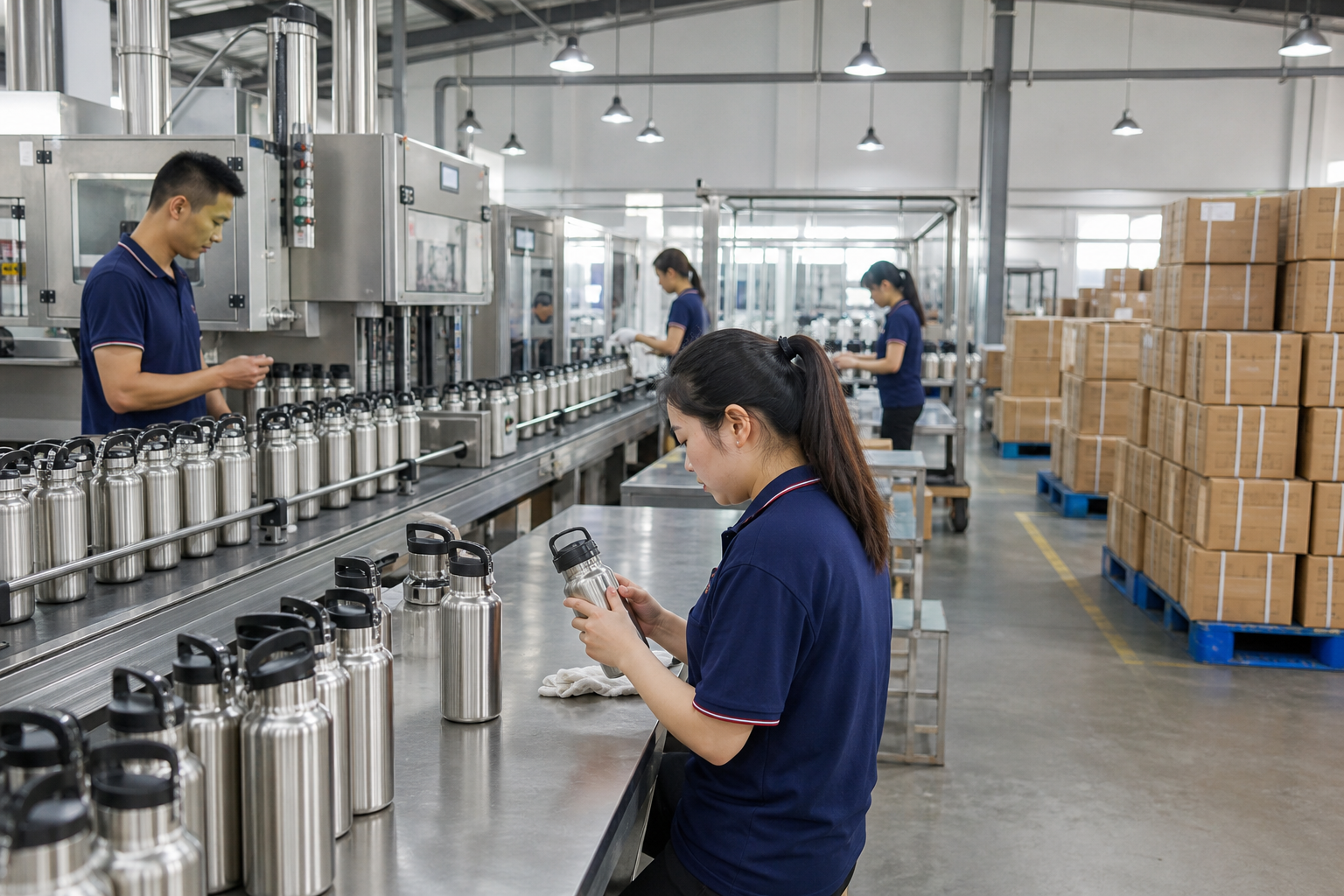
If you are buying canteen custom for retail, promotions, or distributor programs, start with the spec sheet, not the logo. A canteen looks simple. The real cost drivers are steel grade, wall thickness, lid seal, coating method, and carton test. We have seen buyers fixate on print placement, then the buyer flagged a 0.3 mm wall and the quote moved. In Zhejiang and across China, a serious canteen factory asks how the bottle will be used before it prices the artwork; QC pulled the sample and checked the lid with a torque wrench.
For BottleForge Industrial, we run 50,000 units per month, with MOQ from 500 to 3,000 pieces depending on finish and tooling. That is the practical range for a canteen customizable program, whether you need a custom canteen for outdoor retail or a customized canteen for a canteen distributor. The math does not work any other way. On the line, a carton that fails the drop test gets held back fast, so lock the spec first and negotiate FOB after the sample passes.
Define the Product First
I’m rewriting the section in place and keeping the HTML structure intact. I’m tightening the language, adding a few factory-floor details, and stripping the AI-style filler so it reads like a buyer-facing sales note.When a buyer says canteen custom, we do not start with logo placement. We start with capacity, body build, lid, and sales channel. A 500 ml single-wall giveaway canteen is a different run from an 800 ml double-wall retail piece. On the line, a 58 mm mouth and a 33 mm PP lid change the tooling plan fast. If you are a distributor, carton count, barcode, and shelf-ready pack matter as much as the bottle.
For canteen customizable programs, I ask buyers to lock five points: volume, material, wall thickness, closure, and finish. That gives a quote we can stand behind. If the PO says “same as last time” and the wall thickness has a typo, the mold schedule gets messy. We run faster on an existing body than on new tooling, so start from the standard shell when the 3,000-piece MOQ works. The same logic applies if you already sell customizable drinkware or a custom growler line: keep the production method, change the user-facing parts.
- Promotional orders: keep decoration simple and unit cost low.
- Retail orders: define color, tactile finish, and hangtag.
- Distributor drinkware orders: define carton pack, pallet pattern, and reorder speed.
If the canteen vendor asks the right questions up front, landed cost stays under control. Skip one answer and QC finds it later, usually at the 10-drop test. That is the wrong question to ask late.
Materials and Thickness Control
Material choice decides whether a customized canteen feels solid or like a cheap giveaway. For most metal canteen orders, 304 stainless is the baseline we run. It handles daily use, is easy to source in China, and fits most Europe and North America programs. If the buyer wants salty coastal use, acidic drinks, or hard outdoor service, 316 stainless gives better corrosion resistance, but the price jumps. On a straightforward custom drinkware line, that jump only makes sense when the use case really needs it.
Thickness matters as much as alloy. A 0.4 mm shell may save a few cents, but the dent rate climbs fast. QC pulled the sample with a micrometer and the difference shows right away at 0.5 mm, which is the practical floor for a retail-grade canteen custom order; 0.6 mm feels better in hand and survives carton crush and pallet pressure better. For insulated models, ask about vacuum spacing, copper coating, and lid gasket material. A real canteen factory in Zhejiang should hand over material certificates, incoming inspection records, and a cutaway sample if the structure is complex. If they dodge those, the math does not work.
If the wall gauge is not on the drawing, the price is not real.
That is the wrong question to skip. We have seen a PO typo turn 0.5 mm into 0.05 mm on paper, and the buyer flagged it only after the line had already scheduled material. You want the gauge written down before deposit, not after samples land.
Decoration That Survives Use
Logo application is where a canteen promotional order either lands clean or looks rushed. Screen printing stays the lowest-cost move for 1 or 2 colors, especially when you need a sharp unit price on a canteen customized for events. We run this on the line with a 120 mesh screen and a 500 pcs MOQ, and if the buyer wants six colors on a tight budget, the math does not work. Laser engraving fits the premium retail side better because it will not peel and it holds up after repeated washing. UV print and heat transfer give more color, but QC pulled the sample back once the curing temp drifted 8 C, so surface prep matters.
For a custom canteen, keep the artwork practical. Large wrap graphics look good in a mockup, but the real bottle has seams, curvature, and a shoulder that will bend the image. We have seen this go sideways on a 240 mm tall bottle when the buyer flagged a cropped logo on the first pre-production proof. Ask the canteen vendor for a print template, logo safe zone, and Pantone match tolerance before you approve. If you are already selling customized drinkware or a custom growler program, the same rule applies: pick the decoration method for the channel, not the other way around.
Do not over-design the logo
A distributor canteen should read clearly from 1 meter away. A premium retail bottle should still survive dishwasher wear, abrasion, and repeated handling. That is the real test, and this is the wrong question to ask if the logo needs 12 details in 18 mm of space.
MOQ and Price Break Logic
MOQ is set by line time, not by a mood. We run changeovers on the cap press, the sleeve printer, and the packing table, so a standard canteen custom order in China usually sits at 500 to 1,000 pcs per color on an existing body. If you want a new cap, a new mold, or a fully custom canteen shape, 3,000 pcs or more is normal. That is the math. Not a red flag.
Price moves in layers. A simple 500 ml 304 stainless canteen may land around USD 1.10 to 2.40 FOB at 1,000 pcs, depending on finish and logo count. Add vacuum insulation, powder coating, or a special lid, and the number moves into USD 3.50 to 7.00 or higher. A real supplier should break the quote apart, not hide it in one line. Ask for separate pricing on bottle, lid, print, gift box, and master carton. QC pulled a sample last week and found a 0.3 mm gap at the lid seat, and that kind of detail is exactly where the cost changes.
- Sample lead time: 7 to 12 days, if the cap thread is standard and the artwork is clear.
- Mass production: 35 to 45 days after approval, assuming the line is not waiting on a new carton spec.
- Factory output: a stable canteen manufacturer in Zhejiang should handle about 50,000 units per month on a mixed line with a steady packing crew.
If your canteen vendors cannot explain the price ladder, you are paying for guesswork. We have seen buyers approve a quote, then the PO showed 500 ml as 50 ml, and the whole order had to be corrected before we shipped.
Compliance for Europe and North America
If you sell into Europe or North America, compliance is not optional. For metal and plastic contact parts, ask for REACH where relevant, LFGB or FDA food-contact support, and a written BPA-free statement if the lid uses plastic. We ship a lot of canteen custom jobs from Hangzhou, and the first thing we check is whether the test report matches the SKU code on the PO, not just a random sample. Do not accept a generic certificate with no SKU reference.
Quality control should be measured, not vague. A solid inspection plan runs AQL 2.5 for major defects and AQL 4.0 for minor defects, with zero tolerance for leakage. On one 500 ml insulated bottle line, QC pulled the sample and found the lid torque was 0.8 N·m short of spec, so the batch got held. For insulated models, add vacuum retention checks, lid torque checks, and hot-water hold tests. For Amazon FBA, confirm carton dimensions, FNSKU labeling, and master carton marks before production starts. The math does not work if you fix carton marks after packing starts.
- Ask for ISO 9001 and, if possible, BSCI documentation.
- Request pre-production samples and a sealed golden sample.
- Specify drop test and leak test requirements in the PO.
In Zhejiang, the factories that handle export work well are usually the ones that already run this drill every week. The buyer flagged a PO typo once — “canteen custum” instead of “canteen custom” — and the line still caught it before tooling, which saved a reprint and a week of back-and-forth.
Choose the Right Factory
Not every canteen supplier is a real canteen maker. Some are trading firms, some are vendors with a sourcing desk, and some own the line. That difference shows up fast when a buyer asks about tooling ownership, QC records, or a reorder slot. We’ve seen a low first quote turn into a late shipment at 12 days vs 18 days because the factory did not control the mold schedule.
Ask for factory photos, process flow, and a sample schedule. A serious canteen factory should show molding or forming, polishing, printing, assembly, packing, and final inspection. On our line, QC pulled the sample after a 0.3 mm cap-gap check, and that is the kind of detail you want to see. If you manage distributor canteen programs, ask for mixed-SKU cartons, reserve stock plans, and market-specific relabeling. The same rule applies to a custom growler or travel bottle program. No discipline, no margin.
I trust a supplier more when they answer basic ops questions without dancing around: monthly output, MOQ by finish, sample fee, packaging standard, and the fix if a leak shows up. If they go vague on any of those, the math does not work. We had one PO with the buyer’s typo on the carton mark, and that tiny error cost three days on the pack line. For a canteen custom project, the factory you choose decides whether the order stays clean or gets messy fast.
Get a Canteen Quote With Exact Specs
Send capacity, material, lid style, artwork, and annual volume. We will return FOB pricing, MOQ, and sample timing within one working day.
Frequently asked questions
What MOQ should I expect for canteen custom orders?
For a standard canteen custom order on an existing body, expect 500 to 1,000 pcs per color or print version. If you need a new lid, new mold, or a fully customized canteen shape, MOQ usually starts around 3,000 pcs and can go higher. Sample fees are often USD 30 to 80, and tooling may add USD 300 to 1,500 depending on complexity. A practical China canteen manufacturer will also tell you the re-order MOQ, because that is often lower than the first run. Ask for one quote with bottle, lid, decoration, and carton pricing split out.
Which material is best for Europe and North America?
For most buyers, 304 stainless is the right starting point for a canteen customized for retail or promotion. It is widely accepted, cost-efficient, and fits most food-contact programs. Use 316 only when corrosion resistance is truly needed, because it raises cost without helping every category. For lids and seals, ask for food-grade PP, Tritan, or silicone parts with REACH and LFGB or FDA support where applicable. A wall thickness of 0.5 mm is a good floor for retail, while 0.6 mm improves dent resistance. If you need insulated performance, confirm the vacuum layer and thermal test results before you place the order.
Can you do full-wrap printing on a canteen?
Yes, but the method depends on the finish and the use case. A canteen promotional order often uses screen printing for one to two colors because it is stable and economical. Full-wrap graphics are possible with UV print or transfer methods, but the design must respect seams, curvature, and the shoulder zone. For a premium custom drinkware line, laser engraving or embossed marking is usually more durable than ink. Ask the canteen supplier for a flat artwork template, a Pantone target, and the logo safe zone before approval. Good artwork control prevents misalignment and keeps repeat orders consistent.
How do you control quality from a canteen factory in China?
Start with a golden sample and a written spec sheet. Then require in-line checks for bottle body, lid fit, print placement, and leak performance. A reasonable inspection plan uses AQL 2.5 for major defects and AQL 4.0 for minor defects, with zero tolerance for leakage. For insulated products, add hot-water hold tests and lid torque checks. Ask for ISO 9001 and, if possible, BSCI documents, plus traceable test reports tied to your SKU. If you are buying from Zhejiang or elsewhere in China, insist on pre-shipment photos, carton counts, and one retained sample from the final batch.
Can you support distributor drinkware or FBA programs?
Yes, and the packaging details matter. For distributor drinkware, we can set master carton counts, barcode labels, pallet patterns, and reserve stock by SKU. If you sell through Amazon FBA, ask for FNSKU labeling, carton dimensions, and moisture-protection instructions before production starts. Mixed-color cartons can work for canteen distributor programs, but only if the channel can handle them. If you also run a custom growler or other custom drinkware line, you should align carton weight and outer box dimensions across SKUs to reduce freight waste. The best setup is one that lowers handling cost, not just unit price.