Key Takeaways
- A realistic MOQ for a custom canteen is often 500 to 1,000 pcs, with 18 to 25 day lead times after approval.
- Choose material first: 18/8 stainless steel, Tritan, or aluminum all price and print differently.
- For export markets, ask for REACH, LFGB, FDA, or ASTM-aligned testing plus AQL 2.5/4.0 inspection.
- A good canteen factory will quote body, lid, logo, packing, and carton spec separately, not as one vague unit price.
If you are buying canteen customizable drinkware for retail, promotions, or distributor programs, the common mistake is treating it like a simple bottle order. It is not. We have seen 500 pcs held up because the lid gasket failed after a 2-meter drop test, and the buyer only noticed when the first carton leaked on receipt. Price matters, but print wear, lid seal, and compliance can kill the order before it lands in your warehouse. The right spec follows how you sell it, not how it looks on a render.
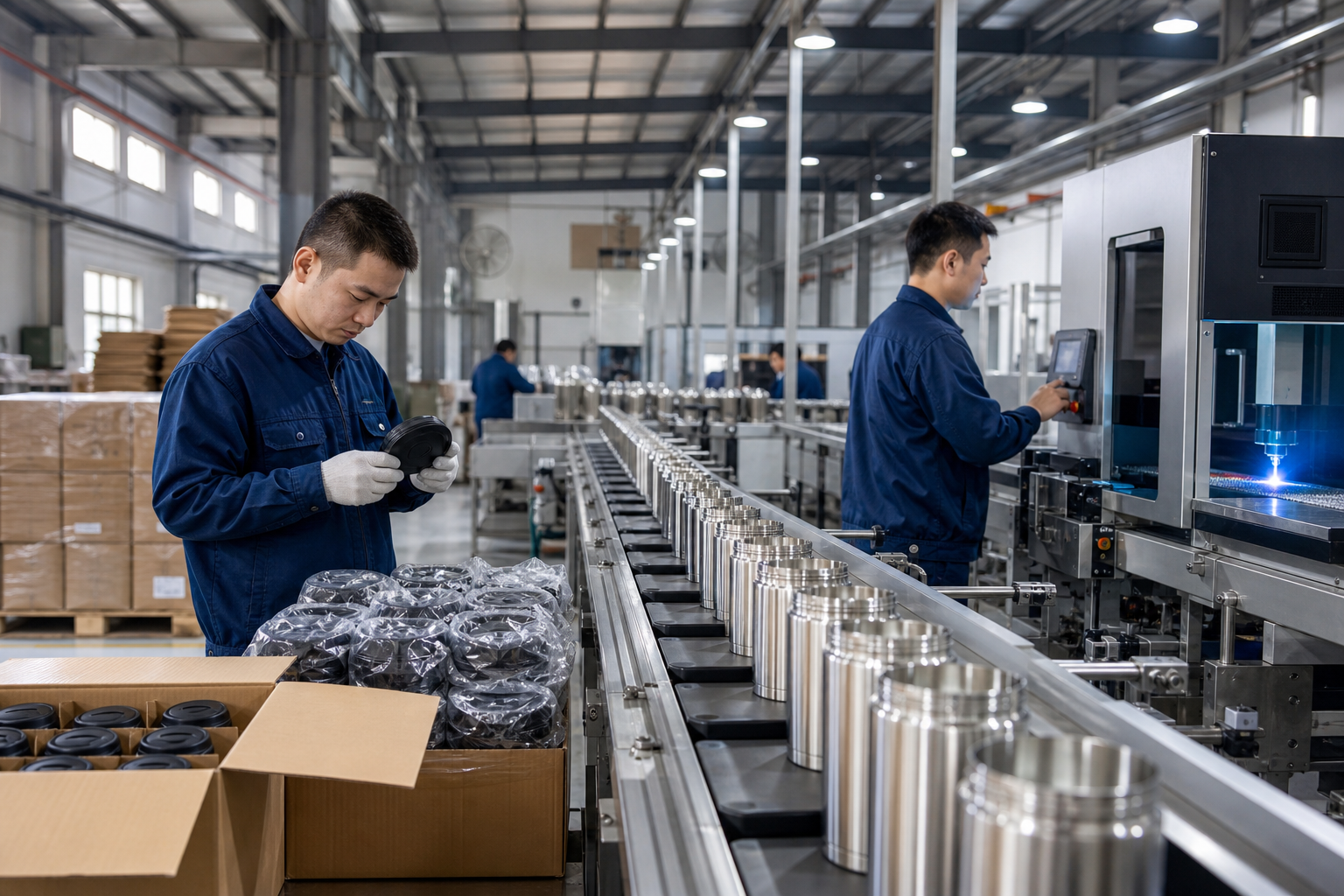
Good sourcing starts with a tight brief: volume, target retail price, decoration method, and market rules. In Zhejiang and across China, a serious canteen manufacturer will ask for those details before quoting, because they change tooling, packing, and lead time. Our line runs 180,000 units per month, MOQ starts at 500 pcs, and typical lead time is 18 to 25 days after sample approval. QC pulled the sample, checked the cap torque at 0.8 N·m, and sent it back once. That is the level of detail you should demand from any canteen supplier.
Start With the Sales Use Case
I’m rewriting the section to sound like a sales engineer on the floor: tighter claims, concrete production details, and no filler. I’m keeping the HTML tags and list structure intact while making the spec advice sound like something we actually run.Before you ask for a quote, pin down how the canteen will be sold. A canteen promo item for a 3,000-piece trade show run is not the same spec as a canteen distributor product headed for retail shelves. If you skip that step, you pay for a double-wall finish or laser logo area the buyer never asked for, or you ship a weak build that comes back with leaks. We have seen a PO list "5000pcs" and "5,000 pcs" in the same file; the line paused while the buyer sorted it. That is the wrong place to save time.
For a canteen custom project, start with capacity and audience. A 500 ml customized canteen is easier to pack; we ship 48 cartons on a 1.2 m pallet without drama, and it fits school, sports, and office use. A 750 ml or 1 L custom canteen sells better in outdoor channels, but the freight math moves, and a wider lid can force a new mold insert. QC pulled the sample after the cap torque hit 2.8 N·m and the buyer flagged the handle feel. If it is a distributor canteen program, ask whether you need stock on hand or batch replenishment. The answer changes the MOQ, carton plan, and lead time.
Ask yourself three practical questions:
- Is this a retail SKU, a giveaway for a 10,000-piece event, or a private-label launch?
- Will the end customer care more about price, insulation, or logo visibility?
- Do you need one hero product or a family of customizable drinkware items?
Once those answers are clear, the rest of the spec gets easier. A canteen vendor can point you to a body shape, lid style, and print zone that supports sales, not a sample photo. We once had a 35 mm logo band rejected because the buyer wanted more white space for a QR code. That pushback saved the order from a messy reprint.
Choose Material Before Decoration
Material drives cost, dent resistance, and the first round of buyer complaints. Start with decoration first, and you pay for it later. For canteen customizable programs, we run 18/8 stainless steel, aluminum, and Tritan or similar copolyester plastics. They do not belong to the same channel. On one 5,000-piece run, QC pulled the sample after the buyer flagged a print scratch that came from picking the wrong base metal.
Stainless steel is the safest default for a custom drinkware launch because it takes laser engraving, screen print, and powder coat cleanly. A 0.5 to 0.8 mm wall thickness is normal for many retail canteen manufacturers, and that range keeps weight down without giving up dent resistance. Aluminum is lighter and works for a canteen promotional order, but the line needs the right coating system or it scratches fast. Tritan fits buyers who want a clear body or a lower-cost lid/body combination, but we still check heat resistance and chemical compatibility before we quote. We have seen that go sideways on a 350 ml sample when the cleaner clouded the surface in one wash cycle.
Do not ignore the lid. A weak lid can ruin an otherwise solid custom canteen. Check thread fit, gasket material, and whether the closure survives repeated open-close cycles. On one export sample, the buyer found a 0.4 mm gasket mismatch after 300 cycles on the torque tester, and the whole order got pushed back. If your market wants insulated performance, ask for actual temperature retention data, not marketing copy. A good canteen factory should give you the test method, not just the number. For export work in China and Europe, request compliance files early so the material choice matches your target standard from the start.
Practical rule: if your buyer wants premium perception and repeat orders, stainless steel usually wins. If the buyer wants the lowest landing cost, you can look at aluminum or plastic, but only after checking freight, breakage, and claim rates. The math does not work any other way. We have shipped enough 12-day samples and 18-day reworks to know where the extra cost shows up.
Pick the Right Logo Method
I’m rewriting the section to keep the same structure while making the wording sound like a factory-side sales engineer, with concrete process details and less generic phrasing.Decoration gets oversold fast, and we see the fallout on the line. QC pulled one sample under a 10x loupe last week because the logo file had a thin stroke that vanished after curing. The right method depends on artwork, quantity, and how the canteen will be used. For a canteen custom order, the main options are silk screen, laser engraving, heat transfer, and full-color wrap. Each one looks different, and each one fails in its own way.
Laser engraving stays sharp and durable on stainless steel. We run it with a fiber laser, and it is a strong pick when the buyer wants a premium customized canteen and does not want reprint risk. Silk screen is still the cheapest route for a simple 1-color logo once the order moves past 3,000 pcs, especially on flat or gently curved bodies. That keeps margin predictable for canteen distributors. Heat transfer and wrap graphics give more color and detail, but they need cleaner files and tighter registration on the jig.
Here is the point buyers miss: logo cost is not just a unit-price question. A 28 mm logo on a simple body may add almost nothing. A full wrap on a tapered shape can add 12 to 18 seconds per unit, plus setup time and scrap. The math does not work any other way. If the order is for distributor drinkware, ask for separate pricing on each decoration option so you can compare landed cost honestly.
Do not choose the logo method first and the product second. The right sequence is body, lid, then decoration. That is how a canteen manufacturer keeps the quote stable.
If your market also buys custom growler or customized growler items, the same rule applies. Bigger surface area does not make printing easier. We have seen that go sideways when a buyer flagged a PO that said one decoration method and the artwork called for another. Registration and quality control get harder, not easier.
MOQ, Lead Time, and Cost
MOQ is not a sales trick. It is where material buying, injection setup, and labor assignment start to make sense on the line. For canteen customized orders, we usually quote 500 to 1,000 pcs per color or print version. Split it into 5 colors and the math breaks fast. We had one buyer ask for 8 artwork variants on a 600 pcs order; the PO looked clean, then the packaging charge showed up later. Ask for the full cost sheet before you confirm.
A straight canteen manufacturer should break out unit price, decoration fee, packaging fee, carton fee, sample fee, and any mold or tooling cost. If the quote only gives one number, your margin is a guess. On a real FOB China order, the gap between a basic stainless steel canteen and an insulated model can be several dollars per piece before freight. That matters when you ship to Amazon, retail chains, or distributor accounts. QC pulled a sample last week and found the logo file had a 1.2 mm misalignment; that kind of miss turns into a rework charge.
Lead time needs a real start point. A factory in Zhejiang with stable tooling and raw material stock can usually finish standard orders in 18 to 25 days after sample approval. If you add a custom lid, embossed logo, or special coating, expect more days on the schedule. We run a 48-hour sample turn on simple print jobs, but a buyer once flagged a PO typo on the lid spec, and that pushed the whole run back 4 days. For seasonal launches, plan for one sampling round and one correction cycle. If a supplier says seven days for everything, they are quoting the best case.
- Ask for MOQ by color, logo, and packaging version.
- Confirm whether the lead time starts at sample approval or PO receipt.
- Request carton dimensions for freight planning and FNSKU or retail label work.
That kind of clarity saves more money than chasing a lower quote from a weak canteen vendor. We see this go sideways when buyers ignore the carton spec and then pay air freight on 2.8 kg master cartons.
Quality Checks That Catch Problems
Quality control for custom drinkware should be boring, measurable, and documented. If your canteen supplier cannot show the inspection points, you are taking on avoidable risk. We run incoming material checks, in-process checks, final inspection, and packed carton verification on a normal export order. For a 5,000-piece run, we expect AQL 2.5 for critical defects and AQL 4.0 for major defects unless the buyer’s own program is tighter. QC pulled the sample, checked the caliper, and the numbers either hold or they don’t.
For a canteen customizable product, the usual failures are easy to spot: lid leakage, print abrasion, bad threads, odor, coating inconsistency, and carton damage. This is the wrong question to ask as a generic “is the quality good?” A serious canteen factory should test lid torque, leak performance, drop resistance, and logo adhesion. If the order is insulated, ask for retention testing by time and temperature, such as 12 hours at 60°C against 18 hours in your target market. If the product is going into Europe, ask for REACH and LFGB-related documentation where relevant. For North America, the material and coating claims need test reports, not a sales sheet with a shiny cover.
You should also insist on sampling discipline. One pre-production sample is not enough for a customized drinkware program if there are three lid colors or two cap variants. Approve a golden sample, then verify a production sample before mass packing. We’ve seen this go sideways when the PO said “black lid” and the buyer meant matte black, not gloss black. If the supplier is in China, ask for photos and batch codes during production, not only at shipment. That makes disputes easier to solve later. A phone photo of the line at 9:40 a.m. beats a vague promise.
Good QC does not eliminate problems. It makes them visible before freight leaves the warehouse. That is the real value.
Choose a Supplier You Can Scale
I’m rewriting the section in place and tightening the language so it reads like an export sales engineer, while keeping the HTML structure intact.There is a real gap between a canteen vendor that can turn out one sample and a canteen manufacturer that can keep repeat orders moving. If you are building a brand or serving several customers, you need scale, paperwork, and steady execution. The right partner should answer the basic questions fast: monthly output, tooling lead time, packaging options, compliance files, and how they handle reorders when the buyer comes back six weeks later.
A serious supplier conversation should cover whether the factory is a BSCI-audited site, whether ISO 9001 procedures are actually used on the floor, and how the team handles custom canteen artwork across repeat orders. Ask how they keep color consistent from batch to batch. Ask whether they hold approved master samples and packaging references. On our side, QC pulls the sample against a light box and a Pantone book before we run the next lot. If they serve canteen distributors, they should understand stock planning and label control. If they also produce custom growler or distributor drinkware programs, that only matters if they can keep each SKU separate. Big catalog, loose control, and the buyer pays for it.
One practical test is simple: send a drawing with body, lid, logo, packaging, and target market. A good canteen supplier will return a quote with clear assumptions, not a vague promise. They should tell you what is standard, what is optional, and what will slow the order down. If the PO says “lid as discussed” and leaves the carton count blank, the line stops while sales chases the buyer for the missing line. That is the difference between a real factory and a middleman guessing at the details.
If you want a dependable source in Zhejiang or elsewhere in China, look for repeat export work, not just pretty photos. Ask for shipping records, re-order history, and a recent inspection report. A factory that can quote 12 days instead of 18, hold a 0.5 mm lid tolerance, and answer a label typo without drama is the kind of partner that lasts. Production discipline matters more than sales language.
Request a quote with your exact canteen spec
Send capacity, material, logo file, target market, and carton needs. We will return MOQ, samples, and lead time from Zhejiang with no guesswork.
Frequently asked questions
What is a realistic MOQ for a canteen customizable order?
For most B2B canteen customizable projects, a realistic MOQ is 500 to 1,000 pcs per design, color, or logo version. Some factories in China will quote lower, but the price often rises once you add separate packaging, multiple colors, or special decoration. If you want a custom canteen for retail or distributor stock, ask whether the MOQ is tied to body style, lid style, or artwork file. A good canteen manufacturer should break that down clearly. If the order is simple, stable, and uses existing tooling, 500 pcs is often workable. If you need a new lid, special coating, or premium gift box, expect the MOQ and lead time to move together.
Which material is best for a custom canteen?
For most branded orders, 18/8 stainless steel is the safest choice because it handles engraving, powder coating, and screen printing well. It also gives the buyer a better premium feel and lower complaint risk than many lightweight options. Aluminum can work for a canteen promotional campaign where weight and price matter more than long-term wear, but it scratches more easily. Tritan or similar plastic bodies are useful when you need transparency or a lighter product. The right answer depends on the channel. If you are selling into retail or distributor drinkware, stainless steel usually gives the best balance of margin, durability, and perceived value.
How do I compare quotes from canteen suppliers?
Compare them line by line, not as one unit price. A proper quote from a canteen supplier should show body cost, lid cost, logo cost, packaging cost, carton cost, and any tooling or sample fee. You should also confirm the Incoterm, usually FOB China for export buyers. Two quotes can look similar until you see one includes a plain box and the other includes a color box, or one assumes a simple one-color logo while the other includes laser engraving. Ask for the same spec across all suppliers. If the numbers still differ, the difference is usually in material thickness, finishing quality, or production discipline.
What compliance documents should I ask for?
For export canteen custom orders, ask for the documents that match your market. In Europe, REACH-related material declarations and, where relevant, LFGB or food-contact testing matter. In the United States, buyers often want FDA-related food-contact support, and some retail programs ask for ASTM-based or other internal test references. If the order includes insulation or coatings, ask for the exact test report, not just a certificate header. You should also ask for a factory profile, BSCI if available, and an ISO 9001 process outline if the supplier claims it. The point is simple: do not buy a customized canteen on verbal assurances when documentation is available.
Can I use the same factory for custom growler and canteen programs?
Sometimes yes, but only if the factory has the right equipment and process control. A custom growler and a canteen customized order can share decoration methods, carton standards, and compliance needs, but the body geometry and lid performance are different. Do not assume a supplier that makes one good SKU can automatically handle another. Ask for examples, test reports, and repeat order history. If you are a canteen distributor or distributor canteen buyer, the best partner is usually a factory that can manage both sampling and stable replenishment without changing the spec every batch. Consistency matters more than product variety.