Key Takeaways
- Most canteen customized orders start at 3,000 pcs, with 25-35 days lead time after sample approval
- 304 stainless steel with 0.5-0.6 mm wall thickness is the safest baseline for custom drinkware
- For Europe and North America, ask for REACH, LFGB, FDA, and AQL 2.5 inspection records
- A workable FOB China price for a basic 500 ml customized canteen often sits around USD 2.10-3.80 depending on finish and packaging
If you are buying canteen customized drinkware for retail, promotions, or distributor programs, color is the easy part. The hard part is fitting the SKU to margin, compliance, and shipping costs. A 500 ml stainless canteen can look clean in a mockup and still fail a coating rub test or add too much to carton cost once we run the line.
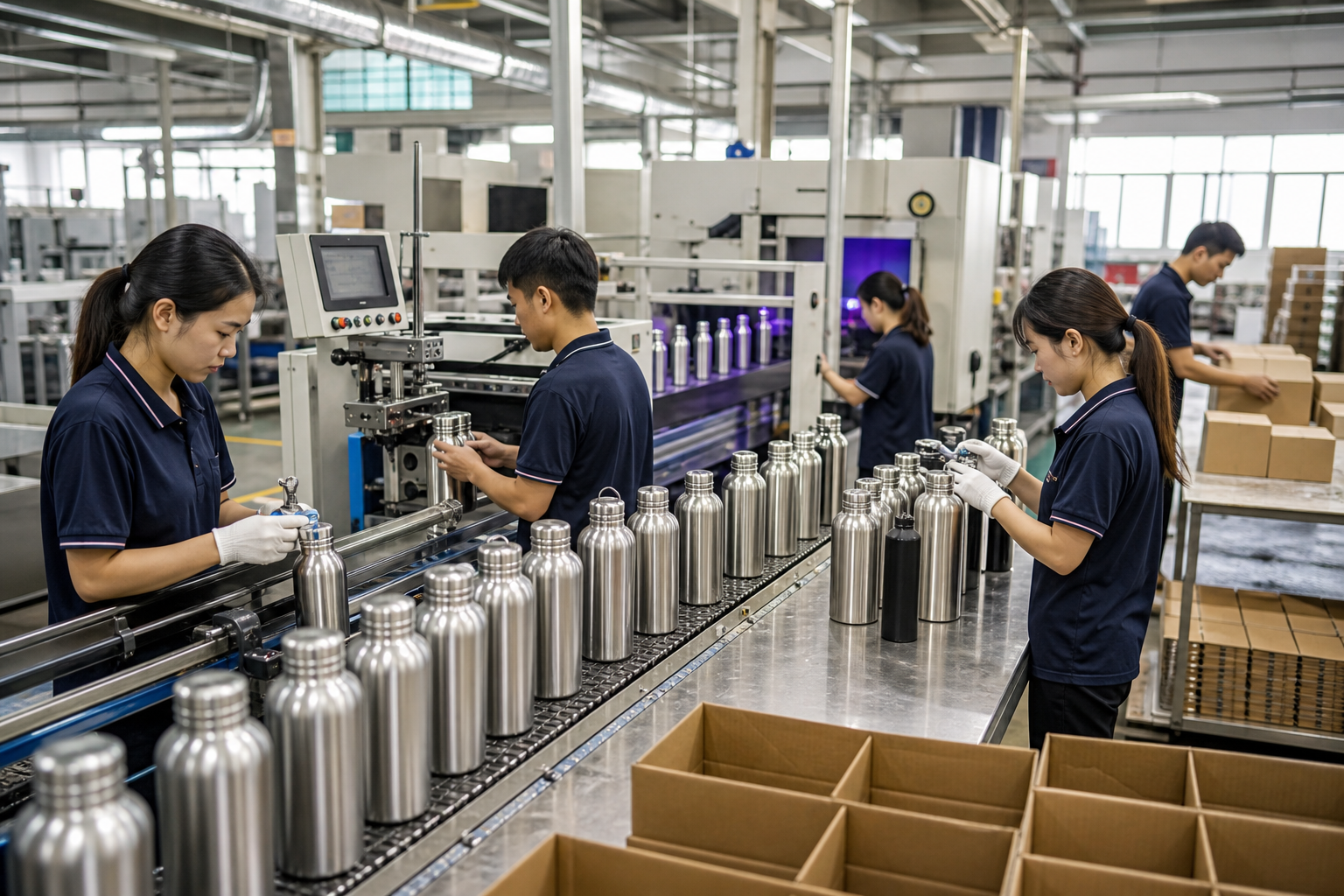
From our Zhejiang factory, we see the same pattern every week: a buyer sends a logo idea, then the order lands at a 3,000-piece MOQ, a 35-day production window, REACH-compliant coatings, and packaging that has to survive a 1.2-meter drop test. QC pulled the sample, and the buyer flagged a typo on the PO before printing started. If you want a supplier that ships repeatable quality, judge the canteen manufacturer by process, not by catalog photos. China has plenty of capacity; the question is whether the canteen factory can hold it.
Start with the use case
Before decoration, lock the use case. A canteen custom order for a hiking retail program is a different job from a canteen promotional giveaway for a trade show or a distributor drinkware line sold through ecommerce. Capacity, mouth size, lid type, and coating all move with the channel. On our line, a 500 ml body often ships with a narrower mouth and a matte powder coat for shelf appeal, while 750 ml fits outdoor buyers who hate stopping for refills.
Ask three questions first: who carries it, how often will it be washed, and what is the retail or giveaway price ceiling? If the answer is weekly use, dishwasher exposure, and under USD 12 retail, the math does not work for fragile coatings or oversized embossing. QC pulled a sample last week with a lid seal that looked fine but leaked at 45 degrees after 20 cycles. For a custom canteen program, the body material and lid seal matter more than a fancy carton. A good canteen manufacturer maps those choices to the use case instead of pushing the same SKU to every buyer.
- Retail outdoor: 500-750 ml, 304 stainless, powder coat, leakproof lid
- Promo campaign: 350-500 ml, simpler decoration, lower landed cost
- Distributor canteen program: repeatable SKU, stable color code, carton efficiency
Choose materials that survive real use
The base material is where most failures start. For customized drinkware, 304 stainless steel is the usual starting point because it gives solid corrosion resistance, workable cost, and steady supply here in China. If the buyer asks for stronger salt-spray performance or lower odor pickup, 316 is the answer, but the quote usually jumps 12-20% and fewer lines will run it at high volume. On a metal customizable canteen, we hold wall thickness at 0.5-0.6 mm. Go thinner and the line starts seeing dents after a few drops, and the cup feels flimsy in hand.
Glass and plastic do sell, but for most B2B canteen distributors, stainless wins on shelf value and fewer breakage claims. BPA-free Tritan lids and silicone seals are standard on the closure side. If you are building a canteen distributor catalog, keep one material family per line so spare parts and reorders stay clean. We had a buyer flag a PO typo once—mixed lid codes across two SKUs—and that small mistake turned one simple order into a headache. QC pulled the sample, checked the hinge fit, and the math still said separate constructions slow everything down.
Practical rule: if the buyer can drop it, stack it, and wash it daily, choose the simplest construction that still meets the target price.
Ask the canteen supplier for material certificates, coating data, and a sample cutaway if the design is new. In Zhejiang, the better factories keep these records by batch, not by memory. We ship this kind of file with the lot code on the carton, and if a supplier cannot show the 304 mill sheet or a 0.2 mm coating reading, that is the wrong factory to trust.
Decoration affects price and durability
Decoration is not just branding. It moves the unit cost, the lead time, and the reject rate. A single-color silkscreen logo is the cheapest route for a custom canteen; we run that on the pad-print line with a 60 mm fixture and it keeps setup simple. Laser engraving gives a cleaner mark on stainless steel and holds up better after 500 tape rubs. Powder coating in a custom Pantone color pushes the price up, but it gives you a cleaner retail shelf look. If you are selling customized canteen units through distributor programs, locking one body color and two logo methods is the sensible move. We had a buyer flag a PO typo on the logo size once, and the whole batch had to be rechecked.
For a premium custom growler or customizable growler style product, laser engraving plus matte powder coat is the usual pick because it feels solid and supports a higher shelf price. For a giveaway piece, 1-color print is enough. Ask for abrasion testing if the logo will be handled every day. A decent factory should quote a 500-cycle tape rub result or tell you the artwork is too fine for that method. QC pulled the sample on one job because the hairline text was under 0.3 mm, and the math did not work.
What changes the quote
- 1-color silkscreen: lowest setup cost
- Laser engraving: better permanence, slightly higher labor
- Full-body powder coat: higher material and cure cost
- Embossed or debossed branding: mold work, not just printing
For canteen vendors and canteen suppliers, consistency is the point. If one run is matte black and the next comes out slightly glossy because the coating batch changed, your retail team will spot it before the end customer does. We saw this go sideways on a 3,000-piece order when the oven temp drifted by 12°C, and the finish shift was enough to split the lot.
Know the real MOQ and lead time
Buyers often ask for a “small trial order,” then the real floor math shows up: color matching, carton setup, and line changeover all need a practical minimum. A typical canteen factory in Zhejiang will quote 3,000 pcs MOQ for a customized stainless canteen, while 5,000 pcs runs cleaner when you want two or three colorways. If you mix SKUs, the MOQ goes up or the unit price jumps 8-15% because the line has to stop for a new jig and QC pulled the sample again.
After sample approval, standard lead time is usually 25-35 days for production, then 5-10 days on the water if the shipment goes by sea to Europe or North America. Custom cartons, printed manuals, and FNSKU labeling for Amazon add another 3-7 days. If a canteen manufacturer promises “7-day delivery” on a made-to-order item, ask whether they are moving stock blanks, because true customization does not clear the packing table that fast.
Our Hangzhou team ships about 300,000 units per month across stainless and insulated lines, but that capacity only works when artwork, packaging, and compliance files are locked early. The delays we see are usually simple: a missing Pantone code, a carton spec with no thickness, or a buyer who cannot decide between a flip lid and a screw lid. We run into this every week, and the math does not work if the PO still has typos when printing starts.
Check compliance before you place a PO
I’m checking the section structure and rewriting the prose in place, keeping the tags and the compliance terms intact while tightening the language around how a buyer actually checks a factory.Europe and North America do not forgive sloppy compliance. For a canteen customized order, ask for REACH paperwork for coatings and plastic parts, LFGB or FDA food-contact declarations based on the destination, and BSCI or a similar social audit if the retailer asks for it. For stainless steel, request grade confirmation and migration test reports. If the item carries paint or powder coat, check heavy metals and odor results. On our line, QC pulls the sample before packing, and one wrong ink stamp on the test report is enough to stop the booking.
A buyer who skips this step pays twice: once for the goods, once for rework or a customs hold. If the product is going to Amazon or a big-box chain, the carton and unit label must match the SKU structure line by line. A misplaced barcode can turn a clean shipment into a warehouse mess. For custom drinkware, this is where a capable canteen supplier earns its margin. We saw one PO typo on an FNSKU add 48 hours at the DC gate, and the buyer flagged it fast.
- Food-contact: FDA or LFGB depending on market
- Chemical safety: REACH for Europe
- Factory audit: BSCI, Sedex, or buyer-specific code of conduct
- Inspection: AQL 2.5 for major defects, AQL 4.0 for minor defects is common
If the canteen vendor cannot explain which tests apply to which component, keep looking. The wrong question is whether the factory has a certificate; the real question is whether they can point to the cap, body, and coating and name the test for each one. We run that check on every lot, and in 30 plants you will still find a few that cannot keep the paperwork straight.
Price is a system, not a number
Procurement mistakes start when buyers look at unit price alone. A 500 ml customized canteen can quote at USD 2.10 FOB China for a plain print and standard box, then jump to USD 3.80 once you add powder coating, laser engraving, upgraded lids, and retail packaging. That gap is labor, material, and scrap. The wrong question is “Can you make it cheaper?” The better one is “What is in this quote, line by line?”
Break the price into body, lid, decoration, packaging, testing, and carton load efficiency. We once saved 11% on freight density just by changing the inner tray layout on a 5-ply export carton, and that beat a 5-cent lid cut. If you are building a distributor canteen line, ask for pricing at 3,000, 5,000, and 10,000 pcs. Then you see where the line starts to run clean. A Zhejiang factory that knows its numbers will show the step-down; the weaker ones hide margin in “extra fee” lines. The math does not work any other way.
Ask about spare lids too. If the closure cracks, after-sales cost climbs fast. We ship 2-3% extra lids with the order, or hold them in local buffer stock, because we have seen one broken cap turn into 200 complaints. QC pulled the sample, checked the hinge at 1.2 mm, and the buyer flagged a PO typo on the lid code the same day. Small detail, big mess.
Sampling decides whether the project lives
Do not approve a project from renderings alone. A sample tells you what the spec sheet misses: hand feel, lid torque, coating texture, smell after a hot-water rinse, and whether the logo sits straight after curing. For a canteen customizable project, we run one pre-production sample and one sealed golden sample before mass run. If the lid comes in two versions, sample both. The seal geometry changes pressure resistance and leak performance, and the buyer flagged this on a 500 ml order before we caught it on the line.
Test the sample with a 24-hour inversion test, then a hot-fill cycle at 90°C if the bottle is for hot drinks. Check engraving depth or print opacity under strong light, not under office LEDs. If you are buying for a canteen manufacturer program for North American distributors, confirm carton drop resistance and pallet pattern too. We had one PO typo where the carton count was printed as 24 instead of 12, and that one line would have blown the shipping math. A clean sample process saves most avoidable disputes later.
Ask the factory to put every approved detail into a production sheet: color code, finish, lid type, gasket material, carton count, barcode placement, and inspection standard. That sheet is the reference when the reorder comes back six months later. We keep the signed sheet next to the QC record, and QC pulled the sample twice when a Pantone code drifted by 1.5 mm on a reorder. In Zhejiang, the factories that keep records tight are the ones that scale without drama.
Send your spec and get a factory quote
Share capacity, logo method, destination market, and target price. We will match your canteen customized order to a workable production plan in China.
Frequently asked questions
What is a normal MOQ for canteen customized orders?
For a standard stainless steel canteen customized order, 3,000 pieces is a realistic MOQ at most Zhejiang factories. If you want multiple colors, special packaging, or several logo methods, the practical MOQ can rise to 5,000 pieces. For very simple stock blanks with one-color printing, some canteen suppliers may go lower, but the unit price usually climbs 10-20%. If you are testing a new distributor canteen line, ask for one sample run of 300-500 pcs only if you accept a higher setup cost.
How much does a custom canteen cost FOB China?
A basic 500 ml custom canteen made from 304 stainless steel often falls around USD 2.10-3.80 FOB China, depending on lid type, decoration, and packaging. Laser engraving, matte powder coating, or premium gift boxes can push the price higher. A 316 stainless version usually adds 12-20% over 304. The cheapest quote is not always the best value if the finish scratches easily or the seal fails in transit.
Which material should I choose for customized drinkware?
For most B2B buyers, 304 stainless steel is the safest default for customized drinkware because it balances corrosion resistance and cost. Use 316 only if the market demands stronger chemical resistance or you are targeting a higher-end outdoor line. For lids, BPA-free Tritan and food-grade silicone are common. If you need a lighter promotional item, plastic may work, but for a premium canteen custom program, stainless feels more credible and reduces return risk.
What compliance documents should a canteen manufacturer provide?
For Europe, ask for REACH documentation and, where relevant, LFGB test results for food-contact parts. For North America, FDA food-contact declarations are common, and many retailers also want proof of factory social compliance such as BSCI or Sedex. You should also request material grade confirmation for stainless steel, coating test data, and an inspection plan based on AQL. A serious canteen manufacturer in China should be able to provide these without delay.
How long does production take for a customized canteen?
After artwork and samples are approved, production usually takes 25-35 days for a customized canteen order. Add 5-10 days for sea freight to major ports in Europe or North America, and another few days if you need carton labels, FNSKU stickers, or retailer-specific packing. If a canteen vendor promises much faster delivery on a fully customized item, check whether they are shipping existing stock instead of true made-to-order goods.