Key Takeaways
- A realistic MOQ for canteen customized orders is usually 500 to 1,000 pcs per SKU, with sample lead time of 7 to 10 days.
- For stainless custom drinkware, 18/8 steel with 0.4 to 0.6 mm wall thickness is the safest baseline for export programs.
- Most distributors can target FOB pricing from USD 1.60 to 4.80 per unit, depending on structure, finish, and decoration.
- A factory in Zhejiang with 300,000 units per month and AQL 1.0 major / 2.5 minor control is easier to scale with than an ad hoc vendor.
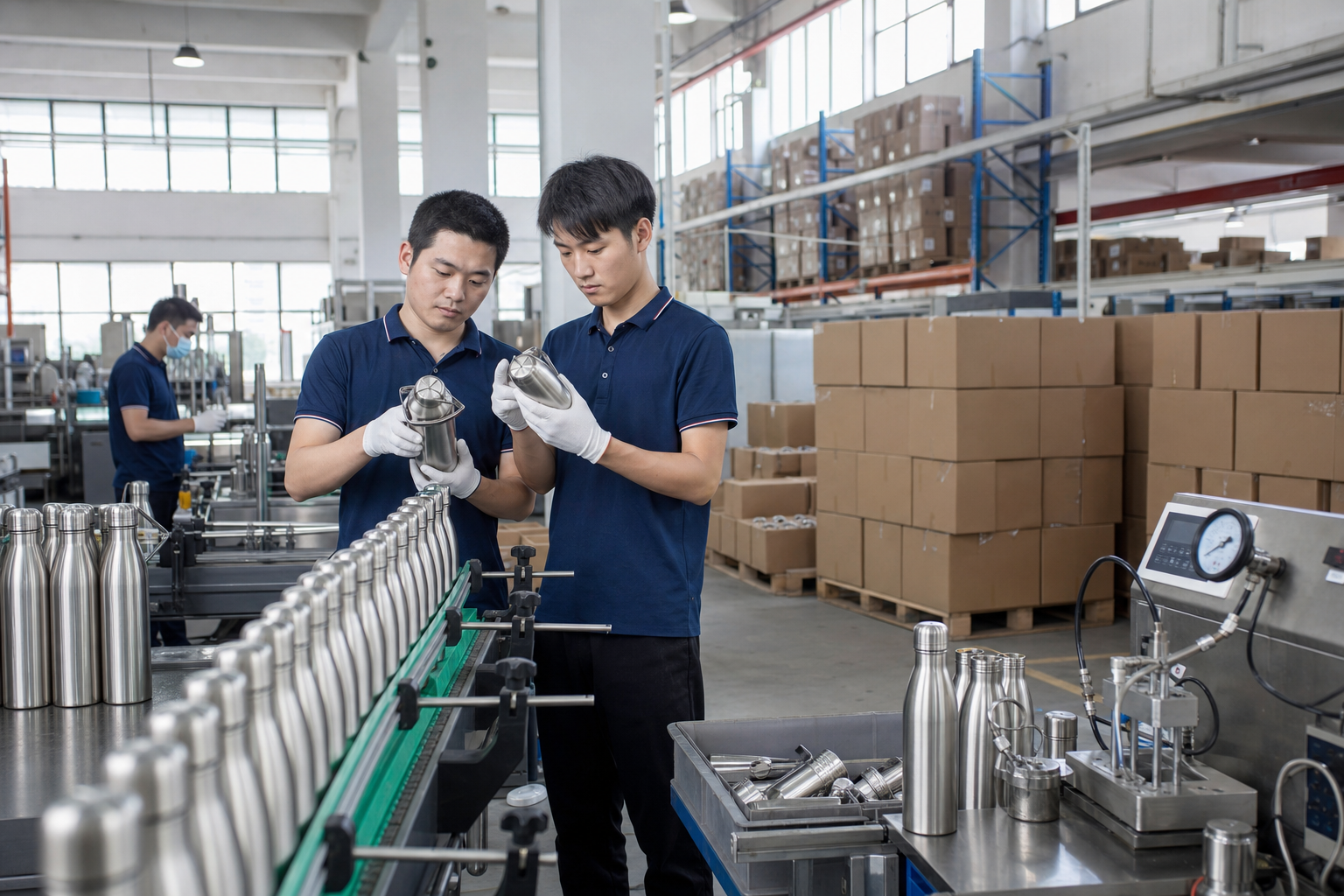
If you are a canteen distributor, the hard part is not finding a bottle. It is finding a canteen manufacturer that keeps decoration sharp, passes compliance, and still leaves margin after freight. We have seen a 500-piece sample look fine on the table, then fail on the line because the lid dripped after a 1.2 m drop test or the pad print rubbed off after 50 wipe cycles. That is the wrong question to ask first.
Buyers in Europe and North America need a sourcing rule set, not guesswork. A serious canteen factory in Zhejiang should quote material, finish, MOQ, testing, and lead time in one pass, with the spec tight enough that QC can pull the sample and check 304 stainless, coating thickness, and carton strength before the PO is locked. We run programs off repeatable specs, not loose promotional notes, because a typo on the artwork file or a weak shipper carton will blow up replenishment fast. If you want a custom canteen line that scales, decide the steel grade, coating, compliance, and reorder plan before the first order goes in.
Start With the Sales Channel
Before you ask for samples, pin down the sales channel. A distributor selling to schools, outdoor chains, or corporate gift programs does not buy the same canteen. Carton pack, lid color, print area, even pallet height change with the channel. We once lost a week because the buyer wanted 6-pack retail cartons and the PO said bulk pack; the line was ready for the wrong setup.
Start with three numbers: target retail, landed cost, and reorder volume. If the shelf price is USD 14.99, landed cost usually has to sit around USD 3.50 to USD 5.50 once freight and channel fees land. That is the math. It also means the factory needs a stable base bottle, not a one-off canteen that only works at 10,000 pcs. Ask the supplier straight: can you ship a test order of 500 pcs, or do you need 1,000 pcs before the tooling and print setup make sense? For distributor canteen programs, repeatability beats novelty every time.
- Define the end user: school, gym, retail, or corporate
- Set the target margin before you talk decoration
- Confirm whether the order is a one-time test or a rolling program
A good canteen vendor will ask these questions early. QC pulled a sample with a 0.8 mm lid gap once, and the buyer flagged it before we shipped. That is a good sign, not pushback.
Choose Material and Construction
Material choice sets price, durability, and compliance risk. For stainless steel, 18/8 or 304 is the standard starting point for export custom drinkware. We run wall thickness around 0.4 to 0.6 mm on the line; QC pulled the sample with a micrometer, and once you drop below 0.4 mm, denting and seam issues show up fast. Push past 0.6 mm and the unit gets heavy, the quote climbs, and the math does not work for a canteen distributor.
For insulated products, double-wall vacuum construction is the standard call for premium lines and for any custom growler or customizable growler program. Single-wall bottles can work for volume-driven distributor drinkware, but they do not carry the same price band. Tritan and PETG fit lighter, lower-cost canteen customizable lines when you need a clear body and lower freight; we ship those in programs where every gram matters. Glass still has a place in a few niches, but once the breakage rate moves, the whole supply plan goes sideways.
Ask the canteen manufacturer for weight, seam detail, cap material, and insulation performance in writing. If the bottle claims 12-hour cold retention or 24-hour hot retention, the test method should be clear. On our bench, QC pulled the sample after a dishwasher run at 65°C, and that is where weak caps and sloppy seals show up. A Zhejiang canteen factory that knows export work should talk through ASTM-style testing, dishwasher limits, and BPA-free resin declarations without dodging the question.
Use the material that supports your reorder model, not the one that just photographs well.
That advice saves money on the second purchase order. We have seen a PO typo turn “matte black” into “mint green,” and the line had to stop while the buyer fixed it.
Lock Decoration And Branding
I’m rewriting the section now, keeping the HTML structure intact and tightening the language so it reads like a factory-side sales engineer wrote it. I’m also folding in concrete shop-floor details and removing the AI-style filler the brief called out.Decoration is where a lot of canteen distributors give up margin. The bottle looks simple until the logo method, color match, and setup fee hit the quote. Pick the branding method before you start artwork revisions. On our line, we run laser engraving for 304 stainless when the buyer wants a mark that still looks clean after 12 months of wash cycles. Silkscreen works for one-color logos and lower MOQ. UV print and heat transfer handle more complex graphics, but QC pulled the sample after the abrasion tester showed edge wear at 200 rubs. The math does not work if you choose the method last.
If you want a canteen promotional line, put logo size, position, and Pantone target on the spec sheet. “Logo on body” is not a spec. It usually means two sample rounds and a late change that slows the whole order. One buyer flagged a PO typo that placed the mark 8 mm too low, and we had to remake the print jig. A usable file pack should include vector artwork, decoration location, finish code, and carton labeling. For a customized canteen, state whether the lid, straw, handle, or silicone ring can change color.
- Laser engraving: best for wear resistance and a premium feel
- Silkscreen: best for simple logos and lower unit cost
- UV print: best for multi-color graphics, but test scratch resistance
For distributor canteen programs, the safest setup is one core body and one or two repeatable decoration options. That keeps replenishment moving and stops every minor customer request from becoming a new SKU. We ship faster when the line only swaps the print screen or laser file, not the tooling. A vendor that understands repeat orders will keep the decoration library tight and leave less room for surprises on a 500-piece reorder.
Set MOQ, Price, Lead Time
MOQ is the point where the line can run cleanly and the FOB price still makes sense. For most canteen factories, 500 to 1,000 pcs per color or per logo variant is the practical floor. If you want two colors, printed cartons, and a custom lid, the number goes up fast. We have seen buyers push for 200 pcs on a complex canteen, then complain when the replenishment quote jumps. The math does not work.
For pricing, a basic stainless custom drinkware bottle may start around USD 1.60 to 2.40 FOB, while insulated or decorated versions often land between USD 2.80 and 4.80 FOB. Add another USD 0.10 to 0.35 for special cartons, inserts, or barcode labels. If a quote lands far below that, ask what got cut. On the line, it is usually the 0.4 mm steel wall, the powder coat thickness, or the lid spring that gets downgraded first. QC pulled the sample and the buyer flagged it.
Lead time needs to be fixed in writing. Sample time is usually 7 to 10 days. Mass production is commonly 25 to 35 days after sample approval and deposit. If the canteen factory in China is running a 300,000-unit monthly output, it should tell you where your order sits in the queue, not hide behind vague promises. We ship by slot, not by hope. One PO typo on the carton count can push the line back a full day, so the schedule has to be clear.
For distributors, the best quote is the one you can repeat next quarter without a price shock.
Check Compliance And Testing
Compliance is not paperwork for legal teams. It is what keeps your stock moving in Europe and North America. For food-contact custom drinkware, ask for REACH, LFGB, and FDA-related declarations where relevant, plus BPA-free statements for plastic parts. On one line last month, QC pulled the sample after a buyer flagged a faint odor in a 500 ml coated bottle; the coating had passed the draw test, but the smell check still failed. If the lid uses a straw or flip top, the contact materials matter as much as the shell.
Quality control should be measured, not implied. A sensible export inspection plan uses AQL 1.0 for major defects and AQL 2.5 for minor defects. That means you are not betting a container on a quick visual scan. Ask the factory for incoming material checks, in-line inspection, and pre-shipment reports with defect photos. We run these checks with a torque meter on lids and a caliper on neck finish; if a supplier cannot show that level of control, it is not ready for repeat distributor drinkware work.
Zhejiang has a dense cluster of bottle plants, but the pin on the map does not protect your order. The suppliers worth keeping can document the process: raw material traceability, torque testing on lids, drop testing from 1.2 meters, and carton compression checks for export pallets. We saw a PO last quarter with a typo on the carton count, 24 pcs written as 42 pcs, and that mistake would have wrecked the loading plan. A good canteen vendor also knows how test reports map to your customer buying requirements. That part is non-negotiable.
That documentation is what protects your margin when a retailer asks for proof, not promises. If the file is thin, the buyer will push back fast, and the math does not work in your favor. We ship better when the paper trail is clean, because the line stops less and claims stay rare. Keep the test pack ready before the first sample leaves the plant.
Build A Reorder Program
The gap between a one-off PO and a distributor program is replenishment. A custom canteen line only pays when we can reorder the same SKU with the same print and the same carton spec in 30 to 45 days. That takes a locked file set, signed samples, and a factory that treats repeat orders as line work, not a fresh project every time. QC pulled the sample on the bench and checked the logo position against the master; that is the level of control you want.
Build the line in three tiers. The entry tier is a low-cost canteen for campaigns and seasonal promos, usually run with a simple one-color print and a 500 MOQ. The middle tier is a durable retail bottle with a clean logo and a 2 mm tighter cap fit. The premium tier is a customized growler or insulated bottle with better heat retention and heavier packaging. This is the right structure. It keeps the buyer from asking for one product to do three jobs, and that math does not work on the line.
A distributor plan should include spare parts from day one. Lids, straws, gaskets, and spare caps are small line items, but they protect school accounts and corporate programs when a part goes missing. We have seen this go sideways when the buyer flags a loose lid in week two and the carton is already in transit. Ask the canteen supplier to quote parts with the main SKU, and lock the price before the first shipment leaves the dock.
- Approve a master sample and keep it with the PO file
- Store artwork, carton spec, and test reports in one folder
- Pre-negotiate spare parts pricing for reorders
When the process is tight, you stop restarting every season and start running a repeatable China sourcing program. The buyer sends the same PO again, the line pulls the same tooling, and we ship without guessing.
Source your next canteen line with less risk
Send your spec, target MOQ, and market, and we will match the right canteen factory setup, compliance package, and export pricing.
Frequently asked questions
What MOQ should canteen distributors expect for custom orders?
For most custom drinkware programs, a realistic MOQ is 500 to 1,000 pcs per color or logo version. If you add a custom lid, specialty coating, or printed carton, the MOQ can move to 1,500 pcs or more. Simple laser engraving is usually easier to run at lower quantities than full-color decoration. A Zhejiang canteen factory with stable tooling may split MOQs across a family of SKUs, but you should confirm that in writing before sample approval. If a quote looks unusually low at 200 pcs, check whether the factory has hidden setup fees or a weak margin that will collapse on reorders.
Which decoration method lasts longest on a canteen?
Laser engraving is usually the most durable for stainless steel canteen customized orders because the mark is mechanical, not a surface print. It resists abrasion from washing, transport, and shelf handling much better than basic silkscreen. For color branding, UV print and pad print can work, but they should be tested for rub resistance and dishwasher exposure. A good benchmark is 100 to 200 wash cycles for premium retail, depending on the product position. If the line is for canteen promotional use and short-term events, silkscreen may be enough. For a distributor canteen program, ask for a signed artwork proof and a sample under real handling conditions.
What compliance documents should I request from a canteen supplier?
Ask for REACH and LFGB if you are selling into Europe, plus food-contact declarations and BPA-free statements for any plastic components. For the US, request FDA-related material declarations where relevant. If the bottle uses stainless steel, ask for material grade confirmation such as 304 or 18/8. For the lid and seal, get the contact-material spec and migration test summary. A proper canteen manufacturer should also provide inspection records, packaging confirmation, and a pre-shipment report. If the factory cannot produce those documents, your risk rises fast once the goods leave China and enter a distributor network.
How long do custom canteen orders take from sample to shipment?
A normal schedule is 7 to 10 days for samples and 25 to 35 days for mass production after sample approval and deposit. If your order has new tooling, unusual decoration, or a complex cap, add another 5 to 10 days. Ocean freight to Europe or North America can add 20 to 35 days depending on the lane. If your distributor program needs faster replenishment, ask the canteen factory to pre-book raw materials and carton inventory. That is often the difference between a 30-day and a 45-day release. A stable supplier should state the schedule by stage, not only give you one vague delivery promise.
How should I price a custom drinkware line for distributors?
Start from landed cost, not factory price. If a canteen custom bottle costs USD 2.40 FOB, freight, duty, and inland delivery can push it near USD 3.20 to 4.10 landed. Then add your channel margin based on sell-through, not just a markup target. For many distributor drinkware programs, a 35% to 55% gross margin is reasonable if the product has repeat demand and controlled packaging cost. Premium insulated units can support higher dollar margins, while basic promotional items depend on volume. Ask the canteen vendor for a clear quote that separates bottle, decoration, carton, and spare parts so you can model margin accurately.