Key Takeaways
- A usable canteen factory quote should include capacity, material grade, decoration method, and a clear MOQ, often 1,000-3,000 units.
- Lead time for custom canteen orders is usually 25-35 days after sample approval; rush orders often trade speed for higher scrap risk.
- For Europe and North America, ask for REACH, LFGB, FDA, or ASTM-related test records before you approve any customized drinkware.
- A decoration choice such as silk screen, laser engraving, or heat transfer can change unit cost by 8-25% and affect warranty claims.
If you buy from a canteen factory, the risk is not finding a supplier. The real risk is signing off the wrong spec sheet. A canteen can look fine on a sample table and still fail leak testing, coating wear, or logo adhesion after 5,000 or 20,000 units. We have seen buyers approve a clean sample, then the line catches a 0.3 mm lip mismatch in mass production and the whole order slows down. For procurement teams, brand owners, and canteen distributors, the job is to separate sales talk from the details that hit margin, delivery, and repeat orders.
That is why the better canteen manufacturers in Zhejiang and across China talk in numbers: 500 ml or 750 ml capacity, 0.4 mm to 0.8 mm wall thickness, MOQ from 1,000 to 3,000 pieces, and a 25 to 35 day lead time after artwork approval. QC pulled the sample on the drop tester at 1.2 m, and the buyer flagged the print rub-off after 50 wipes, so we stopped the batch before packing. A serious canteen supplier should tell you what is tested under REACH, LFGB, FDA, or ASTM conditions, not just what looks good in a catalog. If you need custom drinkware that holds up in distribution, retail, or field use, you need a factory process, not a sales pitch.
What A Canteen Factory Actually Does
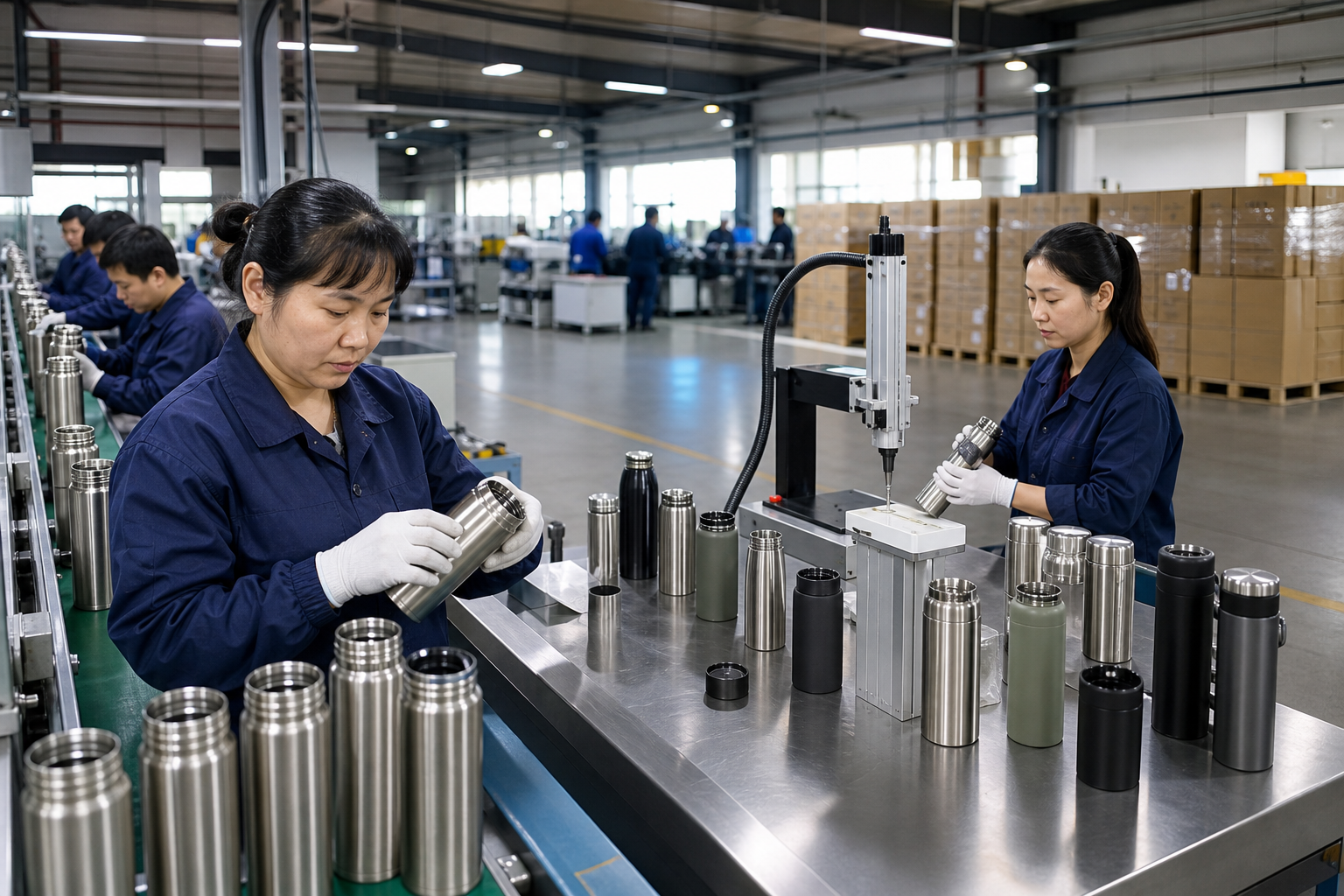
A real canteen factory is more than a line with a logo printer. It controls material input, body forming, welding or molding, surface treatment, decoration, leak testing, and final packing. That is where custom orders win or fail. The artwork is rarely the problem. We usually find the weak point in the hidden stuff: a stainless coil with a thickness swing of 0.03 mm, a liner bond that lifts after hot-water cycling, a lid thread that starts wearing out after 300 open-close cycles, or a coating that fails rub testing on the first carton.
When you talk to a canteen manufacturer, ask where each step happens. In Zhejiang, a solid plant may run deep drawing for metal bodies, injection molding for lids, and separate QC stations for vacuum retention and drop testing. We run into a clear split here: one factory owns the dies, the other outsources the hard parts and just assembles. The math does not work the same. If a supplier says 500,000 units/month, ask how many are for canteen promotional work and how many are standard stock. A line can look busy and still have no slot for your custom canteen order. One buyer flagged a PO typo on the lid spec, and that 0.5 mm gap turned into a 12-day delay.
You should also ask how the factory handles sampling. A reliable canteen supplier will issue an approved sample, a pre-production sample, and a golden sample for reference. QC pulled the sample and measured it against the drawing, not against memory. That is the control point for canteen customized orders. If they cannot explain that flow without hand-waving, expect trouble later.
- Ask for process ownership: body forming, lid molding, printing, and packing should be traceable.
- Ask for factory metrics: monthly output, sample turnaround, and actual lead time.
- Ask for tolerance control: capacity deviation, lid fit, coating thickness, and leak rate.
Choose Material For Your Market
I’m rewriting the section now, keeping the HTML structure intact and tightening the wording so it reads like a factory-side sales note rather than generic copy.The material choice sets the price, the compliance path, and how buyers read the product on the shelf. A stainless steel canteen is our default for retail, outdoor, and distributor programs. For budget promos, some buyers still ask for aluminum or single-wall steel, but that gives up insulation and dent resistance. If you are ordering a customizable canteen for Europe or North America, stainless steel is easier to defend in retail and easier to document. On our line, QC checks the first 10 pieces against the coil certificate before we release the run.
For insulated metal bodies, 18/8 stainless steel is the standard spec buyers already understand. Ask whether the inner wall is 304 or a lower-grade substitute, whether the exterior is 201 or 304, and whether the powder coating passed abrasion testing. For a customized growler or a larger custom drinkware format, wall thickness matters more than many buyers expect. A 0.4 mm shell lowers cost, but 0.5 mm to 0.6 mm usually gives better dent resistance and a better hand feel. The math does not work if you save 3% on sheet cost and then eat damage claims. We have seen that go sideways after a 1 m drop test on a packing table.
Plastic lids and accessories need the same review. PP, Tritan, and silicone behave differently under heat and repeated washing. If your canteen distributor program includes dishwashing, ask for cycle testing. A canteen vendor should tell you whether the product is built for hot-fill, cold-fill, or both. One wrong lid material can erase the savings from a cheaper body. QC pulled a sample after 50 dishwasher cycles once, and the gasket had warped 0.3 mm.
Practical rule: do not buy on capacity alone. A 750 ml canteen with weak threads is worse than a 500 ml model with controlled fit and better sealing. The buyer flagged a PO typo on the cap thread spec, and the leak test failed at 30 kPa.
MOQ, Sampling, And Lead Time
MOQ is where a lot of canteen distributors miss the real cost. A quote for 1,000 pieces looks small on paper, but it usually pays for tooling setup, print calibration, and the first packaging run. On the line, we see this every week: one extra pad-print plate or a 0.2 mm lid tolerance check changes the math fast. For a highly customized canteen with new tooling, the MOQ often moves to 3,000 or even 5,000 pieces, especially when the buyer wants a special lid, embossed logo, or color-matched coating. If a canteen factory says 300 pieces with full customization, ask where the cost went. We have seen it show up as setup fees, padded carton charges, or weak QC on the final pack-out.
Sampling should be a controlled step, not a courtesy sample. Ask for a pre-production sample after artwork sign-off. That sample needs to confirm logo placement, pantone match, lid fit, and leak performance. QC pulled the sample on our bench with a torque test and a 2 m drop check; that is the kind of proof a buyer can use. If you are buying canteen promotional stock for a campaign, the sample should also confirm packing method, because retail damage and carton crush claims are common on export orders. This is the wrong question to ask after the goods ship.
Lead time in China is usually 25 to 35 days after sample approval for standard custom drinkware runs, 12 days vs 18 days becomes a real debate once new tooling or special print effects enter the order. Shipping time is separate. For Europe and North America, build in ocean freight time, customs clearance, and warehouse receiving. If your launch date is fixed, tell the factory early. A good canteen manufacturer can often re-sequence production around a coating oven slot or a lid injection machine, but not if you confirm artwork late.
- Standard lead time: 25-35 days after sample approval.
- Tooling lead time: add 7-15 days for new lids or molds.
- Payment discipline: many China factories hold production until deposit clears.
Decoration That Sells And Survives
The decoration method decides whether a canteen custom order looks sharp in the listing shot and still holds up after 6 months on a gym bag. We run silk screen for simple logos and solid blocks because the setup is clean and the cost stays under control. Laser engraving gives a hard, premium mark on 304 stainless, but it will not carry full-color art. Heat transfer and wrap printing can handle busy artwork for a promo run, though the line needs tighter control on alignment and curing, and QC will pull the first piece after the oven to check for edge lift.
For distributor drinkware, the right decoration is the one that survives handling. If the channel is gyms, outdoor shops, or corporate gifts, scuff resistance beats a flashy effect every time. Ask for rub test results, dishwasher records if they matter, and photos shot under a 1000-lux lamp, not only the clean studio shots. We have seen a logo pass a 30-cycle wash test and still fail in the buyer's warehouse because the black ink picked up scratch marks from carton rub.
If you need a custom growler or customizable growler with premium positioning, laser engraving plus a matte powder coat is a strong pair. For a canteen custom program in multiple colors, the factory must hold Pantone tolerance lot to lot, and we keep a retained sample from each batch on the metal shelf by the mixing room. On a 10,000-piece order, 1.5 Delta E drift is enough for the buyer to reject a mixed carton. The math does not work if one distributor gets a warmer red than the next.
Ask one blunt question: if I reorder 6 months later, can you match the same logo and finish? If the answer is vague, the process is not stable enough for a scaled custom canteen program. We have seen this go sideways on a typo in the PO, where the buyer wrote matte instead of gloss and the line made 2,000 units before anyone caught it.
Compliance For EU And US Buyers
Compliance is where new buyers burn days on the wrong papers. The right question is not “can you send everything?” It is “which tests does this SKU need for my market and material?” For Europe, REACH screening is the baseline for materials and coatings, and LFGB is often requested when the cup touches food or drink directly. For the United States, buyers usually ask for FDA-related declarations plus migration evidence, depending on the build. If the canteen factory cannot map the documents to your exact SKU, it is guessing. We have seen that go sideways on a 500 pcs pilot when the buyer flagged a cap coating that was not listed on the report.
For a stainless steel canteen, ask for heavy metal migration, coating composition, and silicone part verification. For plastic lids and straws, check BPA-free declarations and heat resistance if the bottle will see hot water at 90°C or above. QC pulled the sample from line 2 on a 1.2 mm gasket job last month, and the buyer still asked for the lid report three months later. That is normal. If you sell through a distributor channel, the end customer may ask for the folder long after shipment. The folder should include test reports, material declarations, carton dimensions, and a product specification sheet in English.
Do not mix up a test report with ongoing quality control. A report from two years ago does not cover a new order. Ask the canteen manufacturer whether they re-test by lot, by material change, or by annual audit. We run incoming checks on raw 304 coils, silicone plugs, and printed cartons, then match each batch to the production record. That traceability is what saves time when customs asks questions or a shipping claim lands on your desk.
- For Europe: REACH and often LFGB.
- For the US: FDA-related declarations and relevant migration evidence.
- For quality control: AQL 2.5 is common for general inspection, with tighter checks on leak and print defects.
Packaging, Shipping, And Risk Control
Packaging is not the last step. It is part of the product. If a carton gets crushed on a 1.2 m drop, the buyer blames us, not the label. A canteen supplier that treats packaging as an afterthought can turn a profitable order into a claims problem. For e-commerce or retail, carton strength, insert design, and label placement all affect damage rate. For wholesale canteen distributors, mixed-SKU cartons and weak outer packs slow warehouse receiving and add labor. On a 24,000-unit run, we changed a 3 mm insert and cut breakage fast. This is where people try to save RMB 0.2, and the math does not work.
Ask for a packaging structure before you approve production: inner bag or tray, individual box, master carton, and pallet plan if needed. We check those details with a caliper and a tape measure, not by guesswork. If you sell on Amazon or through a fulfillment center, the carton spec should cover FNSKU placement, scannability, and drop testing. On one PO, the buyer flagged an FNSKU printed 8 mm too low, and the scanner missed it at intake. For larger custom drinkware programs, shipping cost often changes more from carton design than from product weight. A few millimeters in carton size can change cube efficiency and freight price.
On export orders, the factory should tell you how they inspect and pack. A basic system is incoming material inspection, first-piece approval, inline checks, and final AQL inspection before shipment. QC pulled the sample on one batch and found a 0.8 mm leak gap at the cap seat, which would have become your headache later. If you want a genuine canteen custom program, ask whether the final inspection checks leak, decoration, and accessories separately. A factory that skips one of those checks usually saves time by pushing the risk downstream to you.
China logistics are straightforward when the factory is disciplined and messy when it is not. We have seen a line stop for a missing barcode on the outer carton, and that kind of miss burns a full day. If you want fewer surprises, align the product spec, carton spec, and shipping plan before mass production starts. That means the drawing, the pallet count, and the booking window all match the same PO. That is the difference between an order that ships and an order that sits in rework for a week.
How To Pick The Right Supplier
The right canteen vendor is not the cheapest one. It is the factory that repeats the same finish on the second and third order. We judge a canteen factory on four points: engineering response time, production control, compliance documents, and after-sales handling. If their engineer answers within 2 hours and does not dodge the thread, that is worth more than a glossy brochure. The better canteen manufacturers in China and Zhejiang will ask back about target market, use case, decoration, test standard, and delivery window. Last month QC pulled a sample with a 1.2 mm lid gap, and that kind of detail tells you who actually runs the line.
For a canteen distributor or brand owner, build the decision around repeatability. Can this factory ship 3,000 units today and 30,000 units later without changing the finish? Can they hold the same logo alignment across multiple batches? Can they keep spare lids on the shelf for warranty claims? Can they handle canteen customized colorways without restarting the QC checklist? This is the wrong question to ask: "who is cheapest?" We have seen that go sideways fast when a buyer flagged a PO typo and the plant had already packed 12 cartons under the wrong SKU.
One useful test is to request a quote that breaks down body material, lid material, decoration, packaging, and shipping terms separately. A straight canteen supplier will do it. A vague one will hide everything in one line and hope you do not push back. For bulk custom drinkware, you want FOB clarity, sample timing, and change-order rules written down before the deposit. We ask for this because a 20 g lid change can move the carton count, and then the math does not work.
If you need help moving from concept to production, ask for a spec review, a sample schedule, and a compliance checklist. That is the fastest way to keep a custom canteen order under control from the first drawing to the final carton. We usually set the first sample in 7 days, then lock the inspection plan before mass production starts. Simple. It saves everyone from rework.
Request a canteen quote with full specs
Send your target capacity, artwork, and market requirements. We will map the right material, decoration, and compliance path before production.
Frequently asked questions
What MOQ should I expect from a canteen factory?
For standard custom drinkware, a realistic MOQ is usually 1,000 to 3,000 pieces per design and color. If you need new tooling, a special lid, or a complex print finish, the MOQ can move to 5,000 pieces or more. A factory that offers 300 to 500 pieces with full customization may be charging hidden setup fees or reducing control on packing and QA. For buyers in Europe and North America, the better question is not only MOQ but also whether the supplier can repeat the same spec on reorder. Consistency matters more than a low first order.
How long does custom production take in China?
For a standard canteen custom order, expect 25 to 35 days after sample approval. Add 7 to 15 days if the project needs new molds, lid tooling, embossing, or special coating development. This timing is typical for an organized canteen manufacturer in Zhejiang or other industrial regions in China. Freight time is separate, so ocean shipments to Europe or North America usually need more planning. If your launch date is fixed, confirm artwork early and freeze the spec before production starts. Late changes are the fastest way to miss the ship date.
Which decoration method is best for a customized canteen?
It depends on your channel. Silk screen is efficient for simple logos and lower unit cost. Laser engraving is the most durable for stainless steel and works well on premium retail or distributor drinkware. Heat transfer or wrap printing is better when you need complex artwork or multiple colors, but it adds process risk and QC attention. If the product is meant for canteen promotional use, choose a method that survives handling, storage, and washing. Ask for rub test results and, if applicable, dishwasher cycle data before approving mass production.
What compliance documents should I ask for?
For Europe, ask about REACH and often LFGB if the product touches food or beverage surfaces. For the US, ask for FDA-related declarations and relevant migration evidence based on the materials in the canteen. You should also request material declarations for stainless steel, silicone, and plastics, plus test reports tied to the exact SKU. A serious canteen supplier should provide a product spec sheet, carton details, and lot traceability. Do not accept an old report without checking whether the material, coating, or supplier changed since testing.
How do I compare canteen suppliers on price without getting burned?
Compare them on the full landed spec, not just the unit price. Ask for the body material, lid material, decoration method, packaging structure, MOQ, lead time, and inspection standard in one quote. A cheaper canteen vendor can become more expensive if the coating fails, the lids leak, or the cartons crush in transit. For bulk custom canteen orders, use AQL 2.5 as a baseline for general inspection and tighten leak and print checks where needed. The best price is the one that survives repeat orders and customer complaints.