Key Takeaways
- A normal custom canteen order from China starts around 1,000 pcs MOQ, with 25-35 days lead time after sample approval.
- For stainless steel, 18/8 or 304 material is the standard baseline; 0.5-0.8 mm wall thickness is common for durable custom drinkware.
- AQL 2.5 for critical defects and AQL 4.0 for minor defects is a realistic inspection target for canteen manufacturers.
- A Zhejiang canteen factory with 280,000 units per month can support distributor canteen programs, but only if artwork, specs, and packaging are frozen early.
Choosing a canteen manufacturer is not about chasing the lowest quote. The real test is whether the factory can hold wall thickness, seal the lid, keep the logo from scratching off, and ship on time without turning the next lot into a claims problem. We run this every day on the line. If you buy custom drinkware for retail, promotions, or distribution, the gap between a safe supplier and a risky one shows up in the small stuff: 18/8 stainless grade, lid fit, coating adhesion, and whether the next order matches the first one within the same 0.2 mm tolerance.
A serious canteen supplier should talk in numbers, not soft promises. In Zhejiang, China, that usually means a clear MOQ, sample lead time, and a production schedule you can build around. QC pulled the sample at 24 hours, checked the thread with a gauge, and found the cap torque off by 1.5 N·m on one batch. If you are sourcing canteen custom work for a distributor program or a branded retail line, this is the wrong question to ask: can the factory make one nice sample, or can it ship 5,000 units with the same result?
What a canteen manufacturer controls
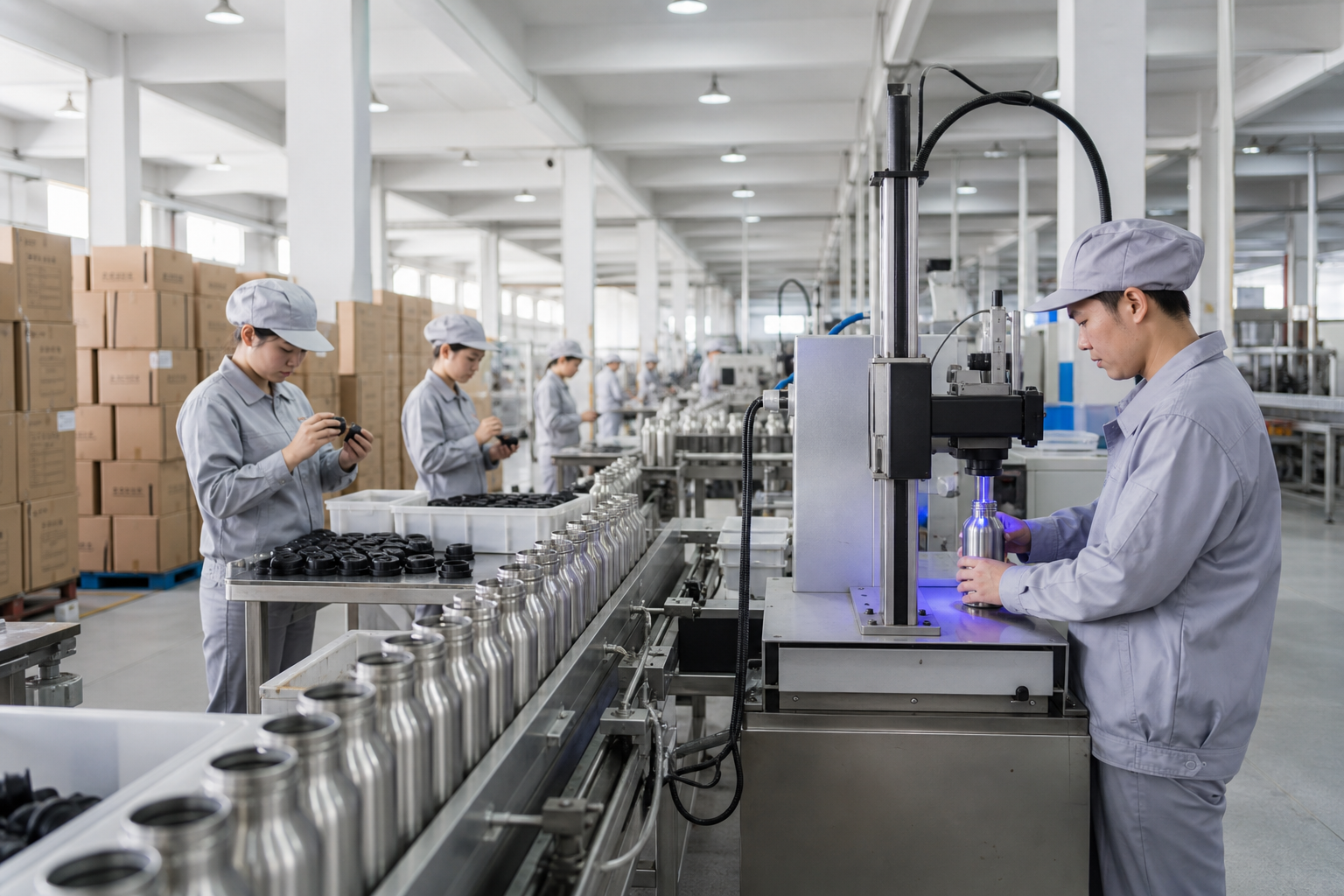
I’m rewriting the section in place and keeping the HTML structure unchanged. I’m also stripping the canned phrasing and replacing it with tighter factory-level details so it reads like an actual sourcing note.A real canteen manufacturer does more than assemble parts. It controls coil sourcing, deep drawing or blow molding, welding, surface finishing, lid fit, leak testing, and final packing. On the line, a 0.3 mm neck-thread drift can turn a clean sample into scrap. That matters because a canteen built for one buyer can fail at the next step if the body shape, thread, or gasket spec shifts. If you are comparing canteen manufacturers, ask which processes stay in-house and which go outside. The more steps the canteen factory runs itself, the easier it is to hold tolerances and repeat orders.
For custom drinkware, the factory should give you a spec sheet with capacity in ml and oz, material grade, lid type, coating type, logo method, and carton configuration. If they cannot list those basics, they are acting like a trading middleman, not a canteen supplier. We have seen a PO show 500 ml on one line and 550 ml on the next, and that kind of typo burns time fast. That may be fine for a 500-piece spot buy, but it is the wrong question to ask for distributor drinkware programs or a canteen promotional campaign that needs the same product across 4 SKUs.
Good buyers also ask how the factory handles change control. If you ask for a thicker base, a new cap color, or a matte finish, a disciplined canteen vendor should show revised drawings and updated samples before mass production. QC pulled one sample with a 0.4 mm base change last month, and the buyer flagged the cap color before we cut steel. Skip that step and the math does not work after the first shipment leaves China.
Practical rule: if the supplier cannot quote MOQ, sample lead time, and production lead time in one message, they are not ready for a serious canteen custom order.
For Zhejiang and wider China sourcing, the useful question is not just can they make it. It is can they make it the same way twice. A 304 stainless body can look fine on first check and still fail when the 58 mm lid meets a 60 mm neck on the next run. That is where weak canteen factories show their hand.
Materials that hold up in use
Material choice decides whether a canteen feels solid or cheap the moment a buyer picks it up. For stainless steel, 304 or 18/8 is the standard in most export programs. It holds up against corrosion, handles acidic drinks better than low-grade steel, and matches what buyers expect in Europe and North America. Aluminum can work for a lighter SKU, but it needs the right lining and a clear use case. On our line, QC pulled a 304 sample after a 24-hour salt-spray check with no red rust. For hiking, gym, or promo retail, weight, dent resistance, and taste neutrality matter more than a glossy catalog photo.
Wall thickness is where too many canteen suppliers cut corners. A 0.5 mm body can pass for basic promo use, but 0.6-0.8 mm feels steadier, dents less, and reads better in hand. For a custom growler or growler-style bottle, vacuum integrity and weld quality matter more than the outer paint. We run leak checks at 35 kPa, and a thin shell usually shows its weakness there first. This is the wrong question to ask: the box claim does not matter if the vacuum drops after 12 hours.
For plastic components, check whether the lid, spout, and seals are BPA-free and compliant with your target market. REACH for Europe and food-contact rules for the US are not optional if you want real volume. If your canteen customizable program uses mixed materials, make sure the factory separates each batch and tracks it by lot. We label seal bags with a lot code before assembly, and the buyer flags it fast when the carton code does not match the part code. That is basic control, not premium service.
- Stainless steel: best for custom drinkware sold through retail or distributor channels.
- Aluminum: lighter, but more sensitive to lining and coating quality.
- Plastic lids and seals: inspect for odor, fit, and repeated opening performance.
Buy the structure first, the decoration second. That is how canteen suppliers keep returns low. A nice print cannot save a shell that dents on the first drop test.
Branding methods that survive shipping
Branding on a canteen is not just decoration. It decides whether the mark survives abrasion, dishwashing, sun exposure, and the carton rub we see after a 1.2 m drop test on the line. Buyers like to squeeze unit price, but the wrong question is usually the logo method, because that is what the end user handles every day. Screen printing works for flat-color logos and large runs. Laser engraving gives a clean permanent mark on stainless steel. UV printing carries more colors, but we always run an adhesion check before we sign off a full canteen customized order.
If you need a canteen custom program for retail, ask for logo samples on the exact substrate and finish you plan to order. A brushed steel body behaves differently from powder coating or matte paint, and we have seen a 0.3 mm shift on a curved shoulder ruin an otherwise clean layout. The buyer flagged it on a proof once, and that saved a full rework. Good canteen manufacturers will send pre-production artwork and a placement proof, not just a static mockup from design.
What to confirm before approval
- Logo size in mm, not only in percentages.
- Print position tolerance, especially on curved bodies.
- Color reference, ideally Pantone.
- Rub test or tape test expectations.
For canteen vendors selling to distributors, packaging can matter as much as the logo. Individual boxes, barcode labels, and FNSKU-ready carton markings matter if the same product will move through Amazon or warehouse channels. We ship a lot of these, and a carton typo on the PO is still one of the fastest ways to create a mess. If you are building a distributor canteen line, lock the outer carton spec before production starts. Repacking after shipment burns time and money.
One practical point from China sourcing: a sharp logo that chips in transit costs more than a simpler mark that survives the 18-day trip from Zhejiang to your warehouse.
MOQ, pricing, and lead times
MOQ is where a lot of buyers burn a week for nothing. A serious canteen manufacturer will separate sample MOQ, trial order MOQ, and mass production MOQ. For most custom drinkware programs, 1,000 pcs is a clean starting point. We have seen a buyer push for 300 pcs with three colors and one laser logo plate, and the math does not work. Setup, tooling, and color matching stay on the line whether you run 300 or 3,000. Last week, QC pulled a sample because the lid gap ran 0.3 mm wide. If you need a canteen distributor launch across several SKUs, bundle sizes and colors into one run instead of scattering small orders everywhere.
Lead time needs to be stated in warehouse dates, not wishful start dates. A sample usually takes 5-10 days if the mold exists. Mass production often needs 25-35 days after sample approval, depending on coating, printing, and packing complexity. Add sea freight, and the total cycle can stretch to 45-60 days. On our side, one PO typo on carton count once cost a full day because the packing team had to recheck every outer box mark. If your sales calendar is fixed, tell the supplier the date goods must arrive in your warehouse. That is how we run a real schedule with canteen suppliers in Zhejiang, China.
Pricing should be read as a system, not a single number. A quote may look low until you add logo setup, special packaging, carton inserts, and test fees. Ask for FOB terms, sample charge policy, and whether tooling is refundable against volume. We have seen this go sideways when a buyer approved the price and then flagged the PI after the carton spec changed from 24 pcs to 20 pcs. A canteen vendor that lays out the cost stack early is easier to work with than one that hides charges until the PI stage.
For distributor drinkware, the cheapest unit price is rarely the lowest landed cost. Freight, cartons, defect rate, and returns matter more.
If you want a long-term canteen manufacturer relationship, ask for a forecast-based price ladder. A factory running 280,000 units per month can usually reward stable volume better than one-off spot buying. We track this by SKU on the line, and a 12-month forecast lets us lock raw material buys before resin prices move. The wrong question is, "Can you go lower?" The better one is, "What volume gets me a better ladder at 3,000 pcs, 10,000 pcs, and 30,000 pcs?"
Quality checks that prevent returns
I’m rewriting the section now, keeping the HTML structure intact and tightening the language so it reads like a factory-side buyer note, not generic copy.Quality control belongs in the order, not after the first complaint lands. On our line, we lock the checkpoints before a 5,000 pcs run starts: incoming material check, in-process check, final leak test, and carton audit. For custom canteen orders, I set AQL 2.5 for critical defects and AQL 4.0 for minor defects. That gives the buyer something they can measure instead of a vague "looks fine" from QC.
Leak testing is non-negotiable for insulated bottles, custom growler programs, and any canteen customized with a screw cap or flip lid. Ask whether the factory does 100 percent leak checks or sample checks by lot. QC pulled a sample at 0.25 bar and found one lid weeping after 30 seconds; that is the kind of miss that turns into a return. For powder-coated surfaces, ask about cross-hatch adhesion tests and salt spray if the product will sit in humid storage or ride a long ocean route. If the product is sold as food-contact drinkware in Europe, REACH and LFGB expectations should be part of the document pack. For the US, align on food-contact declarations and material traceability.
Audit background matters too. A canteen factory with BSCI audit history, ISO 9001 procedures, and documented lot tracking is easier to trust than a shop that only sends photos. We once traced a carton typo from one batch code to a 12,000 pcs claim in 20 minutes. If the buyer is a canteen distributor, ask for batch codes on cartons and a simple claim workflow. That is the right question to ask, because it lets you isolate one bad pallet instead of stopping the whole program.
- Incoming inspection: steel gauge, seal hardness, coating color, 0.02 mm thread check.
- Process inspection: weld quality, thread fit, print alignment, cap torque on the line.
- Final inspection: leak test, drop test, carton drop check, label scan before packing.
Good quality control is cheaper than one re-shipment from China. We’ve seen a 2,400-unit return wipe out the margin on a full month of production. The math doesn’t work if inspection is optional.
Choosing a supplier for distribution
If you are a canteen distributor, supplier choice goes beyond one quote. You need a canteen supplier that can keep repeat supply steady, hold packaging the same, control variants, and answer after-sales issues without delay. The better canteen vendors keep artwork files, track tooling records, and know which carton spec goes with which SKU. We run into this every week when a buyer sends a PO with one lid code and the wrong outer carton count. That sort of typo turns into a mess fast. It matters when your channel mix includes retail, corporate gifting, and distributor drinkware bundles.
Look at response quality, not just speed. A solid factory in Zhejiang, China, will send capacity, MOQ, sample timing, and packaging options in one reply, usually with a 20-foot container plan or a 7-10 day sample window. Weak suppliers send a price and make you chase the rest. If you are comparing canteen manufacturers for a long-term program, ask whether they can handle custom logo updates, seasonal colors, and a small line extension without resetting the whole production plan. We have seen that go sideways when the buyer flagged a Pantone shift and the sales team had no lab dip record. That is the difference between a vendor and a manufacturing partner.
For custom canteen programs, ask for a pilot run before you scale. A 300-500 pcs trial can expose print issues, lid torque problems, or carton breakage before you commit a larger PO. QC pulled the sample, checked cap torque at 0.8 N·m, and found the liner sat 1 mm off on one batch. That is the wrong question to ask if you are still arguing only over unit price. It is also the cleanest way to test a canteen promotional item with your customers. If the trial sells cleanly and the complaints stay low, you can scale with more confidence.
Distributor buyer checklist:
- Can they support multiple SKUs under one order?
- Do they offer barcode, FNSKU, or retail packing support?
- Can they hold the same color and logo across repeat batches?
- Do they answer directly from the canteen factory, not only through trading staff?
If the supplier can do all four, you are probably dealing with a canteen manufacturer worth keeping. We ship those accounts on a tighter schedule, and the line usually tells the truth by week two.
Request a canteen quote with specs today
Send your capacity, logo method, and target market. We will reply with MOQ, FOB price, and sample timing from Zhejiang, China.
Frequently asked questions
What MOQ should I expect from a canteen manufacturer in China?
For a standard custom canteen order, 1,000 pcs is the most common MOQ, especially for stainless steel and printed logo work. Some canteen manufacturers can accept 500 pcs for a repeat item or a simple color change, but the unit price usually rises because setup, printing, and packing are spread across fewer units. If you want mixed colors or multiple sizes, ask whether the factory allows one combined MOQ across SKUs. For a distributor canteen program, that flexibility is often more useful than chasing the absolute lowest quote.
How long does custom drinkware production usually take?
A typical sample takes 5-10 days if the mold or body shape already exists. After sample approval, mass production usually runs 25-35 days for a canteen custom order, depending on coating, logo method, and packaging. If you add special cartons, gift boxes, or extra QA steps, add a few more days. Sea freight from China to Europe or North America can add another 20-35 days depending on routing. If you need stock for a campaign date, work backward from warehouse arrival, not from production start.
Which material is best for a customized canteen?
For most B2B drinkware programs, 304 or 18/8 stainless steel is the safest choice. It is durable, resists corrosion, and fits retail or promotional use in Europe and North America. If the product needs to be lighter, aluminum can work, but the lining and coating need more attention. For lids and seals, confirm food-contact compliance and odor control. A customizable canteen with 0.6-0.8 mm stainless wall thickness usually feels more solid than a thinner promo-grade body, and that perception matters for distributor drinkware sales.
What quality standards should I ask for before placing an order?
Ask for AQL 2.5 on critical defects and AQL 4.0 on minor defects as a minimum inspection framework. For food-contact drinkware, ask for REACH documentation for Europe and material declarations for the US market. If the product is insulated, request leak testing and, ideally, a documented temperature-retention method. A canteen factory with BSCI and ISO 9001 systems is generally easier to audit and scale with than one without records. The key is traceability: material lot, print lot, and packing lot should all be visible.
How do I reduce risk when sourcing from a canteen supplier in China?
Start with a sample that matches the final spec, then freeze the artwork, capacity, lid, and carton before mass production. Ask for photos and measurements during production, not only after shipment. Use a written inspection standard, and if the order is important, consider a third-party inspection before balance payment. For Zhejiang sourcing, choose a factory that can explain capacity, MOQ, and lead time in one message. A clear factory process is usually a better risk signal than a low quoted price.