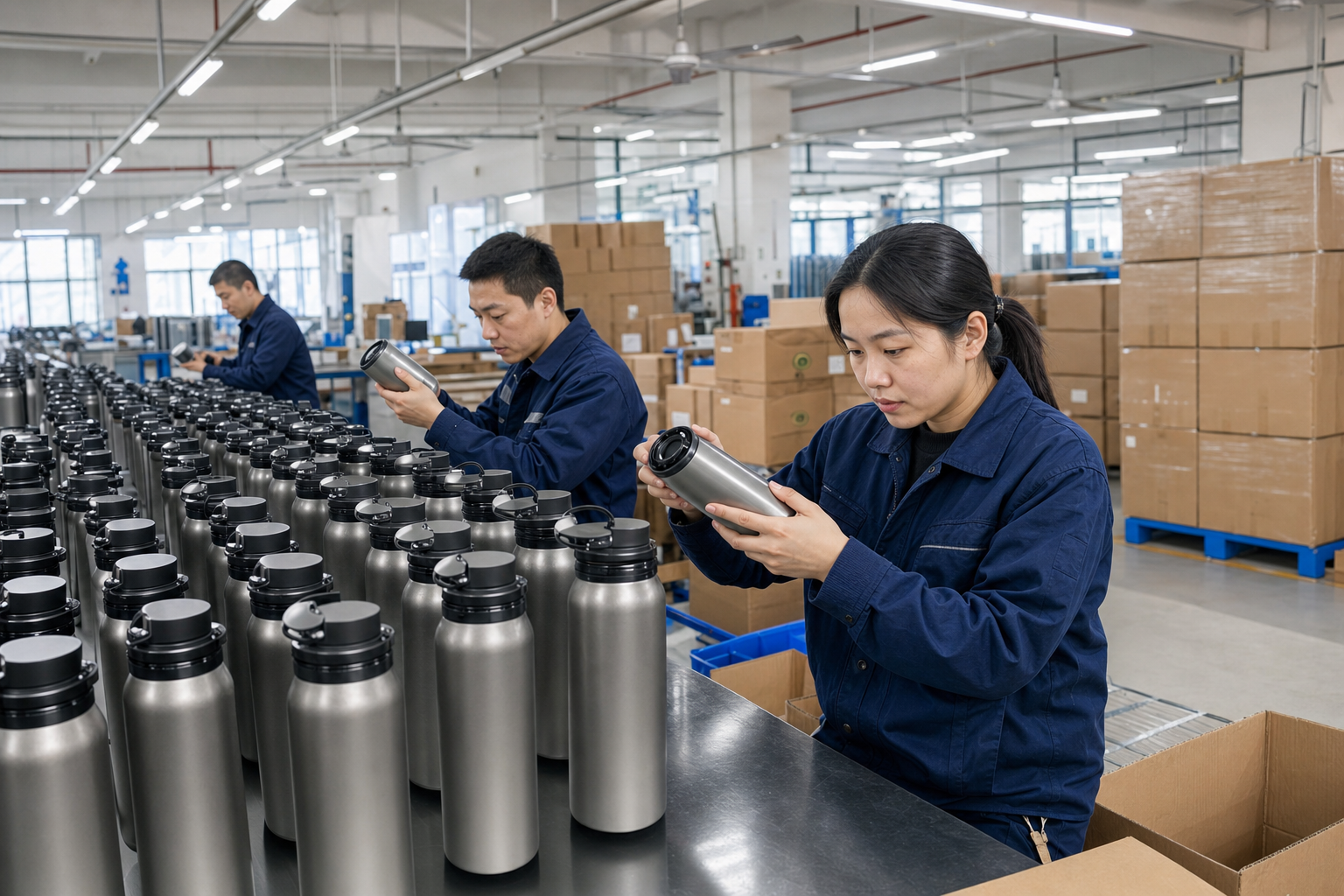
Key Takeaways
- A serious canteen manufacturer should quote 3,000 pcs MOQ, 25 to 35 days production, and monthly capacity in units, not vague promises.
- Material choice changes the whole job: 304 stainless, 316 stainless, aluminum, and BPA-free plastics all serve different channels and price points.
- For Europe and North America, ask for REACH, LFGB, FDA, and an AQL 2.5 major / 4.0 minor inspection plan before sampling.
- Decoration, lid type, and packaging can move your landed cost by 12% to 30%, so you should price the full program, not the bottle alone.
If you buy from canteen manufacturers, price is the easy part. The real work is matching the canteen to the channel, the compliance file, and the reorder plan. A retail outdoor line needs a different spec from a canteen promotional item for a distributor, and a customized canteen for a school campaign carries different risks than a custom growler for beverage programs. We have seen the buyer flag a 20 oz spec mismatch on the PO because the print file was copied from the wrong SKU. That kind of mistake burns time fast.
In Zhejiang, China, a better canteen factory speaks in numbers: 3,000 pcs MOQ, 25 to 35 days lead time, and 600,000 units per month capacity when the line is running well. That is the level you should expect from any serious canteen supplier or canteen vendor. If you are buying for Europe or North America, you need REACH, LFGB, FDA, and a clear AQL plan before you commit. QC pulled the sample at 1.2 mm wall thickness last week, and the math still has to work on the line. Otherwise the order goes sideways.
Choose the right canteen material
The first sourcing mistake is treating every canteen as the same product. A custom canteen for an outdoor distributor, a school program, or a retail shelf needs a different body, wall thickness, and finish. For most metal programs, 304 stainless steel is the default because it stays stable, keeps cost in line, and passes food-contact tests without drama. If the buyer wants better corrosion resistance for salty or acidic use, 316 stainless is the stronger pick, but the unit cost climbs fast. Aluminum still works for lightweight promotional runs, but we ship it with clear limits on dent resistance and coating wear. QC pulled a dent test on a 1.2 m drop last week, and the 0.35 mm sample lost the argument.
For practical buying, ask the canteen manufacturer to specify wall thickness, not just material. A common stainless body sits around 0.4 to 0.6 mm. Buyers often ask for the thinnest shell; that is the wrong question to ask. Go too thin and the bottle feels cheap. Go too heavy and freight plus material cost climb. On our line, we check the body gauge with a micrometer, and if it drifts by 0.03 mm the inspector flags it. If you are building a customized drinkware line, ask for finish options such as brushed, powder coated, or matte paint, then check whether the coating survives 50 to 100 dishwasher cycles if that matters to your channel. A canteen factory that knows its job will also tell you which material is better for laser logo work versus screen print.
- 304 stainless: best all-rounder for retail and corporate programs.
- 316 stainless: better for premium or harsher-use positioning.
- Aluminum: light and promotional, but easier to dent.
- BPA-free plastic: lower price, but be precise on odor and heat limits.
Match design to the channel
The channel should set the design, not the other way around. We run this kind of check on the line every week: an canteen custom order for outdoor retail usually wants a 68 mm wide mouth, a screw cap, and a carry loop, while a school or sports account asks for a slimmer body, one-hand opening, and a cap that still survives a 1.2 m drop. For a canteen promotional campaign, the logo panel usually matters more than premium hardware, because the buyer is buying visibility, not a trophy. For distributor runs, fill rate, carton count, and reorder stability matter more than a fancy silhouette. This is the wrong question to ask: which design looks best? Ask which channel will pay for it.
Capacity is another detail buyers overcomplicate. 350 ml to 500 ml fits compact daily use, 750 ml is the number we quote most on retail lines, and 1,000 ml sells when the bottle is meant for hiking, gym, or 12-hour shifts. If you are comparing a customizable canteen with a customizable growler, mouth size and closure type matter more than the basic volume. A growler needs a tighter seal and a stiffer body; a canteen can stay lighter and easier to carry. Ask the factory for lid torque specs, gasket material, and drop-test results from 1.2 m to 1.5 m. On one job, QC pulled the sample and found the lid at 0.8 N·m instead of 1.0 N·m, so we fixed it before mass production. If they cannot answer, you are not talking to a real canteen supplier.
What to lock before you quote
- Capacity in ml and oz.
- Mouth diameter in mm and lid type.
- Carrying loop, strap, or handle.
- Logo area, print colors, and Pantone target.
- Primary channel: retail, corporate, distributor, or food service.
Price decoration with the product
Decoration is where buyers burn margin if they ask for a logo first and a process second. A laser mark on brushed stainless comes off clean and holds up in the wash; a full-color silk screen on a powder-coated body is a different job, with different ink and cure time. We ran both on the line last month, and the buyer flagged a 0.3 mm shift on the pad print after the first wipe test. If your canteen customized order is 500 to 1,000 pieces and you need sharp lines, laser engraving is usually the safer call. If you want a retail look, silk screen or pad print can work, but the setup fee and color limits change fast. This is the wrong question to ask: ask for artwork, substrate, and target price before anyone quotes.
For a custom drinkware line, decoration belongs in unit economics, not as a line item you tack on later. One-color laser engraving on stainless can move cleanly at 3,000 units; QC pulled the sample, checked the depth at 0.15 mm, and cleared it in one pass. Multi-color print on a curved bottle needs extra tooling, more scrap allowance, and tighter inspection at the carton stage. If you run a canteen distributor program, keep the imprint window fixed at 45 mm by 60 mm and cut the color count to two or fewer. That keeps reorders simple and helps the factory hold output across batches. We've seen this go sideways when a buyer changed the logo from Pantone 186C to a four-color gradient after sample approval, and one PO even came in with two color names on the same line. The math doesn't work. The cost gap is often 12% to 18% once you add full-color print and individual boxes, so line up the artwork method with the sourcing spec before you sign off.
Ask the factory to quote the same bottle three ways: laser, one-color print, and multi-color print. On our side, QC will spot the gap in the first sample sheet, and you can see where the margin goes.
Check compliance before sampling
I’m rewriting the section to sound like a factory-side compliance check, while preserving the existing HTML tags, list structure, and required terms like `AQL 2.5`.If you sell into Europe or North America, compliance is a gate, not something you clean up after the first shipment. We ask for food-contact declarations before tooling starts, and we keep REACH support, LFGB where needed, plus FDA material files ready if the buyer wants them. On metal drinkware, we check migration risk on coatings, inks, and seals; QC pulled one sample straight from the pad-print line last month because the coating file was thin. For plastic parts, ask for BPA-free resin statements and the exact test scope. If the bottle has a straw or sports cap, the valve, spring, and gasket need the same paper trail as the body.
Quality control should be set in writing too. For canteen work, we usually lock AQL 2.5 for major defects and 4.0 for minor defects, then define leaks, print errors, dents, and coating flaws in the PO. Ask whether the factory runs ISO 9001 procedures and whether the site has BSCI or similar social compliance coverage if your retail customer requires it. The sample looks fine is the wrong question to ask; we have seen a buyer reject a 5,000-piece order because the carton mark had a two-digit typo. We keep prior test reports on file, so a reorder does not start from zero.
- Ask for material declarations before tooling.
- Confirm food-contact scope for the lid, gasket, and coating.
- Set defect definitions in the PO.
- Require carton drop test and leakage checks.
Read the factory numbers carefully
When you compare a canteen manufacturer with a canteen distributor or trading company, capacity is the first number to check. A real factory will tell you how many lines it runs, how many units per month it ships, and where the line slows down. In Zhejiang, China, a solid drinkware plant might run 600,000 units per month across metal and plastic programs, but that figure only matters if it matches your product. We have seen a laser-only custom canteen line move fast while a molded cap station sits on one extra trimming step and drags the whole schedule.
MOQ matters just as much. For custom work, 3,000 pcs per color is a common starting point, and some canteen vendors will ask for 5,000 pcs if you want multiple print positions or special packaging. Sample time is usually 5 to 7 days for existing tooling, then 25 to 35 days for bulk production after sample approval. Add another 7 to 10 days if you need retail cartons, barcode labels, or FNSKU stickers for Amazon FBA. QC pulled the sample on a 0.5 mm print offset last week, and the buyer flagged it before we packed the lot. If a supplier says 10 days for everything, check the fine print. They are likely quoting stock, not custom work.
Use those numbers to decide whether you need a factory-direct model or a distributor canteen model. If speed and low complexity matter, a stock-supported vendor can work. If you need a customized drinkware program with repeatable color, packaging, and compliance, go direct to the canteen factory. We ship programs like this every week, and the math does not work any other way when the PO has a typo on the carton count and the buyer wants the same spec on the next reorder.
Set up reorders for scale
The best buyers do not stop at sample approval. They lock the reorder path. If you are building a customized canteen or a full line of customized drinkware, fix one spec sheet with body material, lid code, color code, decoration method, carton count, and test requirements. That sheet becomes the control point when QC pulled the sample again six months later. It also keeps a canteen distributor from asking for a new size or color and forcing the factory to quote from zero. We have seen a PO typo like “matte balck” cost a week on the line.
Package the product with the same discipline. Inner boxes, hanging tags, master cartons, and barcode placement change carton size and freight cost fast. A 12-piece master carton works for some retail channels, while 24-piece cartons cut hand touches for B2B distribution. If you are sourcing from a canteen manufacturer in China, ask if they can handle bilingual carton marks, palletization, and inspection photos before loading. The math does not work if you ignore those steps. A 2 mm shift in carton height is enough to change the pallet plan and trigger a freight complaint.
Once the program is stable, grow by line extension, not by changing the base product every time. That is how canteen suppliers keep quality, color, and margin in line. We ship better when the mold stays fixed and the buyer only changes the lid, the finish, or the pack-out. This is the right way to scale.
Source your next canteen program with less risk
Send your spec sheet, target price, and compliance needs. We will quote the right material, decoration, MOQ, and lead time for your market.
Frequently asked questions
What MOQ should I expect from canteen manufacturers?
For a custom canteen or other custom drinkware, 3,000 pcs per color is a normal starting point in China. Some canteen manufacturers will accept 1,000 to 2,000 pcs for stock bodies with simple laser logos, but once you add special lids, multi-color print, or retail packaging, the MOQ rises quickly. For a real factory in Zhejiang, the quote should also show whether the MOQ is by color, by SKU, or by carton spec. If a supplier cannot explain that clearly, you will probably pay for it later in hidden setup costs or mixed inventory.
How long does production usually take?
For a straightforward custom canteen, sample time is often 5 to 7 days if tooling already exists. Bulk production is usually 25 to 35 days after sample approval. If you need a new mold, special coating, or FNSKU labeling for Amazon FBA, plan 35 to 45 days. A canteen factory in China should also state whether shipping time is included or separate. A quoted lead time of 10 days for a fully customized run is usually unrealistic unless the product is already in stock and only needs light marking.
Which compliance documents matter for Europe and North America?
For Europe, ask for REACH support and, where relevant, LFGB food-contact documentation. For North America, ask for FDA-related material declarations and any test reports tied to coatings, gaskets, and inks. If your canteen manufacturer uses stainless steel, you still need documentation for the lid and seal, not just the bottle body. For larger retail programs, many buyers also request ISO 9001 process control and BSCI social compliance. The important point is that the file set should match the full product, including decoration and packaging, not just the metal shell.
Is laser engraving better than screen printing?
It depends on the channel. Laser engraving is usually better for a premium, durable mark on stainless steel and works well for a custom growler or a brushed metal canteen. Screen printing is better when you need color and strong shelf impact. In many cases, a one-color laser mark is cheaper to maintain across reorders, while screen print can be better for canteen promotional programs with large logo zones. Ask the factory to quote both options on the same item so you can compare unit price, setup cost, and rejection risk side by side.
How do I choose between a factory and a distributor?
Choose a canteen factory if you need repeatable customization, compliance control, and stable reorders. Choose a distributor or trading partner if you need speed on a stock item or a low-complexity canteen promotional run. The difference shows up in capacity, documentation, and how much you can change after the sample stage. A factory in Zhejiang, China, should be able to quote capacity in units per month, explain AQL levels, and support the same SKU across multiple production rounds. If those details are missing, you are probably not dealing with the right source.