Key Takeaways
- A practical MOQ for many custom canteen orders is 500 pcs, while complex lids or premium finishes often start at 1,000 pcs
- 304 stainless is the default for most custom drinkware; 316 adds corrosion resistance for harsher use and usually costs USD 0.20-0.60 more per unit
- For EU-bound shipments, ask for REACH and food-contact declarations; for North America, request FDA-compliant material statements and carton labeling control
- A disciplined canteen factory should provide AQL 2.5 major / 4.0 minor inspection records, leak tests, and a clear 20-35 day production schedule
If you are sourcing from a canteen supplier for retail, promotions, or distributor channels, you are not just buying a bottle. You are buying margin, a compliance file, and the risk of a repeat order. A wrong stainless grade, a wall that measures 0.35 mm when the spec called for 0.45 mm, or a cap that pops loose in transit turns into leakage claims, rejected cartons, and ugly emails after the first shipment.
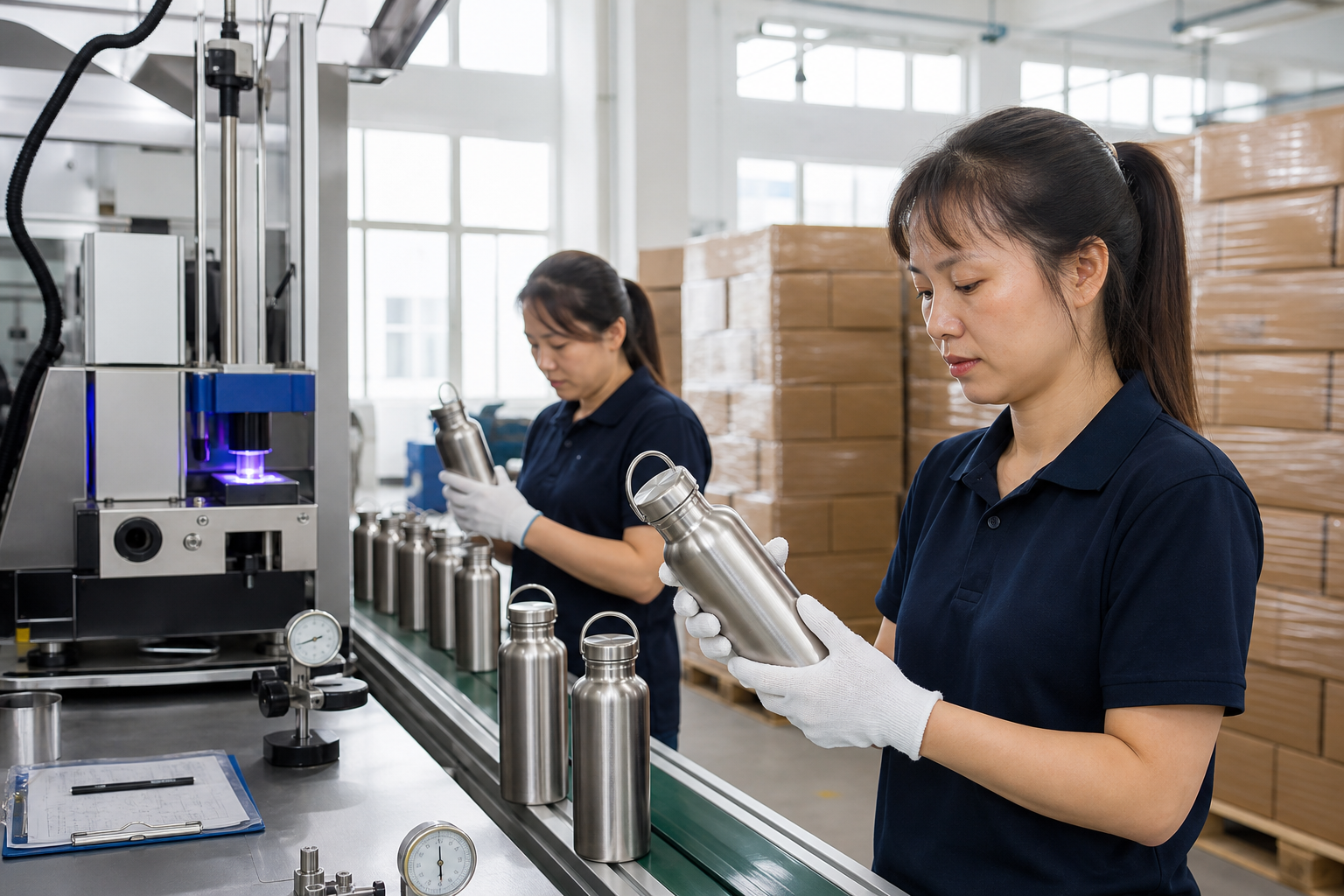
A serious canteen supplier in Zhejiang or elsewhere in China should quote by material, finish, accessory pack, and test standard, not by product photo alone. Our factory in Zhejiang runs 800,000 units per month, with MOQ starting at 500 pcs for many custom canteen models and a 20-35 day production lead time after sample approval. QC pulled the sample twice last week because the buyer flagged a printed logo shift of 1.5 mm; that is the kind of detail you want on the table before you issue a PO.
Start With the Sales Channel
The first mistake buyers make is asking for a price before they define the channel. A canteen supplier will quote a retail SKU, a canteen promotional campaign, and a canteen distributor program on different terms. On our line, QC will flag carton codes and barcode placement before we even talk about cap color. If you sell through distributors canteen-style, you need stable carton counts, barcode discipline, and re-order consistency. If you sell direct-to-consumer, the same product may need a better finish, cleaner logo placement, and retail packaging that survives shelf handling.
Think in terms of use case, not just shape. A custom canteen for outdoor retail can take a slightly higher unit cost if the finish resists scratches and the cap feels solid in hand. A distributor drinkware order often wins by shaving USD 0.15-0.30 off packaging, not by changing the body. That is the wrong question to ask if the pack-out is not fixed. A canteen manufacturer should ask these before quoting: What is the retail price target? Will the carton go to a warehouse or shelf? Do you need master cartons with 6, 12, or 24 pieces?
For canteen vendors and canteen suppliers who only sell from catalog stock, that planning step is often skipped. At the factory, it changes the mold, the carton spec, and the inspection sheet. We have seen a buyer flag a PO because the barcode was printed 2 mm too low. If your buyer program includes Amazon, chain stores, or a regional canteen distributor, fix the pack-out requirements before sampling.
Choose Materials by Use Case
Material choice decides whether the order lands cleanly at the buyer’s dock or comes back as a claim. For most custom drinkware and custom canteen programs, 304 stainless steel is the standard starting point. It runs well on our line, holds up for daily water, sports use, and plain promo giveaways, and the cost stays under control in China. If the canteen will see salt water, acidic drinks, or harsher wash cycles, 316 stainless gives better corrosion resistance, but it is not free. Expect a modest premium, usually USD 0.20-0.60 per unit depending on wall thickness and finish. We had a buyer flag a PO typo once, and the batch almost got held because the material code was written wrong.
Wall thickness matters more than many buyers expect. A 0.4 mm wall can work for low-cost promotional canteen orders, but it feels thin in hand and dents faster on the packing table. For a more credible custom drinkware line, 0.5-0.6 mm is the better baseline. If the spec is a premium insulated model or a custom growler / customizable growler style product, ask for 0.7-0.8 mm in the body, the lid gasket material, and weld quality. This is the wrong question to ask if the buyer only wants the cheapest quote. A canteen customized for rough logistics also needs passivation done right and internal burrs kept under control; QC pulled one sample last month with a burr that could cut a finger.
Do not ignore the cap and gasket. A good bottle body paired with a poor lid still leaks, and that is how a small order turns into a resend. Ask for silicone grade, O-ring hardness, and whether the cap has been drop-tested with liquid inside. We run a simple 1.2 m drop test on full units before packing, because a dry cap test tells you little. A canteen manufacturer in Zhejiang should be able to give those numbers without guessing, and if they cannot, the line is not ready for export work.
Decoration Changes Unit Economics
Decoration is where a custom canteen order starts making money or bleeding margin. The same body can ship as a cheap giveaway or a premium retail SKU depending on how we mark it up. We run silk screen on a 6-head line for simple one-color logos, and it stays the cheapest route when the artwork is clean. Laser engraving costs more on the front end, but it holds up against abrasion and dishwasher wear better. For a promotional program, that usually matters more than shaving a few cents.
Match the decoration to the selling price. A flat logo on brushed steel is fine for a procurement giveaway, and the buyer usually pushes back only if the logo looks off-center by 1-2 mm. A powder-coated, customized drinkware line for outdoor retail may need laser, embossing, or heat-transfer graphics with tighter color matching. If you are building a canteen customizable range for distributors, keep the logo area fixed across SKUs so reorders do not turn into new tooling and new setup fees. We've seen that go sideways fast.
- Silk screen: low setup cost, best for 1-2 colors, practical for 500-1,000 pcs
- Laser engraving: clean and durable, good for premium custom canteen orders
- Powder coat with print: stronger retail feel, often adds USD 0.30-0.80 per unit
- Full-wrap print: higher visual impact, but needs tighter color control and more proofing
A serious canteen supplier should show print alignment samples, color swatches, and abrasion test results before mass production starts. QC pulled the sample last week and caught a 3 mm drift on the logo placement, which is the kind of miss that becomes a buyer complaint after 5,000 pcs are packed. If the PO has a typo on the pantone code, stop there and fix it before the line starts.
Test The Compliance File
For Europe and North America, compliance is part of the buying decision, not a checkbox. If your canteen supplier cannot produce the right paperwork, the goods may still leave China, but they can get stuck at customs, sit in a warehouse hold, or fail a customer audit. Ask for food-contact declarations, REACH compliance for the relevant materials, and LFGB support if you sell into Germany or other tighter EU channels. For North America, ask for FDA-compliant material statements and, where coatings or accessories are involved, Proposition 65 awareness. On our side, QC checks the test report number against the carton batch code before release. We have seen the wrong gasket spec on a PO cause the whole file to get challenged.
Inspection matters just as much as paperwork. A solid canteen factory should work to an AQL plan, commonly AQL 2.5 for major defects and AQL 4.0 for minor defects. That means more than a visual check. You want leak tests, lid torque checks, drop tests, and carton drop simulation. If the product has a coating, ask for cross-hatch adhesion and salt-spray data. If the order is for children, ask whether the model needs CPSIA-style review. On the line, QC pulled the sample after the first 20 cartons when a cap torque reading drifted by 0.3 N·m. China has enough factories that say yes to everything; you need one that writes the answer down.
Do not accept a generic statement like “food grade.” Ask for the exact resin, steel grade, gasket material, and test report reference number.
That is the difference between a real canteen manufacturer and a trading desk with a catalog. The buyer flagged a PO typo on a gasket code once, and the file was dead until the spec sheet matched line by line. This is the wrong question to ask: “Can you ship fast?” Ask which material lot was tested, which lab ran it, and which batch the samples came from.
Price the Order Correctly
Most pricing mistakes start when buyers look at only the unit price. That is the wrong question to ask. A usable quotation should break out the body, lid, surface treatment, logo, inner packing, master carton, and any testing charge. For a standard 500 ml custom canteen in 304 stainless, FOB China pricing usually sits around USD 1.05-1.85 depending on finish and decoration. An insulated version can move into USD 3.20-6.40 FOB if the wall structure, vacuum quality, and cap are upgraded. On our line, QC will check whether the laser logo is centered within 1 mm before we release the sample, because a cheap quote with a bad logo costs more later.
Sample timing is another hidden cost. A normal sample cycle is 7-10 days if no new tooling is needed. If you need custom tooling, embossing, or a proprietary cap, add another 10-20 days. Production lead time for a standard order is often 20-35 days after deposit and sample approval. Peak season can push that to 12 days vs 18 days for some steps, and the buyer flagged it when the PO carried the wrong cap code. We run into this often. China manufacturing is fast, but it is not magic, so build buffer time before the ship date.
Ask about packaging economics too. A blank polybag and egg-crate divider are cheap. Printed cartons, hang tags, and retail sleeves raise landed cost, but they protect margin if your channel is shelf-ready or if the buyer expects distributor drinkware to arrive retail-clean. We had one carton spec slip from 50 pcs to 48 pcs per case on a packing sheet, and the math did not work until we fixed the master carton size. On exports like this, packaging is not decoration, it is part of the price.
Audit The Factory Before PO
Before you place an order with any canteen vendor, ask for proof that the factory can repeat the same job twice, not just once. A serious canteen supplier will send production photos, line videos, and recent inspection records without excuses. In Zhejiang or any other export-heavy area in China, they should answer BSCI, ISO 9001, and third-party audit questions without calling the salesperson back three times. That does not promise perfect output, but it tells you the line is used to export checks, not showroom talk.
What should you request? Start with these three items: 1) a pre-production sample with the exact logo and finish, 2) a batch inspection report showing defect counts and AQL results, 3) packing photos with carton marks, item codes, and pallet layout. On one job, QC pulled the sample from tray 03 and caught a 1.2 mm logo shift before the line ran 5,000 units. If you need Amazon FBA, add FNSKU labeling, carton weight limits, and case pack confirmation. If you sell through a canteen distributor network, confirm whether they need master carton labels or mixed-SKU cartons. The buyer flagged a PO typo on carton count once, and that mistake would have broken the whole shipment.
One practical test is to ask the factory how they handle a defect complaint. A real canteen factory will tell you the replacement process, how they sort the lot, and who pays for the rework. Ask for the last complaint file, not a promise over WeChat. A weak supplier will talk around it. That is the wrong question to dodge, and the price gap rarely covers a bad lot, a re-sorted pallet, or a 12-day delay at the dock.
Send your canteen spec for a factory quote
Share material, size, logo method, and target market. We will return pricing, MOQ, and compliance options from our Zhejiang production line.
Frequently asked questions
What is a realistic MOQ for a custom canteen order?
For many standard custom canteen models, 500 pcs is a realistic MOQ in China. If you want a special lid, deep embossing, or a premium coating, 1,000 pcs is more common. For very simple promotional runs, some canteen manufacturers can sample at 300 pcs, but the unit price will usually be higher. Plan 7-10 days for a normal sample and 20-35 days for production after sample approval. If you need multiple colors, ask whether the MOQ is per color or total order, because that changes your landed cost quickly.
Should I choose 304 or 316 stainless steel?
For most custom drinkware and canteen promotional programs, 304 stainless is enough. It balances cost, availability, and performance. Choose 316 when the product will see salty air, acidic liquids, or harsher washing conditions. In practice, 316 usually adds USD 0.20-0.60 per unit depending on size and wall thickness. If you are selling a premium customized drinkware line or a customizable growler for harsher environments, 316 is easier to justify. For standard distributor drinkware, 304 is usually the better commercial choice.
What compliance documents should a Europe or North America buyer request?
Ask for a food-contact declaration, material specification, and REACH support for EU-bound shipments. If your market is Germany or another strict EU channel, LFGB support is worth requesting. For North America, ask for FDA-compliant material statements and a coating or ink declaration if decoration is involved. A serious canteen supplier should also provide ISO 9001 or BSCI audit evidence if available. On the quality side, request AQL 2.5 major and 4.0 minor inspection records, plus leak-test results. If the item is for children, ask whether CPSIA-style review is needed.
How long does production and shipping usually take from China?
For a standard canteen factory order in China, production is often 20-35 days after deposit and sample approval. Simple samples take 7-10 days. Sea freight to Europe or North America can add another 25-40 days depending on port and season, while air freight is much faster but expensive. If you need to hit a retail launch date, build in a buffer for carton approval, label checks, and any last-minute logo correction. Zhejiang factories that run high monthly volume can move quickly, but they still need clean artwork and a frozen spec.
Can a canteen supplier handle distributor packaging and FBA prep?
Yes, if you ask early. A good canteen supplier should be able to add barcode labels, retail sleeves, master carton marks, and pallet counts for a canteen distributor program. For Amazon FBA, confirm FNSKU labeling, carton weight limits, and case-pack logic before production starts. The same applies to distributor canteen orders that need mixed-SKU cartons or region-specific language on the box. Expect a small added cost for labeling and pack-out, but that is usually cheaper than reworking inventory after arrival.