Key Takeaways
- A workable canteen MOQ is often 500 to 1,000 pcs per SKU, but print method and lid tooling change the number fast.
- 304 stainless steel is the practical baseline; 316 makes sense only when corrosion resistance is worth the extra cost.
- Typical factory lead time is 25 to 45 days after sample approval, with rush orders depending on stock and decoration.
- Good vendors in Zhejiang and China will show AQL inspection plans, REACH documents, and leak-test results before shipment.
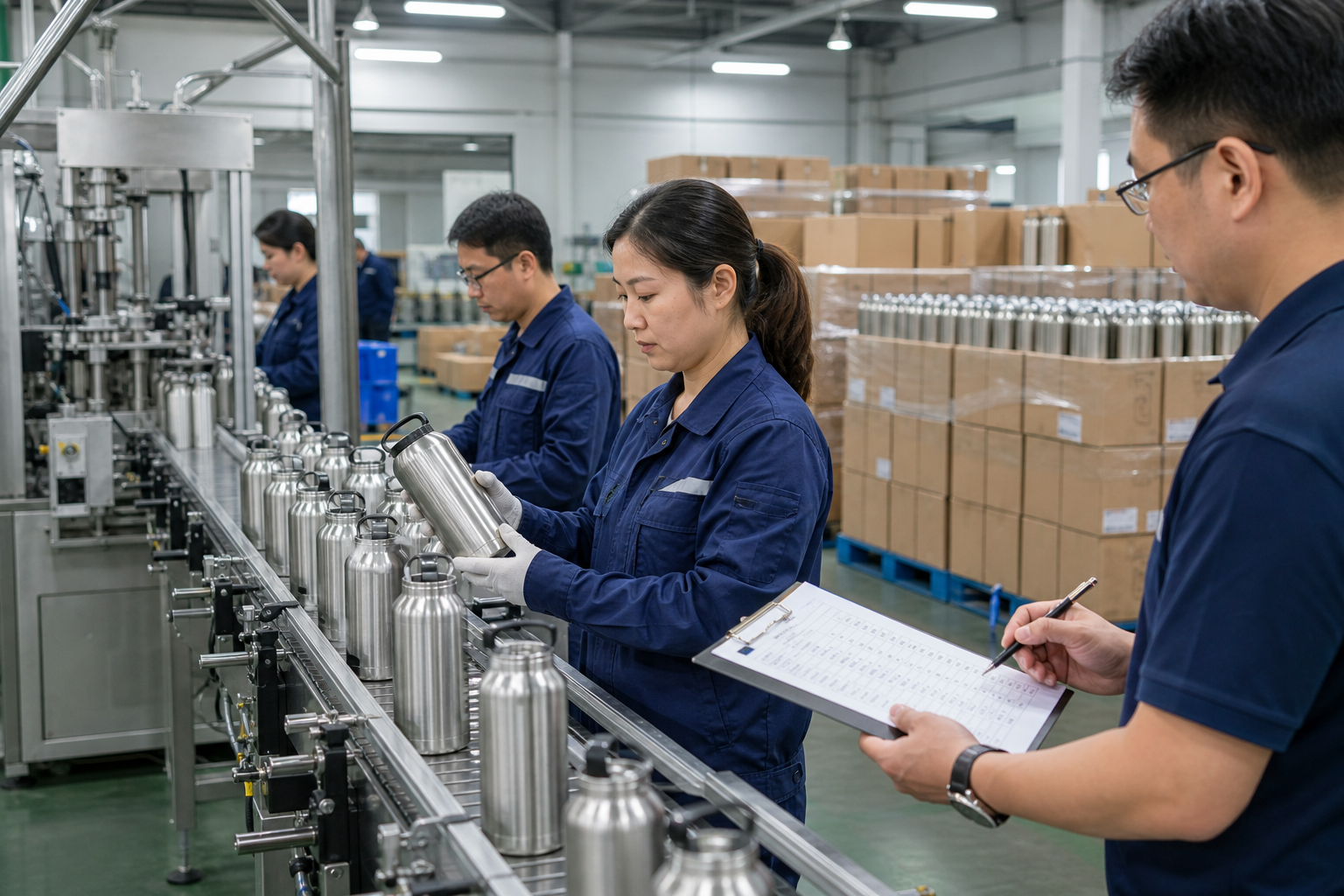
If you are a canteen vendor, the hard part is not picking a bottle. It is finding a canteen manufacturer that can hold your target price, keep the logo crisp after 5,000 washes, and ship on schedule without turning the next reorder into a mess. We run into this all the time: the buyer flags a 1 mm shift on the print, then the sample gets approved and the bulk order still misses. The details decide the job. Steel grade, lid seal, print method, carton count, and whether the factory actually holds AQL standards instead of eyeballing QC. That is the real test.
In Zhejiang and across China, plenty of canteen suppliers promise flexible MOQs and fast lead times. The math does not always work. A serious canteen factory should give you the exact MOQ, confirm whether the line can run 200,000 units per month, and show how they handle REACH, BSCI, and leakage testing on a 12 mm gasket or a 304 stainless body. If you are sourcing a custom canteen, a customizable growler, or distributor drinkware for retail or promotional channels, you need a vendor who thinks in margin and freight cubes, not just samples. We have seen this go sideways when the PO says 3,000 pcs and the carton spec is typed wrong by one digit.
Start With The End Use
Before you talk colors or logos, pin down where the canteen will be sold and how it will be used. A canteen vendor serving sports retail needs a different build than a distributor filling school programs or corporate gifts. A 600 ml stainless canteen for hiking is one thing; a 750 ml promo canteen with a gift box is another. We run this check first because once the use case is fixed, the line stops guessing.
Most buyers should start with three points: do you need hot and cold retention, do you want a single-wall or vacuum body, and does the shape have to fit an existing shelf or carton spec? A wide-mouth canteen is easier to fill and wash, but QC pulled the sample and found the lid seal failed after a drop test at 1.2 m when the hinge was weak. A slim body looks better on retail shelves, yet it can add tooling cost and push the carton size from 12 pcs to 10 pcs per master carton. The math does not work if you skip that check.
- Outdoor and sports: prioritize weight, grip, and dent resistance.
- Promotional orders: prioritize decoration area and low decoration cost.
- Retail orders: prioritize shelf appeal, carton efficiency, and return rate.
Good canteen manufacturers in China ask these questions before they quote. If they do not, they are pricing a generic bottle and hoping it fits your market later. We have seen that go sideways on orders where the buyer flagged a 2 mm logo shift only after the PO typo changed the carton code.
Choose The Right Material
Material choice sets the price, the weight, the compliance path, and the complaints you will get later. For most custom drinkware jobs, 304 stainless steel is the standard we run. It holds up in normal beverage use, resists corrosion, and keeps landed cost under control. On our line, QC pulls the coil tag before first cut. If the canteen is going into acidic drinks or long soak times, 316 stainless is the safer pick, but the buyer should expect a 10% to 20% price rise depending on thickness and finish. Some buyers ask for 316 on every SKU. That is the wrong question to ask.
Wall thickness matters more than first-time buyers expect. At 0.4 mm, a vacuum canteen body is light and efficient, but it can feel flimsy in hand. At 0.5 mm to 0.6 mm, the bottle feels solid and survives carton crush and drop tests better. We have seen a 0.4 mm sample pass bench checks and still come back with dent claims after a 1.2 m drop in transit. Saving a few cents at FOB can turn into returns later. The math does not work if you are selling through retail or e-commerce.
What to ask the factory
- What steel grade do you run, and do you have food-contact paperwork for it?
- Is the inner liner polished or brushed, and what finish do you actually ship?
- What gasket material is in the lid, silicone or TPE, and what is the hardness spec?
- Has the product passed vacuum retention, thermal retention, and leakage tests on the line?
A serious canteen factory in Zhejiang should answer with numbers, not promises. If they cannot tell you the tested seal life or the thermal retention result, you are still in sample territory. We have seen this go sideways when a buyer approved a PO with one typo on the lid spec, then the whole batch came back wrong.
Branding That Survives Use
Decoration is where a lot of canteen custom jobs go sideways. QC pulled one sample that looked fine on the bench, then the first run showed a weak color match, a thin coat, and a logo that started lifting after a few dishwasher cycles at 65°C. Pick the marking method for the use case, not for taste. Silkscreen keeps cost down for simple one- or two-color artwork. Laser engraving holds up well and gives a cleaner premium look. Heat transfer and UV print fit more complex branding, but the body finish and coating have to match the ink system.
If you are buying a customizable canteen for distributor drinkware programs, ask for decoration tests on the exact body finish. Powder-coated bottles, mirror-polished surfaces, and matte lacquers behave differently on the line. We had a buyer flag a logo that looked sharp on a white matte canteen, then warped on a metallic body with the same artwork. The factory should give you a decoration tolerance, usually 1 to 2 mm for placement on cylindrical surfaces, and show a mockup before mass production. This is the wrong question to ask after the PO is locked.
For promotional orders, keep the artwork simple. A two-color logo on a clean body usually sells better than a busy design that loses detail at arm's length. If you need a customized canteen for retail, push for the carton or sleeve at the same time. We ship a lot of shelves where the bottle is fine, but the pack is what closes the sale. A good carton matters when the buyer is comparing three SKUs and your MOQ is 1,000 pieces.
MOQ, Pricing, And Lead Time
Most procurement mistakes start with unclear order economics. We quote unit price, mold or plate charges, decoration setup, sample fees, and carton costs as separate lines. On the line, a 500 pcs MOQ can turn into extra lid parts if the buyer changes from a plain cap to a matte spray finish. For standard custom drinkware, MOQ often starts at 500 pcs per color or 1,000 pcs per SKU. Special lids, gift boxes, or a non-standard body shape push the MOQ up fast. That is normal. The wrong question is why the MOQ moved; ask which part of the spec caused it.
Lead time usually falls between 25 and 45 days after sample approval, with 7 to 10 days for sample development if the design is straightforward. We run multiple lines in Zhejiang, but the coating oven still sets the pace when a 350 mm tumbler needs two spray passes. A 200,000-unit monthly output means little if the buyer wants a brushed finish, a printed carton, and a rushed ship date in the same week. Ask where the bottleneck is before you sign a PO.
FOB price is only useful if the carton spec, loading plan, and decoration method are fixed. We have seen a PO typo on carton size add 0.8 RMB per piece after the freight calc. Otherwise, you are comparing different products under the same number.
If you are a canteen distributor, ask for separate pricing for stock body plus custom logo versus fully customized production. QC pulled the sample and the logo sat 1.2 mm low on the first pad print, so we know the gap is real. That split gives you margin options for different customers instead of forcing one expensive SKU into every channel.
Quality Checks You Should Demand
A buyer who skips quality standards usually pays later in claims, chargebacks, or replacement freight. We run AQL checks, leak tests, drop tests, and visual inspection for scratches, dents, and print defects on the line before packing starts. For export orders, ask for AQL 2.5 for major defects and 4.0 for minor defects, or another written standard. No written plan, no control. We have seen that go sideways too many times.
Compliance is not optional if you sell into Europe or North America. REACH paperwork matters for chemical safety in coatings and inks, and the factory should keep the raw material lot, lid material, and packaging batch tied to one job card. A serious canteen supplier can show batch records, not just a clean sample room. We once saw a PO typo that swapped the lid code by one digit, and that kind of miss is exactly why traceability matters.
Function tests should be practical. A good factory will check vacuum hold, cap torque, hot-fill performance, and drop resistance from 0.8 m to 1.0 m depending on the category. If you are buying a custom growler or customizable growler, pay close attention to the seal and handle joints. QC pulled the sample after a 1.0 m drop and found a slow seep at the cap thread, which is the kind of failure that never shows in showroom photos.
Ask for pre-shipment photos and one retained sample from each lot. That makes dispute resolution far easier if an issue appears after arrival. We also keep the carton count and lot code on the packing sheet, because a missing box or mixed batch is easier to settle when the records are tight. Simple rule. If the supplier cannot keep one retained sample, they will struggle when the buyer flags a claim at destination.
How To Work With A China Supplier
I’m rewriting the section to sound like a buyer-facing factory note, not a generic guide. I’m keeping the same HTML structure and tightening the language around specs, packing, and reorderability.Working with a China canteen factory starts with a clean spec sheet. Send capacity, dimensions, material grade, finish, logo file, carton count, and target FOB. If you only send a photo and ask for a quote, you get a guess. On the line, QC pulled the sample with a caliper, and a 0.5 mm wall change was enough to affect the lid fit. Good canteen suppliers in Zhejiang answer faster when the request is precise, because they can match it to existing tooling or tell you what needs to change.
Choose the trade term carefully. FOB Ningbo or FOB Shanghai is common for custom drinkware, but the carton master data has to match the loading plan. If you are a distributor canteen buyer, ask for master carton dimensions, gross weight, and palletization data early. We’ve seen a buyer flag a PO with one wrong carton count, and that typo pushed the whole booking off by a day. The wrong question is to ask for the lowest unit price before the loading plan is set.
Think in channel terms. A retail canteen vendor needs consistent output and tight packaging. A promotional buyer wants speed and simple branding. A canteen distributor needs a product family that can be reordered with small changes, not a one-off design that dies after one campaign. I’ve watched a screen-print change chew through half a shift because the buyer asked for six logo colors on a 12,000-piece run. The best canteen vendors stay flexible on customization and strict on process. That is what keeps a China supply chain workable across several seasons.
When the supplier knows your market, the order gets easier to repeat. That is the real advantage of working with a capable canteen manufacturer in China instead of chasing the lowest quote every time. We ship better when the buyer sends the same art file, the same carton spec, and the same mark-up sheet on the second order. Small details matter.
Source Your Next Custom Canteen Properly
Send your spec, target MOQ, and channel. We will quote the right body, decoration, and packing for your market, not a generic sample.
Frequently asked questions
What MOQ should I expect for a custom canteen order?
For a standard stainless custom canteen, many factories in China will start at 500 to 1,000 pcs per SKU. If you use a common body and only change the logo, the MOQ can stay lower. If you want a special lid, new mold, or custom box, expect 1,000 to 3,000 pcs. For a canteen vendor, the key is to separate stock body orders from fully customized runs so you can test the market without locking too much cash into inventory. Ask the supplier for MOQ by color, by print method, and by packaging, because those are usually different.
How long does production usually take?
A normal lead time is 25 to 45 days after sample approval. Simple silkscreen orders can move faster if the factory has stock bodies ready. New molds, complex coatings, or special packaging will add time. If you are working with a canteen manufacturer in Zhejiang or another major China export base, ask how many days are needed for tooling, sample approval, production, and final inspection. A realistic schedule matters more than a promise of speed, because missed ship dates usually come from decoration bottlenecks or packaging delays, not the bottle body itself.
Which material is better, 304 or 316 stainless steel?
304 stainless steel is the standard choice for most custom drinkware because it gives you a strong balance of price, corrosion resistance, and availability. 316 is better when the product may face more acidic use, harsher environments, or premium positioning. Expect 316 to cost about 10% to 20% more depending on thickness and finish. For a canteen supplier serving retail or promotions, 304 usually wins on value. For a customized growler or high-end reusable bottle, 316 may make sense if the buyer will notice and pay for the difference.
What quality documents should I ask for?
Ask for REACH documentation, batch traceability, inspection records, and proof of leakage or vacuum testing. If you sell into Europe, REACH is not a nice-to-have. If you are shipping to the US, ask whether the product has any relevant food-contact declarations or testing based on your channel requirements. A decent canteen factory should also give you AQL inspection criteria, photos from final inspection, and retained sample records. For distributor drinkware, those documents reduce disputes when a customer claims a defect after delivery.
Can I combine custom logo and retail packaging on one order?
Yes, and many canteen distributors do exactly that. The better way is to quote the bottle, the decoration, and the packaging as separate cost items. That lets you build a standard version, a premium version, and a promotional version from the same base product. For example, a silkscreen logo with a white tuck box may be one price, while laser engraving plus a rigid gift box may be 15% to 30% higher. If your supplier cannot break out those costs clearly, you will struggle to manage margin later.