Key Takeaways
- Typical children water bottle MOQ is 1,000-3,000 units, with 20-35 day lead times from a children water bottle factory direct.
- For school buyers, Tritan, PP, and 304 stainless each solve different problems; don’t buy by price alone.
- Ask for REACH, FDA food-contact, and leak test data; AQL 2.5 is a normal commercial inspection target.
- Custom logo printing usually adds USD 0.12-0.85 per unit, while full children water bottle private label packaging adds more.
If you buy for a school district, chain retailer, or kids-product program, children water bottle wholesale is not about picking the prettiest bottle. It is about avoiding leaks, complaints, and compliance problems after the PO is already in motion. We have seen a 30-day project blow up because the cap gasket was 0.5 mm off and the buyer flagged a drip test on day three. In Zhejiang and across China, the factories that do this well stay boring on purpose: stable tooling, repeatable QC, and test reports that match the shipment.
You also need a supplier who knows how children water bottle bulk orders behave. A school order of 5,000 units is not the same as a promotional run of 500, and the math does not work if you price them the same. The questions are plain: what material, what closure, what MOQ, what lead time, what standard applies. A good children water bottle manufacturer in China should answer with numbers, not slogans. At BottleForge Industrial in Hangzhou, Zhejiang, we run 450,000 units a month, and our OEM lead time is 20-35 days depending on decoration and packaging. QC pulled the sample yesterday on a 3-color print job, and the registration was off by 1 mm, so we stopped the line before it became a claim.
Start With the Use Case
Before you compare children water bottle suppliers, pin down the use case first. A school district wants a bottle that takes knocks, washes clean fast, and does not leak in a backpack. An online kids-product importer cares about shelf appeal, carton count, and whether the bottle survives a 1.2 m drop in the last mile. A summer camp promo order can live with plain printing; a school contract cannot. We’ve seen the wrong spec cost more in returns than a 3%-5% unit price gap.
Age range comes next, and the size has to match the child. Ages 3-6 usually work with 350-500 ml bottles and a straw lid or push-button cap that opens easily but does not pop loose. Ages 7-12 usually fit 500-650 ml better. For children water bottle wholesale bulk buying, height matters too. A 500 ml bottle at 190-220 mm tall fits most side pockets. We tested one 85 mm body on the line, and it looked fine until QC pulled the sample and tried it in a school bag.
Ask the children water bottle vendor for four numbers: volume, empty weight, lid type, and drop-test result. If they cannot say whether the cap passed a 1.2 m drop test or whether the straw assembly survived 10,000 hinge cycles, the math does not work. A serious children water bottle distributor should know those figures before you send a PO. In Zhejiang, the better factories build around use first, then decorate after the structure is locked.
Choose Materials That Fit Kids
Material choice is where buyers either save real money or end up with a carton of dead stock. For a children water bottle custom program, the short list is PP, Tritan, 304 stainless steel, and glass only for limited-age, supervised use. PP is the cheap, light option, and we run it a lot for school promos. Tritan costs more, but the bottle looks clearer, takes a knock better, and sells easier on retail shelves. 304 stainless works for thermal hold and long service life, yet it adds weight and the cap design has to be tighter. We had one buyer flag a 260 ml stainless sample because the lid felt awkward in a 6-year-old’s hand; the math does not work if the bottle is too heavy.
For plastic bottles, ask for food-grade PP or Tritan with documented BPA-free claims and migration test support. Wall thickness matters. For rigid plastic bodies, 1.5-2.0 mm is common; once a factory goes below 1.2 mm, the bottle starts to feel flimsy and the line shows more rejects. On one PO, the buyer typed “1.8” but the sample spec sheet said 1.2 mm, and QC pulled the sample before packing. For stainless, 0.4 mm to 0.5 mm 304 gauge is standard in this category. Thinner walls cut cost, but dent resistance drops fast. If the order is for younger kids, skip lids with tiny detachable parts. Safety beats extra features.
- Best low-cost school choice: PP, 350-500 ml, single-color print
- Best retail choice: Tritan, 500-650 ml, custom logo and retail carton
- Best premium choice: 304 stainless, powder-coated body, silicone base
When you compare children water bottle manufacturers, ask for material certificates, not just a verbal “BPA-free” claim. A serious children water bottle factory in China should show traceable resin or steel lot records. We ship this kind of file with the shipment when the buyer asks for audit backup. That is what protects a private label order later, because the paperwork is there when the customer’s compliance team comes back six months after launch.
MOQ, Price, and Lead Time
Children water bottle wholesale pricing comes down to material, printing, lid structure, and packaging. For a plain PP bottle, EXW usually starts around USD 0.85-1.40 at 3,000 units. Tritan bottles sit in the USD 1.80-3.80 range, depending on the lid and mold detail. 304 stainless bottles with custom lid systems often start around USD 3.20-6.50. These are factory numbers from China, not retail math. If a supplier quotes far below this, the line is probably using thinner material, skipping test items, or leaving out packaging cost. We’ve had buyers flag a PO typo on the carton count and that alone changed the quote by 8%.
Typical MOQ for a children water bottle manufacturer is 1,000-3,000 units per design and color. A simple promo run can go lower, but the unit price climbs fast. If you need 3 colors, ask whether the MOQ is per color or 3,000 total across the model. Some distributors split the bill into printing, packaging, and carton setup, then the buyer thinks the price is lower. That question is the wrong one to ask. Ask for one landed breakdown: bottle, lid, decoration, packaging, master carton, and FOB port cost. QC pulled the sample last week and found a 0.8 mm lid gap, which is the kind of issue that shows up when someone is shaving cost.
Lead time is usually 20-35 days after sample approval and deposit. If molds are new, add 20-30 days for tooling. A direct factory quote should show sample timing too, because physical approval is where the order gets real. In Zhejiang, better-planned factories can ship a repeat order in 15-20 days if the same mold and decoration method stay unchanged. New art, new packaging, and custom inserts all add days, so build that into your procurement calendar. We run the line in 2 shifts when a buyer needs an urgent re-order, but a fresh mold and new print file still need their own clock.
Decoration and Private Label
Children water bottle custom branding has to survive daily washing, backpack rub, and the odd dishwasher cycle. We run three main methods: silkscreen, pad printing, and laser engraving for stainless steel. Silkscreen gives the best cost on simple logos and 1-2 colors. Pad printing handles curved or uneven panels better. Laser engraving holds up on stainless and looks cleaner, but it is more understated. If your customer wants children water bottle with custom logo for retail, check Pantone matching and how many print positions the PO allows. QC pulled a sample last week and the buyer flagged a logo shift of 1.5 mm on the back panel.
Print cost usually sits at USD 0.12-0.45 per unit for simple single-color decoration, and USD 0.35-0.85 for multi-color or wrapped graphics. Full children water bottle private labeling with retail boxes, hangtags, barcodes, and FNSKU labels can add another USD 0.20-0.60, depending on inserts and carton layout. For Amazon or similar channels, the outer carton needs scannable labels that stay flat. We’ve seen this go sideways when the buyer sent a PO with the barcode line typed one digit off. Smudged ink and bent labels waste labor at the warehouse.
Children water bottle customized packaging should match age and safety, no shortcuts. Leave out tiny loose parts in the box, and do not print glossy claims that you cannot back up. If the bottle is sold as dishwasher safe, confirm the temperature limit, usually 60-70°C for printed plastic parts and higher for stainless. The wrong question is, "Can we print anything?" The right one is, "Which decoration method holds up after 50 wash cycles?" A responsible children water bottle vendor will tell you which method fades first, and that saves both sides from arguments later.
Compliance You Should Demand
For school districts and importers, compliance is the gate. Miss it, and the PO stalls or the cargo gets held at port. Ask your children water bottle supplier for REACH test reports for Europe, FDA food-contact documentation for the US, and migration test results matched to the material. If the bottle has silicone straw parts, ask for silicone compliance too. For 304 stainless bottles, ask for material grade proof and lead control on decorative coatings; we had one buyer flag a PO because the print file said “SS” instead of “304,” and that typo turned into a three-day delay.
Inspection should be specific. AQL 2.5 for major defects and 4.0 for minor defects is common for finished goods, though some school buyers push tighter checks on leakage and decoration accuracy. Leak tests need to run on every production batch, not just samples. We use a 24-hour inverted storage test at room temperature, plus a 1.0-1.2 m drop test for closure integrity. QC pulled the sample on one line because a cap started weeping after the second drop. If your children water bottle manufacturer cannot walk you through the QC sequence, that is the wrong supplier.
“For kids bottles, the cap is the product. The body is just the container.”
That line sounds sharp because it is. Most failures come from lids, seals, straw assemblies, or hinge fatigue. We run the closure tooling harder than the body color checks, and there is a reason for that. A 0.3 mm seal mismatch can sink a whole carton. We have seen buyers focus on print shade while ignoring the latch, and the math does not work.
How to Vet Suppliers Properly
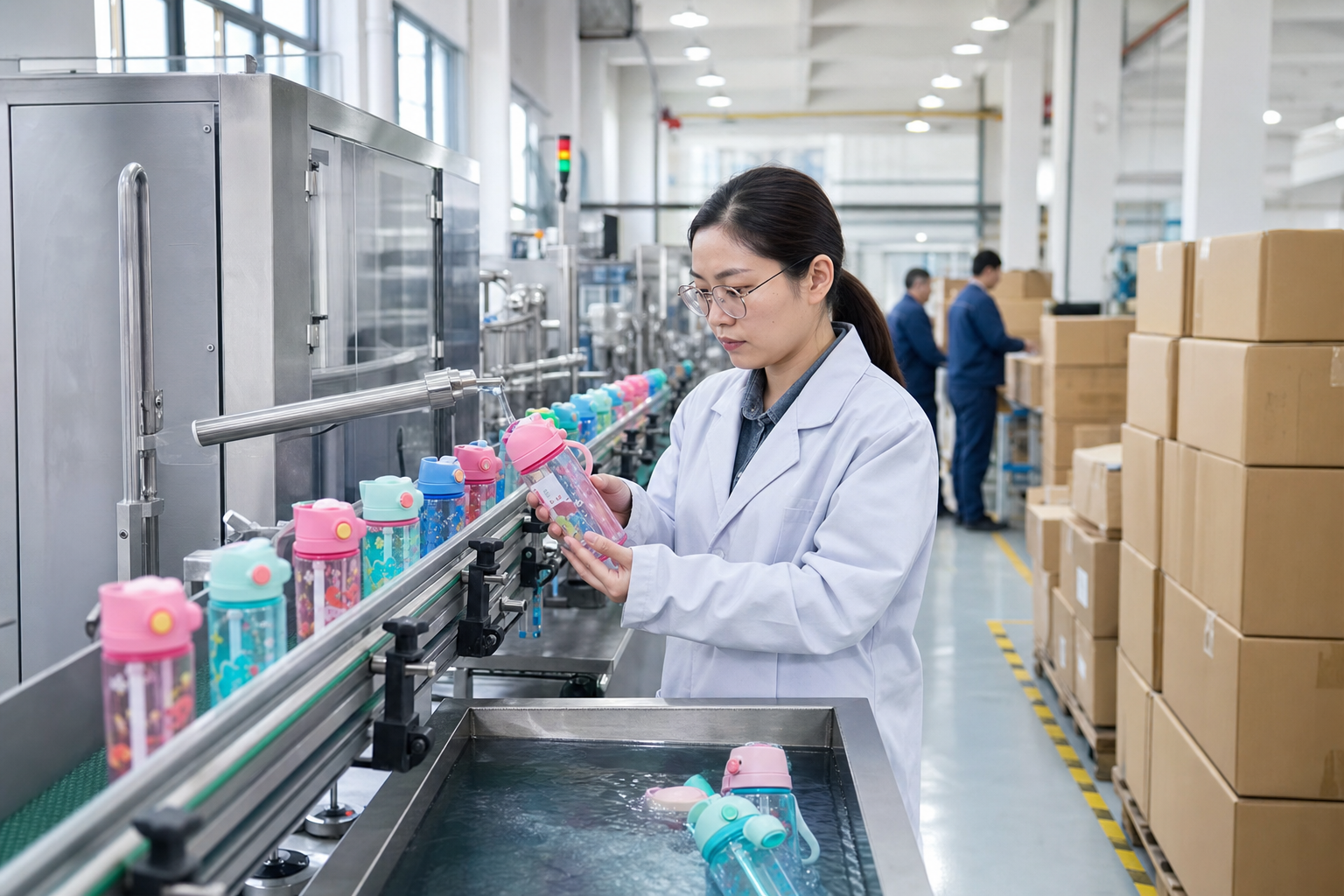
A children water bottle supplier list or children water bottle supplier directory is only the starting point. We still check whether the company is a real children water bottle factory or just a trading desk. Ask for factory photos with the line running, not office shots. Ask for the number of injection machines, assembly lines, and packing stations. A real children water bottle OEM manufacturer should tell you monthly capacity, typical yield, and which parts are made in-house versus outsourced. If they dodge those three numbers, the math does not work.
Useful screening questions include:
- What is your MOQ per color and per artwork version?
- Can you supply BSCI, ISO 9001, or Sedex audit evidence if needed?
- What is your standard inspection point: IQC, IPQC, OQC?
- Can you show a recent 30,000-unit order with defect rate below 1.5%?
For North American and European buyers, factory direct is usually cheaper and clearer than working through multiple children water bottle vendors. We ship FOB Ningbo and Shanghai every week, and the buyer flagged one PO where “DDP” was typed as “DDM” — small typo, big delay. Direct sourcing only helps if the quote is clean. Ask for one quote in FOB Ningbo or Shanghai, one in EXW, and one in DDP if you want landed comparison. QC pulled the sample on a 12 mm cap gap before it left the packing table, and that is the kind of detail that saves a claim later. Good sourcing is less about chasing the lowest number and more about checking what the number includes.
Ordering for Schools and Retailers
School district buyers and kids-product importers do not buy the same way, even when they want the same bottle. Schools usually want 1 SKU, plain branding, and a fixed ship date tied to the semester start. Retailers want more color options, shelf-ready packaging, and room to reorder. If you are planning children water bottle buy in bulk for a district, lock the spec early and freeze artwork before production. We had a PO last spring with a logo typo, and the line had to stop for 2 days.
For schools, set the carton plan around how staff will hand out bottles. A case pack of 24 units is easier than 36 when homeroom teachers are opening cartons one by one. For retail, retail-ready cartons and clean UPC placement matter more. If you are a children water bottle distributor, ask whether the factory can ship mixed-color master cartons and whether each unit goes in a polybag or an individual box. That changes warehouse labor more than most buyers expect. QC pulled one sample with a loose cap at 52 mm, and the buyer flagged it on the first check.
When you place a children water bottle wholesale order, keep the document set tight: approved sample, signed spec sheet, inspection standard, packing list, and artwork proof. That covers most programs. If the factory is in Zhejiang or another manufacturing center in China, ask for a pre-production sample and a shipment sample kept by both sides. We run this way because the math does not work if you rely on memory later. A small batch of 200 pcs for sign-off costs less than a container dispute.
Request a factory quote and sample pack
Send your target volume, age range, and logo files. We will return a clear spec, MOQ, and FOB price without sales fluff.
Frequently asked questions
What is the usual MOQ for children water bottle wholesale orders?
For most children water bottle wholesale programs, MOQ is 1,000-3,000 units per design and color. Simple PP promotional bottles can sometimes start lower, but the unit price rises. If you need custom artwork, retail cartons, or multiple lid colors, expect the MOQ to move upward. A serious children water bottle manufacturer in Zhejiang will tell you whether MOQ is per SKU or total across the order, which is a detail that changes your cost structure fast.
Which material is safest for a children water bottle?
For everyday school use, PP and Tritan are the most common choices because they are light, impact-resistant, and easy to clean. 304 stainless steel is better if you want a premium feel or thermal performance. If you sell in Europe or North America, ask for REACH and food-contact documentation, plus material traceability. Safety is not just the resin or steel grade; it is also the cap design, seal material, and print ink used on the bottle.
How much does a custom logo add to unit cost?
A basic single-color logo usually adds about USD 0.12-0.45 per unit. Multi-color prints, wrap graphics, or laser engraving on stainless can add USD 0.35-0.85 or more, depending on setup and coverage. If you also want children water bottle private labeling with cartons, inserts, and barcode labels, add another USD 0.20-0.60. Always ask for the decoration cost separated from the bottle cost so you can see the true factory price.
What compliance documents should I request from a China supplier?
Request REACH reports for EU shipments, FDA food-contact documentation for US sales, and material certificates for PP, Tritan, silicone, or 304 stainless. Ask for leakage test records, drop-test procedures, and AQL inspection standards. If the supplier is a proper children water bottle factory in China, they should also provide business licenses, audit reports such as BSCI if available, and photos or videos of the actual production line. Documentation should match the exact model you are buying.
How long does a custom children water bottle order take?
Typical lead time is 20-35 days after sample approval and deposit for existing molds. If tooling is new, add 20-30 days. Decoration method affects timing: simple silkscreen is usually faster than full-body graphics or specialty packaging. A repeat order from a children water bottle factory direct in Zhejiang can ship faster, sometimes 15-20 days, if the mold, cap, and artwork stay unchanged and the factory has raw materials in stock.