Key Takeaways
- Stainless steel vacuum bottles usually start at 3,000 units MOQ and 35–45 days lead time after sample approval.
- Tritan and polypropylene bottles can reduce unit cost by 20–35% versus stainless steel, but temperature and impact performance are different.
- For EU and North America, ask for REACH, food contact declarations, and test reports against LFGB, FDA, or relevant ASTM methods.
- A factory in Zhejiang with 200,000+ units/month capacity can still bottleneck on decoration, not molding, so plan artwork early.
If you buy custom drinkware for retail, promotions, or e-commerce, the hard part is not finding a bottle. The hard part is picking the right material, closure, decoration method, and compliance set without wrecking your margin. A nice-looking bottle can still fail leak tests, drop tests, or the freight math. This guide should start with the buyer’s job, not the factory catalog.
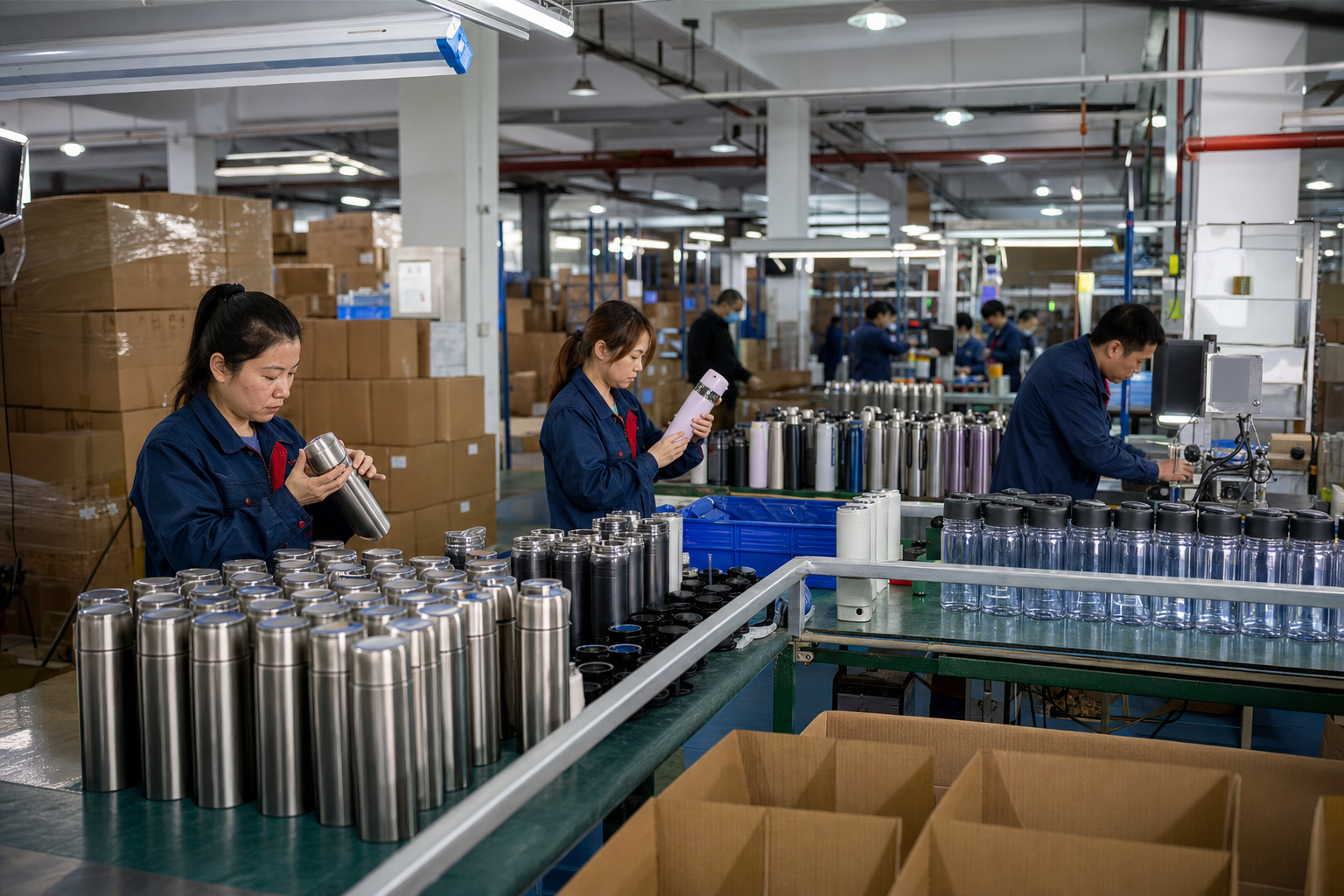
From our Zhejiang production floor in China, we see the same mistakes every week. Buyers ask for a 500 ml vacuum bottle with a 300 ml mug lid, then the tooling quote comes back and the 2,000-unit launch no longer works. QC pulled the sample on the line and found a 0.8 mm wall mismatch, so the buyer flagged it and the PO had to be corrected. If you want a useful guide to drinkware, you need the numbers: MOQ, wall thickness, coating durability, AQL, and the standards your market actually cares about. That is what matters when you order by container, not by sample.
What buyers mean by drinkware
In B2B sourcing, “drinkware” is not one product. It covers a pile of containers with different limits: a complete guide to water bottle order does not match a complete guide to thermos run for hot-fill drinks. You might be buying a complete guide to reusable water bottle SKU for gyms, a complete guide to growler item for craft beer, or a complete guide to canteen for outdoor retail. One line of 24 oz bottles, another of 64 oz growlers. Different caps, different liners, different tests.
For procurement, define the use case before you ask for material. A commuter bottle needs one-handed use and leak resistance; we run torque checks on the cap at 1.2 N·m for that. A gym bottle needs fast hydration and a body that fits cup holders. A premium gift item may need powder coating, laser engraving, and a boxed pack-out. A basic promo item may only need a food-safe plastic body and one-color silk screen. If the use case is vague, you over-spec the product and pay for features your customer will never notice. We've seen that go sideways on a 5,000-piece PO with the wrong lid called out.
We usually split requests into five buckets:
- Hot and cold insulated: vacuum insulated bottle, thermos bottle, thermos flask, thermal bottle
- Cold beverage: tritan bottle, bpa free water bottle, plastic water bottle
- Premium reusable: stainless steel bottle, stainless steel water bottle, vacuum flask
- Glass: glass water bottle with sleeve or infuser lid
- Specialty: growlers, canteens, travel tumblers
This classification points you to the right factory process, and it cuts quoting time when you compare suppliers in Zhejiang and other manufacturing regions in China. QC pulled the sample on a 304 stainless order last week because the buyer flagged a 0.5 mm lid gap; that kind of detail matters more than marketing language.
Materials that actually sell
Material choice drives cost, complaints, and shelf position. A complete guide to drink bottle sourcing should never treat every bottle as the same item, because the raw material changes hand feel, drop resistance, and the compliance route. We had a buyer flag a PO typo once: “PET” was written on the spec, but the artwork said “Tritan.” The line stopped for half a day. If you are building a price-sensitive retail line, a complete guide to plastic water bottle program makes sense. If you need a more premium item, a complete guide to stainless steel bottle or complete guide to stainless steel water bottle is the cleaner commercial move.
Stainless steel still gives the strongest perceived value. Most vacuum products run 18/8 stainless inner and outer walls, with 0.4 mm to 0.5 mm sheet thickness on the body. That gives decent dent resistance without blowing up unit cost. On one 500 ml run, QC pulled the sample and measured the wall at 0.38 mm on one side; the buyer rejected the lot before packing. A standard complete guide to vacuum bottle or complete guide to vacuum insulated bottle usually uses double-wall construction with a vacuum gap under 0.3 mbar. If the factory cannot tell you the insulation hours and the test method, the math does not work.
Tritan works when you need clarity, lower weight, and better impact resistance than basic PET. A complete guide to tritan water bottle program sells well for sports, kids, and outdoor retail. It is not for boiling water or long heat retention. We run a 24-hour dishwasher check on the line for these parts, and that catches lid warp before shipment. Polypropylene costs less and molds well for caps, sports lids, and some body styles, but the market reads it as a lower-ticket material. That is the trade-off.
Glass sells on purity and taste. A complete guide to glass water bottle project usually needs a silicone sleeve or protective case, because breakage is a real issue in transit. We once shipped 3,000 pcs with a sleeve thickness of 2 mm, and the breakage rate dropped hard after carton-drop testing. For the right customer, though, glass has strong shelf appeal and almost no odor retention.
Practical rule: if your target retail price is under USD 6 FOB, start with plastic or Tritan. If you are above USD 8 FOB, stainless steel is easier to justify.
Vacuum insulation and thermal performance
Buyers asking for a complete guide to thermos flask or complete guide to thermos bottle usually want one number: how long the bottle holds temperature on the shelf and in the field. Factory talk should stay on test data, not marketing copy. A proper double-wall vacuum bottle should keep hot water above 60°C for 6 to 12 hours, depending on fill volume, room temperature, and lid structure. For cold retention, 24 hours is realistic if the cap seals well and the body size is not too large. We test this with a thermometer probe in a 20°C room, not in a brochure.
The search terms matter because buyers type different phrases. Complete guide to thermal bottle, complete guide to double wall bottle, and complete guide to double walled bottle all land in the same category, but the end use is often different: a narrow-mouth lunch bottle, or a wide-mouth sports flask. Wide mouth makes ice loading and cleaning easier. Narrow mouth gives better sip control and usually a tighter seal. We saw a buyer flag a 3 mm lid gap on the first sample, and the complaint rate followed the cap, not the steel shell.
Ask for these details before approval:
- Vacuum leak rate test method
- Heat retention test at 95°C fill, 20°C ambient
- Cold retention test with ice water
- Drop test from 1.0 m to concrete or steel plate
- Seal cycle life, usually 3,000 to 5,000 cycles for better products
On our Zhejiang line, insulated production can run over 200,000 units per month, but lids, straws, and coating ovens set the pace. A custom print with a special cap usually takes 35 to 45 days after sample sign-off; "two weeks" is not a real schedule. We ship plenty of volume, but the math does not work if a buyer wants fast lead time, low MOQ, and tight vacuum retention all at once. QC pulled a bottle from the rack last week and found the heat curve slipped after a bad lid fit, which is why we push test data before PO.
Decoration that survives retail
Decoration is where a sample can look solid on a light box and fall apart after 200 cycles through a warehouse carton. The right method depends on the base material, logo colors, and abrasion risk. For a complete guide to water bottles program going into mass retail, a one-color silk screen is often enough. For corporate gifting or premium DTC, laser engraving on stainless steel gives a cleaner mark and holds up better after dishwashing and truck loading. For bright branding, water transfer or full-wrap UV printing works, but we always check scratch resistance with a coin rub before we green-light the line.
Do not ask us to stack every decoration method on one SKU. The math does not work, and the yield drops fast. A powder-coated stainless bottle with a laser logo is durable and looks premium. A glossy printed Tritan bottle photographs well, but the buyer needs to accept the trade-off: more visual punch, less abrasion resistance. We saw one Amazon account come back with 3% returns because the logo chipped, while the body was fine. That is a decoration problem, not a bottle problem.
Here is the practical hierarchy most buyers use:
- Laser engraving for metal, best durability
- Silkscreen for simple logos and good unit economics
- Heat transfer for more color, moderate durability
- UV printing for complex graphics, higher setup control needed
A smart buyer asks for logo size limits, Pantone matching tolerance, and curing method. If the supplier cannot tell you the maximum printable area on a curved body, they are guessing. Last month QC pulled a sample with a 1.5 mm logo shift because the fixture was worn; we stopped the batch and reset the jig. In Zhejiang, the factories that handle export programs well will send artwork templates, print bleed allowances, and a defect reference sheet before mass production.
Compliance for Europe and North America
Compliance is not optional if you ship into Europe or North America. If customs stops the container, paperwork is what saves the order. For the EU, we usually prepare food-contact declarations and test support against REACH and, in some channels, LFGB. For the US, buyers ask for FDA-related food contact support. If the bottle has coatings, silicone parts, straws, or printed inks, each material gets its own file. We had a buyer flag a 0.3 mm ink layer on a 500 ml tumbler because the ink supplier’s declaration was missing.
Buyers often mix up a complete guide to bpa free water bottle claim with real compliance. That is the wrong question to ask. “BPA free” only covers one chemical issue. It does not clear phthalates, heavy metals, migration limits, or taste and odor. If you are selling a complete guide to polypropylene bottle or Tritan SKU, ask for test reports on the resin and the finished cup. Finished product testing matters because a gasket, cap liner, or pad printing can change the result. QC pulled the sample once and the smell test failed after the third wash.
A sensible QC plan includes:
- Incoming material verification
- First article inspection
- In-process leak testing
- AQL final inspection, often AQL 2.5 major / 4.0 minor for consumer drinkware
- Carton drop and transit simulation
For export orders, get carton marks, inner pack details, and barcodes locked early. If you sell on retail channels, FNSKU or UPC placement should be fixed before the line starts. We once saw a PO typo on the carton label—“12 pcs” became “21 pcs”—and the buyer killed the shipment. Most “quality problems” are packaging mistakes, not molding defects. The math does not work any other way. China factories can ship solid product, but export documents need the same control as the molding machine and the leak test bench.
MOQ, pricing, and lead times
Price only makes sense when you put it next to MOQ and lead time. A complete guide to drinkware for procurement should show where the money goes. On a basic plastic bottle, FOB China often lands around USD 0.80 to 1.80, depending on capacity, print, and packaging. For a stainless vacuum bottle, we usually see USD 2.80 to 6.50. Add custom tooling, a special lid, or colored coating, and the math jumps fast. QC pulled a 500 ml sample last week and found the cap print cost more than the bottle body, which is the kind of surprise buyers miss on the first quote.
Typical order logic looks like this:
- Tritan / PP bottle: 3,000 to 5,000 MOQ
- Stainless vacuum bottle: 3,000 MOQ, sometimes 5,000 for custom color
- Glass bottle: 2,000 to 3,000 MOQ
- Custom growler or canteen: 3,000 to 6,000 MOQ depending on tooling
Lead time is usually 25 to 35 days for standard orders and 35 to 50 days for custom color or complex packaging. Need samples? Add 5 to 12 days for a normal sample; a new mold takes longer. We had one buyer flag a PO typo on the sleeve size, and that small mistake added three days before the line could start. Shipping time is separate from production time, and buyers mix those up all the time. FOB Ningbo or Shanghai is common from Zhejiang, and your freight forwarder should pick the port based on rate and sailing schedule.
Low MOQ often hides higher defect risk because the setup cost gets spread across fewer units. This is the wrong question to ask if you only want the cheapest quote. A 3,000-unit order with stable packaging usually gives better unit cost than a 500-unit test that eats margin and still leaves you with weak pricing. We ran that comparison on a 24 oz bottle order last month, and the smaller trial came out 18% higher per unit before freight.
Choosing the right supplier in China
Not every bottle factory can handle export drinkware. You need a supplier that knows structure, decoration, test reports, and pack-out, not just fast quoting. In Zhejiang, the better plants usually keep molding, assembly, coating, and final inspection under one roof, or in a small local cluster we can reach in 20 minutes. That matters when the lid is off by 0.3 mm or the carton spec changes on the PO.
Ask direct questions before you shortlist anyone:
- What is your monthly capacity by SKU, in pieces?
- Do you weld vacuum cups in-house, or do you send that out?
- Which tests do you run on the line, and which ones go to a lab?
- Can you send BSCI, ISO 9001, or factory audit documents?
- What defect rate do you accept at final inspection, AQL 2.5 or your own standard?
For branded programs, ask for the full production flow, not just a quotation. We want to see where the risk sits: mold lead time, color matching, print curing, leak testing, or carton packing. QC pulled the sample last month and found a 2 mm print shift, and the buyer flagged it before mass production. If the factory gives clear answers, you can set inventory and reorder points with some confidence. If the answers stay vague, this is the wrong supplier for European or North American retail.
The best working relationship is simple: you bring product position, target price, and market rules; we run process control and give you lead times that hold. We had one buyer send a PO with "matte balck" in the notes, and the typo turned into a wrong-finish sample. That kind of slip costs a week. Get the details right, and you avoid paying twice for the same mistake.
Request your custom drinkware quote now
Send your target price, material, and artwork. We will match the right spec, MOQ, and compliance path from our Zhejiang team in China.
Frequently asked questions
What MOQ should I expect for custom drinkware?
For most export-ready drinkware, expect 3,000 units MOQ for stainless vacuum bottles and 3,000 to 5,000 for Tritan or polypropylene. Glass bottles often start at 2,000 to 3,000 units because tooling is simpler, but packaging can raise the minimum. If you want custom color, special lid, or wrapped print, the MOQ usually moves up by 1,000 units. A factory in Zhejiang may quote lower, but check whether that includes printing plates, packing inserts, and export cartons. Small orders are possible, but the unit price often jumps 15% to 40%.
How do I choose between stainless steel and Tritan?
Choose stainless steel if you need premium perception, temperature retention, or a stronger retail price. A 500 ml double-wall stainless bottle typically keeps hot water above 60°C for 6 to 12 hours. Choose Tritan if you want clear walls, lower weight, and a lower unit cost. Tritan works well for cold drinks and sports use, but it is not a thermal solution. In practice, stainless steel usually costs USD 2.80 to 6.50 FOB, while Tritan can be USD 0.90 to 2.80 depending on lid and decoration.
What compliance documents should I request for Europe and North America?
At minimum, ask for food-contact declarations, material test reports, and finished product testing. For Europe, REACH compliance support is common, and LFGB-style testing is often requested by retailers. For the US, buyers usually ask for FDA-related food contact support. If your SKU includes silicone, coating, or printed graphics, request separate material documentation for each component. For retail programs, also ask for carton marks, barcode placement, and AQL inspection records. Do not rely on a verbal claim that a product is “BPA free”; that is not the same as full compliance.
What lead time should I plan for a custom bottle order?
A standard custom order usually needs 25 to 35 days after sample approval. If you need a new mold, custom color, special coating, or complex packaging, plan 35 to 50 days. Sampling takes another 5 to 12 days if tooling already exists. Shipping time is separate from production time. If your supplier says they can produce and ship a complex stainless bottle in 10 days, that is usually a sign they are selling stock, not real customization. In China, production speed is good, but quality control still needs time.
What should I inspect before approving mass production?
Check the sample for leak resistance, lid fit, odor, print clarity, and surface defects. For stainless vacuum products, ask for temperature retention data at 95°C fill and confirm the vacuum seam is uniform. For plastic or Tritan, inspect wall thickness, gate marks, and stress whitening. In final approval, I would also confirm carton dimensions, master carton drop resistance, and barcode location. Use AQL 2.5 for major defects and 4.0 for minor defects as a practical starting point. If the sample is not stable, mass production will not improve it by itself.