Key Takeaways
- A usable custom growler order usually starts at 500-1,000 pcs, with 30-45 days lead time from approved sample.
- For stainless steel, 304 is the common choice; 316 costs more but helps when buyers want stronger corrosion resistance.
- Decoration choice changes your risk: laser engraving is durable, while screen print and UV need tighter handling and test approvals.
- Good export programs use AQL 2.5 for critical checks, carton drop testing, and documented REACH or LFGB support when required.
A custom growler looks simple on a sample table. On the line, it is not simple. You are buying a sealed container that must hold carbonation, survive export cartons, pass REACH or LFGB requirements where needed, and keep a clean logo after 200 wash cycles. Get the wall thickness, lid system, or decoration method wrong, and the unit price is the least of your problems. QC pulled one sample with a 0.3 mm neck variance last week, and that is the sort of miss that breaks a shipment.
For buyers in Europe and North America, the real question is not whether a growler can be customized. It is whether your canteen manufacturer or drinkware supplier can hold tolerances, repeat color, and ship on time. We run that check with drawings, a 3-step sample sign-off, and a real MOQ before anything starts. A capable canteen factory in Zhejiang or elsewhere in China should give you specs you can use, a production plan that matches the PO, and a price that holds when the buyer flags a typo on the artwork file. That is the standard to insist on.
What a custom growler really is
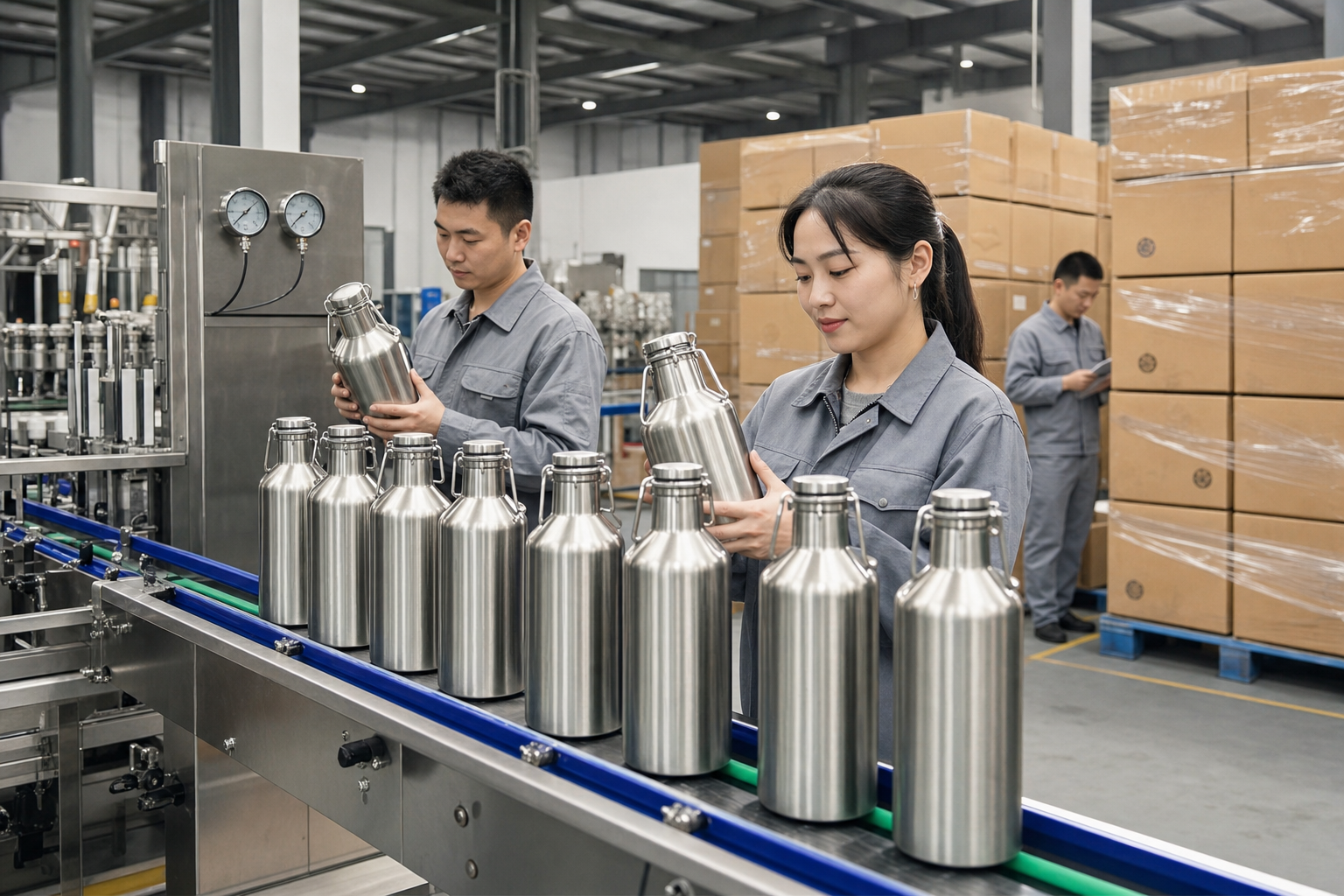
In B2B sourcing, a custom growler is a reusable container for beer, cold brew, kombucha, or other carbonated drinks. Most buyers pick stainless steel because it takes hits better than glass and clears customs without the breakage risk we see on retail cartons. The usual sizes are 32 oz, 64 oz, and 128 oz. For a retail line, the 64 oz format usually hits the best balance between shelf presence and freight cost. We run that size a lot on the line.
A growler is not just a bigger bottle. It needs a lid that seals, a body that does not dent too easily, and a decoration method that still looks clean after handling. A canteen customizable platform can be adapted for growler use, but the factory has to control thread fit, gasket compression, and coating thickness. We have seen buyers flag a PO because the cap spec was written as "fits tight" instead of a real thread standard. A canteen manufacturer with export experience is worth more than a generic bottle vendor. In Zhejiang and across China, the stronger factories show measurement reports, not just a photo and a price.
When you compare options, ask for wall thickness, lid torque, and neck finish standard. A 0.5 mm wall on a vacuum-sealed stainless body is common for mid-range products; premium builds may go to 0.6 mm or more. QC pulled the sample on a recent run and the torque wrench showed one lid at 1.8 N·m instead of the target 2.0 N·m, so the batch had to be rechecked. If the factory cannot give you these numbers, the product is not controlled. It is a guess.
Material choices that hold up
Material choice drives price, compliance, and end-user satisfaction. On the line, 304 stainless steel is our default for a custom growler because it keeps cost in range and clears the usual requirements in Europe and North America. If the buyer wants better corrosion resistance for acidic drinks or a stronger retail story, 316 is the upgrade, but the material premium still lands around 12-20% depending on the market. For the outside, powder coating gives a harder finish than standard paint, and matte hides scuffs better after the powder coat booth and carton packout. That is the right question to ask, not whether the shell feels premium in a sample photo.
Some buyers still ask for glass, usually when the growler is positioned as a promo piece or a lifestyle item. Glass looks clean, but the freight risk is higher and carton strength matters more than the product shot. We have seen that go sideways when a buyer pushed for thinner cartons and then the warehouse reported corner crushes after the 1.2 m drop test. If you are a canteen distributor or a drinkware buyer, stainless is usually the safer export choice. It takes more weight on the scale, but it cuts damage claims when you ship 10,000 pcs through Europe or North America.
You should also ask about BPA-free components, food-contact testing, and gasket material. Silicone seals are standard; low-grade rubber is not acceptable for a serious export order. QC pulled the sample on the gasket bench and the buyer flagged a typo on the PO because the material code did not match the test report. A good canteen supplier will send the material declarations and line up third-party testing if your customer needs it. We run that file before mass production, not after the complaint lands.
Decoration that survives use
Decoration is where a lot of custom drinkware programs fail quietly. We see it on the line all the time: the logo looks clean on day one, then a dishwasher test after 10 cycles turns it into a complaint. Pick the process for wear, not for the lowest quote. For a custom growler, laser engraving, screen printing with controlled curing, and powder coat plus laser reveal are the three that hold up. Laser is the safest when the buyer needs the mark to stay readable for years. Screen print works for a promo canteen run, but only with the right ink system and adhesion checks.
If you want a cleaner retail finish, ask for Pantone tolerance with a hard number, not a vague promise. We usually quote delta under 2.0 on higher-end jobs, and QC pulled the sample against a Pantone book under 5000K light before we signed off. That small gap matters when you ship one artwork across 3 SKUs. For a canteen customized order, lock down print area, registration tolerance, and whether the logo wraps or stays on one panel. Leave that open and the factory will run for speed, not for shelf appeal. That's the wrong question to ask if the goal is a premium line.
Practical rule
Use laser for durability, powder coat for grip and feel, and skip multi-color art unless you are ready to approve a physical pre-production sample. If the design has fine lines, ask for a test print before mass production. We have seen 0.3 mm strokes spread after curing and the buyer flagged it only after the cartons were packed. That is how a 12-day prototype turns into an 18-day delay after airfreight is already booked.
MOQ, pricing, and lead time
Procurement decisions usually fail at the cost model, not the product design. For a custom growler, we run 500 pcs MOQ on a standard spec and 1,000 pcs when the job needs new tooling, printed cartons, or two-color decoration. On the line, QC pulled the sample with a vernier caliper and caught a 1.5 mm lid gap; that is the sort of miss that shifts a schedule. A Zhejiang factory may run 200,000 to 300,000 units per month across its drinkware lines, but your order does not jump the queue. Lead time still comes down to mold readiness, the coating queue, and when the buyer signs the box proof.
For a simple 64 oz stainless custom growler, ex-works pricing often sits around USD 4.20 to 7.80, depending on steel grade, lid style, finish, and print steps. Add custom cartons, barcode labels, and retail inserts, and the math changes fast. We had a buyer flag a PO typo on the carton count last month, and that one line item added two days at packing. If you source from a canteen factory or canteen supplier in China, split unit price, packaging, and freight. Anything else gives you a fake comparison, and this is the wrong question to ask if you want a clean quote.
Lead time is usually 30-45 days after sample approval for a normal program. If you need a rush order, ask early whether the factory can release a partial shipment. Some canteen vendors can do it, but only if the coating oven and final inspection slot both line up. We have seen this go sideways when a buyer waits until the last week to push for split delivery. The cheapest quote is often the one with the weakest delivery promise.
Compliance and testing basics
Compliance is not optional if you sell into Europe or North America. For a serious custom growler program, we ask for food-contact declarations, traced lot codes, and REACH or LFGB reports when the buyer wants proof on paper. If the product has coating, ink, or plastic lids, each part needs its own file. We have seen buyers get stuck at customs because a supplier sent one vague line and no test report behind it.
For production control, ask your canteen manufacturer how they check incoming stock and finished goods. A proper export factory should state its AQL standard, usually AQL 2.5 for critical and major defects and AQL 4.0 for minor defects, then show the actual check points on the line. For Amazon or retail orders, they should also run carton compression and drop tests, not just say “passed.” If the supplier cannot explain the inspection flow, the math does not work.
In China, the better factories do not hide the process. They show batch records, inspection photos, and a sampling standard before the truck leaves the gate.
That matters on a brand launch. A missing LFGB page can hold a container for 12 days, while the same shipment clears in 18 days only after the buyer chases paperwork twice. We have seen a PO typo on carton marks turn into a chargeback. A growler distributor that wants repeat orders should treat documents as part of the product.
How to choose a factory
Pick the factory first. The photo sample is secondary. A real canteen factory should quote standard and custom jobs, explain the gap between a customized canteen and a customizable growler, and show how it keeps color within the same Pantone target from first batch to last. The better shops run forming, welding, polishing, coating, and packing in one plant. Fewer handoffs mean fewer defects. We have seen this go sideways when coating gets outsourced two towns away.
Ask straight questions. How many pieces per month can you actually run? What is the MOQ for a custom canteen versus a customized growler? Can you support OEM packaging for a distributor canteen order? Can you send BSCI, ISO, or audited factory documents when the buyer asks for them? A good canteen manufacturer answers with numbers, not sales talk. If they dodge the monthly output figure, the math does not work.
- Confirm whether sampling is free or chargeable, and whether sample freight gets deducted from the mass order.
- Ask for a production timeline from artwork approval to final packing, down to the day the line hands off to QC.
- Require one pre-production sample for color, fit, and print approval.
- Use a written spec sheet with material, thickness, finish, and carton count.
If you are working with a canteen supplier in Zhejiang or another export hub in China, this level of discipline is the baseline. We run the line this way because one typo on the PO or one loose carton count can burn a repeat order fast.
Specify your custom growler with real numbers
Send the size, finish, and target market. We will quote MOQ, lead time, and compliance details for China production without guesswork.
Frequently asked questions
What is the usual MOQ for a custom growler?
For most export orders, the MOQ is 500 pcs for a standard stainless custom growler and 1,000 pcs if you want custom tooling, special lids, or multi-color decoration. Some canteen suppliers will quote lower for a simple logo run, but the unit cost usually rises fast below 300 pcs. For a retail launch, 500 pcs is the practical starting point because it gives you enough volume for testing, photography, and distributor samples without overcommitting cash. If you need mixed colors, confirm whether each color has its own MOQ. Many factories in China will treat each color as a separate SKU for production planning.
Is 304 or 316 stainless steel better for a customized growler?
For most buyers, 304 stainless steel is the right choice because it is cost-effective, widely used, and suitable for beer or cold drinks. If the growler will carry acidic beverages more often, or you want a higher-end spec for a premium canteen customized line, 316 is stronger on corrosion resistance. Expect 316 to add roughly 12-20% to material cost, depending on market conditions and wall thickness. If the buyer does not have a specific use case, 304 is the better commercial decision. The lid, seal, and coating are usually more important to customer satisfaction than jumping to a higher-grade alloy.
How long does production take in China?
A normal custom growler order from a capable factory in China usually takes 30-45 days after sample approval. That timeline assumes the mold or tooling is ready, the artwork is final, and the packaging is confirmed. If you need a new finish, special carton, or a busy season slot, add time. Some canteen manufacturers can ship partial quantities earlier, but only if your spec does not require a single packed batch. For imported drinkware, you should also allow time for pre-shipment inspection, freight booking, and customs clearance. If the supplier promises 15 days for a complex order, check the details very carefully.
Which decoration method lasts longest on a growler?
Laser engraving usually lasts the longest because it removes the top layer and does not rely on ink adhesion. For a custom growler that will be used daily, laser is the safest choice. Screen printing can also work well if the factory uses the right ink, curing temperature, and adhesion test, but it is more vulnerable to abrasion and dishwasher wear. Powder coat plus laser reveal gives a strong premium look and is popular for customized drinkware programs. If your customer wants a promotional item with low unit cost, screen print is acceptable, but you should approve a physical sample first and ask for abrasion or dishwasher testing if the product will be washed often.
What documents should I ask from a canteen factory?
At minimum, ask for material declarations, food-contact statements, and the factory's quality inspection procedure. If you are selling in Europe, request support for REACH or LFGB testing. For North America, many buyers also ask for ASTM-related test references depending on the product and channel. A strong canteen factory should be able to provide lot traceability, production photos, and a final inspection report using AQL 2.5 or a similar standard. If the order is for retail or e-commerce, ask for carton drop or compression test evidence too. For distributors, this paperwork is not overhead; it protects your margin when the customer asks hard questions.