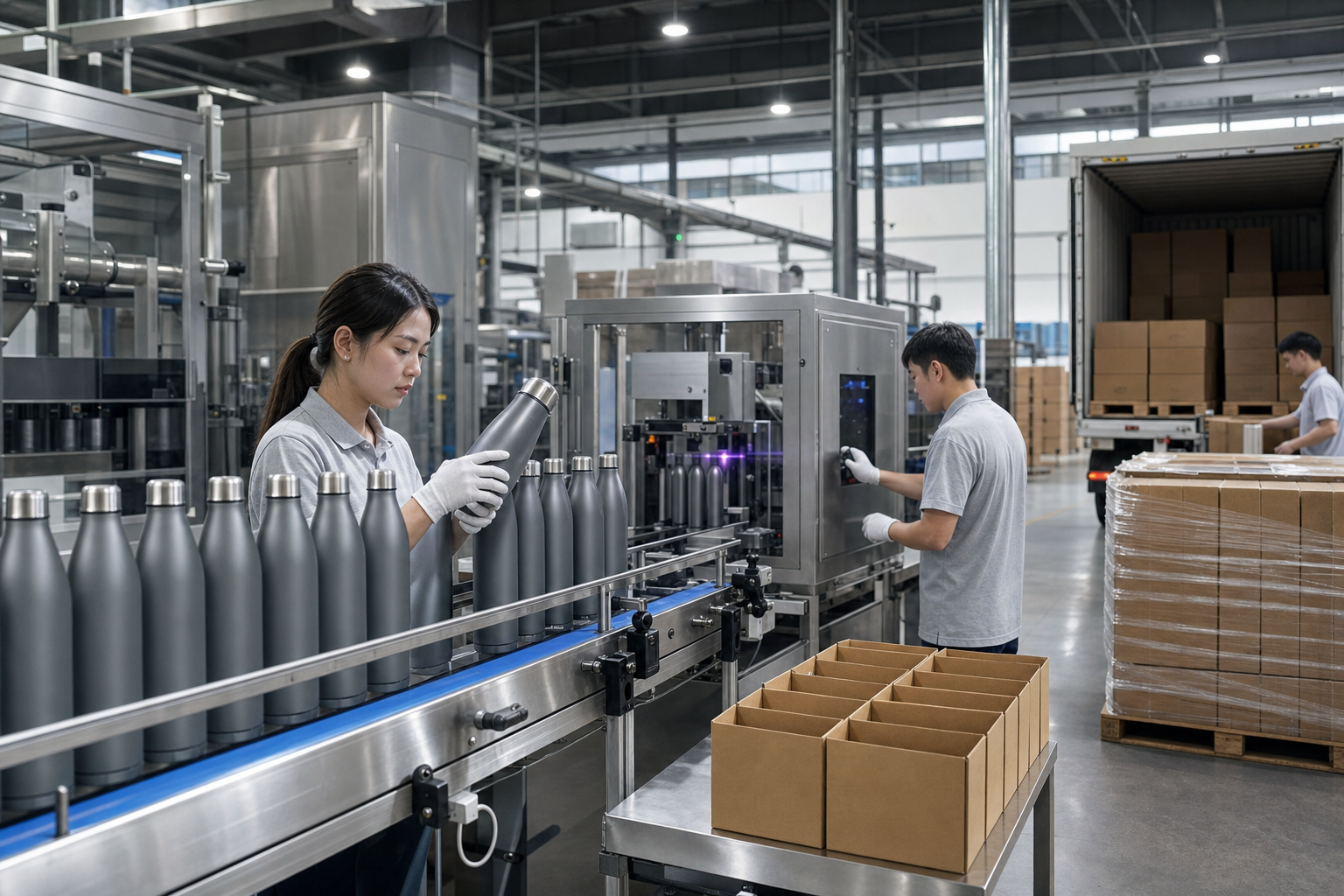
Key Takeaways
- MOQ usually starts at 1,000-3,000 pcs, with 45-60 days lead time for custom stainless steel bottle programs
- Double-wall vacuum insulation is typically 0.4-0.5 mm 304 stainless steel outer and inner walls
- FOB China pricing for mid-spec bottles commonly lands at USD 2.20-4.80 per unit before freight
- Reputable suppliers should support REACH, FDA-style food contact, and AQL 2.5/4.0 inspection plans
If you are sourcing a custom stainless steel bottle, do not treat it like a plain container. You are buying a formed metal body, a closure, a print surface, and a compliance pack that still has to land in the United States, the United Kingdom, or Germany without a dented carton or a missing test report. That is where margin lives or dies. We have seen a 0.4 mm wall spec turn into a freight claim after a drop test at the carton corner.
At BottleForge in Hangzhou, Zhejiang, we see the same thing every week: the buyer sends artwork first, then QC pulled the sample and the real questions started—wall thickness, 304 versus 316, powder coat adhesion, and whether the logo holds after 3,000 dishwasher cycles. A proper custom stainless steel water bottle program starts with use case, not decoration. If you need a custom stainless steel tumbler for retail, a custom stainless steel flask for promotions, or a gym bottle for private label, the spec has to fit the channel. One PO typo on cap color can waste a full line changeover.
What buyers mean by custom stainless steel
Buyers asking for a custom stainless steel bottle are usually talking about three different items: a vacuum insulated bottle for chilled retail stock, a narrow-mouth sports bottle, or a printed flask for promotions. Those are not the same build. The neck changes the mold, the cap changes the leak rate, and the decoration method changes the unit cost. We ask the use case first, because guessing here wastes a week and the quote ends up wrong.
For a standard private-label run, we usually quote 18/8 or SUS304 stainless steel on the inside, with a stainless finish or powder coat on the outside. If the buyer wants a premium line, SUS316 makes sense for acidic drinks or tougher corrosion resistance, but it normally adds 10-18% to material cost. Wall thickness is where people get caught. Inner and outer walls usually sit around 0.4-0.5 mm; if a supplier is far under that, the math does not work, and we’ve seen the line start shaving thickness to hit a target price. QC pulled the sample and found that fast.
Common search intents we see:
- custom stainless steel water bottle for outdoor retail
- custom stainless steel tumbler for corporate gifts
- custom stainless steel flask for spirits promotions
- custom stainless steel bottle usa buyers want for Amazon or wholesale
We also see custom stainless steel bottle uk, custom stainless steel bottle germany, and custom stainless steel bottle united states in RFQs, but the sourcing checklist stays the same: steel grade, decoration, leak test, and carton strength. A buyer once sent a PO with the carton size typed as 12 kg instead of 12 pcs, and the shipping team caught it before booking. That kind of typo turns into a headache fast.
Specs that decide your margin
Most first-time buyers start with print area and miss the mechanical spec. That is the wrong starting point. The bottle has to survive shipping, drop tests, and normal customer abuse before the logo gets any attention. On a recent run, QC pulled the sample and found a 2 mm dent after a 1 meter corner drop, so the carton spec changed the same day. For a custom stainless steel water bottle, the sheet should list capacity, wall thickness, insulation performance, cap type, surface finish, and carton loading. If any of those lines are vague, you pay for it later.
The targets are plain. A double-wall vacuum bottle should hold beverage temperature for 12 hours hot and 24 hours cold if the vacuum seal is clean and the cap closes tight. A silicone gasket must be food-grade and seated in the groove, not just pushed in by hand. For travel, a leak-proof lid should pass inverted shake tests and a 1 meter drop test on six faces. If your channel is the custom stainless steel bottle america market, buyers often ask for dishwasher resistance, and they are not wrong to ask; powder coat and some prints still wear after repeated cycles, especially on the lip and base.
Here is where a practical quote should be specific:
- 304 stainless steel inner and outer wall
- 0.45 mm wall thickness
- 550 ml or 750 ml capacity
- Powder coating or matte paint with laser logo
- FOB Ningbo or FOB Shanghai, depending on route
For a custom stainless steel bottle us order, ask if the factory can do laser-etched calibration marks, Pantone color matching, and replacement lids. We had one PO with a typo on the lid code, and the buyer flagged it before production; that saved a rebuild. Those small details cut returns more than shaving a few cents off the unit price.
Pricing and MOQ in China
Let’s talk numbers. That is what matters. In Zhejiang and across China, a standard custom stainless steel bottle with 304 steel, powder coating, and a one-color logo usually lands around USD 2.20-3.20 FOB at 1,000 pcs. If the buyer asks for a premium cap, gift box, or two-color print, the quote moves to USD 3.40-4.80. A custom stainless steel tumbler with a trickier lid or straw system goes higher again, especially once you add a retail-ready carton and barcode labeling. On the line, we once caught a PO typo that changed “1,000 pcs” to “1000 set” and the buyer flagged it before we cut labels.
MOQ is not one fixed number. A factory with real capacity may offer 1,000 pcs for a standard finish, 3,000 pcs for custom color, and 5,000 pcs if you need a unique mold or special lid. At BottleForge, we run 600,000 units a month across drinkware lines, so a 3,000-piece bottle run is normal work. Lead time is usually 20-25 days for standard colors and 45-60 days when new tooling, sample approval, and mass production all sit on the critical path. QC pulled the sample on a 2 mm lid gap once, and we held the shipment until it matched the spec.
If you are comparing custom stainless steel bottle united kingdom or custom stainless steel bottle deutschland demand, do not compare unit price only. Compare landed cost, defect rate, and carton failure rate. A bottle that saves USD 0.18 at source but breaks 4% more in transit is not cheaper. Ask for a proforma invoice with packaging dimensions, gross weight, and carton count per pallet. That is the math. We have seen buyers chase the lowest FOB and then pay for replacements after the corner crush test failed at 12 kg load.
Decoration methods that last
Your logo is not just a mark on metal. It is a process choice, and the process decides whether the bottle still looks clean after 200 washes or starts failing after 2. Laser engraving, silk screen printing, heat transfer, and UV printing each behave differently on stainless steel. If you sell to premium buyers in the custom stainless steel bottle british or custom stainless steel bottle american segments, durability matters as much as line sharpness. We have seen a cheap logo flake after two dishwasher cycles, and the buyer flags it fast.
Laser engraving is the safest pick for long wear because it cuts through the top finish and exposes the metal underneath. We use it a lot on a custom stainless steel flask, corporate gifts, and bottles that go to site crews or hikers. Silk screen printing works better for solid brand colors, but you need to confirm ink adhesion and whether the bottle is hand-wash only. Powder coat plus laser is a strong combo: the surface feels premium, and the mark holds up. Full-wrap artwork is a different story. The setup takes more time, and MOQ discipline matters. On one 5,000-piece run, the buyer flagged a 1.2 mm artwork shift, and we had to recheck the jig before the line could move.
Practical rule: if the bottle will be handled by commuters, gym users, or field staff, pick decoration that survives abrasion before you pick decoration that looks busy in a catalog.
Ask the supplier for a decoration test report, not just a sample photo. A real factory in Hangzhou or elsewhere in China should be able to show tape test results, scratch resistance data, and reference photos from prior production. If they cannot, the math does not work. We run tape tests with 3M tape and pull the sample twice; if the ink lifts at the edge, QC stops it there. One PO we saw even had “UV pringting” typed in the notes, and that typo told us the buyer had not checked the spec sheet carefully.
Compliance for Europe and North America
For B2B drinkware, compliance is part of the quote, not a side note. If you sell a custom stainless steel water bottle usa program into retail or e-commerce, buyers will ask for food-contact papers, restricted-substance declarations, and carton marks. For Europe, REACH is the first box to check. For the United States, the usual ask is an FDA-style food-contact declaration or a third-party lab report. If the order goes through Amazon or similar channels, we also check packaging copy and barcode rules, including FNSKU labels. We had a buyer flag a 2 mm barcode margin on a shipper once, and the carton was held until we reprinted it.
One report does not cover the whole bottle. A stainless steel body may pass migration, then the coating or pad print fails. Caps, straws, silicone seals, and painted areas each need their own review. If you are sourcing a custom stainless steel bottle united states program for a retailer, ask for test reports on the finished bottle, not only the raw steel tube. For a custom stainless steel bottle uk order, British buyers still ask for food-contact declarations in EU style, and that question comes up even after Brexit. QC pulled the sample on a 500 ml bottle because the lid ink rubbed off after 50 cycles in the tape test. We ship a lot of these, and this is the wrong question to ask: “Does the steel pass?” The math does not work that way.
In China, a serious factory runs incoming inspection, in-process checks, and final inspection against AQL 2.5 for major defects and 4.0 for minor defects. That does not make a bad design good, but it gives you a real control point. If a supplier in Zhejiang says they do not track AQL, walk away. Last month we caught a PO typo that listed “304 stainelss steel,” and the buyer wanted the correction before production; that is the kind of paper trail you need when customs or a retailer asks questions. We run the line with calipers, leak testers, and a simple checklist, and that is the level export orders need.
How to brief a factory correctly
Weak briefs cause most of the trouble. Tell the factory what the bottle is for, who buys it, and where it ships. A custom stainless steel bottle for a U.S. gym chain is a different spec from a promo bottle. Same with a custom stainless steel bottle Germany order for a premium retailer; we would not use the same carton as a giveaway item. Good engineering follows the sales channel, plain and simple.
Your brief should include the following:
- Capacity: 350 ml, 500 ml, 750 ml, or 1,000 ml
- Material: 304 or 316 stainless steel
- Finish: matte, glossy, or powder-coated
- Logo method: laser, silk screen, or UV
- Packaging: mailer box, color box, or gift box
- Target market: custom stainless steel bottle usa, custom stainless steel bottle uk, custom stainless steel bottle america, or retail export to Europe
If you are launching a custom stainless steel water bottle america line on Amazon, ask about carton drop strength, barcode placement, and whether the lid can be taken apart for inspection. We run this test with a 1.2 m drop, and the buyer flagged a warped inner tray on the last round. If you sell through distributors, standardize spare parts like gaskets and lids. That cuts after-sales cost and keeps reorders clean. The math works.
Request samples early. Do not approve from photos. On the line, a phone shot can hide weld marks, overspray, or a weak vacuum seam. QC pulled one sample last month and found a 0.3 mm lip mismatch; the PO had a typo on the lid code, too. A physical sample costs far less than a rejected run.
Choosing the right bottle type
Not every stainless steel product should be sold as a bottle. A custom stainless steel tumbler fits coffee, office desks, and open-top hydration. A custom stainless steel flask works for spirits promotions, heritage branding, and gift sets. A custom stainless steel water bottle fits sports, travel, and retail where leak-proof performance matters. Force the wrong shape into the wrong channel and returns climb fast; we saw one buyer’s 2,000-unit pilot hit a 7% complaint rate because the lid spec was off.
Think in simple terms. Tumblers usually need a wider mouth, easier cleaning, and lids that support sipping or straw use. Bottles need better sealing, a slimmer profile, and a grip finish that does not slip when the line packs them at 3.5 kg per carton. Flasks are often smaller, more gift-oriented, and less demanding on insulation, but the finish has to stay clean because the buyer will spot a tiny scratch in daylight. If your market includes the custom stainless steel bottle britain or custom stainless steel bottle deutschland search clusters, premium presentation often matters as much as function.
At BottleForge, we keep it practical: choose the use case, define the tolerance, approve the surface, then lock packaging. That sequence cuts dead time. One PO came in with a typo on the lid code, and QC pulled the sample before the print run started; that saved us from a 12-day rework. In Zhejiang, where export drinkware production is packed close together, the factories that ship fastest are the ones that engineer first and decorate second.
Request a factory quote with real specs
Send your capacity, finish, logo method, and target market. We will return a practical FOB quote, MOQ, and lead time from Zhejiang.
Frequently asked questions
What is a normal MOQ for a custom stainless steel bottle?
For a standard custom stainless steel bottle, MOQ usually starts at 1,000 pcs. If you want custom color, special lids, or a unique mold, expect 3,000-5,000 pcs. Standard samples can be ready in 7-10 days, and mass production often takes 20-25 days after approval. If you are ordering from China to the United States or Europe, always confirm whether the MOQ changes by finish or packaging. A factory in Zhejiang should state MOQ by SKU, not just one vague number.
How much should I budget per unit FOB China?
For a mid-spec custom stainless steel water bottle, plan on USD 2.20-3.20 FOB for 1,000 pcs with 304 steel and one-color branding. Better lids, powder coating, gift boxes, or laser work can bring it to USD 3.40-4.80. A custom stainless steel tumbler with a more complex lid can be similar or slightly higher. Freight, duties, and inland delivery are extra, so your landed cost into the U.S. or UK will be noticeably higher than FOB. Ask for carton dimensions before you compare quotes.
Which material is better, 304 or 316 stainless steel?
For most drinkware, 304 stainless steel is the standard and gives good corrosion resistance at a controlled cost. Use 316 when the product will see more aggressive liquids, marine environments, or premium positioning that justifies the extra cost. 316 usually adds about 10-18% to material cost. For a custom stainless steel bottle usa retail line, 304 is enough for the majority of buyers. If you sell a high-end custom stainless steel flask or premium bottle into Europe, 316 can support the story, but it is not mandatory for every project.
What tests should I ask the factory to provide?
Ask for leak testing, vacuum retention checks, tape adhesion for printing, and carton drop tests. For compliance, request food-contact documentation, REACH-related declarations for Europe, and whatever testing your U.S. customer needs for the finished article. A good supplier should also support AQL 2.5 for major defects and 4.0 for minor defects on final inspection. If you are ordering a custom stainless steel bottle united states program, insist on reports for the full finished bottle, not only the raw steel cup. Caps, seals, and coatings matter too.
Can I sell the same bottle in the US, UK, and Germany?
Yes, but do not assume one package fits all three markets. The bottle body may be the same, but labeling, language, barcode rules, and compliance paperwork can differ. A custom stainless steel bottle us or custom stainless steel water bottle usa program may need different carton markings than a custom stainless steel bottle uk or custom stainless steel bottle germany order. If you sell through Amazon or retail distribution, you may also need FNSKU labels, retail-ready cartons, or country-specific instructions. The product can be common; the commercial setup usually is not.