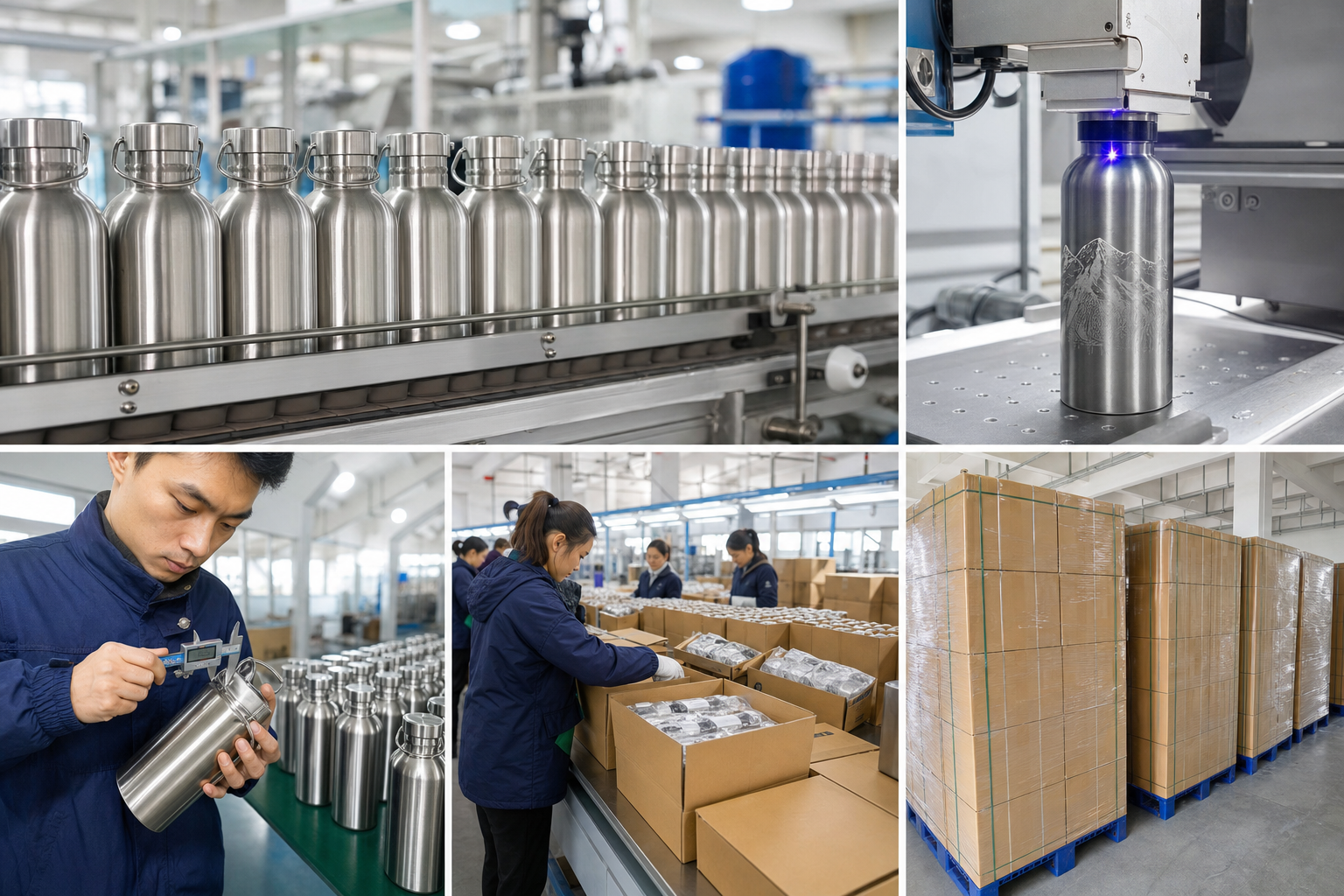
Key Takeaways
- A practical customizable canteen program usually starts at 1,000 pcs MOQ, with 5-7 day samples and 25-35 day bulk lead time.
- For most buyers, 18/8 stainless at 0.5 mm is the safest default for a custom canteen; 304 beats 201 for durability and resale value.
- Laser engraving, one-color silkscreen, and powder coating are the most reliable branding methods when the canteen will be washed often.
- A serious canteen factory should support AQL 2.5 inspection, 100% leak testing, REACH documentation, and export-ready carton labels.
A customizable canteen looks simple until you compare steel grades, lid styles, and decoration methods. On our line, a 5 mm gasket or a weak laser mark can decide whether the sample passes a 24-hour leak test. If you buy for retail, promotions, or distributor programs, the wrong question is not "which bottle looks best?" It is whether the canteen can carry your brand and still hold up on repeat orders.
In Zhejiang, we see the same failure pattern: buyers approve a clean sample, then the buyer flags a logo that scratches off, a lid that leaks after 12 days of carton drops, or an MOQ of 3,000 pcs that does not fit the channel. QC pulled the sample, checked the cap torque, and found the PO had a typo on the lid color. A good canteen manufacturer should help you balance price, compliance, and production speed. The math does not work if you only chase the first quote.
What a Customizable Canteen Changes
Before you print anything, lock the base spec. A canteen customizable run starts with capacity, wall thickness, lid, and finish. We see the same four sizes on the line: 350 ml, 500 ml, 750 ml, and 1,000 ml. For promo programs, a 500 ml single-wall canteen ships cheaper and lighter. For outdoor retail, gym bundles, and distributor packs, 750 ml or 1,000 ml gives the buyer more shelf value. QC pulled a 500 ml sample with a 0.8 mm base ring last week, and the buyer flagged the denting after one drop test. The wrong question is "what logo do we print first?" The real question is which body sells without drama.
For metal bodies, 18/8 stainless steel at 0.5 mm is the default we run. It holds up better than thin 201 steel and does not push you into overbuilt cost. If the job needs a carabiner lid, sports cap, or wide-mouth screw cap, lock the lid first, then set the neck finish. That saves a tooling change later. Same logic on a custom growler or customizable growler: fix the user interface after the bottle dimensions stop moving. We once had a PO typo call out a 51 mm neck as 15 mm, and that single line would have killed the mold quote.
- Start with size, not logo.
- Lock the lid thread before tooling.
- Use one SKU for one channel unless you have a clear reason to mix.
That looks simple, but the math works. When you are ordering canteen custom or canteen customized lines across 3 markets, one loose spec can turn into 12 days of back-and-forth and a dead carton layout.
Materials That Hold Up
Material choice decides whether the product feels like a real brand item or just another giveaway. For a customized canteen sold in Europe and North America, 304 stainless steel is our default because it holds up in daily use without drama. On the line, a 0.8 mm body still feels solid, and QC can pull a sample for a salt-spray check before packing. 316 stainless costs 12 to 20 percent more on the raw body. Use it when the buyer wants stronger corrosion resistance or a higher price point. The math does not work for every order.
201 stainless can work for low-cost canteen promotional orders, but you need to be straight about the trade-off. It is cheaper, yet it dents faster and turns into a complaint on distributor programs after a few months. We have seen that go sideways when the PO says "retail quality" and the sample is clearly promo grade. Aluminum is lighter, though buyers usually ask for more hand feel; if the MOQ is 3,000 pcs, we still push them to compare it against 304 before they lock the spec. If you are building a broader line, the same logic applies to a custom canteen, a customized drinkware set, or a custom growler program: one material family should fit the channel, not just the budget.
Capacity also changes how the product sells. A 350 ml canteen fits a backpack pocket and moves on impulse. A 500 ml SKU is the easiest to replenish. A 750 ml format gives more shelf presence without punishing freight. Once you pass 1,000 ml, carton weight and freight density matter more than unit price; at that point the buyer is usually asking about 12 kg export cartons, not the print finish.
Decoration That Survives Daily Use
Decoration is where a lot of canteen suppliers overpromise. We have seen a logo look clean on day one and still fail after 20 to 30 wash cycles when the method does not match the surface. On brushed steel, laser engraving is the workhorse. It costs more than a one-color print, but it will not peel, and the canteen lands with a cleaner retail look. On the line, QC pulled a brushed sample after an abrasion rub, and the engraving still read clearly.
For powder-coated bodies, silkscreen holds up when the artwork stays simple, usually one to two spot colors. Pad printing works on curved zones and small marks, but it is the wrong choice if the bottle gets knocked around in the field. UV printing can carry strong color, yet the buyer flagged it after a 1,000-rub test, and that is the number that matters. For a canteen vendor serving a canteen distributor, the print spec has to fit the channel. A canteen promotional order can live with a simpler finish. A premium customized canteen cannot.
If the artwork fails after 20 wash cycles, the decoration spec is wrong for the channel.
Ask for Pantone references, logo size in millimeters, and a clear print position drawing. We also check the PO line by line, because one missing digit on a 38 mm mark can send the sample back. If you need multiple product families, the same decoration logic can support a custom growler, a customized growler, and other customizable drinkware without changing the brand standard every time.
MOQ, Price, and Lead Time
Buyers usually start with price, but MOQ and lead time drive the deal just as much. On our Zhejiang line, we run about 120,000 units a month, and the standard MOQ is 1,000 pcs for a simple printed order or 3,000 pcs when you want a new lid mold, special coating, or a tight color match. QC pulled the sample on a 5 mm print offset last week, so we kept sample lead time at 5 to 7 days and bulk production at 25 to 35 days after sample approval.
For price planning, use ranges, not wishful numbers. A 500 ml single-wall stainless canteen with a one-color logo usually lands around USD 1.90 to 2.60 FOB at 1,000 pcs. A vacuum version with laser engraving and a premium lid can move into the USD 3.20 to 5.80 FOB range, depending on wall thickness, packaging, and test requirements. We had a buyer flag a PO typo on lid color before we cut the tooling, and that saved a rework bill. The math is simple: quote by structure, not by a vague style name.
If you are a canteen distributor, ask for tiered pricing at 1,000, 3,000, and 5,000 pcs. The cost drop is often 10 to 18 percent between tiers, and that spread decides whether the program still leaves room after freight, warehousing, and sales commission. We ship these cases every week, and the wrong question is always the same one: "Can you just make it cheaper?"
Compliance and Factory QC
For Europe and North America, compliance is not a last-minute checkbox. We build it into the quote from day one. A serious canteen manufacturer in China should show BSCI or similar social audit coverage, ISO 9001 process control, and material declarations for REACH. If you sell into the EU, ask for the food-contact declarations and test reports tied to the exact parts in your spec. If you sell into the US, ask for the food-contact paperwork and the test basis behind it. We have seen POs miss one gasket material code and the buyer flagged it after the sample was already packed.
On inspection, push for AQL 2.5 on major defects and AQL 4.0 on minor defects unless your program is tighter. Leak testing should be 100 percent, not sample-based. For a customized canteen with coating, ask for adhesion testing and a salt-spray or corrosion reference where it applies. For cartons, a drop test and clear master carton labels are basic. The factory should also confirm barcode placement, case pack, and outer carton weight before shipment leaves Zhejiang or any other China export port. QC pulled the sample on the line once and found a 1.2 mm cap gap. That is the kind of miss that turns into a claim later.
- Material declaration
- AQL inspection report
- Leak test record
- Carton drop test result
That is the minimum paper trail a disciplined canteen supplier should hand over without a fight. If a factory needs to be chased for these four items, the math does not work and the shipment is already at risk.
Distributor Planning That Prevents Dead Stock
If you are building a line for distributors, the first mistake is loading too many variants before the numbers are real. We usually start with 3 capacities, 2 lid types, and 2 decoration options. That gives 12 sellable combinations, which is enough to cover retail, corporate gifts, and seasonal promo without filling the warehouse with slow movers. On the line, we check carton count against the SKU list before we approve the order. The wrong question is "how many options can we offer"; the real one is "what can we move in 90 days?"
Build the range around the channel, not around the sample room. One brushed-steel SKU can carry premium retail, while a powder-coated version does the heavier promo work. If the buyer wants a lower ticket point, keep the bottle body fixed and change the pack. That keeps tooling costs flat and makes quotes cleaner. We had one PO with a typo on the lid code, and QC pulled the sample before it hit production. Once the body changes, the math stops working.
The best distributor drinkware programs are usually the plain ones: one factory standard, one color system, one carton spec, one approval path. A 0.5 mm print tolerance is easier to hold than a mixed bag of special cases, and the line stays moving. That is how a canteen customized line ships from China to shelf without rework or dead stock. We've seen this go sideways when a buyer adds one extra lid "just in case." It never stays just in case.
Get a canteen quote built for your channel
Send the capacity, lid, logo, and target market. We will price the customizable canteen against MOQ, lead time, and compliance before production starts.
Frequently asked questions
What is a realistic MOQ for a customizable canteen?
For most standard canteen custom orders, 1,000 pcs is the normal starting point. If you only change the logo, packaging, or color of an existing mold, some canteen suppliers can stay at that level. Once you ask for a new lid tool, special body shape, or a deep custom finish, the MOQ often moves to 3,000 pcs or more. Sample lead time is usually 5 to 7 days, and bulk production is commonly 25 to 35 days after approval. If your channel is still unproven, do not push for too many variants at once. A simpler MOQ structure gives you cleaner cash flow and less dead stock.
Which material should I choose for Europe and North America?
304 stainless steel is the best default for most customizable canteen projects. It balances corrosion resistance, price, and brand perception. If your buyer expects a premium product or the canteen will see harsher use, 316 stainless is stronger on corrosion but usually adds 12 to 20 percent to the body cost. 201 stainless can work for canteen promotional programs, but it is a weaker choice for retail or long-life distributor drinkware. For most buyers, 0.5 mm wall thickness is a good practical target. It is thick enough to feel solid without pushing freight and unit cost too high.
Which branding method lasts the longest?
Laser engraving is usually the most durable choice for a customized canteen, especially on brushed or matte stainless steel. It does not peel, and it holds up well after repeated washing. If you need color, one-color silkscreen or pad print can work, but the artwork should be simple and the surface should be matched to the ink system. Powder-coated bodies often take print well, but you should still ask for abrasion testing. A practical buyer target is 20 to 30 wash cycles without visible failure. For premium retail, laser plus a clean outer finish is usually the safest combination.
How do samples and color matching usually work?
A plain sample for a custom canteen can usually be made in 3 to 5 days if the body and lid are already standard. Add logo printing, and the timeline is more often 5 to 7 days. If you want Pantone matching, send the code and a physical reference if possible. Most factories can hold a reasonable color tolerance, but you should agree on what acceptable looks like before mass production. For coated bodies, ask for a production sample or golden sample after the first decoration trial. If your program is serious, pay for a pre-production sample and compare it against the final bulk run.
What documents should a canteen distributor ask for?
At minimum, ask the canteen manufacturer for material declarations, a food-contact declaration where applicable, BSCI or equivalent audit coverage, ISO 9001 process evidence, and a finished-goods inspection report. For export, you also want carton marks, packing list details, and a clear HS code family, usually in the 7323 range for stainless household articles. If the product has coating or a colored finish, ask for adhesion or abrasion test evidence. If your program is headed to Europe, REACH support matters. If it is for the US, make sure the paperwork aligns with your import and platform requirements before you place the order.