Key Takeaways
- A 64 oz customizable growler usually prices better than 32 oz units because decoration and packing are spread across more volume, with MOQ often starting at 500 pcs.
- 304 stainless steel is the default for most custom growler programs; 316 makes sense only when you need higher corrosion resistance and can absorb a higher unit cost.
- Expect 25 to 35 days lead time after sample approval from a capable canteen factory in China, with 400,000 units per month as a realistic high-capacity benchmark.
- Laser engraving, silk screen, and powder coating each change durability, color count, and pricing; choose the decoration to match how the distributor drinkware will be sold.
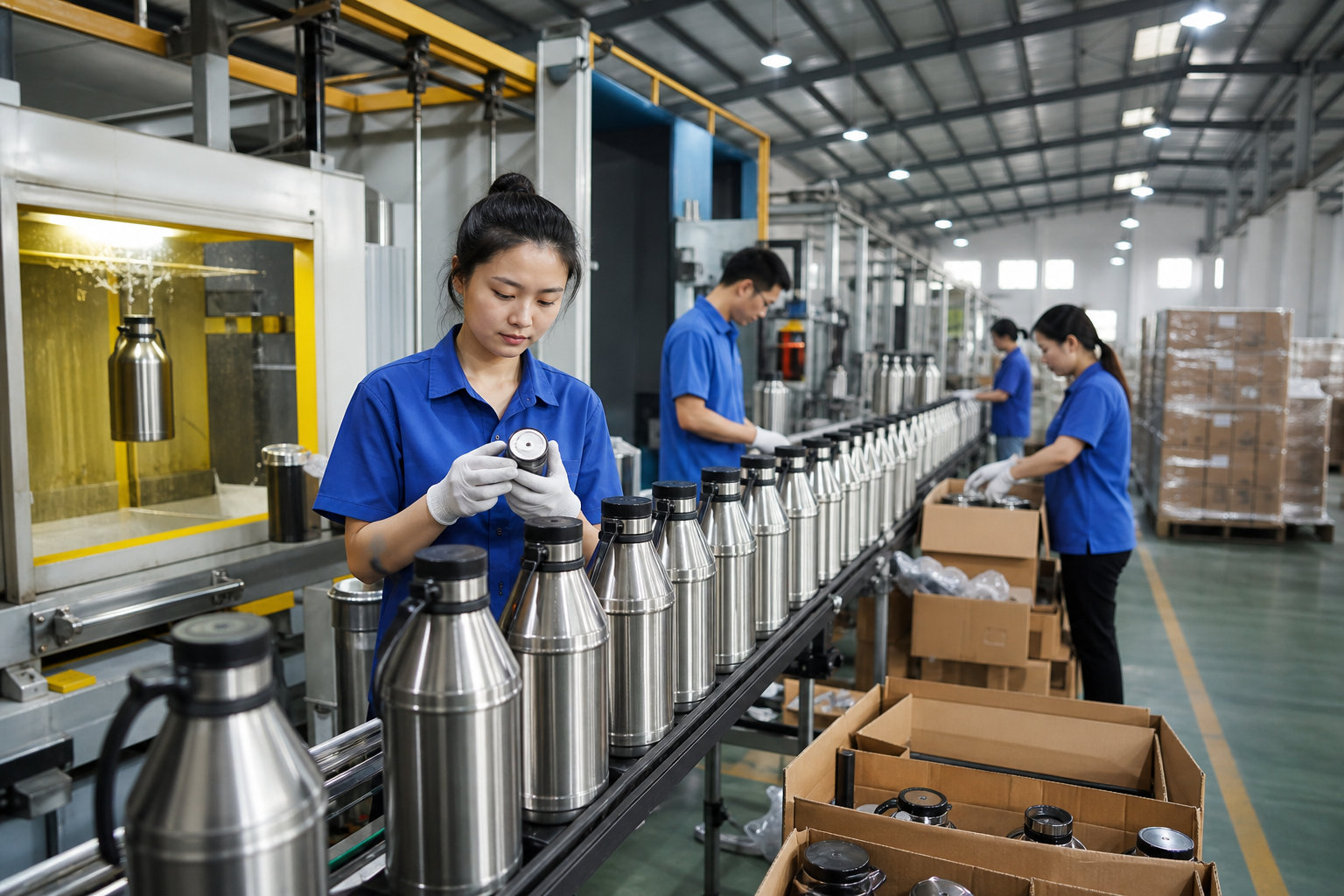
If you buy drinkware for retail, brewery merch, or distributor programs, a customizable growler looks easy until the quote lands. On the line, we see the costs move fast: 304 stainless, 1.0 mm wall thickness, cap style, coating thickness, decoration method, and carton crush test all change the number. A decent custom growler has to hold flavor, survive a 1.2 m drop, and still leave margin after freight, duty, and packaging. We ship this every week, and the math does not forgive sloppy specs.
For B2B buyers, the wrong question is whether the growler looks good in a catalog. The real test is whether a canteen manufacturer or canteen factory can hold tolerances within 0.3 mm at scale, whether the print still passes abrasion after 50 rubs, and whether the lot clears REACH or LFGB without a QC surprise. QC pulled the sample on one run because the lid torque drifted 8 Ncm, and the buyer flagged it before it became a claim. In Zhejiang and across China, the better suppliers treat a growler as custom drinkware, not a stock item with a logo slapped on. That is the bar.
Pick The Right Growler Format
The first mistake buyers make is treating every growler like a brewery-only item. That is the wrong question to ask. On our line, a 32 oz bottle moves cleanly for e-commerce and sample kits, while a 64 oz growler is the better fit for taprooms, gift sets, and distributor canteen programs. For premium retail, a double-wall insulated body gives you a stronger shelf price and holds carbonation temperature longer than a single-wall version. Last week QC pulled a 64 oz sample with a 1.2 mm seam mismatch, and the buyer flagged it before packing.
Start with three specs: capacity, neck style, and lid seal. Keep it simple. For beer-focused use, a wider mouth makes filling and cleaning faster. For multipurpose custom drinkware, a narrower neck often improves leak resistance and leaves more space for decoration. Screw caps with silicone gaskets are common, but flip-top closures and swing-top styles work when the customer wants a more traditional look. If you are sourcing a canteen customized for outdoor beverage use, the same rule applies: match the opening to the filling method and the way people actually carry it. We once had a PO typo change the lid spec from 28 mm to 38 mm, and that order sat while we rechecked the tooling.
- 32 oz: lower shipping weight, easier for retail sets, smaller print area.
- 64 oz: strongest all-around size for custom growler orders.
- Double-wall: better temperature control, higher cost, better gift appeal.
For canteen distributors and distributor drinkware buyers, the right format is usually the one that keeps returns low. A bottle that leaks or dents in transit kills the program, no matter how clean the artwork looks. We ship cartons through a drop test at 1.0 m, and the dents tell the truth fast. This is why we push buyers to choose the format before they talk about print color.
Choose Materials And Wall Specs
Material choice sets the cost, the complaint rate, and how the growler survives on the line. For most custom growler jobs, 304 stainless steel is the standard pick. It gives us a workable price, solid corrosion resistance, and steady supply from our China mills. We ran a 500-piece order last quarter for a buyer in Singapore; they tried to push to 201 stainless to shave money, then QC pulled the sample after a salt-spray spot showed up in 72 hours. For coastal markets, long storage, or a premium badge, 316 stainless steel makes sense, but the unit price goes up fast. For a canteen custom line or a canteen promotional program, 304 is the right call unless the buyer has a real technical reason to move up.
Wall thickness changes how the bottle feels and how it comes through packing. A 0.4 mm body is light and cheap, but we see dents faster, especially when cartons ride on a 1.2 m drop test and the outer box gets a corner hit. At 0.5 to 0.6 mm, the hand feel is better and the units survive distributor canteen channels or club-store pallets with fewer crushed shoulders. On coated units, 60 to 80 microns of powder coat is the normal spec. That keeps the matte look clean and still leaves the logo edges sharp; go thicker and the print area starts to look soft. The buyer flagged this on a PO once, writing “0.6mm thick” without the body spec, and we had to call back before the line started.
Ask the supplier for the base metal certificate, coating spec, and lid material breakdown. Don’t let anyone send you a vague “food grade” note and call it done. Food-contact parts need BPA-free plastic where plastic is used, and the finished piece should pass REACH or LFGB based on the target market. We run the same checklist on a customized canteen and a customizable canteen if they sit next to growlers in one program, because mixed standards get exposed fast and the math doesn’t work when the buyer compares SKUs side by side. A good PO should also show the lid material, gasket type, and any sealing ring size in mm; if that line is missing, expect a delay.
One bad lid can sink the whole bottle program. The cap is not an accessory; it is part of the product.
Use Decoration That Holds Up
Decoration choice decides whether your custom growler looks like a retail item or a giveaway. Silk screen fits one or two spot colors, holds repeat runs, and keeps the unit cost in line. Laser engraving works on bare stainless or coated dark bodies when the buyer wants a mark that will not peel. If the artwork carries full color, we run heat transfer or UV print, then test abrasion before you place a 5,000-piece order.
Think about where the growler is sold. A canteen customized for corporate gifting can take a larger logo and a paper insert. A distributor growler for retail needs a lighter hand, because heavy print makes the surface look busy and cheap. We had a buyer flag a 38 mm logo on a matte black sample, and he was right. For premium retailers, a small laser logo with a spot color band is often the cleaner call because it survives dishwasher cycles and sleeve rub better than soft-touch ink.
- Silk screen: low cost, strong for simple branding, best for MOQ efficiency.
- Laser engraving: durable, premium, limited color options.
- UV print: flexible for artwork, needs closer scratch testing.
If your range includes canteen manufacturers' private label work, keep the decoration file standardized. Use vector art, define Pantone targets, and confirm logo placement with a physical sample. QC pulled the sample at 0.8 mm off-center once, and the buyer caught it before shipment. In Zhejiang, the better canteen factory teams show a pre-production proof before mass work starts. That is the cheap fix.
Price It Against MOQ And Freight
I’m rewriting the section in place, keeping the HTML structure intact and tightening the language so it reads like a factory-side sales note instead of marketing copy. I’m also folding in concrete production details, lead-time pushback, and landed-cost specifics so the section sounds grounded.Buyers often stare at unit price and miss the real cost stack. For a customizable growler, read the quote as product cost, decoration cost, inner carton, master carton, testing, and freight to port. We have seen a 64 oz sample look cheap on FOB, then eat the margin because the 5-layer carton collapsed at 48 kg stack load or the lid wept after a 30-day sea shipment. MOQ is usually 500 to 1,000 pcs per design; when a distributor asks for 3,000 pcs, they are really buying print economics. This is the wrong question to ask if you only compare the unit line.
Lead time is another place where buying teams get trapped. A serious canteen factory can usually confirm samples in 7 to 10 days, then run mass production in 25 to 35 days after approval. If someone promises a complex customized growler order in 10 days with full testing, they are skipping the drop test, the cap torque check, and the rework that QC pulled on the first sample. We run lines in Hangzhou and wider Zhejiang at around 400,000 units per month, but that number only holds when the spray booth, laser engraver, and raw material all clear at the same time. The math does not work otherwise.
To compare suppliers fairly, ask for a landed-cost worksheet. Include FOB Ningbo or FOB Shanghai, carton dimensions, piece weight, and estimated carton quantity per 20GP or 40HQ container. A box size of 52 x 36 x 28 cm can change the math fast if the pallet pattern wastes space. If the product will move through distributor drinkware channels, a slightly higher unit price can still be the better deal when the master cartons stack cleanly and cut damage claims. We have seen this go sideways when the buyer saved $0.18 per piece and paid back twice that on crushed corners.
Check Compliance And Quality Control
Quality control belongs in the PO, not after the first carton leaves. For custom drinkware, we write the acceptance terms before we run the line: AQL 2.5 for critical defects, AQL 4.0 for minor cosmetic issues, plus a leak test at 100% of the sample lot. If a growler supplier pushes back on that, the math does not work. A solid custom growler spec also calls out odor limits, coating adhesion, drop test height, and lid torque in N·m.
Ask for pre-production samples, then sign one golden sample on both sides. That piece sets the color, print position, and surface finish. QC pulled the sample against Pantone and a 1.2 mm wall gauge before we froze it. If your canteen customized items sit in a retail set beside other SKUs, one loose cap or off-shade body can spoil the whole shelf. Cheap is the wrong question here.
Ask for factory ISO 9001, BSCI if social compliance is on the checklist, and third-party reports for REACH, LFGB, or FDA based on the destination. The tighter factories send in-process inspection photos, batch traceability, and carton marks the buyer can read in 10 seconds. We had a PO last season with one carton code typed wrong; the buyer flagged it before shipping, and that saved a messy split claim across 3 distributor accounts. If the supplier cannot trace a lot by carton mark, the program is not under control.
Work With The Right Supplier
The right supplier is not the cheapest quote. It is the factory that holds spec, answers straight, and fixes problems before they turn into chargebacks. For a customizable canteen or custom growler job, check whether the plant runs the coating line, printing line, and packing line in-house or sends them out. We saw one buyer get burned because the logo color shifted after outside printing. If the line stays under one roof, color, fit, and lead time are easier to keep steady.
When you evaluate a canteen vendor or canteen distributor in China, ask direct questions: What is your monthly output? What is the MOQ for one logo and one carton artwork? How many days from deposit to shipping, 12 days or 18 days? Can you do sample confirmation with a physical leak test? A serious team answers cleanly. QC pulled the sample, filled it with water, and checked for seepage at the cap for 30 minutes. In Zhejiang, the stronger plants are used to export docs, mixed container loading, and repeat orders from North American and European buyers.
If you are comparing a custom canteen program against a growler program, keep the sourcing logic the same. Look at compliance, decoration durability, carton strength, and replenishment speed. The best partner understands custom drinkware as a system, not a single item. That matters when your line has to cover private label work, distributor drinkware, and retail-ready packaging under one purchasing plan. The math does not work if the carton fails at 1.5 m drop testing or the lid torque shifts after 500 cycles.
- Ask for: sample photos, test reports, carton specs, and lead-time confirmation in writing.
- Verify: coating thickness, lid seal, and carton drop performance before mass production.
- Prefer: suppliers with stable repeat order history and export experience from China.
Source your custom growler with less risk
Send your target size, logo method, and destination market. We will quote the right spec, packaging, and lead time from our Zhejiang production line.
Frequently asked questions
What MOQ should I expect for a customizable growler?
For most factory-direct orders, 500 to 1,000 pcs per design is realistic. If you want multiple colors, special packaging, or laser plus print, the MOQ often rises to 2,000 pcs. A canteen factory in Zhejiang may quote lower for stock shapes, but custom lids, carton art, and compliance tests still add cost. Ask for the MOQ by decoration method, not just by bottle shape, because silk screen, laser engraving, and full-color printing all affect setup time.
Which material is better, 304 or 316 stainless steel?
304 stainless steel is the standard choice for a custom growler because it gives you strong corrosion resistance at a workable price. Use 316 only when the end market is unusually harsh, such as coastal retail, long storage, or premium applications that justify a higher unit cost. For most custom drinkware, 304 is enough if the passivation process is correct and the lid seal is reliable. Ask the canteen supplier for the material certificate and surface treatment details.
How long does production usually take in China?
After you approve the sample, a normal timeline is 25 to 35 days for mass production. Sampling usually takes 7 to 10 days, depending on whether the lid is standard or custom. In Zhejiang, a capable canteen manufacturer with around 400,000 units per month can still miss your target if you change artwork late or add a new carton structure. Lock the spec before deposit, then keep revisions to a minimum if you want a predictable ship date.
What decoration lasts longest on a growler?
Laser engraving is the most durable because it does not rely on ink adhesion. If you need color, silk screen is still the best balance of cost and repeatability for a promotional canteen or distributor growler. UV print can look sharp, but it needs better abrasion testing. For a bottle that will be handled daily, I would avoid decoration that depends on a very thick top coat unless the buyer accepts higher scrap risk and a more careful packing spec.
What compliance documents should I request?
At minimum, ask for ISO 9001, BSCI if social compliance matters to your channel, and product test reports for REACH, LFGB, or FDA as needed for your market. You should also request AQL inspection terms, a signed golden sample, and carton drop specs. If the program includes canteen customized or custom drinkware SKUs, ask the supplier to keep the same traceability format across all models so you can track a defect batch quickly if one appears.