Key Takeaways
- A 304 stainless steel customizable thermos usually starts around USD 2.80-4.50 FOB at 1,000 pcs, while 316 upgrades add roughly 15-25%.
- For retail programs, ask for 12-24 hour heat performance, 0.35-0.45 mm inner wall thickness, and AQL 2.5 sampling.
- Most serious thermos bulk orders run 1,000-3,000 pcs MOQ, with 25-40 day production lead time in Zhejiang factories.
- Laser engraving is cleaner for premium custom thermos orders; silkscreen is cheaper but usually best for 1-2 spot colors.
If you are buying a customizable thermos for outdoor retail or a promo program, the hard part is not finding a bottle. It is picking one that survives daily use, prints cleanly, clears EU and US compliance, and still leaves margin. A 500 ml double-wall stainless steel thermos can look the same on a spec sheet and still differ by 0.2 mm in wall thickness, 5 hours of heat retention, or a lid that fails after 3,000 cycles. We run this on the line all the time.
Buyers in Europe and North America should treat a custom thermos like a sourcing job, not a merch choice. In Zhejiang, the better thermos factory teams talk in stainless grades, vacuum leak tests, AQL, and lead time in days; QC pulled a sample on a 10-piece check last week and found a cap torque issue before shipping. If your supplier cannot talk that way, you are probably buying a giveaway cup, not a product customers will keep. The math does not work.
What makes a good customizable thermos
A customizable thermos is not decoration first. The flask has to pass the test on the line, because the logo rides on top of the buyer experience, it does not replace it. For outdoor retailers, we usually run a 500 ml or 750 ml stainless steel vacuum flask with 304 inner and outer shell, double-wall vacuum insulation, and a leak-proof lid. For colder markets, we ask for 12 hours hot and 24 hours cold as the floor claim, not a marketing line. If a thermos manufacturer writes “excellent insulation,” we push back and ask for the test setup: starting water temp, room temp, fill ratio, and lid type. QC pulled a sample last week at 95 C into 5 C water, and the numbers told the truth fast.
Wall thickness is where a lot of quotes go sideways. A normal export body sits around 0.35-0.45 mm on the inner wall and 0.4-0.5 mm on the outer wall. Go thinner and the shell dents on the truck; go thicker and you pay for steel you do not need. For a custom thermos sold through outdoor channels, the finish needs to survive carton rub and pallet pressure. Powder coating is the safer pick for scratch resistance. Matte paint looks good on a sales sample, then chips when the distributor stacks 24 pcs high. We see this in Zhejiang all the time: one body, three finishes, same drawing, different yield. The math does not work if the factory cannot hold that finish across all SKUs.
- 304 stainless steel: best balance of cost, corrosion resistance, and export acceptance
- 316 stainless steel: better for salty environments and premium positioning
- BPA-free PP or Tritan lids: standard for consumer markets
- Food-contact compliance: request REACH, LFGB, and FDA documentation before PO
Choosing steel, lid, and capacity
Material choice decides whether your thermos custom order stays profitable. We run 304 stainless steel as the default on most programs because buyers accept it, mills keep it in stock, and the cost stays steady. 316 stainless steel makes sense for salt-air markets, boats, or a retail buyer who wants a premium badge on the shelf. The jump is usually 15-25%, and we have seen that math work when the channel is specialty retail or gift sets. One buyer pushed back on price, then the sample passed salt-spray checks and the order moved.
Capacity changes how the bottle sells and how it packs. A 350 ml unit is compact, but the print panel is small and the margin on decoration is thinner. A 500 ml customizable thermos is the safest all-around size for outdoor retailers. A 750 ml or 1 L thermos bulk program gives more space for pad print or laser mark, yet the ship carton weight climbs fast; on one line, the carton moved from 8.6 kg to 12.4 kg after a size change. For distributors thermos programs, I usually push a two-size line, not four sizes. Fewer SKUs mean fewer customs entries, cleaner stock counts, and less dead stock at month 6.
The lid is where a lot of custom thermos projects go sideways. A screw cap is simple, but a one-hand button lid or cup lid can lift sell-through if your customer wants convenience at the desk or in the car. Ask for 3,000 open-close cycle testing and a 100% leak test before shipment. QC pulled the sample on one job and found seepage at the silicone ring after 18 hours, which saved us from a buyer claim. If the thermos supplier cannot share test data, walk away.
Good sourcing is not about asking “Can you make it?” It is about asking “Can you make it the same way 20,000 times?”
Decoration methods that actually sell
For a promotional thermos, the decoration method often decides whether the order looks cheap or lands well with the buyer. We usually start with the target price and the brand look, then check the line before we quote. Laser engraving is the cleanest choice when you want a permanent logo on a custom thermos. It holds up against abrasion and looks sharp on brushed steel or powder-coated bodies. Silkscreen printing costs less and works fine for a simple one-color logo, but if the distributors thermos program is going to live in trucks, tool bags, or warehouse carts, that is the wrong question to ask. A printed mark on a bottle with a 300 mm drop test history will wear faster than a laser mark, and QC will catch that fast.
Most thermos manufacturers in China can also do 360-degree body printing, wrap labels, or heat-transfer graphics. These fit seasonal campaigns and gift runs, but they do not always belong on a retail bottle that needs a 12-month shelf life. If you need a bulk thermos order for an outdoor chain, keep the decoration tight: 1-2 colors, one logo position, and the same placement across cartons. We have seen this go sideways when the buyer sent a PO with two logo positions and a typo in the Pantone code. The art got busy, color drift showed up, and the registration on the first 500 pcs had to be rechecked at the line.
Pricing usually follows the method. At 1,000 pcs, laser engraving may add about USD 0.20-0.45 per unit, while silkscreen can be lower if the setup is simple. Multi-color wrap decoration can add more, especially when you need extra curing steps and a second pass on the UV tunnel. In Zhejiang factories, the better suppliers quote decoration separately from the bottle body, so you can see the margin instead of guessing. We run that way because the math does not work any other way when a buyer is comparing 18 days versus 12 days on lead time.
- Laser engraving: best for premium and long-term use
- Silkscreen: best for low-cost one-color promotions
- UV print or wrap: best for short runs and seasonal campaigns
MOQ, pricing, and lead time realities
Buyers often ask for a custom thermos at factory pricing, then expect retail flexibility. That is the wrong question to ask. On our line in Zhejiang, MOQ usually sits at 1,000 pcs for one color and one logo, and we only go lower when the cup body, lid, and vacuum line are already running. For a new mold, 3,000 pcs is normal, and tooling usually starts at USD 800-2,500 depending on lid structure and embossing depth.
FOB pricing for a standard 500 ml customizable thermos usually lands around USD 2.80-4.50 at 1,000 pcs for 304 steel with basic decoration. A matte powder coat, copper lining, or 316 steel pushes it up fast. We check wall thickness at 0.35 mm, because the math does not work if someone quotes far below this range and still promises clean vacuum retention. That low number usually means weaker lids, thinner steel, or cartons that fail before the goods leave the warehouse.
Lead time is where buyers get caught. A reliable factory thermos order usually needs 25-40 days after sample approval and deposit. During peak season, we add 10-15 days, and that is before the September-to-December export rush hits the dock. QC pulled the sample last week and found a carton spec mismatch on one PO, so ask for a pre-production sample, carton drop test, and a confirmed ship window before you issue the order.
For larger thermos bulk programs, pricing can improve by 8-15% once you reach 5,000 pcs, but only if the artwork and packaging stay unchanged. One typo on the PO, one lid color swap, or a new retail box layout can reset the quote. We have seen that go sideways more than once. Keep the spec stable, and the factory can hold the number; keep changing it, and the line has to stop and rework the setup.
Quality control you should require
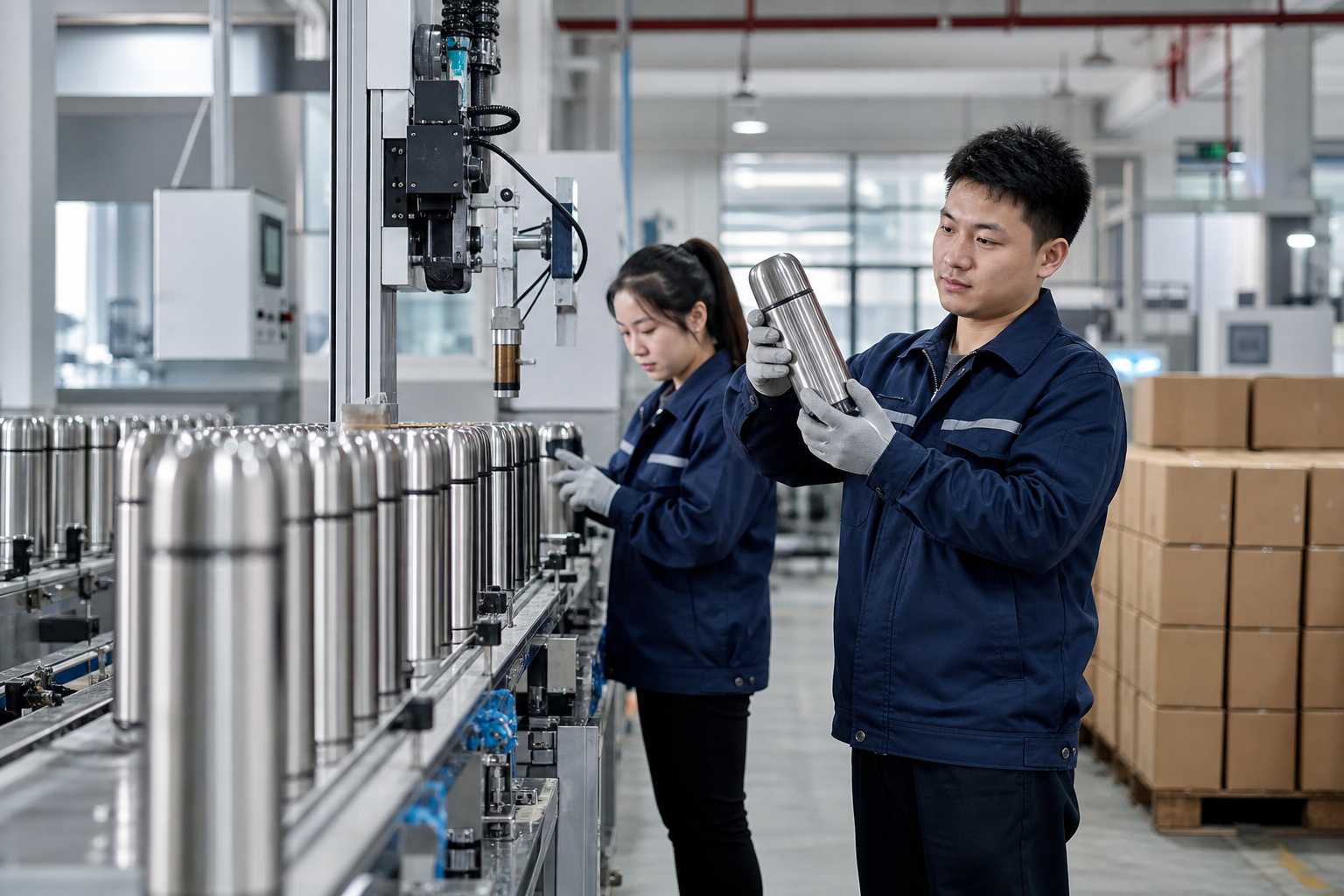
Quality is where a thermos maker shows whether it can run export orders or only chase volume. We check three points: incoming steel, in-line production, and final inspection. Ask for stainless mill certificates on every coil, especially for 304 or 316. QC pulled a 304 sample last month and found the MTC did not match the coil stamp. That sort of mismatch is not a small miss. Ask for vacuum leak testing on every batch, then random thermal retention checks on finished goods. If the supplier says 12-hour hot retention, ask for the test protocol and the thermometer brand, not the slogan.
For export programs, AQL inspection is standard. For a consumer drinkware order, AQL 2.5 for critical and major defects is common, though some buyers use 1.5 for premium retail packs. Cracked lids, leaking seals, and missing logos are rejects. Full stop. A solid thermos supplier should also show drop testing from 1 meter, carton compression results, and coating adhesion tests. If you ship into Europe, keep REACH and LFGB on file. If you sell in the US, keep FDA food-contact declarations and any relevant ASTM test references in the project folder. We have seen a buyer flag a PO because the logo size was typed as 22 mm in one line and 2.2 mm in another. The math does not work, and the line will not guess for you.
Do not ignore packing. A customized thermos can pass inspection and still fail in transit. Inner polybag thickness, divider strength, and master carton spec matter. I prefer export cartons that survive a 1.2 meter drop and 5-layer corrugation for heavier 750 ml or 1 L products. Our carton drop rig has no patience for weak glue. This is basic factory discipline, not extra service.
- Check vacuum seal on 100% of finished units
- Inspect logo placement on first 500 pcs and final random samples
- Use carton codes and batch traceability for distributor thermos orders
How to source from China without mistakes
Most buyers sourcing a custom thermos from China make the same mistake: they judge the supplier by the sample alone. A single sample can be hand-finished and still say nothing about mass production. We have seen a cup pass inspection at 50 units and slip at 30,000 because the vacuum line drifted by 0.3 mm. You need to know whether the thermos factory has stable monthly capacity, in-house coating, and enough QC staff to keep the process under control. A serious Zhejiang supplier should be able to produce 300,000-500,000 units per month across multiple lines, with clear separate output for different bottle sizes. That capacity does not automatically mean quality, but it does mean the factory understands export rhythm.
Ask who actually owns each step. Is the shell made in-house? Is the lid sourced from a third-party thermos supplier? Is decoration done on site or outsourced? The more handoffs, the more room for defects. We run into this all the time: QC pulled the sample, then the buyer flagged a lid gasket from another plant because it changed the seal. For promotional thermos programs, outsourced steps can be acceptable if the timeline is generous. For retail or distributor thermos stock, keep the process as integrated as possible. The math does not work when three factories each blame the other.
You should also check whether the manufacturer can support private label packaging, barcode application, and FNSKU labeling if you are selling through marketplace channels later. If the same supplier can handle box art in English, Spanish, or German, that saves time. We once caught a PO typo on a 5,000-piece order where the FNSKU suffix was missing one digit, and the whole carton plan had to be reprinted. China has plenty of factories that can make a bottle; the better ones in Zhejiang can also prepare it for real export use. That is the difference between a sample and a business program.
Request your custom thermos quote today
Send your capacity, logo method, and target price. We will match the right thermos custom spec, MOQ, and lead time from our Zhejiang factory.
Frequently asked questions
What MOQ should I expect for a customizable thermos?
For a standard 500 ml custom thermos, MOQ is usually 1,000 pcs per color and logo at a working thermos factory in Zhejiang. If you want a new lid mold, deep embossing, or special packaging, the MOQ often rises to 3,000 pcs. Some suppliers will quote 500 pcs, but expect a higher unit price, often 10-20% more, because setup cost is spread across fewer units. For distributor thermos stock, 1,000-2,000 pcs is the most practical starting point.
How much does a custom thermos cost FOB China?
A basic 304 stainless customizable thermos typically costs about USD 2.80-4.50 FOB at 1,000 pcs, depending on capacity, finish, and decoration. Laser engraving usually adds USD 0.20-0.45 per unit. Upgrading to 316 steel can raise cost by 15-25%. A premium lid, gift box, or special coating can push pricing above USD 5.00. If a thermos supplier offers a much lower number, check whether they are using thinner steel, cheaper seals, or weaker cartons.
Which decoration is best for outdoor retail use?
Laser engraving is usually the best choice for outdoor retail because it is permanent and does not peel. It works well on brushed steel and powder-coated bodies. Silkscreen printing is cheaper and fine for promotional thermos campaigns, but it is better for short-life gifting or one-color logos. If the bottle will be handled every day, engraved logos hold up better after 3,000+ cycles of use and transport. For premium custom thermos programs, engraving gives you a more durable brand presentation.
What compliance documents should I request from suppliers?
At minimum, ask for REACH and LFGB if you are selling into Europe, plus FDA food-contact declarations for the US market. For quality control, request stainless steel mill certificates, leak test reports, and AQL inspection records. If your thermos manufacturer has third-party test reports for thermal performance, drop testing, or coating adhesion, keep those on file too. Good thermos suppliers in China will already have these documents ready, especially if they export from Zhejiang to Europe and North America regularly.
How long does production usually take in China?
After sample approval and deposit, a standard custom thermos order usually takes 25-40 days in China. If you place the order during peak export season, add 10-15 days. New tooling or special packaging can extend the schedule further. A reliable thermos factory should confirm the ship date in writing and give you a sample approval timeline first. For a bulk thermos order, do not plan around verbal promises; plan around confirmed production slots and QC checkpoints.