Key Takeaways
- A standard customized canteen order usually starts at 1,000 pcs MOQ, with 25-35 day lead time after sample approval.
- For daily-use custom drinkware, 18/8 stainless steel and 0.4-0.6 mm wall thickness are the safe baseline.
- A real factory quote should include material grade, decoration method, carton pack, test standard, and Incoterms.
- For Europe and North America, ask for REACH, LFGB or FDA support, plus AQL 2.5 major inspection before shipment.
If you are sourcing a customized canteen, the logo is the easy part. The hard part is the spec sheet. We run a 1.2 mm wall check, a lid torque test, and a 24-hour leak test because a canteen that looks fine on the sample table can still fail once it is packed tight in a carton. Meeting EU and North America food-contact rules is not a bonus item. It is the baseline. This is the wrong question to ask: not "can you print my logo?" but "will it survive shipping, washing, and customs review?"
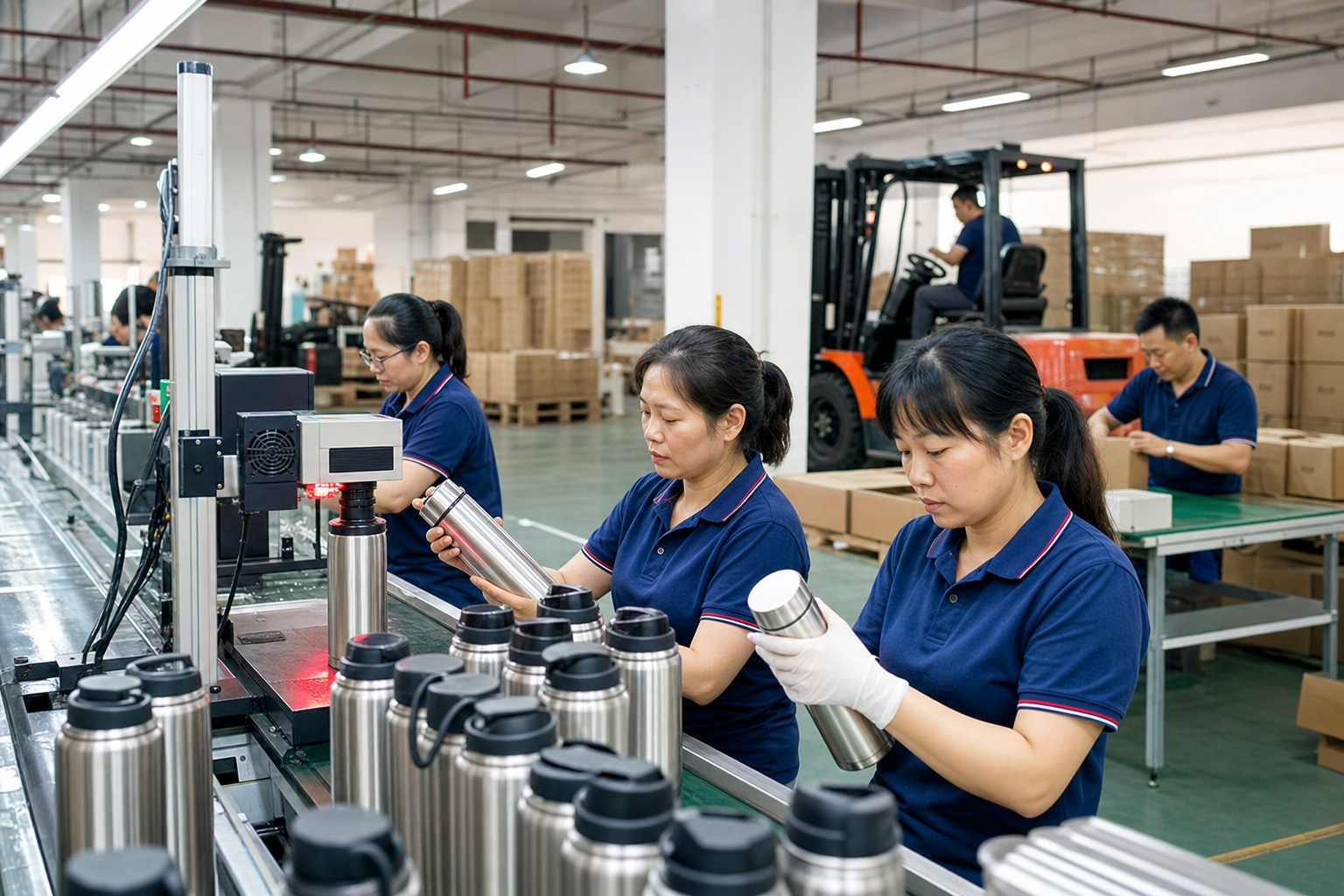
That is why serious buyers treat a canteen manufacturer like an engineering partner, not just a canteen supplier. In Zhejiang, China, the better factories ask about use case, target price, packout, and compliance before they quote; on our line, QC pulled the sample after a PO typo showed "3040" instead of "304" stainless, and that saved a bad run. MOQ, coating, lid style, and carton count all change the math. If they do not ask those questions, you are usually buying a generic shape with a logo, not a canteen customizable enough for retail, promotion, or distributor channels.
Start With The Use Case
Before you ask a canteen factory for prices, define where the bottle will actually be used. A canteen giveaway for Canton Fair has one job; a retail SKU for a sports chain has another. We saw a 400 ml single-wall sample win on price and lose in outdoor stores because the lid opened too easily on a 1.2 m drop test. The same shape can sell in one channel and fail in the next.
Start with four numbers: capacity, target landed cost, intended sales price, and expected order quantity. A 500 ml campaign item, a 750 ml custom canteen for gym use, and a 1 L distributor SKU pull the line toward different wall thickness, lid build, and carton size. On the shop floor, a 0.45 mm body and a 0.60 mm body do not cost the same, and the buyer who skips that math ends up arguing with the quote instead of the spec. That is the wrong question to ask.
For B2B buyers, the real issue is whether the bottle can move through your channel without dents, leaks, or margin loss. If you sell to schools, travel shops, or outdoor stores, ask for lid torque, drop-test data, and leak testing on the first sample round. QC pulled one sample at AQL 2.5 last month because the cap gasket sat 1.5 mm off center; the buyer flagged it before shipment, which saved a return claim. A canteen distributor should also decide early whether the SKU needs a gift box, a retail window box, or plain bulk packing. Packaging changes freight cost, shelf appeal, and breakage rate more than most people expect.
Use the sample stage to lock the use case, not to admire the finish. We run enough lines to know this: a clean-looking bottle can still be the wrong build for your channel. Give the factory a tight brief, and the canteen becomes a product you can ship with confidence.
Choose Material And Build
Material choice decides whether the order becomes a one-off promotion or a SKU we can run for 12 months. For most customized drinkware programs, 304 stainless steel, also called 18/8, is the baseline because it holds up on the line and clears common certification checks without drama. If the buyer wants a premium story or stronger chemical resistance, 316 stainless works, but the unit cost moves up fast. Aluminum is lighter, yet coating and lining control are less forgiving. For a custom growler or customized growler, the lid system and coating consistency matter as much as the shell. We have seen buyers chase a cheaper body and then the buyer flagged a lid odor after QC pulled the sample from the salt-spray rack.
Ask your canteen manufacturer for the body thickness, not just the material grade. A practical range is 0.4-0.6 mm for a lot of drinkware products. We run a micrometer on the first three samples, and 0.35 mm on the shoulder usually turns into dent complaints later. Thin walls can help hit a low promotional price, but the bottle feels flimsy in hand. If the item is insulated, ask whether the vacuum layer is stable and whether the body passed a thermal retention check. If it is single-wall, focus on weight, surface finish, and the seam quality around the neck and base. This is the wrong question to ask: "What grade is it?" The math does not work if the wall gauge is off.
The lid is often the weak point. A canteen supplier should tell you the lid material, gasket compound, and whether the seal has been tested after repeated open-close cycles. PP lids are common; Tritan-style parts may be used in higher-value ranges. Silicone rings should be food grade and sized to avoid compression loss over time. On the line, we torque the cap to 0.35 N·m and send it through the leak tank before it leaves QC. If the bottle is sold as canteen customized for outdoor use, insist on a pressure and leak test. A glossy sample that leaks after two weeks will cost you more than a slightly higher unit price would have.
For distributors canteen programs, repeatability matters more than hero samples. Lock the body gauge, lid spec, and coating system before you talk about logo placement. A 3,000-piece MOQ does not matter if the same lid shade shifts batch to batch. We have seen this go sideways when a PO typo changed the cap color code and the buyer caught it only after the cartons were sealed. Fix the boring details first, then print the logo.
Branding That Survives Use
Decoration is where a canteen custom project turns profitable or becomes a headache. The cheapest logo is not always the right logo. Silk screen is usually the lowest-cost route for a one-color mark and works well for canteen promotional orders where the MOQ is 1,000 pcs and the artwork stays simple. Laser engraving costs more on some models, but it is permanent and will not peel. Powder coat, water transfer, and UV print each have a place, but you should choose by abrasion resistance, not by how clean the sample photo looks. On the line, QC pulled the sample after a tape test and the weak print failed first.
If you are a canteen distributor selling to retail or corporate buyers, ask how many colors the factory can hold without extra setup cost. Most lines can print one or two spot colors efficiently; a third color means another screen frame, more labor, and a longer changeover. For a trial order of 500 pcs, the buyer flagged a four-color spec, and the math did not work. For a custom drinkware program in Europe or North America, a dark coated body with laser branding often reads as more premium than a bright print that can scratch in transit. On a matte surface, the logo also photographs better for e-commerce.
Keep the design brief practical. Tell the canteen vendor the logo size in millimeters, the number of print positions, and whether artwork must avoid the seam or the weld line. We had a 12 mm mark sit too close to the weld on one run, and the head clipped the edge. If the product will be handled daily, ask for rub testing or tape adhesion testing. A canteen vendor quote that ignores decoration durability is incomplete. We have seen that go sideways when a buyer wanted the logo to stay sharp after 30 or 50 wash cycles.
Good branding on custom drinkware is not about adding decoration everywhere. It is about choosing a method that still looks acceptable after shipping, retail handling, and 30 or 50 wash cycles.
Compliance For Europe And US
For Europe and North America, compliance is part of the product definition, not a footnote. A canteen supplier should be ready with REACH screening for restricted substances, food-contact declarations, and, where needed, LFGB or FDA paperwork. If the bottle carries a printed coating, ask for heavy metal and migration test results on the inks and surface finish. For California, buyers often ask for Proposition 65 screening too. Do not leave the target market vague; we have seen POs say “EU/US” and the line had to stop while we clarified the actual destination.
Quality control belongs in the order. Put AQL 2.5 for major defects and AQL 4.0 for minor defects under ISO 2859-1 into the PO. A good canteen factory in Zhejiang should show incoming material checks, in-process inspection, and final packing inspection. If the factory claims BSCI, ISO 9001, or another audit, ask for the certificate number and the site scope. A paper that covers a different workshop is useless. QC pulled the sample once and found a 1.2 mm print shift; the buyer flagged it before shipment, which saved a clean dispute.
Testing should match the channel. For e-commerce and distributor drinkware, leak testing, drop testing, carton compression, and barcode verification matter. For freight-heavy programs, an ASTM or equivalent packaging drop test can cut down hidden damage claims. Ask for retained samples by lot number so any issue can be traced later. We run this as routine on export jobs, and we keep samples for 12 months, not “somewhere in the warehouse.” If your canteen manufacturer pushes back on test reports, the math does not work—the cheapest quote often turns into the most expensive claim.
Compliance is a sales tool too. With the right documents, your distributor team sells faster, prices with less hesitation, and gets fewer back-and-forth emails from retail buyers. A clean file moves. A messy file stalls.
What A Real Factory Quote Includes
A real canteen factory quote should read like a spec sheet, not a guessing game. At minimum, it should show material grade, wall thickness, finish, lid type, logo method, packaging format, carton quantity, sample fee, lead time, and Incoterms. Leave out one item, and you are not comparing suppliers fairly. You are comparing assumptions. On our line, a 0.4 mm wall and a 0.6 mm wall are not the same job, and that gap shows up fast in cost.
Ask whether the factory is quoting EXW, FOB Ningbo, or another term, because freight can swing landed cost by a lot. A Zhejiang factory with a monthly capacity of 300,000 units may quote a lower unit price than a smaller workshop, but only if the order fits its tooling and schedule. Standard customized canteen MOQ is 1,000 pcs. A fully custom shape is often 3,000 pcs or more. Sample lead time is usually 5-7 days. Mass production after sample approval is commonly 25-35 days, depending on coating and packaging. QC pulled the sample twice last month because the buyer flagged a lid fit issue, and that kind of delay is exactly why the timeline matters.
A good quote also tells you what will trigger a reprice. Color matching, extra print positions, special cartons, mixed SKUs, and retail inserts all change cost. If you need to plan cash flow, ask for a clean split between product cost, decoration cost, and packout cost. We run into PO typos all the time, like 5,000 pcs written as 50,000 pcs, and that mistake can turn into a messy invoice dispute. This is the wrong question to ask if you only chase the lowest line item. The math does not work.
When you compare canteen suppliers, line up the same assumptions first. If two quotes use different lid materials, different carton counts, or different test claims, the cheaper one may just be a thinner offer. We ship quotes that spell out the carton spec, usually 24 pcs or 48 pcs per carton, because that detail changes the freight math. If one supplier hides that, we've seen it go sideways.
Distributor Packaging And Margin
For distributors, packaging is part of the product. A distributor canteen program has to be built around shelf impact, freight efficiency, and reseller convenience. We ship a lot of cartons at 24 pcs and 48 pcs, and the math breaks fast if the packout adds 0.08 USD per unit. If your buyers sell on Amazon or another marketplace, they will ask for FNSKU labels, suffocation warnings, and a carton spec that fits inbound warehouse rules. For wholesale, bulk pack with divider protection usually wins. The wrong packout can kill margin faster than a weak logo.
Think about who handles the SKU after it leaves the canteen manufacturer. Retail buyers want a clean inner box and barcodes that scan on the first pass; we run code checks with a Zebra printer on the line before packing starts. Corporate buyers usually want simple packaging that turns fast. One base canteen with 2 or 3 packaging versions works better than 3 bottle structures. We’ve seen this go sideways when a buyer asked for one carton style for six channels, then QC pulled the sample because the inner tray crushed at a 1.2 m drop test. Keep inventory tight, or dead stock shows up later.
Sales teams need data they can use without chasing the factory for every detail. Put capacity, weight, diameter, material, logo process, carton size, and test claims on one sheet. A canteen supplier that can keep photography, carton marks, and back-of-pack copy consistent makes the channel easier to sell. The same applies to a custom growler or custom canteen program. If the product can be reboxed for gift, retail, or distributor drinkware use, one tooling set can cover more accounts, and you avoid paying for a new mold just because the buyer changed the box art.
That is the real value of working with a canteen vendor that knows export programs in China and Zhejiang: keep the structure fixed, then tune the packaging and branding for each channel. We had a PO last month with “ctn” typed as “cntn”; small typo, big delay if nobody catches it. This is the right place to be picky.
Source your custom canteen with a real factory brief
Send your capacity, logo, packing, and compliance targets. We will quote the right build for Europe, North America, or China distribution.
Frequently asked questions
What MOQ should I expect for a customized canteen?
For a standard mold, 1,000 pcs is a normal starting point at a serious canteen factory. If you want a fully custom shape, expect 3,000 pcs or more because tooling and setup need to be spread over volume. For a canteen promotional program with simple one-color print, some canteen suppliers can sample at 1-2 pcs and mass produce in 25-35 days after approval. If you need mixed colors, packaging inserts, or a premium finish, budget extra time and a higher MOQ. A clear brief saves more money than negotiating unit price by itself.
Which material is best for custom drinkware canteen orders?
For most B2B customized canteen programs, 304 stainless steel is the safest default because it balances cost, corrosion resistance, and certification support. If the buyer wants a higher-end retail story or stronger resistance to certain chemicals, 316 stainless is available, but it raises price. For lightweight promotional use, single-wall stainless or aluminum may work, but you should check coating durability and dent resistance. Ask the canteen manufacturer for wall thickness, usually 0.4-0.6 mm, plus the lid gasket material. The lid is often what fails first, not the bottle body.
What decoration method lasts longest on a canteen customized order?
Laser engraving is usually the most durable because the mark is physical, not a surface layer that can peel. It is a strong choice for premium retail and repeated wash cycles. Silk screen is cheaper and works well for canteen custom promotional orders, but one-color prints can wear if the surface gets heavy abrasion. Powder coat with laser reveal can look premium and hold up well if the factory controls coating thickness and cure time. Ask for rub testing, tape adhesion results, and sample photos under the final packing method, because shipping scuffs can matter as much as daily use.
What compliance documents should a canteen supplier provide?
For Europe and North America, ask for food-contact declarations, REACH support, and LFGB or FDA-related evidence depending on the market and material. If the coating or printing is involved, request migration or heavy metal screening where relevant. A solid canteen supplier should also provide ISO 9001 or BSCI audit details if they claim them, plus AQL inspection results, usually AQL 2.5 for major defects and AQL 4.0 for minor defects under ISO 2859-1. If you sell through retail or Amazon, carton labels, barcode verification, and retained samples by lot number are also worth demanding.
Is a canteen promotional order different from retail sourcing?
Yes. A canteen promotional order usually prioritizes low unit cost, fast production, and simple branding, often with bulk packing or basic gift boxes. Retail sourcing needs stronger packaging, clearer product data, better barcode control, and lower defect risk. If you are working with a canteen distributor or distributor drinkware channel, the same base model can serve both, but the packout, labeling, and quality checks must change. Retail buyers may also ask for FNSKU labels, case pack rules, and more detailed carton markings. The product can be the same; the commercial requirement is not.