Key Takeaways
- A practical customized growler order usually starts at 500-1,000 pcs, with 25-35 days lead time after sample approval.
- 304 stainless is the default for most markets; 316 is worth it only when the buyer needs extra corrosion resistance.
- For export retail, ask for AQL 2.5, leak testing, coating adhesion checks, and carton drop tests before shipment.
- A Zhejiang canteen factory with 200,000 units/month output can support distributor drinkware orders, but only if the spec is frozen early.
Most buyers start with the logo and the color. That is the wrong order. A customized growler only works as a B2B product when the steel grade, lid system, coating, carton plan, and test standard all match the channel you sell into. Miss one point and you pay for it later in returns, weak margins, or a carton that fails the 1.2 m drop test we run before shipment.
If you source from China, a Zhejiang factory can usually give you tighter control than a trading-only setup: tooling changes, lead-time updates, and sample turns move faster. The catch is simple. Not every canteen manufacturer or canteen supplier is set up for retail-grade drinkware. We see this go sideways when a buyer signs off on a clean render, then QC pulls the sample and finds a 0.8 mm lid gap. The math does not work if you buy on mockups alone.
What Buyers Mean By Growler
In B2B drinkware, a growler is not just a bottle with a handle. It is a reusable, large-capacity container we usually build in 32 oz, 64 oz, or 128 oz sizes, depending on the market and sales channel. On the line, QC pulled the sample twice because the handle weld sat 1.5 mm off center. When a buyer asks for a customized growler, they usually want brand value, cold retention, and a product that looks right on a retail shelf. That puts it closer to premium custom drinkware than to a plain utility bottle.
The category also overlaps with canteen custom programs. Some customers call the same piece a custom canteen, customized canteen, customizable canteen, or distributor growler when they buy through a regional channel. The name is not the issue. This is the wrong question to ask. The real test is whether the spec fits packaging, margin, and compliance, and whether the carton can survive a 1.2 m drop without the cap scuffing the print.
A growler can be built for different end users:
- Retail: premium look, stable carton pack, clear barcode space, and a box count that still works at 3,000 pcs MOQ.
- Promotional: canteen promotional pricing, lighter decoration, faster lead time, and fewer color steps on the spray line.
- Channel stock: standardized size, easy replenishment, predictable repeat orders, and a spec the buyer can reorder without new artwork every round.
If you treat a growler as a generic bottle, the math does not work. We have seen buyers push for a cheap cap, then the leak test fails at 60 kPa and the whole order gets held. If you treat it as a customizable growler with a defined sales channel, the handle, lid, finish, and carton spec stay under control, and the quote is easier to defend.
Choose Steel And Construction
The quickest way to narrow a customized growler spec is to lock the construction first. For most export orders, 304 stainless steel is the default, and that is not a guess. It gives you a workable cost point, broad market acceptance, and steady performance for hot and cold drinks in normal retail use. We have seen buyers push for 316 on the first round, then back off when the sample quote comes in 12 to 18 percent higher and the shelf result is the same for most channels.
For a premium custom growler, double-wall vacuum construction is the standard. A practical wall thickness is 0.4-0.6 mm, depending on the body shape and whether the line is running deep drawing or spin forming. Check the lid assembly too: silicone gasket compression, thread engagement, and whether the cap stays tight after 300 open-close cycles without wobble. QC pulled one sample last month that looked fine on the outside, but the section cut showed a weak gasket seat. A canteen manufacturer that knows the job will show you section drawings, not just a pretty rendering.
Pay attention to finish. Powder coat takes handling abuse better and hides mark-off from the packing line; polished stainless looks cleaner, but it shows scratches fast. If you are building a canteen customizable line for a distributor, matte powder coat usually gives better retail consistency across a 5,000-piece run. If the buyer wants a custom canteen with a harder premium signal, laser engraving on bare steel is the cleaner route. We have seen the wrong finish sink a good product because the buyer flagged scuffs on the first carton open.
Practical rule: if the product will cross ocean freight, sit in a warehouse, and then be handled by consumers for months, the lid and coating matter more than the mockup.
In China, a canteen factory that already runs insulated bottles can usually adapt the same vacuum line for growlers, but only if the neck diameter and cap tooling match the target volume. A 63 mm neck and the wrong closure tool will waste a shift. That is where a real canteen supplier earns the fee. We ship faster when the tooling is right from the start, and the math does not work any other way.
Decoration Changes Your Margin
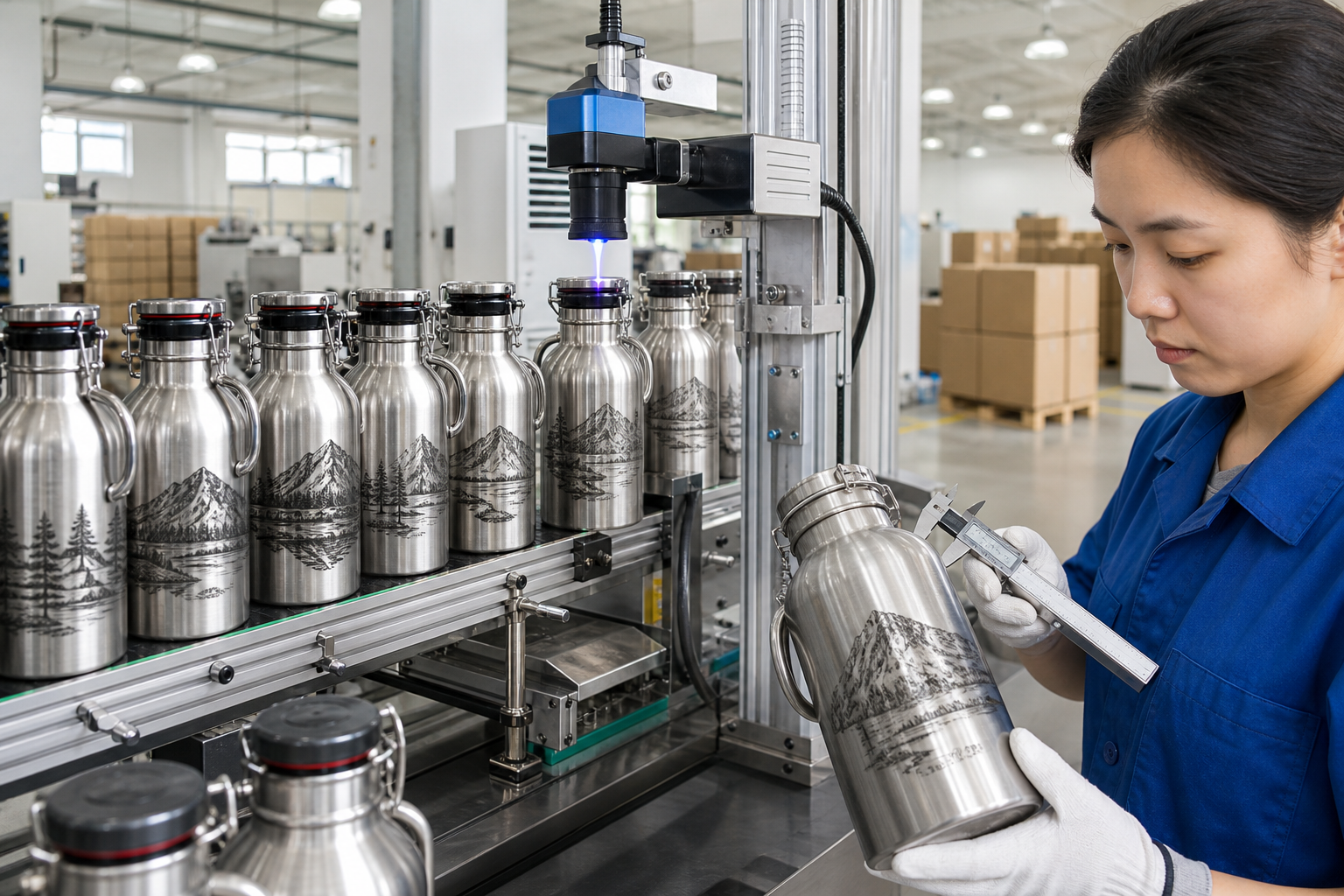
I’m rewriting the section to sound like a factory-side sales engineer: tighter wording, fewer generic transitions, and more concrete production details tied to margin and decoration choice.Decoration is where a lot of canteen vendors overpromise. The logo method has to match the sale price, the order size, and the wear level. For a promotional canteen or a budget customizable drinkware program, silkscreen printing is the lowest-cost route. We run it clean on one or two colors with a 120 mesh screen, and it gives a repeatable result. If the buyer wants a premium finish, laser engraving is the better call because it does not peel or fade under normal use. On the line, QC pulled one sample after a 1.5 mm logo shift, and that is the kind of miss that kills a re-order.
For a custom growler sold through retail or ecommerce, powder coat plus laser engraving is often the strongest mix. The finish looks deliberate, not crowded. If you need bright branding or a wraparound graphic, heat transfer or a full-color wrap can work, but you should confirm adhesion and scratch resistance before mass production. We run a 100-rub test and a tape pull on the first sample, because a pretty photo does not pay for a return. This is the wrong question to ask if the buyer is choosing from a mockup alone.
Typical economics matter here. On a 500-1,000 pcs MOQ, a simple printed growler from a China factory may land in the low single-digit USD range at FOB ex-factory, while a coated and engraved version can add $2-$4 per piece. That gap is real, and it often decides gross margin. Samples usually take 5-7 days, and production after approval often runs 25-35 days, assuming the art file is clean and the packaging spec is frozen. We have seen this go sideways when a buyer changes the Pantone after proof approval, and then the whole line waits for a new screen.
If you are buying as a canteen distributor, request two decoration quotes at the same time: one for a low-cost distributor canteen program and one for a premium retail version. That gives you a clearer read on pricing before you commit to tooling. We usually ask for both on the same artwork file, same logo size, same 3 mm line weight, so the math does not hide behind the sample. Tooling is not the place to save $200 if the second channel is retail.
Test Against Real Retail Use
A growler can pass the photo test and still leak on a shelf. We write QC into the PO because that is where the risk belongs. For export drinkware, we ask for internal leak testing, vacuum retention checks, coating adhesion checks, and carton drop testing at 1 meter. If the supplier cannot explain the method, you are buying a story, not a product.
For Europe, REACH and food-contact compliance usually come up first. For North America, buyers ask for FDA-related food-contact paperwork and, on some channels, Prop 65 exposure awareness. We ship to retail accounts that want the file before the pilot run starts, not after cartons leave the warehouse. QC pulled the sample, the buyer flagged one missing test report, and that order stopped until the documents were clean.
A serious growler factory should be able to run AQL 2.5 for major defects and AQL 4.0 for minor defects on incoming and final inspection. If the plant says every piece is checked by hand, ask how that is recorded and what happens when output hits 200,000 units per month in Zhejiang. Hand checks do not scale. A line with torque tools, leak jigs, and training records does.
What to verify before mass order:
- Leak test and vacuum performance on every batch.
- Logo and coating consistency against signed samples.
- Box compression and 1-meter drop tolerance.
- Traceable lot codes for each carton.
This is where a factory separates itself from a trader that just resells stock. We saw one PO with a 304 stainless line item typed as 340 stainless, and that typo would have gone straight into production if nobody caught it. The math does not work if QC is an afterthought; distributor drinkware turns into returns, and returns eat margin fast.
Package For Ecommerce And Distribution
Packaging is part of the product. If you sell through Amazon, DTC, or a regional distributor, the carton has to survive 1.2 m drops, vibration on the truck, and stacking in the warehouse. For a customized growler, paper sleeves alone usually fail on export routes. We run better results with molded pulp trays, EVA inserts, or a tight carton partition that keeps the lid from knocking the body; QC pulled the sample and the cap still marked the shoulder after a 6-drop test.
If you are shipping for ecommerce, ask the factory to hold label space for the FNSKU or barcode before artwork is locked. The buyer flagged a PO last month because the code crossed a seam on a curved shoulder, and that kind of mistake burns a launch week fast. For distributor canteen programs, the master carton should be easy to count, easy to palletize, and marked with clear SKU, color, and quantity data.
Common pack-outs are 12 or 24 pcs per master carton, depending on bottle size and carton strength. Bigger units usually need a lower count to keep gross weight under control; we have seen 24 pcs on a heavy bottle push the carton past 18 kg, and that is the wrong number for the line. If you are importing into the US or EU, confirm whether the shipment moves FOB from Ningbo or Shanghai, then match the carton spec to the freight forwarder’s pallet rules. A vendor that ignores carton dimensions is not thinking past the factory gate.
For branded retail, packaging can do real work. A printed belly band, recycled kraft box, or sleeve with usage instructions adds shelf value without changing the bottle itself. That is useful when you need a premium look and still have to hold the landed cost under control. We ship better when the packaging and the bottle are designed together; a 0.8 mm mismatch at the insert can turn a clean gift box into a damaged return, and the math does not work.
How To Vet A Supplier
I’m rewriting the section to sound like a factory-side buyer note: tighter language, more concrete production details, and no AI-style filler. Next I’m keeping the HTML structure intact and only changing the prose inside each paragraph.Do not start with price. Start with evidence. Ask for a dimensional drawing, a production sample, compliance documents, and photos from the actual line. On a real canteen line in Zhejiang, QC pulled the sample, checked a 0.8 mm weld bead, and the cap still clicked shut after 20 open-close cycles. If a supplier cannot show that kind of control, it is not a factory worth betting on.
Ask five direct questions: Can you hold the same finish across 3,000 pcs? What is the exact MOQ by color and by logo method? What lead time do you give after sample approval, 12 days or 18 days? Which tests stay in-house, and which go out? How do you handle a mixed-SKU distributor drinkware order? A polished brochure is the wrong place to make this call. The line has to answer.
Change requests kill more custom canteen jobs than bad tooling. The buyer flags the handle on Monday, asks for a matte coating on Wednesday, then adds a carton insert after the pre-production sample is signed. We have seen that go sideways. A disciplined canteen vendor freezes the spec before tooling release and prices every late revision, even the PO typo where "satin" became "matte" on page 2.
A strong supplier in China should give you a sample path, a confirmed lead time, and a repeat-order record. For a distributor canteen or distributor growler program, ask for the production calendar and the replenishment forecast model. We run one 8-hour shift at the packing table, and the cartons still stack 400 pcs to a pallet, so the calendar matters. This is the wrong question to ask after stockouts start.
For a long-term custom growler program, the cheapest quote is usually the wrong buy. You want the partner that can repeat the same bottle, same carton, and same QC result on the third order, with the same 304 stainless lot, the same AQL 2.5 check, and the same drop-test result, not a lucky first run. If the second PO drifts, the program is already leaking.
Request a growler quote with real specs
Send your size, logo method, target MOQ, and market. We will match the right custom growler build from our Zhejiang production line.
Frequently asked questions
What is the usual MOQ for a customized growler?
Most factories quote 500-1,000 pcs for a standard customized growler with one logo and one color. If you want a special cap, new tooling, or multiple Pantone colors, the MOQ can rise to 3,000 pcs or more. For canteen custom programs, the MOQ often depends on the decoration method more than the bottle itself. Laser engraving is usually easier to start with than full-color wrap. Ask for separate MOQ by model, finish, and packaging so you can compare real landed cost, not just unit price.
Is 304 stainless enough for export markets?
For most custom drinkware and customized growler orders, yes. 304 stainless is the standard choice for Europe and North America because it balances cost, corrosion resistance, and availability. Use 316 only when the customer specifically needs higher resistance for salty, acidic, or more demanding use cases. For a canteen manufacturer, the bigger issue is usually not the steel grade but the weld quality, coating adhesion, and lid sealing. A clean 304 build with proper QC will outperform a poorly made 316 product.
How long does production usually take in China?
For a normal order, expect about 25-35 days after sample approval. If the project needs new tooling, special packaging, or a busy-season slot at a Zhejiang canteen factory, add more time. Samples usually take 5-7 days, sometimes faster if the model already exists. If you are a canteen distributor planning a launch, build in extra buffer for artwork approval, carton testing, and pre-shipment inspection. The fastest projects are the ones where the spec is frozen early.
What testing should I request before shipment?
At minimum, request leak testing, vacuum performance testing, coating adhesion, drop testing, and visual inspection under an agreed AQL standard such as AQL 2.5 for major defects. For Europe, ask for REACH and food-contact support; for North America, ask for the documentation your compliance team needs. If the order is for distributor drinkware, also request carton compression and barcode verification. These checks are inexpensive compared with a rejected container.
Can I sell a customized growler on Amazon or in retail?
Yes, but the packaging has to be built for the channel. For Amazon, you need barcode space, secure inner protection, and carton dimensions that work with fulfillment rules. For retail, you need a shelf-ready box and a decoration method that survives handling. A custom growler with powder coat and laser engraving usually performs well because it looks premium and holds up to repeated use. If you are planning FNSKU labeling or retail distributor canteen sales, tell the factory before sampling so the pack-out is correct.