Key Takeaways
- A 500ml 304 stainless customized thermos is the fastest-moving size for retail and promotional thermos orders.
- Typical Zhejiang factory output reaches 100,000 to 180,000 units/month, with MOQ often at 500 to 1,000 pcs per style.
- Laser engraving lasts longer than one-color silkscreen, but silkscreen is usually cheaper for thermos bulk campaigns.
- For Europe and North America, ask for REACH, LFGB or FDA-friendly materials, and AQL 2.5 inspection on mass production.
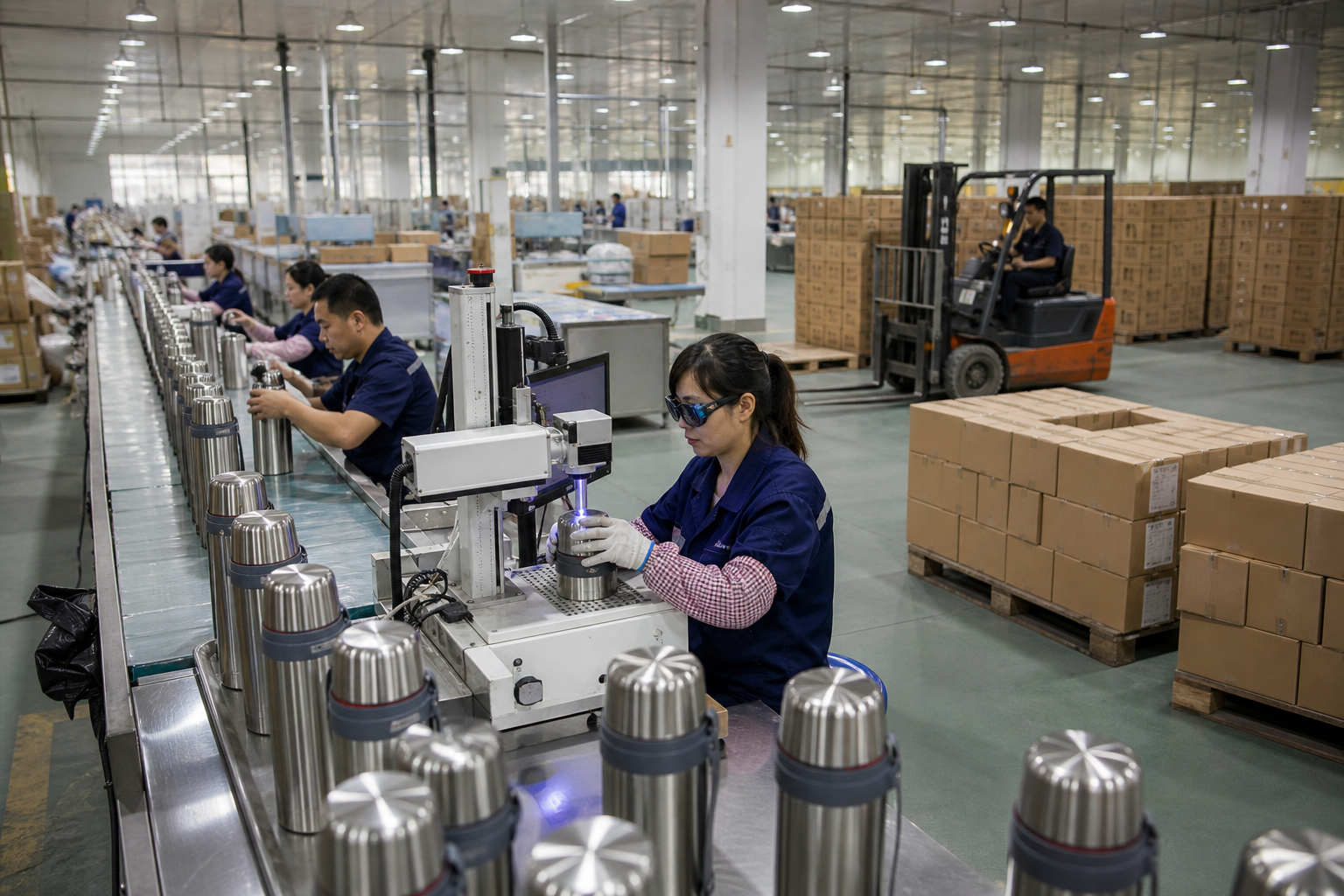
If you are buying a customized thermos for outdoor retail or a promotion, do not treat every stainless bottle as the same. Wall thickness, vacuum structure, lid seal, and coating decide whether the unit survives 12 months on the shelf or comes back with leaks and dents. On the line in Zhejiang, QC pulled the sample after a 24-hour inverted water test, and that is the kind of detail that tells you more than a glossy product photo. The best thermos factory quotes in China show material grade, test method, and packing spec first, unit price second.
For bulk thermos programs, the plan has to match the channel. A distributor thermos line for retail needs a stable finish and repeatable reorder timing; a promotional thermos run needs clean branding, a clear MOQ, and a lead time that fits the campaign. We have seen buyers miss a PO typo on the logo size by 2 mm and lose a week fixing artwork. If you want a dependable thermos manufacturer, ask for real insulation data, AQL targets, and export compliance before you approve the sample. The wrong question is "how low can the price go?"
Start With the Right Steel
The logo is the easy part. Steel decides whether the thermos holds up after 50,000 open-close cycles on the line. For food-contact interiors, AISI 304 is the normal baseline, and 316 makes sense when the buyer wants better corrosion resistance for acidic drinks, salt-heavy outdoor use, or a premium retail line. A real thermos manufacturer should give you the inner wall grade, outer shell grade, and wall thickness, not just say stainless steel and move on.
For bulk thermos orders, 0.35 mm to 0.45 mm wall thickness is common on mainstream vacuum flasks. We see 0.30 mm samples dent in the drop test after 1.2 m, and the buyer flags it fast. Thinner walls reduce weight and price, but they also make the product feel cheap. A stable thermos supplier should also state the vacuum level, the gasket material, and whether the lid uses food-grade silicone. If that is missing, you are not comparing the same build.
- 304 inside for general use and most custom thermos programs
- 316 inside for higher corrosion resistance and premium retail
- Food-grade silicone for seals and lid inserts
- 0.35-0.45 mm wall thickness for a practical balance of cost and durability
For distributors thermos assortments, this is the line item that protects repeat business. A 2 percent price gap on paper can turn into a 12 percent return rate if the steel or seal is weak. We have seen that go sideways on a 10,000-piece order where QC pulled the sample and found the lid insert was the wrong silicone hardness. The math does not work otherwise. Zhejiang has enough capable factories to do it right, but you need the spec sheet, not the sales pitch.
Match Capacity To Use
Capacity sounds simple, but it decides how a customized thermos moves through the channel. A 350 ml bottle fits commuters and coffee buyers who want a compact carry; on our line, it also packs tighter in a 48-carton master case. A 500 ml model is the safest default for outdoor retailers and promotional thermos campaigns because it keeps price, branding space, and perceived value in line. A 750 ml or 1 L model fits trail use, work crews, and buyers who want one bottle for a full day.
Shape matters just as much. A slim body clears a 68 mm cup holder and makes retail packing easier. A wide-mouth body is better for ice, soup, or cleaning; we saw a buyer flag a PO with a 2 mm neck typo because their ice scoop would not fit. If you want a thermos customized for hiking, a carry handle, locking lid, or one-handed push button improves use on the trail. If you want a thermos promotional item, keep the structure simple. Complicated lids raise the failure rate and add parts we have to keep in stock.
Insulation claims need to match the use case. A basic double-wall vacuum thermos can usually target 6 to 12 hours hot and 18 to 24 hours cold, depending on fill temperature and lid design. We do not accept a glossy catalog number without test conditions; QC pulled the sample at 95 C, then checked it again after 8 hours at 23 C. Ask your factory thermos partner to state the starting water temperature, ambient temperature, and measurement point.
A practical rule: the right size is the one your end customer will carry every day, not the one that looks biggest in a catalog.
For thermos bulk programs, 500 ml is usually the most flexible SKU. It retails cleanly, ships in a 24-piece carton without wasting space, and gives us enough print area for logos on both the front and back. We run the math on freight and decoration first; chasing a 1 L hero size for every channel is the wrong question to ask.
Branding That Holds Up
Decoration is where a lot of custom thermos jobs get messy. If you need a clean logo on a brushed steel body, laser engraving is usually the toughest route. If the order is a promo thermos and the buyer wants strong color at a lower unit price, one-color silkscreen is the better call. For artwork with gradients or more than one color, UV print or a full-wrap finish can work, but both add cost and more room for rejection on the line.
For a manufacturer or supplier, the real question is not what can be printed. It is what will hold up after handling, washing, and daily rub marks. A laser mark will not peel. A printed logo can peel if the ink system is weak or the curing time gets cut short. We have seen that go sideways on retail orders, and the first scratch usually becomes the first buyer complaint.
- Laser engraving for premium feel and long wear
- Silkscreen for low-cost, high-volume thermos bulk orders
- Pad print for smaller or curved decoration areas
- UV print for full-color branding when the budget allows
Ask for a logo proof at real size, not just a mockup. Thin strokes under 0.25 mm can disappear on textured powder coat. Small text should stay at 5 to 6 pt minimum. On one 500-unit run, QC pulled the sample because the PO typo dropped a line of text by 1 mm. That is the wrong question to ask if you are building a distributor program. Consistency wins. A clean, repeatable mark will move more cartons than a crowded design that looks sharp on screen and falls apart in hand.
Test For Export Markets
If you buy a customized thermos for Europe or North America, compliance is part of the order, not an afterthought. Ask for REACH-relevant material declarations for coatings and inks, food-contact statements for the lid and gasket, and the paperwork your importer will actually file. For Germany and nearby markets, LFGB checks are usually tighter than a plain factory declaration. For the United States, the materials file still has to stand up to your compliance team. On the line, QC pulled a lid sample and checked the ink batch code before packing. That is the level we ship to.
Inspection matters just as much. We run to an agreed AQL, usually 2.5 for major defects and 4.0 for minor defects, with zero tolerance for leakage or sharp edges. That means carton checks, logo position, lid fit, and vacuum performance are all sampled. If a factory says every piece is perfect but cannot show the inspection sheet, the math does not work. That is sales talk. At one plant, we found a 1.2 mm gasket offset that only showed up after the second lid cycle.
Useful tests for a stainless thermos program include:
- Leak test at room temperature and after thermal cycling
- Hot-fill retention test with defined starting temperature
- Drop test from about 1 meter for retail packaging validation
- Odor and residue check after first wash
BSCI or ISO 9001 audits help, but they do not replace product testing. A thermos factory in China can pass an audit and still miss the gasket fit if a tooling change is not controlled. Ask for lot traceability on body shells, lids, and seals. We have seen this go sideways on repeat orders when a 0.3 mm seal change was not logged. That is how you protect the next shipment.
Know Your MOQ And Price
I’m rewriting the section to keep the HTML structure unchanged while making the wording sound like a real factory-side sales engineer: tighter language, clearer pricing logic, and concrete production details in each paragraph.Price only makes sense once you know what sits behind the spec. On our Hangzhou line, a stable thermos tool can run 100,000 to 180,000 units per month across multiple lines, but MOQ still moves with the lid, the finish, and the carton. A standard customized thermos in 500 ml, 304 stainless, one-color logo, and a simple kraft gift box usually lands at 500 to 1,000 pcs per style. Stock-body promos can go lower. New mold shapes or a special flip lid push the floor up. QC pulled the sample and checked a 1.2 mm lid gap, so this is not a guessing game.
FOB China pricing ties to decoration and box spec. For a mainstream 500 ml custom thermos, expect a working range of USD 2.80 to 4.20 at 1,000 pcs. Laser engraving may add USD 0.25 to 0.60 per unit. A custom printed gift box can add another USD 0.20 to 0.50. If you choose 316 steel, copper-plated vacuuming, or a more complex lid, the price climbs fast. The math does not work if you ask for entry pricing and premium parts at the same time. One typo on a PO can turn a white box run into a full-color carton job.
Lead time is where planning pays off. Sample development often takes 7 to 10 days. Mass production is commonly 25 to 35 days after approval for standard projects, and 40 to 50 days if you need a new mold, special color, or peak-season capacity. For distributors thermos programs, ask the supplier to lock the re-order window before the first PO. We mark that on the traveler card after sample sign-off, because we have seen this go sideways when the buyer changes the lid after approval. China can move fast, but only if your spec stays fixed.
If a quote looks too cheap, check whether it excludes logo setup, carton testing, or export packaging. Many problems start there. A low number on the first page often means the supplier left out the drop-test carton, the inner tray, or the film wrap, and the buyer flagged it only after QC pulled the packing sample. This is the wrong question to ask if the carton spec is missing.
Write A Better RFQ
A clean RFQ cuts 3 to 5 days of back-and-forth and keeps the thermos line from guessing. If you want a custom thermos order to move fast, give the factory the exact capacity, steel grade, finish, logo method, target market, carton spec, and delivery term. Last month QC pulled a sample with the wrong lid size because the buyer wrote "500" and skipped the mouth diameter, so the mold team had to stop the line. The math does not work when the supplier has to fill in blanks.
Use this structure:
- Capacity: 350 ml, 500 ml, 750 ml, or 1 L
- Material: 304 or 316 inner, powder coat or brushed finish
- Logo: silkscreen, laser, pad print, or full-wrap
- Packing: bulk carton, retail box, or gift set
- Market: EU, US, or mixed export
- Compliance: REACH, LFGB, FDA support, or buyer-specific test list
- Incoterms: FOB Ningbo, FOB Shanghai, or another agreed term
For a thermos customized for retail, state the barcode, master carton pack, and any FNSKU or Amazon requirements before we run packing. If the order is for a distributor or promo brand, add the campaign date and the monthly call-off plan too. We have seen this go sideways when the PO said "gift box" but the buyer flagged a 12-pack shipper after pallet build started. A good supplier will lock the first shipment and keep the repeat order spec steady.
Sample RFQ line: 500 ml 304 stainless vacuum thermos, matte powder coat, one-color laser logo, kraft gift box, FOB Ningbo, 3,000 pcs, EU market, REACH and AQL 2.5 required.
Build Your Next Thermos Order Cleanly
Send the spec, target market, and logo file. We will align materials, branding, and export packing before production starts.
Frequently asked questions
What MOQ should I expect for a customized thermos?
For a standard customized thermos in 304 stainless with one logo color, the usual MOQ is 500 to 1,000 pcs per style and color. If the factory uses a stock body and standard lid, some thermos suppliers can go down to 300 to 500 pcs, but the unit price rises. New molds, special powder coat colors, and custom packaging push the MOQ higher. For a promotional thermos campaign, ask whether the MOQ applies per design or per carton spec. That distinction matters when you are splitting orders by region or distributor. In Zhejiang and other China manufacturing hubs, serious factories will explain the MOQ by component, not just by total carton count.
Is laser engraving better than silkscreen for a custom thermos?
If you want a mark that survives heavy handling, laser engraving is usually the better choice. It does not peel, and it works well on brushed steel and powder-coated finishes. Silkscreen is better when you need lower cost and a strong color match for a thermos bulk campaign. On a 1,000 pcs order, laser may add about USD 0.25 to 0.60 per unit, while one-color silkscreen can stay cheaper if the artwork is simple. The tradeoff is appearance versus durability. For a retail custom thermos, laser often feels more premium. For a thermos promotional giveaway, silkscreen can be the smarter commercial decision if the campaign is short and volume matters more than long-term wear.
How do I check if insulation claims are real?
Do not accept a generic claim like 12 hours hot without test conditions. Ask the factory to show the start temperature, ambient temperature, fill level, and measurement time. A sensible test might use 95 C water, a 20 C room, and a defined sample size with readings at 6 and 12 hours. You should also ask whether the lid was fully closed and whether the test used the actual production lid or only a prototype. For distributor thermos orders, the retention result should match the retail claim on the carton. If the supplier cannot show a simple test sheet, the number is marketing, not engineering. A good thermos manufacturer will give you the method before the promise.
Can one thermos model work for both Europe and North America?
Yes, one core model can often serve both regions if you plan compliance early. The body, lid, and gasket can be the same, but the paperwork and carton text may need adjustment. For Europe, buyers often ask for REACH support and sometimes LFGB-related food-contact documentation. For the United States, you may need a different compliance pack for your importer or retailer. If you sell through Amazon or a similar channel, carton labels, warning text, and FNSKU handling can add extra steps. A good thermos supplier in China will separate the physical product from the market-specific packaging so you can reuse the same tooling across both regions without rebuilding the entire line.
What should I ask a Chinese thermos factory before I place a PO?
Ask five things before you pay deposit: exact material grade, confirmed logo method, target AQL, sample lead time, and monthly production capacity. Then ask for carton pack details, spare gasket availability, and whether the factory can repeat the same finish on the next order. A Zhejiang factory that knows export work will answer directly and give you a spec sheet, not just a PDF with marketing photos. For a custom thermos program, this is also where you confirm FOB port, payment terms, and whether the supplier can hold a safety stock for re-orders. If the answers are vague, your order will probably be vague too.