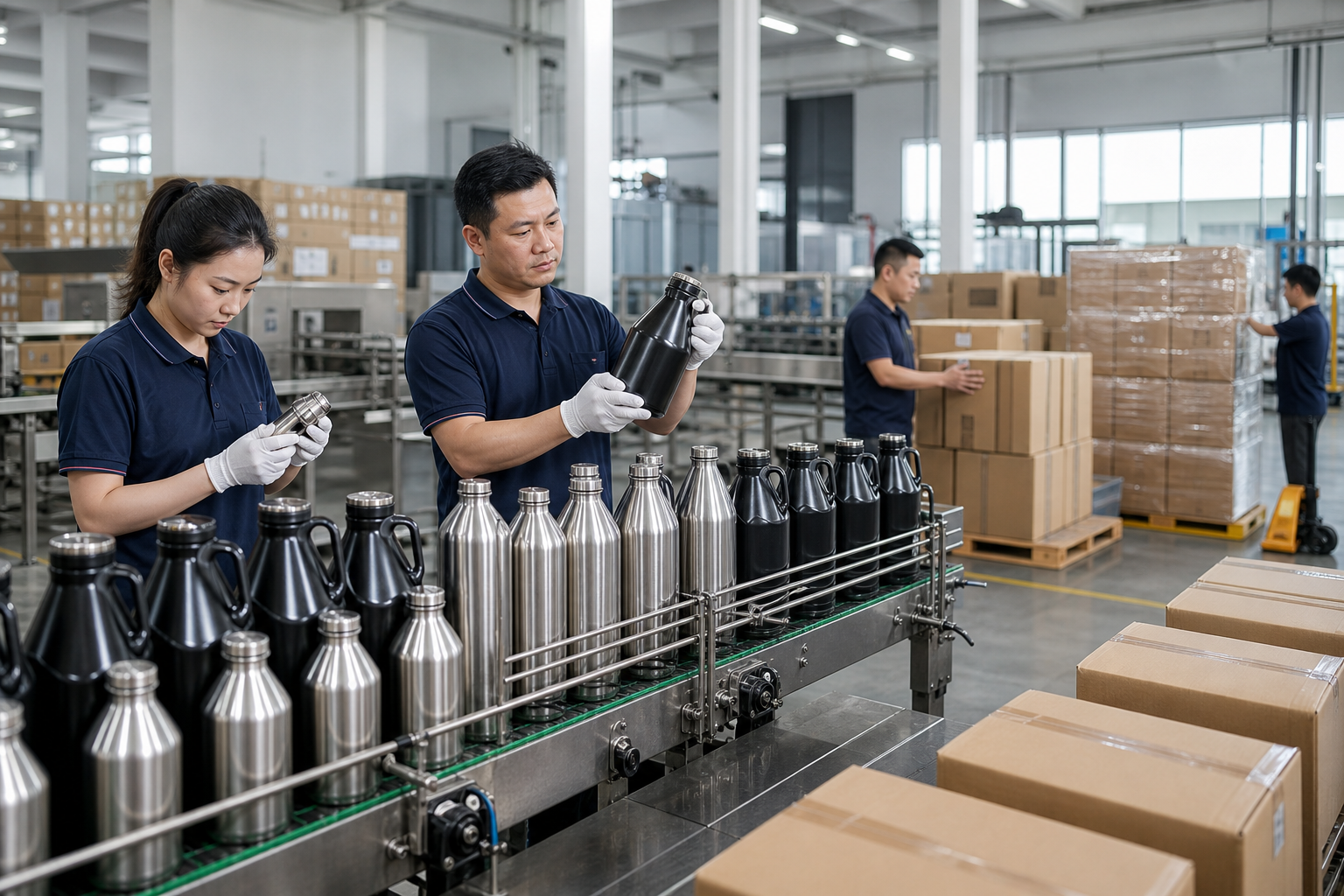
Key Takeaways
- Plan your first distributor drinkware program around 2 to 4 core SKUs, not 20, and target a 3,000-unit MOQ where possible.
- For stainless custom canteen and custom growler orders, 304 steel, 0.4 to 0.6 mm wall thickness, and leak testing matter more than a low unit price.
- A practical factory can run 1.2 million units per month, with 25 to 35 days lead time after sample approval and deposit.
- Use REACH, FDA, ISO 9001, BSCI, and AQL 2.5 as your baseline when you import customized drinkware into Europe or North America.
Distributor drinkware looks simple until you have to protect margin, manage stock, and keep print alignment the same across 3 buyers. A wrong bottle spec turns into a claim on the next 40-foot container. We have seen it happen over a lid that passed sample approval but warped 1.5 mm after heat transfer.
If you buy from China, the job is not finding any factory; it is finding a canteen manufacturer in Zhejiang that can run a stable program, not one cheap shipment. For a canteen distributor, that means locking the body, lid, coating, and carton plan before you quote the SKU. The buyer flagged a 12 mm logo move on the PO once, and the whole shipment had to be rechecked. Done right, custom drinkware becomes a line you can repeat, not a problem you keep relaunching.
What Distributor Buyers Need First
Most distributor drinkware programs fail for one of two reasons: the buyer asks for six colors, four lids, and three price points, or the factory cannot hold the spec after the first repeat order. We see this on the line all the time. Keep the assortment tight. Start with one body size that fits several channels, then decide if the product is a canteen promo item, a retail bottle, or a premium custom growler. Those are different sales jobs, even when the shell looks nearly the same.
A canteen distributor should think in programs, not one-off SKUs. The stronger distributor canteen line usually uses one stainless body, one or two lid systems, and a decoration method that survives real handling. QC pulled the sample at the pad-print station last week because the logo edge was lifting after a 12-day abrasion run. If you are building customized drinkware for corporate gifts, a lighter spec can work. If you are shipping into outdoor retail or campus channels, you need better coating adhesion, stronger cartons, and fewer color breaks. The math does not work any other way.
Use this filter before you request samples:
- Can the SKU sell at least 2 seasons without redesign?
- Can the canteen supplier repeat the same color within a tight Delta E range?
- Can the carton survive a 1 m drop test and a 5-layer export stack?
- Does the closure pass leak testing after 20 to 50 open-close cycles?
If the answer is no on two of those items, the product is not ready for distribution. We have seen this go sideways when a buyer approved a lid on a hand sample, then the mass run came back with a 0.8 mm gap and a typo on the PO sent the wrong cap color. It may still work as a custom canteen for one promotion, but not as distributor drinkware you want to reorder.
Choose The Right Material
Material choice sets your margin, your return rate, and your compliance burden. For most custom drinkware, 304 stainless steel is the default because it balances cost, corrosion resistance, and forming stability. On our line, QC pulls a random cup after the passivation bath and checks the weld seam under a light; when that seam is clean, the refund rate stays down. In a humid warehouse or coastal market, that matters. If the product will hold acidic drinks or see heavy outdoor use, a better lid seal and a thicker liner are more useful than a flashy finish. For premium lines, 316 steel has a place, but it is usually overkill unless the buyer specifically asks for higher corrosion resistance.
For a custom growler or customizable growler, pay attention to wall thickness and weld quality. A 0.4 mm shell can work on lighter retail items, but a 0.5 to 0.6 mm spec is safer for a distributor growler that needs a tougher feel and fewer dents in transit. We had a buyer flag a PO once because the spec sheet said 0.4 mm and the cartons were stacked 12 high; the math did not work. If the product is a canteen customizable for food-service promotion, weight also matters because end users carry it all day. A heavy bottle may feel premium, but a lightweight one often moves faster in distributor channels.
Do not buy on steel grade alone. Two bottles both labeled 304 can still perform very differently if the lid gasket, weld seam, and passivation process are weak.
China has a wide range of canteen manufacturers, but the factory that explains its material stack clearly is usually the one that understands export risk. We run this test on the floor: if a supplier cannot tell you the gasket material, the liner thickness, and the weld method in one sentence, walk away. In Zhejiang, the stronger programs show up when the buyer matches the material to the channel, not to the lowest landed quote.
Decoration That Survives Sales
I’m rewriting the section in-place with tighter sales-floor language, concrete production details, and less generic phrasing. I’m keeping the HTML structure intact and only changing the prose inside each tag.Decoration decides whether your custom drinkware feels like a program or a throwaway promo. Screen printing is still the cheapest choice for flat logo work on a 500 ml canteen custom order, but it starts to look tired if the bottle goes through 12 wash cycles or gets packed tight with 18 kg cartons. Laser engraving costs more up front, yet on a brushed stainless customized canteen it usually gives the cleanest mark and holds up after QC pulls a sample from a 1.2 m drop test. Powder coating, UV print, and wrap graphics all have a place, but each one solves a different problem. The wrong question is, "Which decoration is cheapest?"
For canteen promotional projects, buyers often push for full-color coverage. That can work if the order is going straight into a 2-week campaign and the cartons stay shrink-wrapped. For distributor canteen programs, the safer route is one strong logo, one controlled Pantone finish, and a decoration method the line can repeat across three lots without a shade drift. If your channels include Amazon, retail, or club stores, decoration consistency belongs in the quality spec, not just the art file. We have seen a PO call out Pantone 186C while the artwork attachment showed 187C, and the buyer flagged it before the run started.
Practical decoration rule
Use laser engraving on premium stainless items where scratch resistance matters. Use silk-screen or pad print when you need price control. Use powder coat when the bottle body is the hero and the logo should stay small and durable. On a 25,000-piece run, that also means the fixture has to hold the cup within 0.3 mm or the logo walks off center. That is the logic a serious canteen vendor should explain before you place a PO.
If you want a deeper look at logo methods, compare the decoration choice against the channel first, then against the art file. A custom canteen for a trade show is not the same product as a wholesale bottle for a distributor pipeline. We run those two jobs differently for a reason, and we've seen the wrong decoration choice turn a clean sample into a return case.
MOQ, Capacity, and Lead Time
I’m rewriting the section in place, keeping the HTML tags and list structure intact while making the wording sound like it came from someone who runs real factory quotes and ship dates, not a generic article.MOQ is where distributor drinkware deals start to drift. A canteen factory may quote a low number for a plain blank, then add cost the moment you ask for a custom lid, special packaging, or two print colors. We run those jobs on different setups, and the math changes fast. The clean way to quote is to split body, decoration, and packaging. For a stock body with new print, 3,000 units per SKU is a practical start. For a new cap system or a fully custom mold, 5,000 to 10,000 units is the number that usually holds.
Lead time is a planning input, not a sales promise. A stable Zhejiang factory with around 1.2 million units per month of capacity can usually move a simple order in 25 to 35 days after sample approval and deposit. Once you add new tooling, complex packaging, or export compliance testing, the schedule stretches to 45 to 60 days. We’ve seen a buyer push back on a 6 mm carton change and lose three days on rework. China ships fast when drawings, art, and carton specs are locked before the line starts.
Ask the canteen supplier for the real constraints:
- How many production lines are dedicated to your SKU?
- What is the monthly output per line?
- How many colors can be run without rework?
- What is the acceptable reject rate at final AQL?
If the answers are vague, the vendor is selling hope, not capacity. That is the wrong question to ask. A distributor growler program only works when the factory can repeat volume without changing the spec every time the order gets bigger. QC pulled the sample, checked the cap torque, and still found the same issue on the next batch when the PO had a typo in the carton count.
Compliance And Test Data
For Europe and North America, compliance is not optional. If you sell distributor drinkware into retail, corporate gifting, or e-commerce, you need a file that can survive a buyer review. We have seen buyers stop a 500 pcs order on the first pass because the food-contact file was thin. Ask for food-contact declarations, REACH material declarations, and the right test reports for the market you are entering. For the United States, FDA food-contact expectations matter; for Europe, LFGB is often requested by serious importers even when local law does not name it first. If the product is for children, add CPSIA awareness to the discussion.
Do not confuse paper with quality. A canteen distributor should still check the physical tests: leak performance, thermal retention where relevant, coating adhesion, dishwasher resistance, and odor control. Last month QC pulled a cup from the drop-test jig at 1.2 m, and the lid popped on the second hit. That is the kind of issue a certificate will never show. A good canteen factory will reference ISO 9001 for process control and BSCI for social compliance, then back that up with inspection data. The right production target is often AQL 2.5 for major defects and 4.0 for minor defects, but only if the defect map is clear. The math does not work any other way.
For custom growler or customized growler orders, the seam area and lid gasket deserve extra attention. If you see rust spots, pinholes, or unstable torque, stop the shipment before it turns into chargebacks. We run torque checks at 1.8 N·m for a reason. One PO typo on the gasket spec can send the whole batch off track. That is normal due diligence, not being difficult. A serious canteen vendor should welcome it.
When you compare canteen manufacturers, ask for the test scope, not just the certificate list. A neat PDF does not tell you what happened on the line. Ask for the raw data from the 24-hour leak bench, the salt-spray cabinet, and the last inspection report before packing.
Packaging For Real Channels
Packaging is where distributor margin gets protected or burned. We see it on the line all the time: a bottle clears QC, then a weak carton crushes in a 1.2 m drop test or gets scuffed in a stacked pallet at the warehouse. For distributor canteen runs, the export carton should be built for stacking strength first. If the route goes through ocean freight, warehouse transfers, and club-store handling, a 5-layer master carton, inner tray support, and clear lot coding are basic kit, not a premium upgrade.
Channel fit matters. A corporate canteen program can run on simpler inserts and a lower-cost mailer. A customizable drinkware line for retail needs cleaner shelf presentation and a carton that stays square after 48 hours in transit. For Amazon or other marketplace orders, packaging has to work with FNSKU labeling, barcode placement, and case pack efficiency. If you are building a custom logo wholesale program, check whether the case pack is 4, 6, or 12 units. We had one PO where the buyer flagged a typo on the case pack count, and the freight math broke immediately.
For canteen promotional kits, bundle logic can lift sell-through. One bottle, one extra lid, and one printed sleeve is often enough. For premium distributor drinkware, quieter packaging usually beats loud graphics. The line prints better when the spec is simple. That is the wrong question to ask if someone keeps pushing for more ink coverage. The goal is to cut damage, cut repack labor, and make the receiving team trust the pallet before the end customer ever sees it.
If your plan covers both custom drinkware and custom canteen SKUs, keep the pack style aligned with the channel. We have seen this go sideways when the retail carton and wholesale case pack follow different logic, then the warehouse team spends 12 minutes per pallet fixing labels. Match the structure to the route. That is how you avoid turning a good bottle into a logistics headache.
Build a cleaner drinkware program
Send your target price, channel, and packout. We will map the right custom canteen or distributor drinkware spec before production starts.
Frequently asked questions
What MOQ should I expect for distributor drinkware orders?
For a standard stock body with new logo decoration, 3,000 units per SKU is a realistic MOQ in many Chinese factories. If you want a custom lid, new mold, or special packaging, expect 5,000 to 10,000 units. For a canteen custom program, the MOQ can be lower if you accept limited color options, but the unit price usually rises. A serious canteen supplier should separate body, lid, and packaging costs so you can see where the minimum really comes from. If the quote hides those parts, the order is harder to scale and harder to repeat.
Can I mix canteen, growler, and tumbler styles in one shipment?
Yes, but only if the production plan is controlled. Mixing a custom canteen, custom growler, and tumbler in one container can help freight efficiency, but it should not force you into mixed packaging that raises damage risk. The better approach is to keep one shared export schedule and separate each SKU by carton spec and decoration method. If the products share the same steel grade and lid family, you can often reduce tooling and inspection complexity. If they do not, treat them as separate SKUs for quality control and reorder planning.
What decoration lasts longest on customized drinkware?
Laser engraving usually lasts longest because it removes material instead of sitting on the surface. That makes it a strong choice for premium customized drinkware, especially on stainless steel bottles that will be washed often. Powder coating with a small laser logo is also durable. Screen print is cheaper and works for canteen promotional items, but it can wear faster if the bottle is handled daily or packed tightly. For a distributor canteen line, choose the decoration based on use, not on the artwork alone. If the product is going into retail or outdoor channels, durability should outrank decoration savings of a few cents.
What documents do I need for Europe or the US?
At minimum, ask for a food-contact declaration, material specifications, and test reports relevant to your market. For Europe, REACH-related declarations and often LFGB test support are common buyer requests. For the US, FDA food-contact expectations are the key baseline. If the item is a custom growler or insulated bottle, also request leak test data, coating adhesion results, and thermal performance if you plan to claim it. For larger distributor drinkware programs, ISO 9001 and BSCI factory documents help with vendor approval. Keep the paperwork tied to the exact SKU, because a certificate for one bottle does not automatically cover a modified version.
How do I reduce returns and damage in distribution?
Start with packaging, then inspection. Use a carton spec that can survive a 1 m drop, confirm the lid torque, and require AQL 2.5 for major defects before release. For customized canteen and distributor growler programs, the weak points are usually the lid gasket, coating chips, and crushed outer cartons. Ask the factory to do a pre-shipment check on random cartons from the bottom of the pallet, not just the top layer. If you sell through multiple channels, keep one packaging spec for bulk wholesale and another for retail. That small split often lowers returns more than changing the bottle body itself.