Key Takeaways
- A practical distributor growler order starts with a clear spec: 32 oz or 64 oz, 0.4-0.6 mm wall, and the right closure.
- For bulk FOB China, custom growler pricing often falls between USD 2.10 and USD 6.50 per unit, depending on material and decoration.
- Most serious programs should use AQL 2.5 for critical defects and 4.0 for minor defects, plus leak and drop testing.
- A 500-piece MOQ is common for simple canteen promotional work, but complex customized growler orders usually need 1,000 units or more.
A distributor growler is not a generic bottle with a logo. On shelf, 32 oz or 64 oz, the cap seal, coating gloss, and fill line decide whether it sells or comes back scratched. QC pulled the sample at the torque wrench bench and checked the gasket at 1.5 mm. We have seen buyers argue over artwork first; that is the wrong question to ask. The math breaks when the leak test fails at 12 hours and the margin is gone.
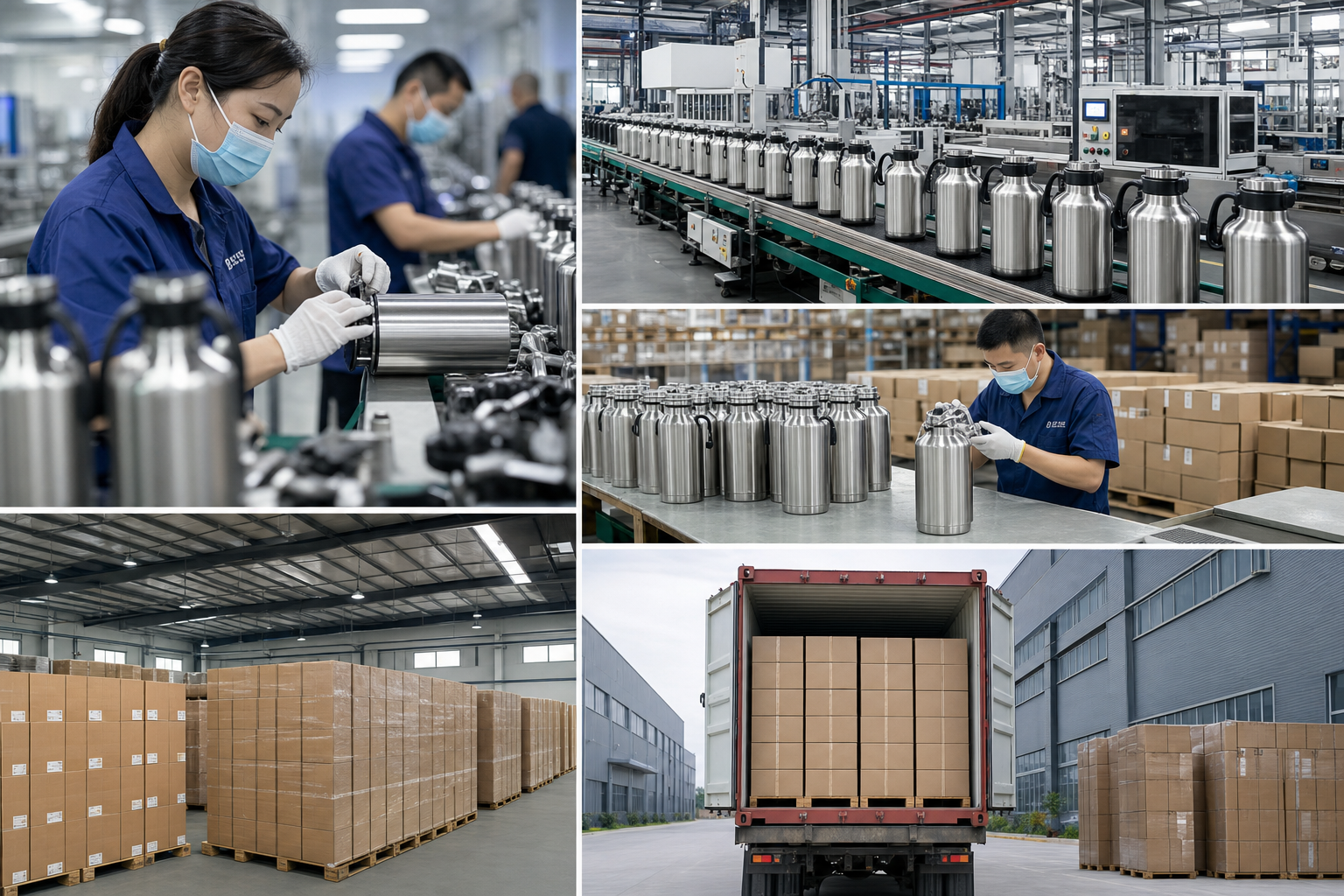
At our Zhejiang plant, we run this every season: the orders that lock down wall thickness, cap type, coating, and drop test before sampling ship cleaner and with fewer reworks. A line can turn out 300,000 units a month, but only when the PO is clean and the carton count matches. Last month a buyer flagged a typo on a PO and saved us from a 12-day delay. If you need custom growlers, distributor programs, or other custom drinkware, pick a supplier that handles export packing, QC, and repeat orders without hand-holding.
Start With The Use Case
The first mistake is shopping by shape. For a distributor growler, we start with the job: retail shelf, taproom resale, event giveaway, or distributor drinkware for a national account. A 64 oz stainless model with a swing-top closure behaves nothing like a 32 oz insulated version with a screw cap. If the buyer is a canteen distributor, a canteen supplier, or a canteen vendor handling mixed channels, the spec has to cover three things at once: low landed cost, decent shelf appeal, and fast reorder cycles. We have seen a 2 mm lid change turn into a PO dispute because the buyer flagged the photo sample as “not the same item.”
For most B2B programs, start with capacity, closure, and finish. The usual sizes are 16 oz, 24 oz, 32 oz, and 64 oz. For hospitality and promotional use, 32 oz is the safest pick because it packs cleanly and fits standard cartons. For retail, 64 oz can work if the shelf price covers the extra weight and freight. Mouth diameter matters too. A wider opening is easier to clean, but it changes the cap system and can push tooling cost up by several hundred dollars. If you are building a custom canteen line beside a custom growler, keep the body family the same so the same line can run multiple SKUs without a full mold reset. We run this kind of changeover on the line all the time.
One rule we use with buyers: if you cannot explain the product in one line, it is too complicated. A clean spec sheet closes faster than a loose promise. That is the wrong question to ask. Ask whether the customer can reorder it in 30 days without new drawings, new samples, or a new headache for QC.
Pick Materials That Hold Margin
Material choice drives margin first, not just specs. For a distributor growler, 304 stainless is the line’s default because it survives cartons, pallet stacking, and a few drops off the loading dock; glass usually does not. On export orders, 304 is the workhorse, and for most customized growler and customizable drinkware programs it is the right call. If a buyer pushes for 316, ask where the bottle will sit and what liquid it will hold. That is usually the wrong question to ask unless there is real chloride exposure. On one recent PO, the buyer flagged the extra 316 cost after seeing the sample marked 304 on the base stamp. For a canteen custom program, 304 with a 0.5 mm inner wall and a 0.4-0.5 mm outer wall usually keeps the landed price where it needs to be.
Insulation matters only when the buyer is paying for time on shelf. A double-wall vacuum build can hold hot liquid for 6-12 hours and cold liquid for 12-24 hours, but it adds welding steps, vacuum processing, and a stricter leak check at the line. QC pulled the sample from the water tank twice on one run because a bad weld bead showed up under pressure. If you are building a customized canteen or customizable canteen range, make the canteen factory split out raw steel, vacuum work, cap, and packaging. Then the math works. Without that breakdown, price comparison is theater.
Do not treat the closure like a minor part. It is the part customers touch every day, and it is usually what brings the repeat order back or kills it. Swing-top, screw cap, and carry-cap systems all fit different channels. A distributor selling to bars can absorb a heavier swing-top; a retail chain usually cannot. We ship fewer complaints when the closure is simple, because there are fewer points for the buyer to blame after transit. On one shipment, a PO typo listed the cap color code wrong by one digit, and the whole batch had to be checked again before loading. For distributor canteen programs, keep the closure plain unless the channel truly needs the extra feature.
Decoration Has To Survive Use
Decoration is where a lot of canteen factories overpromise. A logo that looks sharp on the first sample can fail after 20 wash cycles, scuffing in transit, or a week in a buyer's warehouse. For distributor growler orders, pick the mark for the channel, not for the photo. Screen print works for a single color and low unit cost. Laser engraving holds up on premium custom drinkware because the mark sits in the metal. UV print gives fine detail, but we run a 3M tape pull on the coated panel before we green-light it. Powder coat gives you a tougher base color and a better shelf read on a customized drinkware line.
If you are planning a canteen promotional program, do not pile three effects on one body. A matte powder coat, one laser logo, and one-color carton print usually look cleaner than a crowded layout. For canteen customizable projects, lock the decoration area early so the operator can set the jig and keep the print head from wandering. A logo that lands 3 mm off center is enough to hurt resale on a shelf-ready distributor drinkware program. We have seen buyers flag the proof for less. This is the wrong question to ask: the math does not work when the artwork is trying to do three jobs at once.
Ask for proofs in the same order the line will run: blank sample, decorated sample, packed sample. That is how we catch a bad carton fit or a shifted logo before we ship. This matters with a canteen vendor or a China factory that splits 12 SKUs across one line. The right sample is not the prettiest one. It is the one that still passes at 5,000 pieces without QC pulling the sample off the table for a rerun.
MOQ, Price, And Lead Time
Price only means something when you set it beside MOQ and lead time. A plain distributor growler order from a China factory might start at 500 pieces for a stock-body canteen custom project, but once you add a special coating, embossed tooling, or a multi-step decoration, the real MOQ usually shifts to 1,000 or 3,000 units. We run this every week. At the line, QC pulled a sample with a 0.3 mm coating pinhole, and the buyer flagged it before packing. That is normal. Trying to force a complex build into a low MOQ is the wrong question to ask, and the quality usually pays for it later.
For FOB China pricing, a basic stainless custom growler can land around USD 2.10 to USD 3.40 per unit in volume. Vacuum-insulated, powder-coated, or gift-boxed programs often sit between USD 3.80 and USD 6.50, depending on steel grade, lid style, and print complexity. In Zhejiang, the better canteen manufacturer quotes break out raw material, process cost, packaging, and carton on separate lines, because that is where the math lives. We had one PO with a typo on the carton spec, and the quote looked cheap until the rework hit. If everything is bundled, you cannot see where the margin disappears.
Lead time usually runs 30 to 45 days after sample approval for standard orders. Add another 7 to 10 days if you need custom cartons, FNSKU labels, or mixed-sku export packing. A serious canteen supplier should tell you the bottleneck before you ask, whether it is the 12-color printer or the lid assembly table. If they cannot, expect delays. For a distributor canteen program, predictability beats the lowest first quote every time.
QC And Compliance Come First
If you ship into Europe or North America, quality and compliance are the price of entry. We run leak tests, drop tests, coating adhesion checks, and food-contact verification before a distributor growler leaves the line. For stainless steel, ask for material declarations and test reports tied to REACH, LFGB where needed, and FDA food-contact expectations. On one Amazon carton run, a barcode printed 1 mm off center failed the scanner at the DC gate. One crushed pallet can wipe out the margin on a full container.
On a competent Zhejiang canteen line, the QC plan should be written step by step, not by memory. We use in-line inspection, final AQL sampling, and a pre-shipment checklist, with AQL 2.5 for major defects and 4.0 for minor defects as a practical base for most distributor drinkware orders. Check seal performance, cap torque with the torque wrench, print alignment, and surface finish. If the product is vacuum insulated, ask for a heat-retention or cold-retention test on the bench, not a visual check under the lights. For a canteen custom order, batch traceability by production date and line matters when the buyer flags a lid leak after arrival.
Good export QC is boring. That is the point. If the sample looks sharp but the carton spec is missing edge crush, you are buying trouble.
China factories can build quality at scale, but only if the test method is written down and the buyer insists on it. The line does not guess. We have seen a PO typo turn one carton code into another SKU, and the whole pallet had to be relabeled before shipment. Guesswork gets expensive after the container leaves.
Build Your Next Growler Program
Send your target price, capacity, and artwork. We can quote a distributor growler program with clear MOQ, lead time, and export-ready QC.
Frequently asked questions
What MOQ should I expect for a distributor growler order?
For a simple stock shape with one-color print, 500 pieces is a realistic starting point. Once you add custom tooling, vacuum insulation, embossed details, or premium packaging, most canteen manufacturers will move to 1,000 to 3,000 pieces. That is normal in China and especially in Zhejiang, where factories optimize by line setup. If you are buying for distributor drinkware or canteen promotional programs, ask for MOQ by component: body, lid, carton, and print. That gives you a cleaner forecast and helps you protect margin.
Which material is better: 304 or 316 stainless steel?
For most custom growler and customized drinkware programs, 304 stainless is the right choice. It offers solid corrosion resistance, good availability, and a lower landed cost. 316 is worth considering if the product will see aggressive environments or you need a premium selling point, but it usually raises unit cost by 10% to 20% or more. For a canteen supplier selling to distributors, 304 is the practical default unless the spec truly requires 316. Ask your factory for material certificates either way.
Can I get a logo that survives repeated washing?
Yes, but the decoration method matters. Laser engraving is the most durable for a distributor growler because it does not rely on surface ink. Screen print can last well if the coating and curing process are correct, while UV print needs a proper adhesion test. For canteen customizable and customizable growler programs, ask the factory for an abrasion test and a wash-cycle check before mass production. If your product will be used as custom drinkware in hospitality or retail, durability should beat decoration complexity.
What compliance documents do I need for Europe and the US?
At minimum, ask for food-contact declarations, REACH-related material compliance, and test reports that match the target market. For Europe, LFGB may be required by some buyers even when it is not legally mandatory. For the US, FDA food-contact expectations are the baseline. If your distributor canteen order includes packaging for Amazon or retail, also ask for carton specs, barcode verification, and pallet data. A serious canteen factory in China should provide this without hesitation.
How do I protect margin as a canteen distributor or reseller?
Keep the SKU simple and the spec stable. A clear 32 oz or 64 oz custom canteen family with one lid platform is easier to reorder than a mixed design with constant changes. Ask your canteen vendor to separate raw steel, coating, printing, and packaging costs so you can see where money is being lost. In practice, the best distributor growler programs run on repeat orders, not one-off hero samples. If the factory can hold a 30 to 45 day lead time and maintain AQL 2.5 on critical checks, you have a product that can scale.