Key Takeaways
- A usable thermos spec starts with 304 stainless, 0.35 to 0.5 mm wall thickness, and a defined 12-hour or 24-hour thermal target.
- For stock shapes, custom logo MOQ is often 500 to 1,000 pcs; new colors or lids usually start at 3,000 pcs.
- FOB China pricing for a 500 ml custom stainless thermos often lands around USD 3.20 to USD 6.80 at 1,000 pcs.
- AQL 2.5/4.0, REACH, LFGB, and batch traceability are worth more than a polished sample.
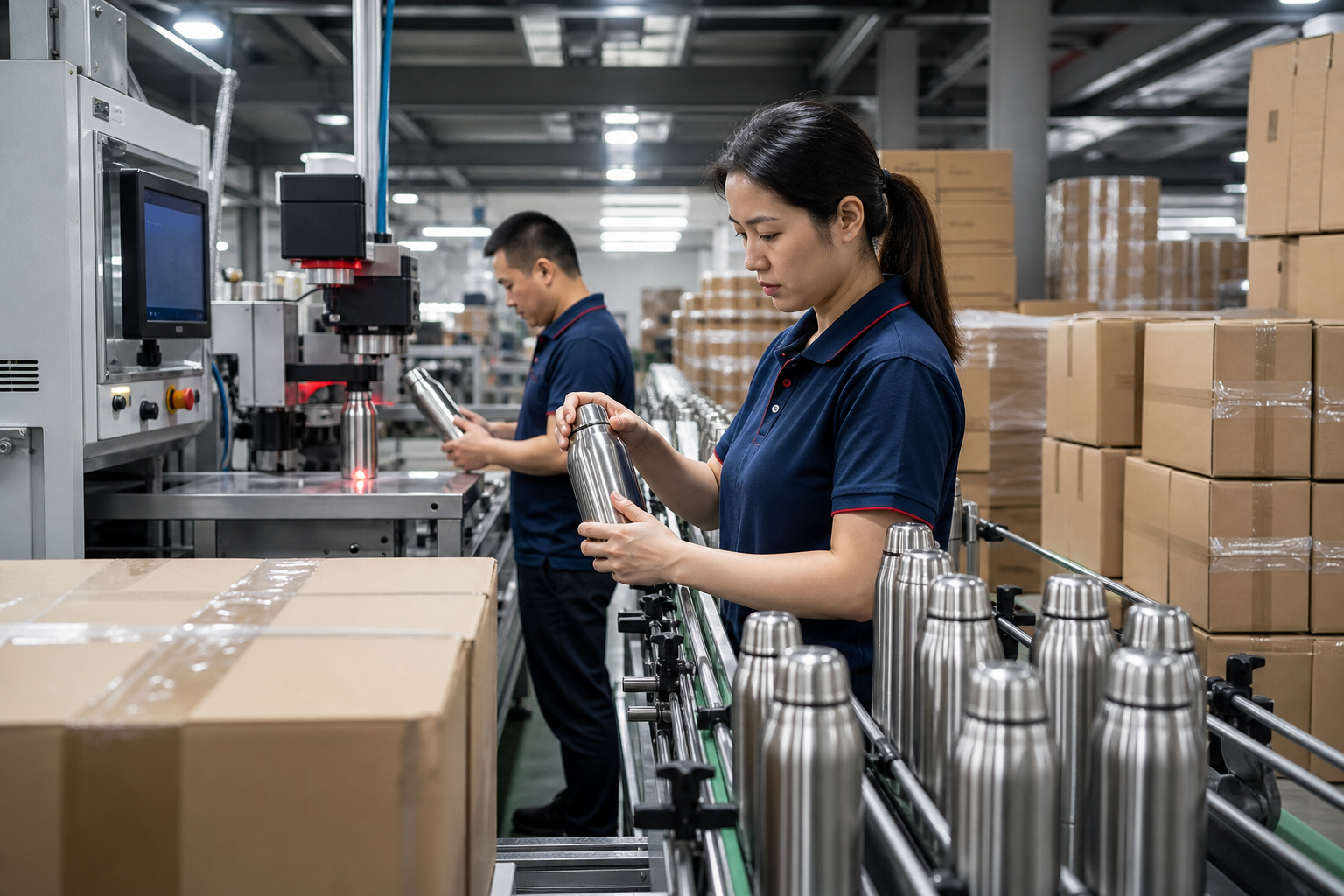
When you source distributors thermos programs, you are not buying a generic bottle. You are buying a repeatable spec that your sales team can reorder without surprises. On the line, we check wall thickness in mm, lid torque, and the silicone seal before the first 500 units run. For outdoor retailers and promotional brands, the margin usually lives or dies on those details: wall thickness, lid seal, decoration method, carton pack, and whether the thermos still holds temperature after 6, 12, or 24 hours.
In Zhejiang, China, a good thermos factory can make 180,000 units a month and still miss the point if the buyer did not define the build correctly. QC pulled the sample, found a 2 mm print shift, and the buyer flagged it on the PO before we shipped. The right China supplier should help you choose the product, not just print a logo. If you handle bulk thermos orders, you need a clear path on MOQ, lead time, compliance, and the final retail or promo packaging before you place the order. That is the wrong question to ask after production starts; the math does not work.
What Distributors Actually Buy
The first mistake is treating a thermos like a commodity. It is not. A distributor needs a tight spec sheet: capacity, mouth size, insulation target, cap style, finish, and carton pack. Leave those loose and two factories can quote the same custom thermos, then ship two different products. I have seen that split happen on the line when the drawing said "standard" and the buyer flagged the sample after the first vacuum test.
Start with the use case. Outdoor retail usually wants a tougher bottle, 500 to 750 ml, powder coat, and a lid that still opens with gloves on. Promo buyers want a simpler thermos customizable for logo placement and fast repeat orders. On a 3,000 pcs run, that detail saves weeks. Before you ask for price, lock these points down:
- Target capacity and target retail price
- Inner and outer steel grade
- Color, finish, and logo position
- Carton pack and master carton count
- Compliance market: EU, US, or both
A serious thermos factory in China will push back on vague requests because vague requests create scrap. That is the right pushback. The partner you want is the one that asks how the bottle will be sold, shipped, and used, not just how many pieces you need. We run into this all the time: QC pulled the sample, the powder coat measured 0.12 mm thin on one side, and the buyer was already asking why the PO still said "as discussed." If you are comparing thermos suppliers, the real test is whether they can turn a sales brief into a stable repeat order.
Stainless Construction That Matters
I’m rewriting the section directly against the factory voice brief, keeping the HTML structure intact and tightening the language around real production details.Material choice is not where buyers should improvise. For most manufacturers and suppliers, 304 stainless steel on both inner and outer walls is the practical baseline for a custom stainless thermos. We run 316 only when the brief calls for stronger corrosion resistance, like acidic drinks, salt spray, or a shelf position that needs a premium story. 201 on the outer shell cuts cost, but it gets hard to defend once the buyer asks about denting after a 1.2 m drop test or daily use in transit cases.
The parts that move performance are the vacuum seal, the neck geometry, and the lid gasket. On the line, QC pulled the sample and the cap left water trapped in the threads, which is a fast way to get complaints from distributors. A good factory thermos shows a steady weld line, a clean vacuum draw, and a cap that seats without rubbing. For a brushed or powder-coated finish, ask for 60 to 80 microns of coating thickness and a cross-hatch adhesion check. For a 500 ml bottle, a realistic hot-retention target is 12 hours above 60 C when filled at 95 C, but test conditions matter.
A good thermos is judged by the seam, the vacuum, and the cap. The logo comes last.
If your thermos distributor is only shown a pretty render, you do not have a manufacturing spec yet. Ask the manufacturer thermos partner for section drawings, not just a sales sheet. A vendor that can explain weld quality, lid tooling, and insulation loss gives you a better shot at a durable thermos custom program that does not turn into returns. One typo on the PO, one wrong lid code, and the whole shipment becomes a headache.
Decoration That Survives Use
Decoration is what turns a customizable thermos into a SKU buyers will actually reorder. The right method depends on MOQ, artwork complexity, and how the bottle gets used on the line and in the field. We run a fiber laser for metal bodies because it will not chip, and it holds up well on brushed or matte finishes. Silk screen is the cheaper call for flat logos and one or two colors. UV print gives stronger color coverage, while wrap graphics make sense when a promo thermos needs shelf impact.
For outdoor retailers, a quiet mark usually sells better than a loud one. A 20 mm to 35 mm logo on the front panel is enough for most retail programs. For promo buyers, you can go larger, but that does not excuse a weak coating. QC pulled the sample after an abrasion test and the buyer flagged it at once when the print scuffed after hand washing. Ask the supplier thermos team which decoration still passes rub tests, hand wash checks, and repeated condensation. If you want a thermos customizable for private label instead of one campaign, the decoration process matters just as much as the body shape.
Match decoration to the channel
- Retail: laser engraving or restrained screen print
- Corporate gift: one-color print with clean box artwork
- Event promo: fast-turn logo plus stock color body
- Premium launch: color wrap, textured powder coat, and gift box
Ask for decorated samples before final approval. A screen print that looks sharp on day one can fail if the surface prep is off by even 0.2 mm in coating thickness. That is the wrong question to ignore. Good manufacturers thermos partners will show you the process window, not just the finished sample.
MOQ, Price, and Lead Time
MOQ should follow the build, not the sales pitch. For stock body shapes with a custom logo, we run 500 to 1,000 pcs all the time. Once the buyer flags a new lid, a new color, or a printed box, 3,000 pcs is the normal line. If you want a fully new mold, plan on 5,000 pcs or more, plus a tooling charge that usually starts around USD 2,000 to USD 8,000 depending on the part. QC pulled a sample lid last week with a 0.4 mm gap at the gasket seat, and that kind of issue is why the factory asks for real volumes before it opens the tool. The wrong question is "can you do it cheaper?" The better one is "what changed on the product?"
On FOB China pricing, a 500 ml stainless thermos can sit around USD 3.20 to USD 6.80 at 1,000 pcs, and decoration, packaging, and cap choice move the number fast. In one Zhejiang factory running 180,000 units per month, we ship a simple re-order in 30 to 35 days after approval. A new color, a new carton, or a peak-season queue can push that to 45 to 55 days. The buyer once sent a PO with the carton size typed as 32 x 23 x 26 cm instead of 32 x 23 x 28 cm, and the line stopped until we fixed the stacking test. Lock artwork and packaging early, or the bulk order just sits in sampling and eats your margin.
Use a simple rule: the more you customize, the more you should buy. A distributor who wants a long program should think in annual volume, not just first-shipment volume. If you want a custom thermos line to stay profitable, treat the first order as the base for the next three reorders. We have seen this go sideways when someone chases a tiny opening order and then expects factory pricing on the second run. That math does not work. Build for repeat volume, and the project stays clean instead of getting trapped in endless revision cycles.
Quality Checks Worth Specifying
Quality control is where China sourcing becomes predictable or expensive. Ask for incoming inspection on steel thickness, vacuum integrity tests, and lid torque before the line runs. On a 5,000-unit order, one weak cap can turn into a full rework, and we have seen that go sideways fast. On our side, QC should be using a micrometer, a torque gauge, and a leak tester before the first carton is packed. On the finished goods side, AQL 2.5 for major defects and 4.0 for minor defects is a normal commercial standard for export drinkware. For Europe, ask for REACH and, where relevant, LFGB migration testing on the drinking-contact materials. For the US, keep your compliance file ready for FDA food-contact expectations and any retailer-specific requirements.
A practical inspection plan is better than a long promise. Ask the thermos supplier to check 100 percent of vacuum bottles for leak and function, then sample the appearance, print alignment, and coating adhesion per batch. QC pulled the sample from carton 17 and found a 1 mm logo shift on one run; that is the kind of miss you want caught before shipment. You also want retained samples, lot traceability, and a clear defect code list. If a supplier says they only do visual checks, that is not enough for a manufacturer thermos program. We run a drop test from 1.2 m, and the good plants in Zhejiang send test records, not just photos.
BSCI or another social audit may matter if your retail customer asks for it. ISO 9001 does not guarantee product quality, but it does tell you the factory has a system. The right thermos manufacturers in China will show you test reports and tell you which parts are made in-house and which are bought from outside suppliers. On one PO, the buyer flagged a typo that read "stainless stel 304", and that kind of mistake tells you how much attention the supplier gives the paperwork. That transparency is worth more than a polished sales deck when you are buying from a thermos factory at scale.
Packaging for Retail and FBA
Packaging is not a side issue when you sell to retailers or ship into fulfillment centers. For outdoor retail, a clean color box with a barcode, care instructions, and a hangtag usually moves better than a bare bottle. For Amazon-style programs, each unit may need a polybag, an FNSKU label, a suffocation warning if applicable, and a master carton that survives a 76 cm drop test without denting the body. If you are selling thermos custom sets, confirm whether the lid, straw, or cleaning brush stays inside the same retail unit or goes out as a separate accessory. We have seen a buyer flag a PO because the brush was packed loose.
Master carton planning changes freight cost more than many buyers expect. A 24-piece carton works for a small bottle, but a heavy 750 ml thermos may need a 12-piece pack to stay under 20 kg and cut carton crush on the line. Ask for carton dimensions, gross weight, and pallet pattern before approval. In China, a good supplier will mock up the pack and send photos before mass production. That saves rework when your distributor thermos order mixes 4 colors or 2 logo versions. The math does not work if you approve the pack first and check the carton later.
For promotional brands, packaging should support the campaign message without blowing up cost. The right thermos vendors know when a two-color box is enough and when a full printed sleeve earns its keep. If you are comparing factory thermos options, the packaging file is part of the product, not an extra. A supplier who treats it that way will usually handle reorders faster and with fewer surprises. QC pulled the sample on a 1 mm print shift once, and that saved us from a bad batch.
Price your custom thermos program with factory data
Send your target price, capacity, logo file, and pack spec. We will match the right build, MOQ, and lead time for your market.
Frequently asked questions
What MOQ should I expect for a custom stainless thermos?
For a stock shape with a custom logo, 500 to 1,000 pcs is a realistic starting point from many China suppliers. If you want a new color, a new lid, or special packaging, 3,000 pcs is more common. A fully new mold often needs 5,000 pcs or more, plus tooling. Sample time is usually 7 to 10 days. If a factory says yes to everything at 100 pcs, check whether they are quoting stock inventory or a real production run.
How long does a thermos bulk order take from China?
A normal production lead time is 30 to 45 days after sample approval and deposit. If the order is simple and the Zhejiang factory is not in peak season, 30 to 35 days is possible. New colors, special cartons, or busy export periods can push the schedule to 45 to 55 days. Sea freight to Europe or North America is separate and usually adds 18 to 40 days depending on route. Air freight is faster, but it is rarely economical for thermos bulk quantities.
Which logo method lasts longest on a thermos?
Laser engraving usually lasts the longest because it removes the top layer instead of sitting on it. For a brushed or matte stainless body, it is the most durable option for a promotional thermos or retail SKU. Silk screen is cheaper and works well for one or two colors, but it can wear faster if the surface prep is weak. UV print gives stronger graphics, but abrasion resistance depends on the coating. If the bottle will be used daily outdoors, ask for an abrasion test and a decorated sample before mass order.
What compliance documents should I ask a supplier for?
For Europe, ask for REACH and, where relevant, LFGB migration test reports for drinking-contact materials. For the US, request documentation that supports FDA food-contact expectations. Also ask for ISO 9001, BSCI if your retail customer requires social compliance, and a factory inspection report showing AQL 2.5 major and 4.0 minor. You should also keep retained samples, lot numbers, and the test scope for each batch. A reliable thermos supplier in Zhejiang will provide these without drama.
Can you do retail packaging and FBA prep?
Yes. A proper thermos factory can build a retail box, insert card, barcode label, and master carton spec for your market. For Amazon or other FBA programs, each unit may need a polybag, FNSKU label, and carton dimensions that fit warehouse handling rules. If the bottle is heavy, 12 pcs per carton may be safer than 24 pcs. Ask for gross weight, carton size, and pallet pattern before you approve mass production. Packaging should be part of the product spec, not a last-minute add-on.