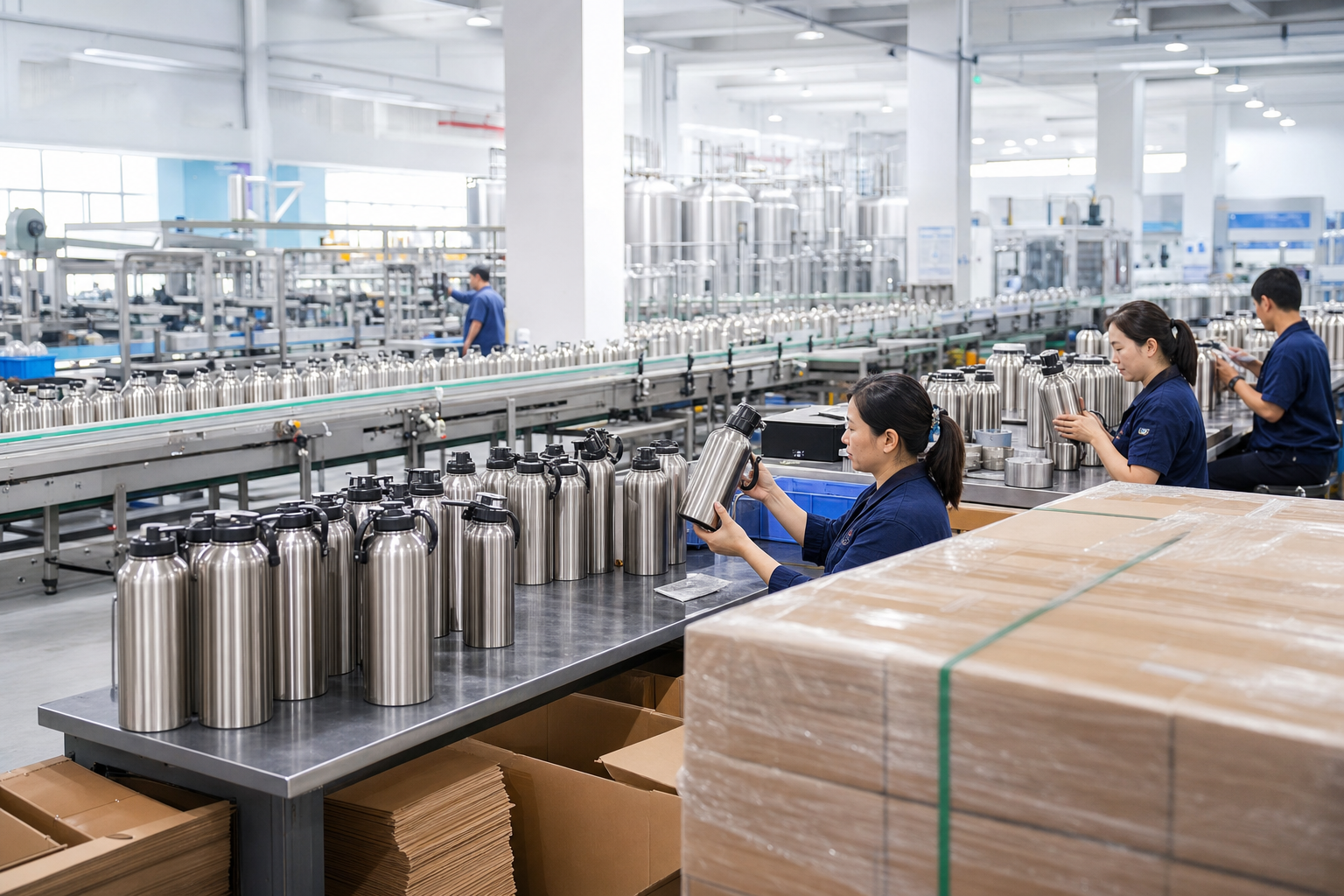
Key Takeaways
- For drinkware bulk, a realistic MOQ is often 1,000-3,000 pcs per SKU, with 15-25 days for standard stock and 30-45 days for custom runs.
- 304 stainless steel covers most wholesale drinkware programs; 316, borosilicate glass, or Tritan are better only when the use case justifies the cost.
- FOB China pricing is only part of the job: packaging, AQL inspection, freight, and labeling can add 12-25% to landed cost.
- A Zhejiang factory with 300,000-500,000 units/month and documented REACH, LFGB, or FDA testing is a safer starting point than a cheap quote with no paperwork.
Drinkware bulk orders look simple until the margin starts leaking. A 500 ml stainless bottle, a 64 oz growler, and a 12 oz beer tumbler do not run the same on the line. One gets a laser mark, one needs a 48 mm cap seal check, one fails if the carton crush test is weak. Buy on price alone and the cost shows up later in decoration rejects, broken packs, or a compliance miss. We have seen that go sideways enough times to say it plainly.
The better move is to lock the product, the use case, and the market standard before you ask for quotes. A real factory in Zhejiang or anywhere in China will ask the same things: capacity, material, logo method, carton spec, testing, and target landed cost. On one recent PO, the buyer missed the MOQ by 300 units and the sample had a logo typo; QC pulled the sample before it shipped. If you answer those points cleanly, you get tighter pricing, cleaner samples, and fewer ugly surprises when the PO lands.
Choose the Right Vessel First
I’m rewriting the section in-place, keeping the HTML structure intact and tightening the wording so it reads like someone who actually ships these SKUs from the floor. I’m also adding a few concrete factory details and removing the generic filler that makes the copy feel synthetic.Before you compare quotes, pin down the vessel. Drinkware bulk is not one product category; it is a mix of containers with different failure points on the line. A wholesale drink bottle for gym retail needs light weight, leak resistance, and a clean print panel. We run drop checks at 1.2 m, and a cracked lid tells you the spec is wrong fast. A bulk canteen or canteen wholesale program for outdoor retail needs dent resistance and a cap that survives repeated drops. A bulk growler or beer growler bulk order is a different job because mouth size, seal, and pressure tolerance matter more than the shell. This is the first question to settle. Comparing quotes before that is the wrong question.
For procurement, the fast way to narrow the field is by use case:
- Hydration retail: 500-750 ml stainless or Tritan bottles for gyms and campus stores
- Travel and office: 350-500 ml insulated tumblers that fit desks and cup holders
- Outdoor and sports: 1,000 ml canteen bulk formats for trail packs and club kits
- Beer and beverage service: 32 oz to 64 oz growler wholesale sizes for taprooms and events
- Promo programs: alcohol flask bulk or beer tumbler bulk with one-color branding
If you are trying to find the best wholesale drink bottle or the best wholesale drinkware for a chain program, start with the end user and shelf price, not the factory catalog. A 12 oz beer tumbler wholesale item and a 20 oz insulated bottle are both drinkware wholesale products, but they move through different channels, use different lids, and fail for different reasons. We had a PO last month where the buyer wrote "20oz" and the sample tag said "24oz"; QC pulled the sample and the quote had to be redone. The more precise your brief, the more honest the quote.
Materials Set the Compliance Floor
Material choice decides whether your order clears customs, survives retail handling, and stays within target cost. For most stainless programs, 18/8 or 304 stainless is the practical baseline. We run a 0.8 mm wall check on the line because one thin spot turns into dents and rejects fast. It stays stable, is widely accepted, and usually is the right answer for wholesale drinkware unless you need salt resistance, acidic beverage compatibility, or a premium finish that justifies 316. For glass programs, borosilicate handles thermal shock better than soda-lime glass. For lightweight promotional bottles, Tritan and PP are common, but you need to check the exact resin grade and the lid components.
Do not rely on marketing language. Ask for the test report set. QC pulled the sample on a recent run and the lid gasket was a different compound than the spec sheet said, which is how a simple PO turns into a delay. For Europe, REACH and food-contact compliance are not optional. For North America, ask for FDA food-contact declarations and, where relevant, migration testing. If the product touches children or sensitive use cases, add BPA-free declarations and phthalate checks. A disciplined supplier in Zhejiang or another China export hub will already have these documents organized by SKU, with ISO 9001 traceability and, if the factory is serious, BSCI audit records.
Practical rule: if the supplier cannot tell you the wall thickness, steel grade, and lid material in one email, they are not ready for a bulk purchase order. We have seen this go sideways on a 5,000-unit run.
For a canteen bulk or wholesale canteen program, durability matters more than glossy features. One 1.0 mm dent from a drop test can cost more than any print upgrade, so we ship for handling first. For a growler wholesale order, sealing performance matters more than decoration. We test the cap with a torque wrench at 12 N·m and watch for leaks after 24 hours. Match the material to the failure mode you want to avoid.
MOQ And Lead Time Drive Margin
MOQ is where drinkware bulk stops being a spreadsheet and starts hitting cash flow. A typical custom run from a factory in Zhejiang starts at 1,000 to 3,000 pcs per SKU for standard shapes, and lids with extra parts or molded inserts push the floor higher. On a plant that ships 300,000 to 500,000 units per month, that number comes from the line, not ego. A 28 mm lid mold change can eat 40 minutes, and if you want a lower MOQ, the unit price goes up and the carton spec gets tighter.
Pricing moves in steps. A plain 304 stainless 500 ml bottle might land around USD 1.80 to 3.20 FOB China depending on wall thickness, lid, and finish. At our laser station, a 0.4 mm wall and a brushed body do not price the same as a 0.5 mm mirror polish. Add laser engraving, a two-color print, or gift box packaging and the number jumps fast. The buyer flagged a PO once for writing “500ml matte black” and skipping the inner box spec, and the math did not work. For alcohol flask wholesale bulk or beer tumbler wholesale bulk orders, you need the landed cost, not only FOB Ningbo or FOB Shanghai.
Lead time is margin too. Standard stock shape with simple logo: 15-25 days. Custom color, custom lid, or retail packaging: 30-45 days. If a factory promises a complex program in 7 days, they are using stock inventory or cutting corners. QC pulled the sample on day 3 and found the logo off by 1.5 mm on one side; that sort of miss shows up later at the packing table. We have seen this go sideways.
A smart buyer asks for a production schedule, not just a quotation. Ask what runs this week, which mold is open, and where your cartons sit in the queue. That is the wrong question to ask if you only want “best price.” It is how you protect a beer growler in bulk program or a canteen wholesale replenishment order from missing the seasonal window.
Branding Should Survive Real Use
Decoration is not an afterthought. It changes unit cost, lead time, shelf appeal, and scrap. On the line, we usually choose between silkscreen, laser engraving, heat transfer, and UV print. Silkscreen works for a one-color logo and a 5,000-piece run. Laser engraving is the cleanest call on stainless steel, and it holds up better on wholesale drink bottle and wholesale growler programs that need a mark to survive shipping and hand washing. UV print gives more color, but we always run an abrasion check first, because a glossy sample that fails after 20 rubs is the wrong sample to approve.
If the program includes alcohol flask in bulk or alcohol flask wholesale bulk, ask how the finish behaves after 95% alcohol wipe-down, cold storage, and carton rub in transit. For beer tumbler in bulk and beer tumbler wholesale projects, a logo that starts flaking after three dishwasher cycles is not a decoration issue. It becomes a replacement claim. We have seen that go sideways when the buyer flagged a PO typo on the carton art and the whole lot had to be reworked.
- Use laser engraving when durability matters more than color
- Use silkscreen for repeat logos and lower setup cost
- Use UV print when the brand needs more graphic detail
- Confirm curing, rub test results, and dishwasher tolerance before approval
Sample review should cover three checks: logo alignment, color delta against your reference, and abrasion after repeated wiping. We pull the sample under the same light box we use for QC, then check the label against the artwork at the 1 mm edge gap. If you are selling into retail, ask for a pre-production sample with the exact carton and barcode label. A factory that knows drinkware wholesale already understands the point: branding and packaging have to pass the same test, or the line stops.
Packaging Protects Your Margin
Most bulk drinkware losses hit after production, not on the forming line. A wrong carton or insert turns a good bottle into a damage claim fast. For export, we ask for a 5-ply master carton, an inner box if the item is retail-facing, and a drop-test spec before mass production starts. On stainless vacuum items, a molded pulp tray or corrugated divider holds better than loose packing; QC pulled a sample last week and the loose-fill version failed at the corner crush point. For glass bottle programs, box structure matters just as much as the bottle wall thickness. The math does not work any other way.
Retail buyers in Europe and North America often require barcode labeling, item code consistency, and Amazon-ready pack-out if the program is going into e-commerce. If you need FNSKU labels, confirm placement and scannability before shipment, not after the cartons are sealed. For marketplace programs, carton count, case pack, and suffocation warnings need to match the listing plan. We shipped one order where the buyer flagged a PO typo on the case pack, and that added a full day of repacking at the warehouse. A lot of so-called best wholesale drinkware suppliers skip this and leave the mess to the buyer.
Use AQL inspection instead of vague promises. A common starting point is AQL 2.5 for major defects and 4.0 for minor defects, but tighten it if the order is high-value or retail-critical. For China sourcing, ask for photo records from pre-shipment inspection and carton drop tests. We run these checks with a tape measure, a scale, and a simple corner-drop rig because that is where weak packaging shows up. If the supplier cannot control packaging, they are not controlling the shipment.
That is especially true for growler bulk and beer growler wholesale programs, where one broken case can wipe out the margin on four or five cartons. On a 12-bottle master carton, one cracked bottle can turn a clean order into a chargeback. We have seen this go sideways when buyers push for the cheapest insert and skip the test pack. This is the wrong question to ask; the real question is whether the carton survives the line, the truck, and the warehouse floor.
Evaluate Suppliers Like A Buyer
The cheapest quote is not the best wholesale drink bottle program. We have seen a 0.30 USD gap disappear after rework, and the math does not work if the seam fails at 8,000 pcs. Start with factory capability: welding line stability, lid mold ownership, decoration equipment, and a written inspection flow. Ask straight out whether they are a trader, a packer, or the actual maker. That changes pricing, control, and how fast problems get solved. A real Zhejiang factory will show line balance, monthly output, and test reports without the sales talk.
Then check the commercial discipline. Do they quote cleanly on FOB terms? Do they state sample charge, sample lead time, and mold ownership in writing? Do they understand whether you need wholesale canteen, wholesale growler, or general drinkware wholesale pricing? This is the wrong question to ask only after the buyer flags a typo on the PO. A serious supplier will break out material, labor, decoration, packaging, and freight-ready packing. On our line, a 2.5 mm logo shift is enough to trigger a redraw, so one unit price tells you almost nothing.
Before you place a PO, ask for three things: a pre-production sample signed off against the spec sheet, a written QC plan with inspection points, and a shipment plan that matches your sell-through window. QC pulled the sample, checked the cap torque at 18 Ncm, and caught a lid mismatch before we packed the first carton. For a long-term drinkware bulk program, you want the same result on reorder six months later, not a fast quote and a different answer on the second run. We ship on that basis, and we have seen the loose version go sideways.
Request a Quote Built For Your Market
Send your target capacity, logo method, and carton spec. We will quote the right drinkware bulk option with clear MOQ, lead time, and FOB terms.
Frequently asked questions
What MOQ should I expect for drinkware bulk orders?
A realistic MOQ for custom drinkware bulk is usually 1,000 to 3,000 pcs per SKU for standard shapes, but it depends on the lid, decoration, and packaging. Simple stock bodies with laser logos can sometimes start lower, while custom molds, special colors, or retail gift boxes can push the minimum to 5,000 pcs. The cleanest way to manage MOQ is to separate body, lid, and packaging decisions. If you want one design across multiple regions, ask for a shared base model so your canteen wholesale, growler wholesale, or wholesale drink bottle program can absorb volume across several SKUs. That is how you keep unit cost under control without overcommitting inventory.
Which material is safest for EU and North America markets?
For most wholesale drinkware programs, 304 stainless steel is the safest default because it is widely accepted, durable, and cost-efficient. For higher corrosion resistance, 316 can be justified, but only if the use case needs it. For plastic items, request the exact resin grade and make sure the supplier can support REACH for Europe and FDA food-contact declarations for North America. If the product is glass, borosilicate is the better option when thermal shock matters. The key is not just material choice but proof: migration testing, BPA-free declarations where relevant, and traceable documentation from the factory in China. If the supplier cannot produce those documents quickly, the risk is usually higher than the price looks.
Can I mix styles in one drinkware wholesale order?
Usually yes, but not without tradeoffs. Factories will often let you mix colors, print variations, or even two capacities if the base mold and packing line are similar. What you cannot assume is that two unrelated shapes will share one MOQ without a cost penalty. If you are building a program around beer tumbler bulk and bulk canteen items, expect separate setup costs and separate inspection records. Mixing helps if you want to reach a container load faster or spread demand across channels. It hurts if it creates too many SKUs with weak sell-through. The best approach is to use one body and vary logo, lid, or carton art where possible.
How do I compare growler bulk and beer growler wholesale prices?
Compare them on total landed cost, not just the unit price. A beer growler bulk quote may look lower because the factory is using a thinner wall, a simpler cap, or lighter packaging. Ask for the steel grade, wall thickness, lid seal spec, carton count, and AQL standard. If one quote includes a gift box and another does not, you are not comparing the same product. For retail programs, also check freight volume because growler wholesale packaging can get expensive fast. The final cost should include FOB China price, inspection, inland freight, ocean freight, and any FNSKU or barcode labeling you need for e-commerce.
What should I check before placing a large alcohol flask wholesale bulk order?
Check seal integrity, surface finish, and packaging first. Alcohol flask bulk programs often fail on leakage after repeated use, not on the first sample. Ask for a leak test on every sample lot, confirm the stainless grade, and verify the finish holds up to alcohol wipe-down and carton rub. If the order is for retail, ask for signed artwork approval and a carton drop test. You should also confirm whether the supplier has BSCI or ISO 9001 records and whether they can show consistent pre-shipment inspection photos. For a large alcohol flask wholesale bulk purchase, a 2% defect rate can wipe out margin, so the inspection plan matters as much as the price.