Key Takeaways
- Most drinkware custom programs start at 1,000 pcs MOQ and 20-35 days lead time after sample approval.
- For Europe, check REACH and LFGB; for North America, ask for food-contact test reports and carton drop testing.
- Decoration choice changes cost and durability: silk screen is cheaper, laser engraving lasts longer, and full-wrap print needs tighter color control.
- A serious canteen manufacturer in Zhejiang should show monthly output, QC flow, and AQL 2.5 inspection, not just photos.
If you are buying drinkware custom for retail, promotion, or distribution, the first mistake is treating every bottle like the same product with a different logo. A 500 ml tumbler with a push lid is not the same job as a 750 ml canteen or a 32 oz growler. We run the line that way too: different steel thickness, different cap torque, different carton insert. One PO typo on the cap color can hold up a 12-day sample run.
In Zhejiang and across China, a decent canteen factory will ask for more than artwork. Expect questions on target price, MOQ, test standard, and the delivery port before anyone talks about print files. QC pulled the sample and found a 0.3 mm gap at the lid on one spec, which is the kind of issue that turns into leakage after freight vibration. That is why this is the wrong question to ask: "Can you make it?" The real question is whether the unit cost, compliance, and shelf look can survive the buyer's pushback and still move through a distributor drinkware program without getting written off.
Start with the sales channel
Before you ask for a quote, define where the drinkware custom order will sell. A canteen promotional gift for a 3-day trade show is not the same product as a retail canteen on Amazon, or a distributor program for a 20-store convenience chain. Channel sets the price ceiling, the carton count, the print area, and how much decoration scrap you can live with.
If you are serving a canteen distributor network, you usually need a family of SKUs with repeatable supply. That means fewer odd shapes and tighter specs. If you are a brand owner, you may want a canteen customizable platform with one cap design, a matte coating, and a single signature color. If you are a distributor canteen buyer, the safer move is to build around a proven body and change only the logo, finish, or lid. We run this every week in Zhejiang, and the line will push back when a design looks nice on a deck but turns into a headache at 5,000 pcs. That pushback saves money. The math does not work otherwise.
Ask for these basics upfront:
- Target retail or wholesale price
- Expected MOQ by color and by logo version
- Market destination: EU, US, or mixed
- Packaging requirement: bulk pack, mailer box, or retail carton
Choose the right material
Material is the part buyers under-specify most often. For custom drinkware, 304 stainless is the safe default for insulated bottles and custom growler programs because it holds up against corrosion and keeps the food-contact story clean. On the line, we run a 0.4 mm wall check with a micrometer before the body moves to welding. For lower-cost canteen custom projects, single-wall stainless or aluminum can work, but you need to control coating, lining, and dent resistance. Ask the canteen manufacturer for the wall thickness, steel gauge, and whether the body is vacuum-sealed or single-wall.
For Europe, ask for REACH documentation and, where relevant, LFGB food-contact evidence. For North America, ask for food-contact test coverage and make sure ink, powder coat, and gasket materials are all included. A good canteen factory in China will state the exact test scope instead of waving at a certificate. We had one PO where the buyer flagged "cap color white" but the gasket spec was never written down; that is how claims start. If you are ordering a customized growler or customized drinkware for beer, coffee, or cold brew, the gasket matters as much as the shell. QC pulled the sample and the seal failed at 12 kPa, so the lot never left the bench.
Practical rule: if the product is meant for daily carry, choose durability first and decoration second. This is the wrong question to ask if you start with print coverage and ignore the body. A 380 g bottle that survives 18 days in transit and a year of locker abuse usually costs less over the program than a thin shell that comes back with dents and claim notes. The 1 m drop test table says the same thing. A heavier bottle is not always the fancy answer, but it is usually the cheaper one once the line starts seeing returns.
Decoration changes the economics
Logo decoration is where 8 out of 10 drinkware custom jobs start bleeding margin. Silk screen is the cheap pick for one- or two-color art, and on a clean PP body it runs fast. On one 500 ml batch, QC pulled the sample after a 0.3 mm dust nib showed up as a pinhole, and we had to reprint 200 pieces. Laser engraving costs more on some builds, but on brushed steel it leaves a cleaner mark that still reads after 50 dishwasher cycles. Heat transfer and full-wrap printing give stronger shelf impact, yet they need tighter file prep, a 2 mm seam allowance, and stricter color control.
A canteen customizable platform should be judged by how the decoration survives use. This is the wrong question to ask: does the mockup look nice, or does the logo stay put after a 1.5 m drop test and a week in a warehouse? If you are building customized canteen SKUs for a canteen vendor or a national distributor drinkware program, ask for post-print samples, not design renders. The buyer flagged a logo shift of 1.2 mm after powder coating once baked out, and the line had to stop while we checked the jig. A good canteen supplier will show you where the seam sits, how the print lands on the curve, and what happens around the neck.
Use the decoration method to fit the price point, not to hide weak bottle design.
For private label drinkware custom work, it is smarter to spend on one strong logo position and one solid box than to pile on four decoration effects and invite scrap. We have seen that go sideways on a 5,000-piece run: approval moved from 12 days to 18 because the buyer kept chasing gloss, metallic ink, and a second placement. A PO typo once listed “matte” as “matt,” and the art team caught it before the line ran, which saved a rerun. Keep the spec tight. The math does not work any other way.
MOQ, pricing, and lead times
The commercial side of drinkware custom gets clear once you put numbers on the table. A stable custom canteen usually starts at 1,000 pcs per design. A more complex custom growler or a multi-part lid system often needs 3,000 pcs before the unit price makes sense. On a Zhejiang line, mixed drinkware output can reach 800,000 units a month, but one fresh mold or a packaging change will still move the schedule.
Plan on 7-10 days for sample development and 20-35 days for production after sample sign-off. If you want bespoke packaging or new tooling, add time. FOB China is the right base for comparison because it keeps factory cost separate from freight and duties. Ask for breaks by color, logo position, and carton spec. We run into this all the time: a lid color change or a sleeve tweak can move the price more than the buyer expects.
Useful pricing questions:
- What is the FOB price at 1,000, 3,000, and 5,000 pcs?
- Is tooling one-time or amortized into unit cost?
- How much does retail packaging add per unit?
- What is the cost of a second logo color?
If a quote looks too cheap, something is missing. Usually it is packaging, testing, or a realistic loss rate. We have seen this go sideways on a PO with a carton spec typo, and the add-on charge showed up after the sample was already approved.
Quality control that protects margin
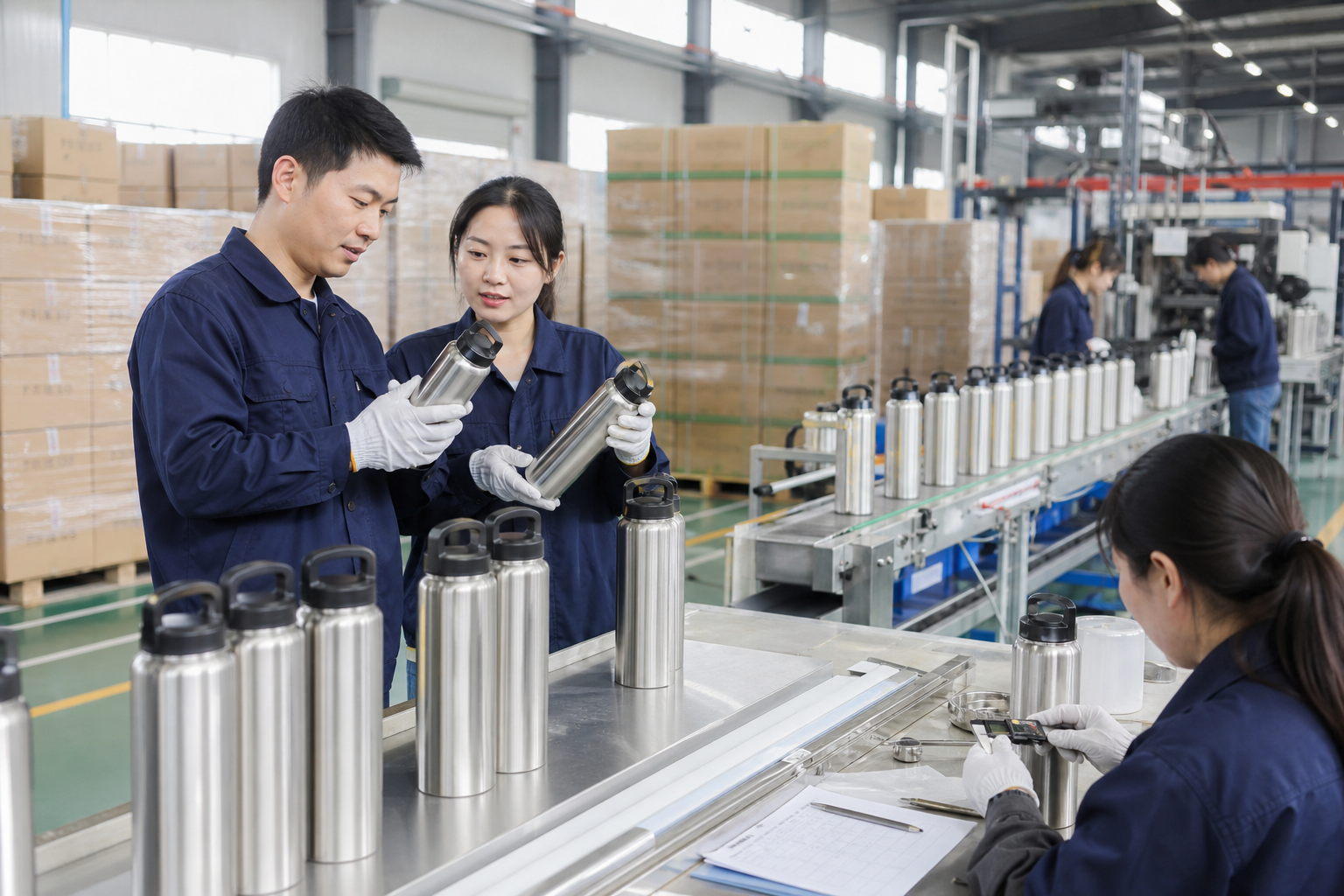
For B2B buyers, QC is not a nice extra. It is the line between a saleable SKU and a container of claims. Ask the canteen manufacturer for a written inspection plan that covers incoming material checks, in-line checks, and final inspection under AQL 2.5 for major defects and 4.0 for minor defects. On the floor, we run a 3-point caliper check on the neck and lid fit before the line moves on. If the factory cannot name its defect categories in plain terms, it is not ready for a serious distributor canteen or canteen distributors program.
Leakage testing, thermal performance testing, paint adhesion, and carton drop testing need to be set before mass production, not after. For insulated products, verify vacuum integrity and temperature-retention claims with a documented test method, not a sales sheet. We have seen the buyer flag a 12 mm barcode shift because the carton print sat too close to the flap, and that sort of mistake costs time at the warehouse. For a canteen promotional order going into retail, confirm barcode placement, carton markings, and FNSKU if you are supplying Amazon channels. If you are buying from China or Zhejiang for export, the paperwork must match the goods exactly: SKU, capacity, material, country of origin, and carton count.
A practical factory will send pre-production samples, then a golden sample, then production photos with batch traceability. QC pulled the sample, checked the lid torque at 1.2 N·m, and matched the batch number against the carton label before we shipped. If the supplier skips those steps, your exposure grows fast, and the math does not work.
Pick a supplier you can scale
The gap between a one-off vendor and a canteen supplier is repeatability. A sample can look clean on the table, then the second batch drifts by 1.5 mm on the lid fit or the Pantone shift shows up under daylight. A canteen vendor can win one order. A serious canteen factory or canteen manufacturers group can hold the same shade, same fit, same coating, and the same print position across 3,000 units, which is what matters when you reorder six months later and the buyer flags a mismatch on arrival.
When you evaluate a drinkware custom partner in China, look at three things: production depth, export discipline, and response quality. Production depth means they can move from custom drinkware to custom growler and back without the line losing control. Export discipline means they know EU and US paperwork, pallet marks, and transit packing; we ship cartons that survive a 1.2 m drop test, not just a good-looking sample box. Response quality means they ask about cap torque, coating thickness, and carton count instead of saying yes to everything.
If you need a canteen customized for promotion, retail, or distributor drinkware, the right factory should talk about mold lead time, sample charges, and whether the product can later become a broader custom canteen family. We have seen this go sideways when a buyer skipped the mold question and sent a PO with the wrong logo size in the artwork notes. That is the wrong question to ask. A real program starts with one part number, one cap system, and one decoration method, then grows from there. In Zhejiang, the better factories can scale from one logo to a full line without tearing up the setup.
For most buyers, the safe move is to start with one proven body, one cap system, and one decoration method, then expand only after the first container passes QC and the market gives you clean feedback. QC pulled the sample on one run because the lid gasket was 0.3 mm under spec, and that kind of miss is cheaper to catch before shipment than after a return claim.
Get a quote for your custom drinkware
Send your target price, MOQ, and market destination. We will match the right material, decoration, and compliance path from China.
Frequently asked questions
What is a realistic MOQ for drinkware custom orders?
For standard custom drinkware, a realistic MOQ is usually 1,000 pcs per design. If you want multiple colors, a special cap, or a custom growler with extra tooling, expect 3,000 pcs or more. Some canteen manufacturers in China can quote lower, but the unit cost often jumps and packaging options get limited. If you need mixed SKUs for a canteen distributor program, ask whether MOQ applies per color, per logo, or per carton spec. That detail changes the real order size fast.
How long does a custom canteen order take?
A normal custom canteen order takes 20-35 days after sample approval, plus 7-10 days for sampling if the body and logo are straightforward. If you need new tooling, special packaging, or a customized growler with multiple components, add time. A reliable canteen factory in Zhejiang should give you a schedule for sample confirmation, production, inspection, and export booking. If the supplier cannot name those stages, the lead time is not controlled.
Which decoration method lasts longest?
Laser engraving usually lasts longest because it marks the metal directly and does not rely on a surface ink layer. Silk screen is cheaper and works well for simple canteen promotional runs, but it can wear if the bottle is rubbed often. Powder coat with a printed logo can look strong, but you need to test abrasion and dishwasher resistance. For distributor drinkware or retail programs, ask for an actual production sample and not just a mockup. The finish on the sample is what your customer will see.
What compliance documents should I request for Europe and North America?
For Europe, ask for REACH compliance and, where relevant, LFGB food-contact evidence. For North America, ask for food-contact test reports and make sure inks, gaskets, and coatings are included in the scope. If you are importing through a canteen supplier in China, also confirm carton marking, origin labeling, and any retailer-specific barcode requirements. A serious canteen manufacturer should provide documentation that matches the exact SKU, capacity, and material structure, not a generic certificate for a similar bottle.
How do I avoid quality problems on first order?
Start with a clear spec sheet and a golden sample. Then require in-process checks, final inspection at AQL 2.5, leak testing, and carton drop testing. Ask the canteen factory to send production photos and batch traceability before shipment. If you are buying a customized canteen or customized drinkware program for a distributor, add one more step: approve the packaging artwork and barcode layout before mass production. Most first-order issues come from missing details, not from the bottle itself.