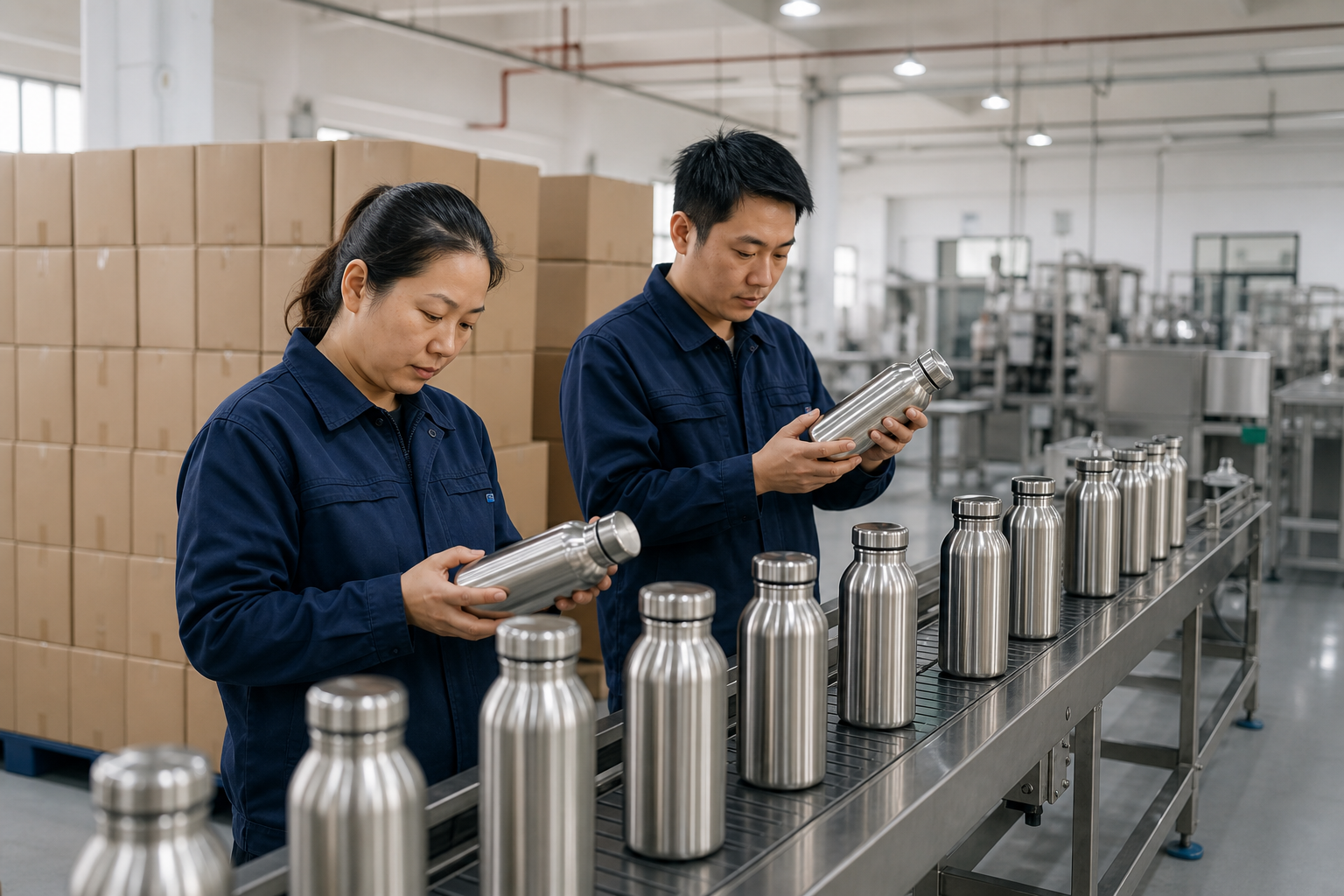
Key Takeaways
- Specify material, lid, finish, and packaging before asking for a quote; missing one detail can move price by 10-20%.
- For custom drinkware, MOQ usually starts around 1,000-3,000 pcs per SKU, with 30-45 days lead time after sample approval.
- Ask for AQL 2.5 or tighter on critical defects, plus REACH or ASTM-related test reports when selling into Europe or North America.
- The cheapest canteen promotional option is not always the best; decoration durability and leak performance matter more than a 0.20 USD unit saving.
If you buy drinkware customizable for retail, promotions, or private label, the bottle is not the hard part. The hard part is writing a spec that still works after the line runs 20,000 pieces and QC pulls the sample at the end of shift. A canteen custom order can look clean on the sample table and still fail the buyer’s drop test if the coating chips, the lid leaks at 45 degrees, or the MOQ gets read wrong. This is the wrong question to ask: the issue is not whether the bottle looks good, it is whether it survives production and shipping with your brand intact.
What you need is a clean buying brief: choose the material, define decoration, confirm packaging, then lock the quality checkpoints before you issue a PO. We run into this every week in Zhejiang, usually after the buyer flags a typo on the PO or the carton spec is missing a 3 mm insert. The best canteen manufacturer and canteen supplier teams will tell you the same thing: vague specs cost money. A tight brief saves weeks when you are ordering 3,000 to 20,000 units from a factory running 200,000 units per month.
What Drinkware Customizable Really Means
Drinkware customizable is not just “put a logo on a bottle.” It means you can define the bottle body, cap system, surface finish, artwork method, packaging, and sometimes the mold geometry. That is the line between a stock SKU and customized drinkware that actually carries your brand and your margin. On our shop floor, QC pulled a sample with a 0.3 mm print shift last week, and the buyer flagged it right away. For a canteen distributor, the right spec can turn a promo item into a fast mover. The wrong spec sits in carton 18 weeks.
In practice, the scope usually falls into four buckets: logo-only, color-only, partial tooling changes, and full custom mold work. A logo-only custom canteen is the fastest route, often with lower setup cost and lower MOQ. Full customized canteen or customized growler work takes longer, but it gives you control over silhouette, handle shape, wall thickness, and closure compatibility. If you need a canteen customized for outdoor retail, do not ignore ergonomics. A 24 oz bottle with a 1.2 mm wall and a sloppy grip sells worse than a slightly heavier bottle that sits steady in hand. We run this test on the line all the time.
Buyers often use the words canteen custom, canteen customizable, and custom drinkware as if they mean the same thing. They do not. A canteen vendor may treat “custom” as a print job, while a canteen manufacturer may assume you want tooling. Write the brief in plain terms: capacity, material, logo method, lid type, Pantone color, carton spec, and target market. If you want distributor drinkware, distributor growler, or distributor canteen programs, define reorder logic too. The factory should know whether this is a 1-time campaign or a 12-month SKU. We have seen PO notes go wrong from one missing word.
Choose Material For The Channel
Material choice decides most of the product’s economics and half of its customer complaints. On the line, we run PET and Tritan for cold drinks because they mold cleanly and keep weight down, but for premium retail and repeat use, stainless steel is the safer call. A 304 stainless canteen is the standard starting point for many canteen manufacturers in Zhejiang, while 316 makes sense if you need higher corrosion resistance or a stronger premium story. For a custom growler, wall thickness and weld quality matter more than a fancy label. The buyer who only asks for the lowest unit price is asking the wrong question.
If the bottle is for promotions, you may be tempted to choose the lowest-cost body. That works only when the use is short and the print is simple. A canteen promotional item for a trade show can be lighter and cheaper than a retail canteen custom line, but it still needs leak performance and surface durability. We saw a 0.5 mm powder coat miss show up after 18 days of courier handling, and QC pulled the sample before it left the floor. For a customizable growler, I would treat a heavier gauge and a secure seal as non-negotiable. The math does not work if the cap starts failing in the field.
- 304 stainless steel: good default for most canteen custom programs.
- 316 stainless steel: better for premium and higher-corrosion environments.
- Tritan: clear, lightweight, useful for sports and lifestyle drinkware.
- Aluminum: cost-effective, but coating and dent resistance need scrutiny.
For Europe and North America, ask for REACH or food-contact declarations tied to the exact resin, coating, or ink batch. Do not accept a generic statement from a canteen supplier if the material changed; we have seen buyers flag a PO typo that swapped the ink code and the paperwork no longer matched the carton mark. China factories vary widely in control. The better ones document lot-level traceability, and that matters when your distributor canteen order scales from 5,000 to 50,000 units. A simple lot card and a retained sample can save a messy claim later.
Decoration That Survives Use
Decoration is where a lot of drinkware customizable projects get weakened by marketing talk. A sharp logo is not enough. On the line, we judge by washing, abrasion, and how buyers actually toss the product into a crate or a dishwasher rack. The common choices are silkscreen, pad printing, laser engraving, heat transfer, and UV print. Each one has a different cost profile and a hard durability ceiling. If you are comparing canteen customized options, ask for a real wear expectation, not a sales promise.
Laser engraving is usually the cleanest choice for stainless steel because it cannot peel. Silkscreen can work for simple graphics, but the ink system and curing have to be right. Our oven runs at 180 C, and a 200 mesh screen changes coverage fast on a curved body. For a custom canteen that will be used outdoors, I would take scratch resistance over a brighter first-day look every time. For a canteen custom order going into retail, one extra color is often not worth the lower pass rate and higher scrap. The math does not work.
Ask these questions before approving art
- What is the maximum print area in millimeters?
- How many color passes are involved?
- Will the finish survive 50 dishwasher cycles or only hand washing?
- Does the artwork wrap over a seam or a curved shoulder?
For canteen distributors and canteen vendors, decoration choice should match SKU strategy. A distributor drinkware program usually needs one premium engraved line and one low-cost printed line. The wrong decoration on the wrong bottle creates margin leakage, and we have seen that go sideways when a buyer flagged a 0.3 mm logo shift after sample approval. If you need a durable custom growler for brewery or outdoor retail use, engraving plus a powder coat is usually the safer call than a soft print that wears off after a few trips. We ship that kind of order with tighter QC, because a pretty sample means nothing if it fails after the first wash.
MOQ, Pricing, and Lead Time
Most buyers underprice MOQ and lead time. They drive the unit price. A canteen factory will quote 1,000 pcs differently from 10,000 pcs because setup, packing, and line labor get spread across fewer units. On our side, a 500 ml bottle with one silk-screen logo can sit at one level; add five logo colors, a special lid, and custom carton art, and the math changes fast. For many canteen manufacturers in China, MOQ starts at 1,000 to 3,000 pcs per design for simpler custom drinkware, and custom mold work can push that much higher. We run this every week. The buyer flagged a PO with two lid styles in one line item, and the price had to be rebuilt from scratch.
Typical lead time after sample approval is 30 to 45 days for standard customization and 45 to 60 days if packaging or tooling is involved. That assumes the factory already has stock on hand and your artwork is final. On a Zhejiang line, where a lot of drinkware production is clustered, we can move fast, but only when the details are locked. One missing carton spec or a typo on the PO can burn three days before QC even pulls the sample. China can move quickly, but only when the buyer is precise. A vague PO is the fastest way to lose a week. We have seen 12 days slip to 18 days over one wrong lid code.
Price should be checked as a landed structure, not just ex-factory. A 0.30 USD saving on the bottle can vanish if the carton fails a drop test or the freight cube is poor. Ask for FOB terms, carton dimensions, net/gross weight, and sample charge policy. If you sell through Amazon or a distributor channel, the pack needs to fit that model from the start. For FNSKU, UPC, or retail-ready packaging, that decision belongs before mass production, not after the first shipment leaves China. We have seen this go sideways when the carton was 2 mm too tall for the shelf spec.
Practical rule: if a supplier will not quote MOQ, lead time, and sample cost in writing, they are not ready for a serious program.
Quality Control You Can Enforce
Quality is not a slogan. It is a gate list with numbers on it. A supplier worth trusting should sign off on incoming material checks, in-process inspection, and a final AQL-based inspection before shipment. For many buyers, AQL 2.5 for major defects and 4.0 for minor defects is a workable baseline, but leakage, sharp edges, and coating contamination need tighter limits. On one line we checked a 0.2 mm burr at the rim with a feeler gauge; that is the level you want in custom drinkware that goes to stores.
Ask for the test list, not a blank “QC passed” stamp. Leak test, dishwasher resistance, drop test, and coating adhesion should be written out with pass/fail numbers. If the product is stainless, check weld quality and passivation where it applies. If it is a custom growler or insulated bottle, run vacuum performance and thermal retention by batch; QC pulled the sample off the line at 30 minutes, not after the pallet was wrapped. A factory that does the work will show the record. A weak one will talk around it.
Documentation matters too. For Europe, you may need REACH-related declarations and food-contact evidence. For North America, FDA-aligned material statements may be required depending on the market and claim set. If you buy through canteen suppliers or canteen vendors, do not assume the paperwork follows the SKU. Match it to the exact product code, coating, and decoration method. We have seen a PO typo on the decoration code send 20,000 units to the wrong test file, and the math does not work.
- Confirm AQL levels before production starts.
- Require photos or video of final packing and carton labeling.
- Keep one golden sample signed by both sides.
- Link artwork approval to the production lot.
Select The Right Factory Partner
The right partner is not the one with the loudest brochure. It is the canteen maker that answers hard questions in plain words and puts them into the proforma invoice. We ask for the line count, the `200,000 units per month` figure, and the QC hold point before we talk price. A Zhejiang factory can push that volume across multiple lines, but volume by itself does not carry your program. QC pulled the sample, checked the cap torque, and found the first run looked fine. The second run is where weak control shows up. That is the wrong question to ask: can they make it once, or can they run it the same way in month three?
For a canteen distributor or distributor canteen project, the factory has to keep reorder speed and packaging consistency intact. Ask how they match color from batch to batch, where they store approved artwork, and whether mixed-SKU cartons are built on the line or packed by hand at the end. We run into trouble when the buyer flags a carton split after the PO is signed. If you are comparing a canteen vendor and a canteen supplier, judge process control, not sales talk. The best suppliers give you the constraint up front, including where a 3 mm print shift will pass and where it will get held.
Use a short qualification list before you commit:
- Can they quote in 24 hours with MOQ, lead time, and FOB terms, or do they need three reminders and a WhatsApp chase?
- Can they provide BSCI, ISO, or comparable audit records if you need them, and will they send the actual file or just say "we have it"?
- Can they show prior customized canteen or customized drinkware work in your price band, with a real carton photo or PO reference?
- Can they support your packaging, label, and barcode requirements without outsourcing everything, or does the line stop every time the buyer asks for a small change?
If your program includes canteen promotional items, retail custom drinkware, or a premium customized growler line, choose one factory partner that can scale with you. The cheapest quote often comes from a shop that cannot hold quality at volume. We have seen this go sideways after the first reorder, when a 12-day sample promise turns into an 18-day correction and the buyer starts chasing replacement stock. In China, that is when the problem shows up, not on the sample table.
Packaging And Reorder Strategy
Packaging is part of the product, not an afterthought. A drinkware customizable order can fail on the shelf if the box crushes, the inner tray rattles, or the retail sleeve looks cheap next to the bottle. On the line, we run a 1-meter drop test and check tray movement in millimeters, because a loose insert turns into a dented cap fast. For custom canteen programs, packaging also hits freight cost hard. A box that adds 12% to volume can wipe out the margin you won by cutting the unit price by 0.15 USD. This is where a lot of canteen distributors get surprised.
Decide early whether the product ships as bulk packed, white-box packed, or retail-ready. For Amazon or e-commerce channels, carton labeling, FNSKU placement, and polybag compliance need to sit in the spec sheet before production starts. We have seen a buyer flag a PO because the carton count was typed as 240 instead of 204, and the whole booking stalled. For distributor drinkware, a mixed pack or shelf-ready carton may work better than individual retail boxes. For canteen promotional campaigns, simplified packaging is the right move if the target is a short event and the bottle itself carries the brand.
Reorder strategy matters too. A customized canteen line with a stable mold and repeatable artwork is much easier to replenish than a one-off prototype SKU built from trial samples. Keep the exact material code, Pantone reference, decoration method, and carton spec on file. We ship faster when those four items are fixed, because the printer, the sleeve cutter, and the carton vendor all work off the same sheet. The wrong question is whether the SKU is "new"; the real question is whether it can be repeated without a fresh approval cycle. The best canteen manufacturers and canteen suppliers in Zhejiang understand that repeat business comes from controlled variation, not reinvention.
In China, the factories that keep a clean archive of samples, documents, and approved packaging are usually the ones that can serve you for years, not months. We keep signed samples, dielines, and QC photos in labeled shelves, and that saves days when a buyer asks for the same custom growler or custom drinkware run six months later. If the sleeve file is missing or the barcode size is wrong by 2 mm, the line stops and the reprint eats time. A clean archive is boring. It also keeps the reorder smooth.
Send your spec and get a working quote
We can review your MOQ, material, decoration, and packaging before production so your custom drinkware order ships cleanly from Zhejiang.
Frequently asked questions
What MOQ should I expect for drinkware customizable orders?
For standard logo or color customization, a realistic MOQ is often 1,000 to 3,000 pcs per SKU. If you need a new mold, special lid, or multi-step decoration, the MOQ may rise to 5,000 pcs or more. A serious canteen manufacturer should tell you the MOQ together with lead time, sample fee, and packaging limits. If the supplier gives only a unit price and nothing else, the quote is incomplete. For seasonal promotions, ask whether mixed colors can be combined into one run; sometimes that reduces risk, but it can raise setup cost. Always confirm whether the MOQ is per color, per size, or per artwork version.
Is a custom canteen better in stainless steel or Tritan?
It depends on the channel. Stainless steel is usually better for premium retail, outdoor use, and repeat purchases because it feels more durable and takes laser engraving well. Tritan works for clear lifestyle drinkware and lighter-weight products where visibility matters. For a canteen custom order aimed at promotions, Tritan can be cost-effective, but it is less suitable if you want a premium feel or high scratch resistance. For a canteen distributor, the best answer is often to carry both: a lower-cost promotional line and a higher-margin stainless line. Ask your canteen supplier for material test reports tied to the exact resin or steel grade, not a generic statement.
What should I ask before approving a canteen customized sample?
Ask about dimensions, weight, capacity tolerance, leak performance, coating adhesion, and artwork placement. Then check the lid seal, thread smoothness, and whether the logo is centered on the production surface, not just on a hand-finished sample. For customized drinkware, a sample should represent the exact final material and decoration method. If the sample is hand-made but mass production will be machine-finished, you need to know the difference. Request photos of the production setup if the project matters. A good canteen factory will show you where the risk is before you approve the tooling or mass run.
What compliance documents do I need for Europe and North America?
For Europe, ask for REACH-related declarations, food-contact statements, and any test reports relevant to coating, ink, and materials. For North America, depending on your claim set and channel, you may need food-contact or FDA-aligned material documentation. If the product is sold as a promotional item, that does not remove the need for safety evidence. For a custom growler or canteen promotional order, the documentation should match the exact SKU, coating, and decoration method. Do not accept paperwork for a similar item. Ask the canteen manufacturer to reference batch numbers and model codes on every file.
How long does a China factory usually need to produce custom drinkware?
For standard customization, a common lead time is 30 to 45 days after sample approval and deposit. If you add new tooling, complex packaging, or multiple decoration steps, plan for 45 to 60 days. A factory in Zhejiang with stable capacity can move quickly, but only if your artwork and specifications are final. If you are ordering from a canteen supplier for a retail launch, build in extra time for packaging approval and shipment booking. Freight schedules, carton tests, and holiday periods in China can add delay, so do not leave the order until the last minute.