Key Takeaways
- Typical MOQ for a custom canteen is 500-1,000 pcs per color, with lead time around 25-35 days after sample approval.
- A stainless custom growler usually uses 18/8 steel with 0.5-0.7 mm wall thickness for a better balance of weight and durability.
- For export to Europe, ask for REACH and food-contact documentation; for North America, check FDA-related declarations and carton markings.
- A factory in Zhejiang producing 300,000 units/month can still miss your deadline if artwork, molds, or packaging are not frozen early.
When you buy drinkware customized, you are not just picking a bottle shape and adding a logo. You are buying a part that has to survive freight, shelf handling, daily washing, and the complaint process after it lands in Europe or North America. A canteen custom order can look clean in a sample photo and still fail if the wall is 0.35 mm too thin, the cap leaks on a 48-hour upside-down test, or the print flakes after 20 dishwasher cycles. QC pulled a sample off the line last week for a 2 mm cap mismatch. That is normal. The line tells the truth.
The smart way to source custom drinkware is to treat it as a manufacturing job, not a branding exercise. Check the material, the tooling, the decoration method, the compliance papers, and the factory's real output. A serious canteen manufacturer in Zhejiang or anywhere else in China should quote MOQ, lead time, and test standards without hand-waving. If a buyer flags a PO typo on the color code, we fix it before production starts; if we miss it, you eat a 12-day delay instead of an 18-day shipment. This is the wrong question to ask: not whether the bottle looks good, but whether the factory can ship the same result 5,000 times without drift.
What drinkware customized really means
In B2B sourcing, drinkware customized means more than a logo on the side. On our line, the spec can change the 18/8 body, the 0.8 mm or 1.0 mm wall, the lid, the finish, the insert card, and the master carton for a distributor's shelf plan. A canteen custom program often starts from a stock body, then shifts to a different cap, a matte powder coat, or a private label box. That is the line between a generic item and a custom canteen that fits the channel.
The useful question is not, "Can you customize it?" The useful question is, "How far can you push it before the MOQ, lead time, or print cost stops making sense?" A canteen supplier should separate stock, artwork-only, and tooling work. QC pulled the sample on a 2,000-piece order last month because the laser mark sat 3 mm off center, and that kind of miss is why we ask for drawings, not just photos. A laser logo on a stainless custom canteen is fast. A full-color wrap on customized drinkware needs new artwork prep and usually a higher MOQ. This is the wrong question to ask if you want a clean quote.
Do not mix up promotional and disposable. A canteen promotional order for a trade show can use lighter packaging and a simpler print spec, but if you are a canteen distributor selling retail or e-commerce, the buyer will flag color drift on the second carton. We ship OEM, ODM, and stock-promo jobs as separate files for a reason. One PO typo on a 500 ml SKU can turn into the wrong neck finish, and the line stops. We've seen this go sideways. In Zhejiang, that discipline is normal because export buyers check every sample sheet.
- Standard customizations: logo, color, lid type, packaging
- Moderate customizations: shape tweaks, handle changes, surface finish
- Tooling-level changes: new body mold, new cap mold, new drinking system
Choose materials and construction
Material choice sets the price, the hand feel, and the scrap rate. For a stainless steel customized canteen or custom growler, 18/8 stainless is the baseline we run. It holds up against corrosion better than lower-grade steel and gives a steadier export record. On the line, 0.5 mm wall thickness is common for cost-sensitive runs, while 0.6-0.7 mm usually feels stronger in hand and takes dents better in shipping and retail handling.
If you are sourcing a customizable growler for beverage brands, check the closure system first. A bad cap will sink an otherwise solid bottle. The silicone ring needs a tight seat, the threads need to cut clean, and the lid should pass inversion and pressure checks. On one recent run, QC pulled the sample because the torque gauge showed a loose close after 18 turns. For insulated models, ask for vacuum integrity testing and temperature-retention claims backed by the factory's own test data, not just the sales sheet.
Plastic and Tritan-style products have their place, especially for lightweight distributor drinkware programs, but they need checks for odor, clarity, and crack resistance. If you need a canteen manufacturer for school, outdoor, or event channels, be specific about the use case. A canteen factory that mainly makes stainless products may not be the right partner for a lightweight custom canteen line. We have seen this go sideways when the buyer wanted a 90 g body and the plant was set up for heavier builds. The right construction follows the channel, not the trend.
Practical rule: the lower the price target, the more you should inspect cap performance, weld quality, and coating durability before approving mass production.
Decoration that survives shipping
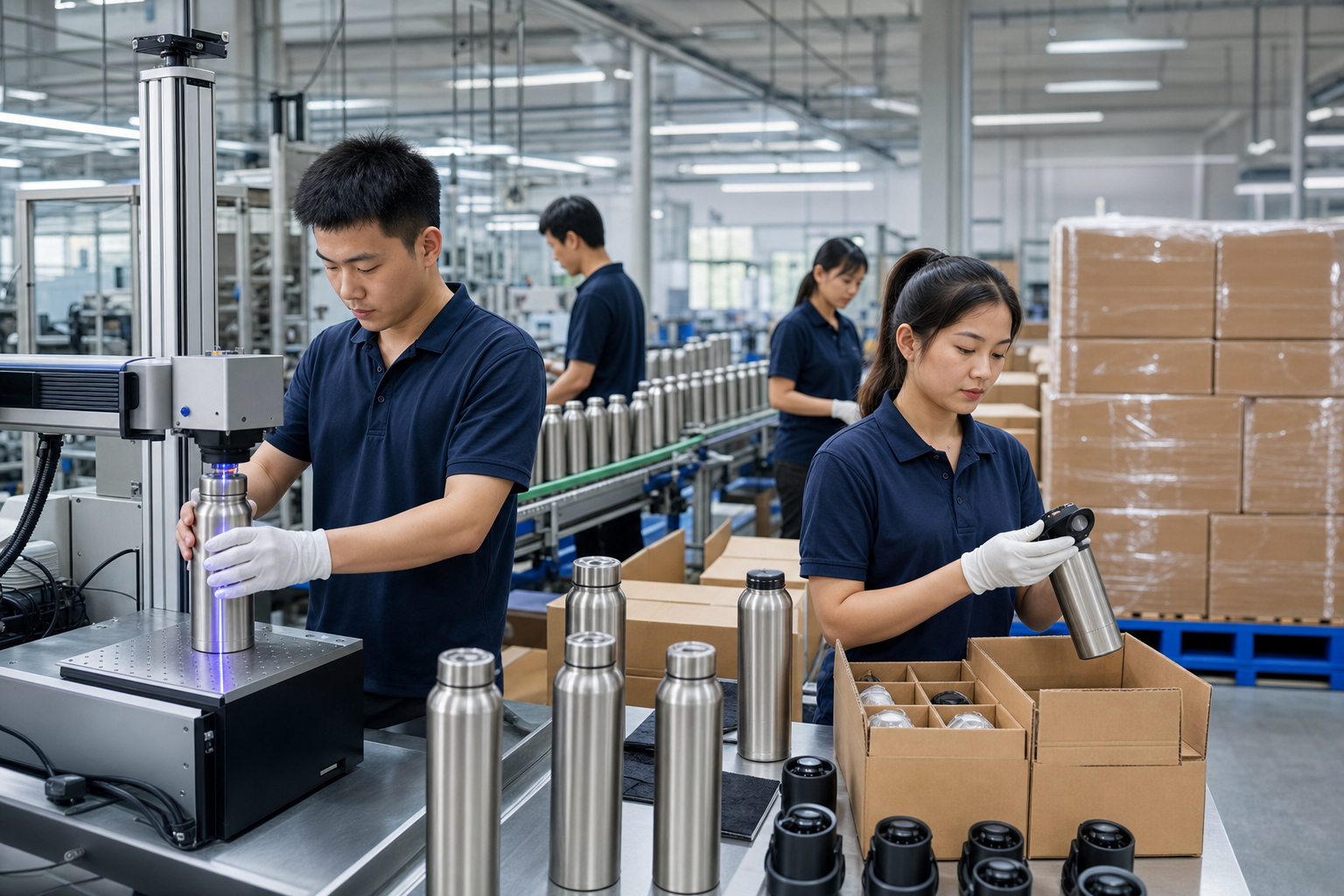
Decoration is where a lot of custom drinkware orders fail. A logo can pass on the first sample and still rub off after 200 cartons on the line, a dishwasher cycle, or a truck ride with loose packing. For a canteen customized for retail, match the print method to the surface and the way it will be used. Silkscreen works for simple art and solid brand colors. Laser engraving is cleaner on stainless steel and fits premium distributor canteen programs. Heat transfer and sublimation work on some coated or coated-polyester surfaces, but they are not a catch-all. QC pulled the sample, and the tape test told the story in 10 seconds.
If you are ordering customized drinkware for Amazon or wholesale fulfillment, ask how the mark holds up under normal handling. A laser-marked custom canteen can suit a minimalist brand, while a powder-coated bottle needs a tighter print window. The factory should give you artwork limits, Pantone tolerance, and placement drawings with millimeter callouts. The buyer flagged it for a reason: "any logo can work" is not a plan, and we have seen that claim fall apart on a 0.3 mm registration miss.
Packaging matters too. If the product ships as a canteen promotional item, plain inner packing may be enough. If it moves through a distributor canteen channel, the outer carton should pass drop testing and pallet stacking without scuffing the mark. A reliable canteen supplier in China will tell you whether decoration happens before or after assembly, because yield changes fast when the cap is already on the line. For a customized growler with three colors, ask whether each color change adds setup time or a new screen. That is usually where the landed price moves, not the bottle body. We ship plenty of orders where the PO typo is one extra color and a 12-day delay.
- Best for stainless: laser engraving, one-color silkscreen
- Best for coated surfaces: pad print, silkscreen, some transfer methods
- Best for premium retail: precise placement, low-tolerance color control
MOQ, pricing, and lead time
I’m rewriting the section to keep the HTML structure intact while making the wording sound like a real factory-side sales engineer, with tighter pricing language and more concrete sourcing detail.Most buyers underestimate how MOQ works in China. A canteen custom order can have one MOQ for the body, another for the lid, and another for packaging. That is normal. On a 48-cavity lid mold, the line still needs setup time, material allocation, and a decoration slot. A factory in Zhejiang may run 300,000 units per month, but your order still sits in the queue. If you want canteen manufacturers to quote honestly, ask for three numbers: sample time, production lead time, and the earliest ship date after artwork approval.
As a rough export benchmark, a simple customized canteen can often start at 500 to 1,000 pcs per design and color, while a more complex custom growler with a new lid or special coating may need 3,000 pcs or more to be economical. Price drops when you simplify the cap, cut print colors from four to two, or stay with standard packaging. The landed cost matters more than FOB. Cartons, inserts, and freight can move the margin fast, and the math does not work if you ignore them.
If you are working with canteen distributors or building a private-label retail line, ask the canteen vendor for a quotation breakdown. The quote should separate unit price, mold cost, sample cost, logo setup, and packaging upgrade. A good canteen manufacturer will also tell you whether your target price is realistic before sampling begins. That saves a round of back-and-forth. We have seen a buyer flag a PO typo on the packing spec after the sample was already approved, and that kind of miss burns a week. In Zhejiang and the broader China supply base, the factories that quote clearly usually ship more reliably than the ones that only quote low. Fast is useful, but predictable is better.
Lead time is usually 25-35 days after sample approval for standard custom drinkware, and 40-60 days if tooling or special packaging is involved. If the lid insert needs a new steel tool, add time, not hope.
Quality control and compliance
Quality control is not a final inspection checkbox. It starts with the drawing and ends with carton loading. If a factory only shows you a final check sheet, that is the wrong question to ask. For custom drinkware, ask which AQL level they run for appearance and function. A common export setup is AQL 2.5 for major defects and 4.0 for minor defects, but the plan should match the product and the channel risk. On the line, we check sealing, print alignment, lid torque, leak resistance, and coating adhesion before packing. Last month QC pulled a sample with a 1.2 mm print shift, and that job got held before it left the factory.
Compliance is equally important. For Europe, request REACH-related declarations and food-contact documentation. For North America, ask for material statements and any relevant FDA-related support from the canteen supplier. If the product is stainless, make sure the steel grade is stated clearly. If it is plastic, confirm the resin type and whether it is BPA-free where applicable. Ask for ISO-based process controls and BSCI or a similar social audit if your retailer requires it. We have seen buyers lose a week because the PO said "304" in one place and "SS304" in another, and customs asked for clarification.
The best canteen manufacturers in China do not hide the test plan. They show it. That means vacuum tests for insulated items, drop tests for packaging, dishwasher or abrasion checks where relevant, and batch records for traceability. If you are buying a canteen promotional program, a looser cosmetic standard may work. If you are building a premium custom canteen line, it will not. We run the math this way: a 12-day delay on one retest is cheaper than shipping 18,000 units with a lid problem. The risk sits with you after the shipment leaves Zhejiang, so get the records before you pay the balance.
- Ask for: AQL plan, test reports, material declaration, carton spec
- Check: leak rate, cap torque, print durability, odor, surface finish
- For retail: barcode, FNSKU, master carton marks, pallet layout
Match product to your channel
Different channels need different drinkware customized programs. A distributor canteen line for sporting goods stores should chase margin, shelf appeal, and fast replenishment. A corporate custom drinkware program usually cares more about logo sharpness, packaging, and a 12-day turnaround. A custom growler for beverage brands often needs a 1.2 mm body, tighter sealing on the line, and a finish that holds a higher price. This is the wrong question to ask if you start with decoration first.
For e-commerce, start with fulfillment. Carton size, drop safety, and barcode placement matter as much as the bottle itself. We run 1.2 m drop checks here, and weak corner pads show up fast. For wholesale and distributor canteen accounts, color consistency across repeat orders matters more than a fancy one-off finish. If you sell through multiple channels, ask your canteen supplier whether they can lock critical specs across reorders. The buyer flagged one PO where the lid code was typed wrong by one digit, and that turned into a week of back-and-forth.
A practical sourcing file should include the approved sample, artwork file, product drawing, packaging spec, and inspection standard. Keep that file with your canteen vendor and your own team. If you are buying from China, especially from Zhejiang, repeat orders stay simple only when the original spec is tight. QC pulled the sample and found a 0.3 mm lip offset once, which was enough to shift the cap fit. The cheaper route is usually to standardize the body and customize only the lid, print, and box. That still gives you a canteen customizable product without turning every order into a new project.
If you want a private-label program that can scale, prioritize standard tooling, stable materials, and a realistic MOQ of 3,000 pcs. That is the difference between a one-time promotional order and a distributor growler or custom canteen line you can reorder with confidence. We ship those reorders faster when the spec does not drift, and the math does not work if every batch needs a new drawing. 18 days versus 12 days is the kind of gap buyers notice fast.
Build your custom drinkware program with clear specs
Send your target price, MOQ, and artwork. We will map the right factory route, test plan, and packaging for your market.
Frequently asked questions
What MOQ should I expect for drinkware customized orders?
For a standard custom canteen or custom drinkware line, expect 500-1,000 pcs per design and color as a realistic starting point. If you add a new lid, special coating, or new mold, MOQ can move to 3,000 pcs or more. Some canteen manufacturers in China will sample smaller quantities, but the real production economics usually show up at larger runs. Ask for MOQ by body, lid, logo, and packaging separately so you can see where the cost is coming from.
Is a custom growler different from a custom canteen?
Yes. A custom growler usually focuses on beverage sealing, carry comfort, and a more premium finish, while a custom canteen can be built for outdoor, school, promo, or retail use. A growler often needs stronger gasket control and a tighter closure system. A canteen customizable program may allow more variations in cap style and capacity. If you are a distributor, ask the canteen supplier which product is easier to reorder and which one has lower defect risk over time.
What documents should I request from a canteen manufacturer in China?
At minimum, ask for a material declaration, product drawing, sample approval sheet, carton specification, and compliance support for your market. For Europe, REACH and food-contact information matter. For North America, you should request relevant FDA-related declarations if the item is in direct food-contact use. If the product is insulated, ask for vacuum or thermal test data. A serious canteen factory in Zhejiang will usually have these files ready, or can prepare them before mass production.
How long does a custom canteen order usually take?
For standard drinkware customized with existing tooling, 25-35 days after sample approval is a normal target. If you need a new mold, special coating, or complex packaging, 40-60 days is more realistic. Shipping time is separate. A good canteen supplier should give you a sample timeline, production lead time, and ship date based on final artwork. If they cannot separate those steps, the schedule is not reliable enough for a distributor drinkware program.
How do I reduce risk on my first order?
Start with a standard body, simple logo, and one packaging format. That lets you test the canteen vendor's quality, communication, and on-time delivery without overloading the project. Use a clear AQL standard, approve a physical sample, and confirm all artwork in writing. If the first order is successful, you can move into a more customized canteen, a customized growler, or a broader private-label range. The key is to control variables before you scale.