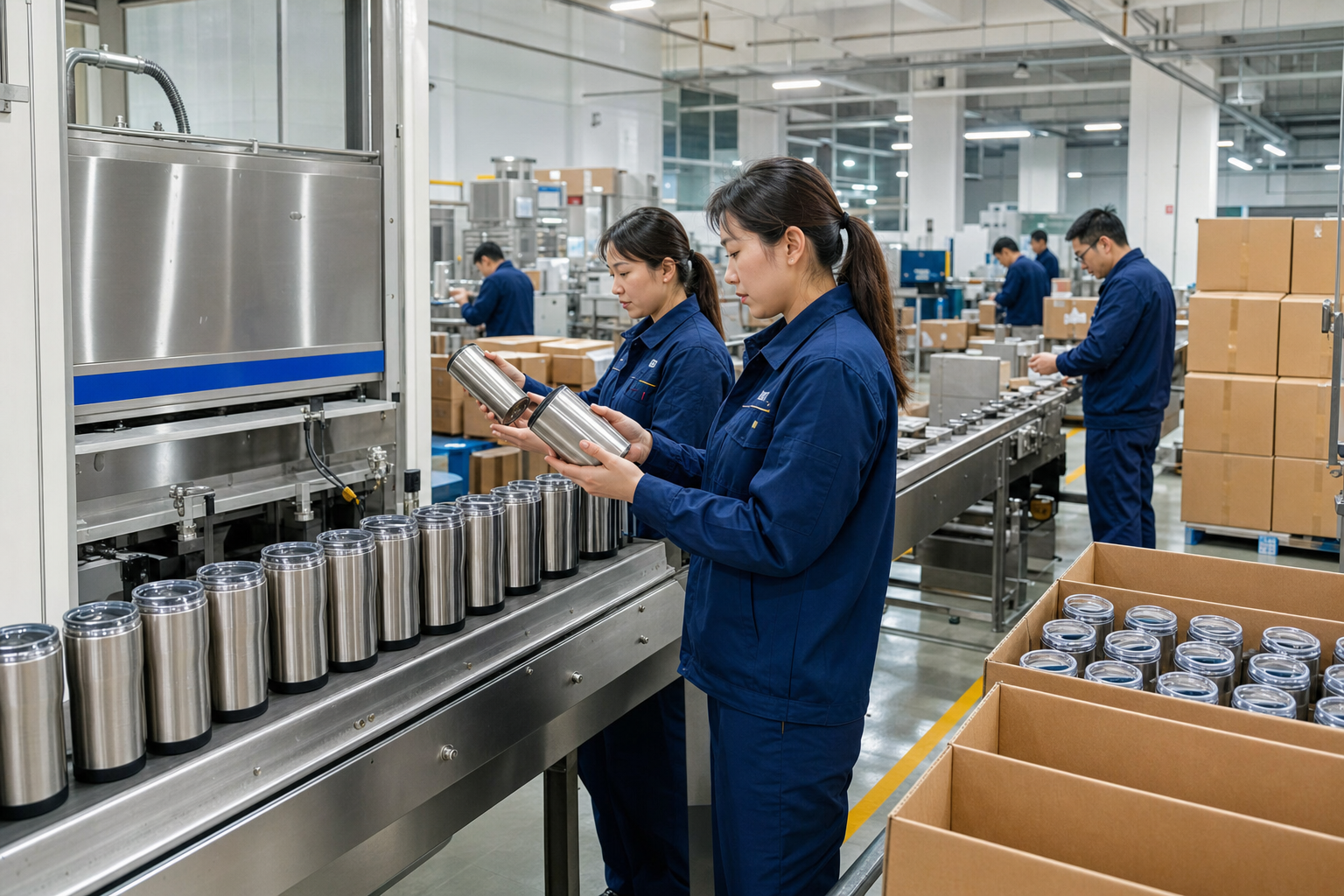
Key Takeaways
- A practical MOQ for custom drinkware is often 500-1,000 pcs per SKU, but molds, lids, and packaging can push it higher.
- A serious drinkware factory should quote sample lead time in 7-15 days and mass production in 20-35 days for standard items.
- For stainless steel, ask for 18/8 or 304 material, 0.4-0.5 mm wall thickness, and AQL 2.5 major defect checks.
- The cheapest FOB price usually hides carton upgrades, print setup, and rework costs that show up after approval.
If you are buying from a drinkware factory, price is usually not the trap. The real mistake is assuming every canteen maker can handle your volume, your packaging, and your compliance file. We have seen a buyer approve a quote on Monday, then the line miss the carton spec by 3 mm on Friday. A solid supplier in Zhejiang or elsewhere in China can make the numbers look easy, then slip on the small details once the order is on the water.
You need a factory that can hold the same color, the same lid fit, and the same print quality across 5,000 or 50,000 units. For custom drinkware, that means asking about MOQ, lead time, raw material certificates, and what happens when your artwork needs a second round. QC pulled the sample, the cap torque was off by 0.2 N·m, and the buyer flagged it before mass production. The cheapest quote is usually the wrong question to ask; you want the one that ships on time, passes inspection, and does not send returns back through your distributor canteen program.
Start With the Selling Channel
Before you ask a canteen factory for a price, decide where the product will sell. A distributor drinkware program needs a different build than a retail launch, and a canteen promotional order is not the same as a premium corporate gift. We run these jobs on the same line, but the carton spec changes fast: a 24-pack shipper for distributor stock, or a 6-piece display tray for retail. If you are supplying canteen distributors, the product has to survive repeated handling, mixed cartons, and price pressure. If you are building a custom growler line for specialty retail, presentation matters more, and the lid finish or box print can support a higher FOB.
Good buyers write the brief around the channel, not around a random product photo. State the use case, target price, and order split by color or capacity. A customizable canteen for a sports club may only need one logo color and a basic kraft box, while a customized drinkware line for North America may need barcode labels, carton marks, and retail-ready inserts. QC pulled a sample last week because the PO said "natural box" and the buyer meant "white box with EAN"; that kind of typo burns 2 days. The same factory can often do both, but you need to be explicit.
- Define the channel: distributor, promo, retail, Amazon, or corporate.
- Define the target price before decoration, packaging, and inland freight.
- Specify whether the order is one SKU or multiple capacities in one run.
- Ask whether the factory has done canteen custom work for your market before.
If you want a canteen supplier to quote accurately, give them the audience, not just the size. That is the difference between a usable quote and a number that has to be reworked three times, and we have seen a 500 ml spec turn into a 480 ml sample because the buyer never named the channel. That is the wrong question to ask.
Choose Materials That Match Use
Material choice sets the price and the failure rate. For a stainless steel canteen, 18/8 or 304 is the baseline buyers ask for, and that is the right answer for most orders. If the customer wants stronger corrosion resistance, 316 works, but the unit price goes up and sourcing takes longer. For plastic lids and accessories, BPA-free PP is standard, while Tritan fits jobs that need better clarity and impact resistance. A borosilicate glass bottle is a different case: cleaner taste, a higher breakage rate, and more carton protection. On the line, we check the spec sheet against the actual resin drum label before we run the first sample.
Do not let a canteen vendor sell you a glossy finish without asking about coating thickness. Powder coating in the 60-80 micron range is common for decent scratch resistance, and we measure it with a coating gauge, not a sales promise. For double-wall vacuum products, spacer geometry and weld quality matter more than the marketing line. In practice, 0.4-0.5 mm stainless wall thickness gives a better balance of weight and rigidity than ultra-thin metal that dents in transit. QC pulled the sample last week and found a 0.32 mm spot near the seam; that is the kind of miss that turns into a claim.
Compliance is part of the material decision. For Europe, ask for REACH and food-contact declarations; for North America, ask what the factory can support for FDA-style food contact claims and packaging safety. A canteen manufacturer in China should show raw material lot tracking, and a serious Zhejiang factory will separate food-contact parts from decorative parts during inspection. We also check the PO against the carton mark line by line, because a typo in the resin grade or SKU code can hold the shipment at the warehouse gate.
Cheap material is rarely cheap after breakage, print failure, and customer complaints.
If you are building a canteen customized line, the right material choice cuts returns more than any discount does. The buyer flagged a 2% breakage rate on the first sample run, and the math does not work if you chase the lowest quote and ignore field failures.
Verify Factory Capability
Not every drinkware factory pulls its weight. Some are trading desks with a few subcontracted lines. Others own the forming, welding, coating, printing, and packing under one roof. You want the second type when the order matters. Ask who owns the tooling, where the lid is molded, and whether the factory controls decoration instead of pushing half the order to a third party. We have seen a buyer flag a PO typo on the lid code only after the cartons were printed. That gets expensive fast.
Capacity matters because your first reorder will slip if the line is already booked. A stable plant in Zhejiang or another export hub in China should be able to show monthly output by category. A factory running around 600,000 units per month across tumblers, bottles, and canteens usually has enough discipline to plan repeat work. That does not make the quality perfect. It does show they know how to keep the press machine, coating booth, and packing bench moving without chaos.
What to check in the factory audit
- BSCI or similar social compliance if your retailer requires it.
- ISO 9001 or an internal quality system with documented checkpoints.
- In-house sample room, print shop, and packaging line.
- Tooling maintenance records for lids, caps, and silicone seals.
- Ability to handle canteen distributors who need mixed SKUs in one shipment.
If a canteen factory cannot explain its rejection process, it will not protect your margin. Ask for photos of the line, recent inspection reports, and a clear answer on which steps stay in-house. We run into this all the time: QC pulled the sample, found a 0.3 mm lid gap, and the supplier still tried to pass it off as normal. This is the wrong question to dodge. That is where the difference between a real canteen supplier and a disposable vendor shows up.
Price, MOQ, and Lead Time
Price only makes sense when it is tied to a real spec. A FOB quote for a custom drinkware item should spell out material grade, wall thickness, finish, logo method, packing style, and carton quantity. Leave any one out, and the quote moves. On our line, QC checks wall thickness with a caliper, and the buyer usually notices the gap after the first sample. For standard items, a sample may cost USD 30-120 depending on tooling and logo setup. For custom molds or a new lid design, the tooling charge can be much higher and should be paid separately.
MOQ is the part buyers underestimate. We hear "500 is too high" all the time. The math does not work that way. For many canteen custom projects, 500-1,000 pcs per SKU is realistic if the factory already has a base mold. Once you ask for a fully customized canteen, special lid, or unique packaging, the minimum can move to 3,000 pcs or more. On a 12-cavity lid mold, that is the floor, not a negotiation trick. A canteen distributor program works better when you accept a few focused SKUs instead of forcing ten low-volume variants.
Lead time also needs to be separated into sample and mass production. A good factory can often make a pre-production sample in 7-15 days. Mass production for a standard canteen customized order usually runs 20-35 days after approval and deposit. If a supplier promises 10 days on a complicated order, they are either guessing or they have not checked the line schedule. We run the pad-printing station and the packing bench on separate slots for a reason, and that queue gets tight fast.
Compare quotes on the same terms: EXW, FOB, packing spec, and decoration method. Otherwise you are not comparing the same product.
For Amazon or DTC buyers, ask whether FNSKU labels, carton marks, and master carton data can be handled at the factory. That prevents a second packing step after arrival. We once saw a PO with the carton mark typed as "Mastar Carton", and the buyer flagged it before the goods left the warehouse.
Build QC Into The Order
Quality control is not a final inspection. It starts at the coil and ends at the carton seal. On a real line, we run incoming checks, in-process checks, and finished goods inspection against a written AQL standard. For a lot of B2B orders, AQL 2.5 for major defects and 4.0 for minor defects is a solid baseline. If the buyer wants retail or distributor drinkware, that standard needs to be locked before the first cup hits the filling jig.
Ask for test methods, not soft promises. For a vacuum canteen, pressure or leakage testing is non-negotiable; QC pulled the sample at 48 kPa, and that tells you more than a sales pitch ever will. For a lid, the factory should state the torque spec and the open-close cycle count. For printed artwork, request rub resistance or dishwasher-cycle data if the product will be washed often. If the order goes to Europe, confirm REACH-related requirements and the exact food-contact declaration the factory can issue. This is the wrong question to ask after production starts.
The better canteen manufacturer will show you the failure path, not hide it. Do they quarantine a bad lot, rework it, or scrap it? Do they re-inspect after rework? Good factories in China and Zhejiang answer that without guessing. We have seen a 12,000-piece order go sideways because one batch had a 0.3 mm lid gap; that one issue wiped out the margin on three clean runs.
- Pre-production sample approval before mass run.
- Inline checks on print alignment, lid fit, and coating finish.
- Leak test, drop test, and carton compression review before shipment.
- Final inspection report with photos, defect counts, and lot traceability.
If you want a canteen vendor to protect your brand, require the inspection report before balance payment, not after the container has sailed. One buyer flagged a PO typo on the carton mark, and that small miss held the shipment for two days at the dock. The math does not work if you find the problem in transit.
Customize Without Creating Problems
Customization should lift sell-through, not turn the line into a fire drill. The usual mistake is stacking too many changes at once: a new Pantone color, a different lid, a stamped logo, a printed gift box, and two capacities in one PO. We have seen that turn a simple canteen order into a 12-day slip. Start with one body, one lid family, and one artwork system. After the first reorder clears, expand with proof, not guesswork.
For decoration, pick the method that fits the channel. Silkscreen works for flat, bold logos and runs of 3,000 pcs or more. Laser engraving stays clean on 304 stainless, holds up in use, and gives a tighter premium look. If you are weighing the methods, see the practical tradeoffs in our guide on custom logo decoration options. For a distributor canteen program, a single-color print often wins because QC can pull the sample in one pass and replenishment stays simple.
Packaging needs the same discipline. A retail canteen bound for Europe may need an inner box, barcode, and hang tag. A promo order can ship with a polybag and master carton, and that is enough. Ask the factory to hold the same print file across repeat orders, because a 1 mm shift in logo position or a typo on the carton code is where rework starts. We run that check on the packing table before the pallet leaves.
When buyers ask for a customizable growler or customizable drinkware line, lock the structural parts first and leave logo or color changes for later. That keeps the tooling steady and cuts the risk of a late shipment. The buyer flagged a mixed-capacity request on one project, and the math did not work with the same cap mold. Build the base SKU first.
If you are comparing options across a broader catalog, review our custom drinkware manufacturing capabilities and quality control standards before you approve the final spec. A disciplined launch beats a flashy one that fails on the second order. We have seen that go sideways too many times.
Send your spec and get a factory quote
Share material, MOQ, logo, and packaging details. We will return a practical quote with lead time, compliance notes, and sampling options.
Frequently asked questions
What MOQ should I expect from a drinkware factory?
For standard custom drinkware, a realistic MOQ is often 500-1,000 pcs per SKU if the factory already has the body mold and lid. If you need a new lid, a new color, or a fully customized canteen, MOQ can move to 3,000 pcs or more. Small runs are possible, but the unit price usually jumps 15-30% because setup time and waste are spread across fewer pieces. Always confirm whether the MOQ applies to total order quantity or per color, because that changes the economics fast.
What documents should I ask for from a canteen manufacturer in China?
Ask for the business license, BSCI or other social audit if your buyer requires it, and a quality system summary such as ISO 9001. For product compliance, request food-contact declarations, REACH-related declarations for Europe, and raw material certificates for stainless steel, silicone, and plastics. You should also ask for the latest inspection report, test photos, and carton specification. A serious China factory can usually provide these without delay. If they cannot, treat that as a sourcing risk, not an admin issue.
Which logo method is best for custom drinkware?
There is no single best method. Silkscreen is efficient for bold, low-cost branding and works well on larger runs. Laser engraving is more durable on stainless steel and looks cleaner for premium retail. Heat transfer and UV print can work on some bottles, but they need tighter process control. For a canteen promotional order, one-color silkscreen is usually the safest. For a custom growler or premium corporate gift, laser engraving often gives better perceived value. The right choice depends on use, wash frequency, and target margin.
How do I compare FOB prices fairly?
Compare only when the spec is identical. That means same material grade, wall thickness, coating, logo method, packing type, carton count, and inspection standard. A quote at USD 2.10 FOB with simple polybag packing is not equal to USD 2.30 FOB with retail box, barcode label, and AQL 2.5 inspection. Also confirm whether the price includes one logo color or multiple print passes. If a supplier leaves out packaging or tooling, the final landed cost will be higher than the initial quote.
Can a factory support Amazon FBA or distributor programs?
Yes, if they understand packing discipline. For Amazon FBA, ask whether the factory can add FNSKU labels, carton marks, suffocation warnings if needed, and master carton dimensions that fit your warehouse plan. For distributor canteen programs, ask for mixed-SKU packing, clear carton labeling, and consistent outer box counts. A good factory should also be able to hold a repeat order file so your second shipment matches the first. If they ship different shades or lids on the reorder, your channel costs rise immediately.