Key Takeaways
- A serious drinkware manufacturer should quote MOQ, lead time, and defect standard up front; 3,000 units and 25-35 days are common for custom orders.
- For canteen custom programs, material choice matters: 304 stainless, 18/8, or Tritan each changes price, weight, and compliance risk.
- Decoration method affects durability more than logo size; laser engraving, silkscreen, and powder coating do not perform the same in field use.
- Ask for AQL inspection, REACH or LFGB documentation, and export carton specs before you place a first order from China or Zhejiang.
Choosing a drinkware manufacturer is not about grabbing the lowest quote. You are buying tooling control, coating stability, compliance paperwork, and the ability to ship the same bottle twice without guessing. We run a 7-day prototype, then QC checks wall thickness with a caliper and logo placement against the print drawing. That is the real test. A factory in Zhejiang can show a polished sample fast; the question is whether it can repeat that result on 30,000 units with the same wall thickness, the same logo position, and the same leak rate.
For custom drinkware, the details stack up fast. A custom canteen, a custom growler, and a distributor program each need different construction, decoration, and pack-out logic. On the line, a 2 mm carton change can break a shipper fit, and we have seen a buyer flag a PO because one carton code was typed wrong. China has hundreds of canteen manufacturers, but only a smaller group can handle REACH, ASTM, ISO 9001, and export packaging without delay. The wrong question is, "Who is cheapest?" Ask whether the factory can keep customs drinkware steady when the order moves from sample to mass production.
What A Real Factory Controls
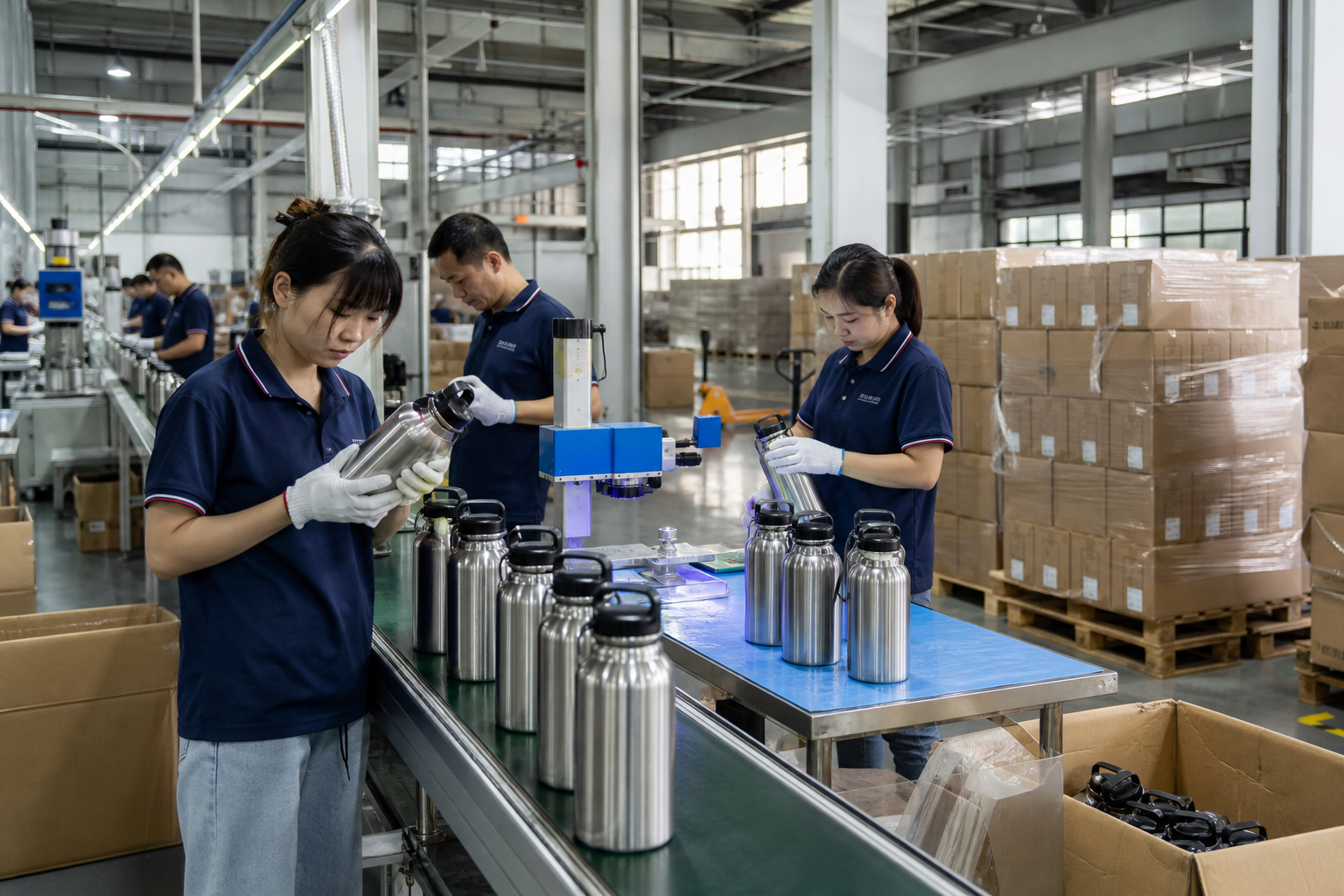
Separate marketing copy from factory control. A real canteen factory owns the mold, raw material buying, forming, welding, coating, printing, packing, and final inspection. If those steps sit with three vendors, the risk goes up fast. We saw a case where the PO said 500 ml but the neck finish on one lot was off by 0.8 mm, and the buyer flagged it after the first carton was opened. You may still ship product, but traceability gets weak, and that is the wrong setup when one carton passes a leak test and the next one does not.
Strong suppliers in China usually show monthly output and quality structure because scale is easy to fake and hard to prove. A mid-size factory in Zhejiang might run 800,000 to 1.2 million units per month across stainless bottles, insulated tumblers, and canteen promotional programs. That size gives room for repeat orders and custom work without turning the line into chaos. Ask who owns the tooling, who signs the first article sample, and whether they run IQC, in-process checks, and OQC before shipment. If they cannot point to the control sheet on the shop floor, they are acting like a trader, not a manufacturer.
For canteen suppliers, accountability beats sales talk. You want one party on the hook if a weld cracks or a lid loses torque in transit. We ship enough cartons to know this matters. The better vendors will show a sample approval sheet, a defect map, and carton drop-test data from the 600 mm test. QC pulled the sample, the weld line held, and the carton still showed a corner crush, which is the kind of detail that tells you they understand export risk, not just local wholesale demand.
Choose The Right Product Format
Not every buyer needs the same bottle geometry. A canteen custom program for an outdoor brand is different from a custom growler for a brewery distributor or a customizable canteen for a school campaign. On the line, a 1 mm change in shoulder angle can alter wall thickness, seal land, handle mold, and carton count. Choose the wrong format and you pay twice: higher unit cost and a pile of complaints from the first 500 pcs.
Start with use case. For hiking, a lightweight canteen customized in 304 stainless with a 0.5 mm body and a wide mouth is easier to fill, wash, and pass QC after a leak test. For distributor retail, a single-wall shell keeps tooling low and lets us ship a one-color print without fighting the budget. For a custom growler, the neck finish and cap torque matter; beer pressure and return cartons leave no room for a loose lid. If you are comparing canteen manufacturers, ask for body gauge, lid material, and seal type. “Premium” is not a spec.
There is a real split between customized canteen and customizable drinkware programs. A customizable canteen usually means standard tooling with logo and color changes. A fully customized canteen means new dimensions, new embossing, or a new cap system, and that moves MOQ, lead time, and unit price at the same time. We have seen buyers approve a sketch, then reject the first sample because the handle looked 3 mm too flat on the shelf. This is the wrong question to ask if the brief is still vague. A canteen distributor who knows the difference keeps the order tied to what we can run on the line, not what looks good in a render.
- Outdoor SKU: focus on weight, grip, and dent resistance. A 280 g target and a 0.5 mm wall matter more than a glossy finish.
- Retail SKU: focus on shelf appeal and carton efficiency. A 24-pack master carton and a clean front panel move faster than a fancy cap.
- Promotional SKU: focus on logo area, price, and repeatability. A 1-color print and a 500 pcs MOQ keep reorders simple.
Materials And Compliance Matter
Material selection decides whether your order clears customs cleanly or turns into a support ticket. For stainless steel drinkware, most export buyers should start with 304, often called 18/8, because it gives a good balance of corrosion resistance, forming stability, and price. For a low-cost canteen promo run, some factories will quote 201 stainless or a thinner wall like 0.4 mm, but the savings usually vanish once rust complaints start or the coating fails after 6-8 months. We run a magnet check and a salt-spray test on the line for a reason. One PO typo, 304 written as 201, can waste a full day of back-and-forth.
Compliance is not optional if you sell in Europe or North America. A credible drinkware manufacturer should support REACH, LFGB where needed, FDA food-contact declarations, and test reports tied to the exact SKU you ordered. If the factory is in Zhejiang or elsewhere in China, ask for batch-level records, not a generic certificate from last year. ISO 9001 tells you the system exists; it does not prove the unit in your carton passed. This is the wrong question to ask if someone tries to swap in a PDF and call it done. QC pulled the sample from carton 18, matched the laser code to the packing list, and still found one lid dye lot that did not match the approved sample. You still need AQL inspection, with a clear major and minor defect limit before shipment.
For distributor drinkware programs, packaging matters almost as much as the bottle. Carton strength, drop testing, and insert quality drive breakage rates and retail returns, and the math does not work if you ignore them. A factory that knows export work will talk about 5-ply cartons, polybags, desiccant where needed, and pallet stacking limits of 8 layers, not vague "strong packaging" claims. We ship this kind of order every week, and the buyer flags it fast when the inner tray is 2 mm short or the carton crushes at 14 kg stack weight. That is the difference between a canteen supplier and one that only knows domestic bulk sales.
Decoration Changes Durability
Logo method is a durability call, not a design detail. We run silkscreen on the flat panel with a 0.2 mm stencil gap when the art is one or two colors, and it holds up fine until the bottle starts hitting dish racks or tool bags. Laser engraving on stainless steel is the tougher option for premium custom drinkware and custom growler orders; the mark is cut into the metal, not sitting on top of it. Powder coating changes the feel and the shelf look, but we still check adhesion, chip resistance, and batch-to-batch color at the line before we release it.
A good canteen manufacturer will say where each process fits. If you need a canteen customized for a sports campaign, laser on bare steel usually outlasts a full wrap print. If you need a canteen custom for retail, a matte powder coat with a clean pad print sells better on the shelf. The wrong question is whether every decoration can do everything. For a canteen distributor shipping into retail, promo, and corporate channels, one base SKU with different decoration keeps MOQ pressure down and makes forecasting less messy; we have seen three mold versions turn into dead stock fast.
Ask for decoration tolerance, not a promise. A serious factory should give you logo placement in millimeters, color delta limits, and a clear wear spec, such as 50 or 100 dishwasher cycles. If they cannot put that on paper, they are selling appearance, not repeatability. We use go/no-go samples and a fixed jig on the line, and QC pulled one last week because the print had drifted 1.5 mm. That is how you keep customized drinkware steady when the order moves from 2,000 to 20,000 units.
Do not approve decoration from a photo alone. Approve it against a signed sample, a print spec, and a defined wear test.
MOQ And Lead Time Reality
Most buyer mistakes start with price and timing set too low. The wrong question is "Can you do 500 pieces?" A real drinkware manufacturer can usually beat a trading company on unit cost, but not when you want deep customization at a tiny quantity. For a standard custom canteen, MOQ may start at 3,000 units per color or per print variant. If you ask for new tooling, special lids, or extra packaging inserts, MOQ can move to 5,000 or 8,000 units fast. That is normal. We run a pad printer on the line, and every setup eats time, ink, and labor before the first sellable piece clears QC.
Lead time follows the process, not the quote sheet. A simple customized canteen with existing tooling may ship in 25 to 35 days after sample approval. A new mold or new finish can stretch that to 45 to 60 days. If you are importing from China into North America or Europe, add ocean transit, customs, and domestic delivery. A 12-day factory promise can still miss your launch if the buyer flags a carton typo on day 8 and we have to rework the master case art. For seasonal programs, leave room for sample revision and carton confirmation. We have seen a 25-day plan slip to 52 days because the buyer changed the lid color after we had already booked the oven slot.
Ask for pricing in tiers. A good canteen supplier will show you 3,000, 5,000, and 10,000 unit breaks, plus the cost of extra decoration colors or individual packing. If the quote is flat and vague, the factory is hiding assumptions. On one PO, the buyer wrote "gift box" in the notes but left out insert foam; that missing line changed the carton cost by 14 percent. For distributor canteen programs, you want a clean price ladder, not a surprise when the second PO is 14 percent higher because the first one was underpriced.
- Confirm Incoterms: FOB, CIF, or DDP before comparing quotes.
- Lock packaging specs before mass production starts.
- Request sample lead time separately from bulk lead time.
How To Judge Supplier Risk
You do not need a perfect canteen vendor. You need one that is straight about its limits and disciplined on the line. Start with factory audit evidence, trade references, export history, and defect handling. If a supplier says it can do everything, stop and ask for sample data. A real canteen manufacturer will show you the SKUs it runs well and the work it sends to a partner shop. That is normal. The risk starts when a canteen vendors list hides the actual production path, especially for 500ml and 750ml orders that change hands twice before packing.
Look for repeatability. Ask for three things: a production photo set from the same SKU, an inspection report with defect categories, and a shipping record for the last 90 days. Then put the sample next to the production unit. If the logo shade is off by one Pantone step, the cap gap measures 0.8 mm instead of 0.4 mm, or the coating feels different to the thumb, the process is slipping. We once had a buyer flag a PO typo on the lid color code, and QC pulled the sample right away. For a distributor growler or distributor drinkware program, that matters because customers reorder on what landed in carton one, not on your explanation.
In China, the factories that last usually have one thing in common: they are boring in the right way. They keep records, answer technical questions directly, and do not hide MOQ changes or coating limits. Whether you buy from Zhejiang or another region, choose the supplier that talks about AQL, packaging, and test reports before they talk about best price. We run this check with a simple rule: if they cannot show a 90-day shipping log and a leak test sheet from the same line, the math does not work. That is the difference between a canteen supplier you can scale with and one you will replace after the first complaint cycle.
Request a quote with real factory specs
Send your target MOQ, material, and decoration method. We will return a practical quote with samples, lead time, and export documentation.
Frequently asked questions
What is a realistic MOQ for a custom canteen order?
For most custom canteen programs, a realistic MOQ starts around 3,000 units per design or color. If you need a new mold, special cap, or multiple print variants, the MOQ often moves to 5,000 units or more. A standard factory in Zhejiang may quote 25-35 days after sample approval for existing tooling, but new tooling can add 15-25 days. Ask whether MOQ is tied to one artwork, one carton spec, or one full SKU. That detail changes your actual inventory risk.
How do I compare drinkware manufacturer quotes correctly?
Compare quotes only after you normalize the spec. Check body material, wall thickness, lid material, decoration method, packing style, and Incoterms. A $0.20 difference can disappear once you add a better cap, individual box, or freight-safe carton. Ask for FOB pricing from the same port in China, then compare sample quality and inspection terms. A serious drinkware manufacturer should also disclose whether the quoted price assumes AQL 2.5, 100 percent leak test, or only spot checks. Without that, the lowest number is not the real cost.
Can I get REACH or LFGB paperwork for custom drinkware?
Yes, but only if the supplier is set up for export compliance. For custom drinkware sold in Europe, ask for REACH documentation tied to the exact SKU, plus LFGB or food-contact support where applicable. For the U.S., ask for food-contact declarations and, if relevant, test reports for inks, coatings, and lids. Do not accept a generic certificate for a different product. A proper canteen manufacturer in China should be able to match the test report to the material batch, the decoration process, and the final packed item.
Is laser engraving better than silkscreen for branding?
It depends on the use case. Laser engraving is more durable on stainless steel and is usually the safer choice for a custom growler or a premium canteen customized for long-term use. Silkscreen is cheaper and works well for simple logos on promotional orders, especially when you need a lower entry price. If the product will be washed often or handled roughly, laser usually outperforms print. If your canteen distributor program needs a bold color logo and a low unit cost, silkscreen can still be the right answer. Test both on the exact surface.
What should I ask before placing a first order with a canteen supplier?
Ask five things before you issue the PO: who owns the tooling, what the MOQ is by color and artwork, what the lead time is after sample approval, what the inspection standard is, and which compliance documents are available. Also ask for carton dimensions and gross weight, because freight can change your landed cost materially. A reliable canteen supplier should answer in numbers, not in general promises. If they cannot specify AQL level, material grade, and shipping terms, you are not ready to place a distributor drinkware order.