Key Takeaways
- Most serious drinkware manufacturers in China run MOQs from 500 to 1,000 pcs per SKU, with lead times around 25 to 35 days.
- A good custom canteen program should quote FOB pricing, decoration cost, and packaging separately so you can protect margin.
- For export, ask for REACH, FDA, LFGB, BSCI, and AQL documents before you approve production.
- Wall thickness, lid seal design, and leak testing matter more than artwork if you want a customized drinkware line that gets reordered.
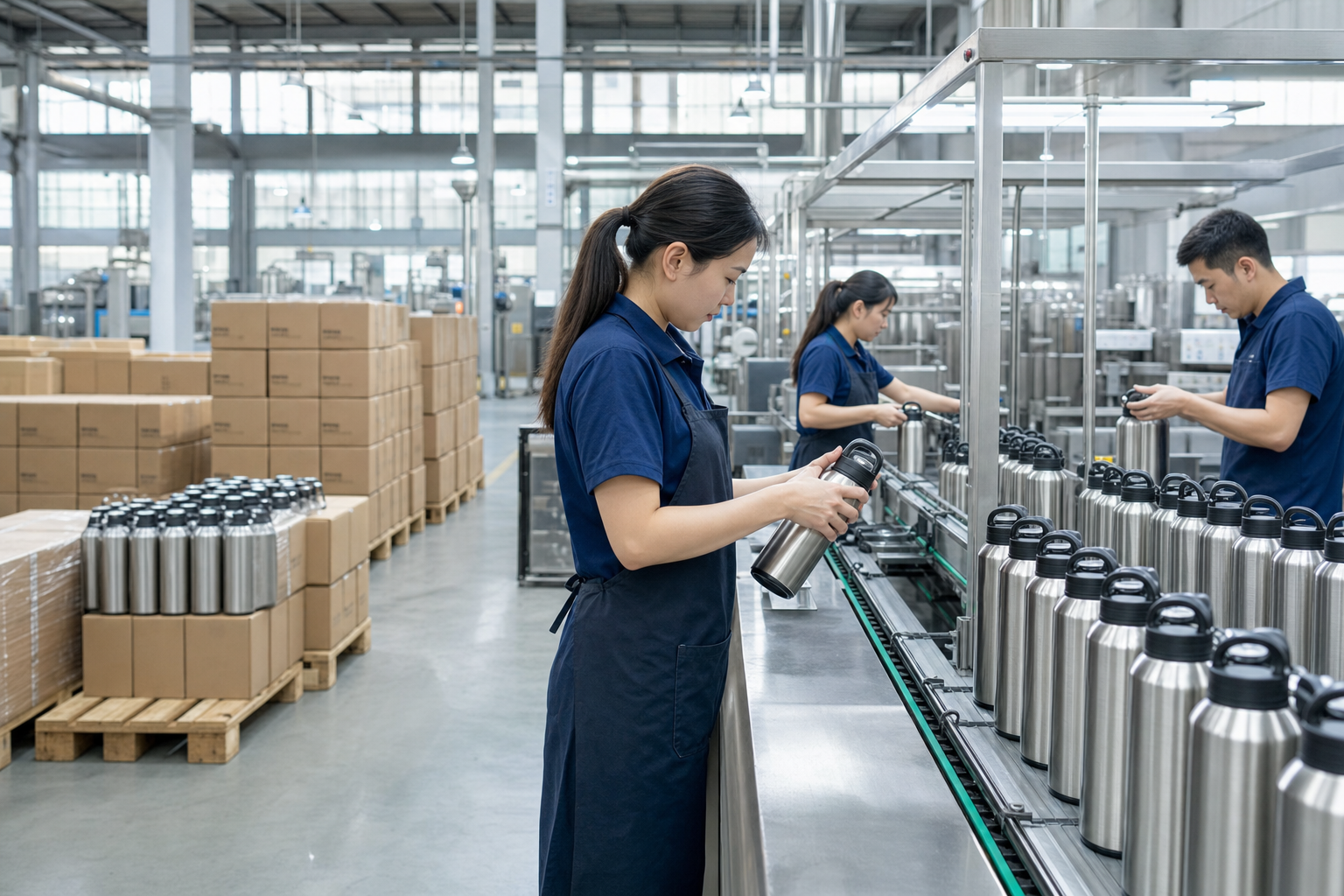
If you are sourcing from drinkware manufacturers, the first mistake is treating every factory like a catalog. A real canteen factory is not a machine shop with a logo press. We run 12-step checks on the line, watch the seam gauge at 0.2 mm, and still have to keep a custom canteen price sharp for your market.
For B2B buyers in Europe and North America, the call usually comes down to margin and risk. A canteen distributor or brand owner may ask for a customized canteen at 300 MOQ, but the order still has to pass REACH, ASTM, or internal drop tests, and it has to ship on time from China or Zhejiang without surprise tooling costs. The buyer flagged a 2 mm print shift on one PO, and that is the wrong question to ignore. The right partner knows where the cost sits, where QC usually pulls the sample, and how to build customizable drinkware that repeats the same way at scale.
What to expect from a factory
Not every canteen manufacturer is set up for export. Some only do domestic wholesale, so carton marks, barcode labels, and distributor paperwork fall apart fast. If you want a supplier you can trust, check factory capacity, process control, and export experience first. Brochure photos tell you almost nothing.
At BottleForge in Zhejiang, a line might run 12,000 units per month on common SKUs, with a standard MOQ of 500 pcs for a custom canteen and 1,000 pcs for more complex molds. We run a cap-torque check and a 24-hour leak hold on the first article before the line moves on. What matters is whether the plant can keep that pace when the order adds three colors, a custom logo, and retail cartons.
Look for clear answers to these points:
- Do they offer stainless steel, aluminum, Tritan, or glass builds?
- Can they handle canteen promotional orders and long-term distributor canteen replenishment?
- Do they have in-house testing for vacuum retention, leakage, and coating adhesion?
- Will they share inspection records, not just a finished sample?
A canteen vendor that cannot explain its process in detail is usually a trading company or a weak subcontractor chain. We have seen this go sideways when a PO typo changed the wall spec and the buyer flagged it only after pre-shipment photos. You do not need perfect English. You need proof that the factory in China can repeat the same result on the 50,000th unit as on the first sample.
Materials and build quality
Material selection is where a lot of custom drinkware programs go off the rails. A buyer sees a low unit price and skips the wall thickness, cap thread fit, or inner coating. For a stainless custom growler or customized growler, 0.2 mm on the wall or one wrong gasket compound is enough to turn a clean sample into a complaint pile. We have seen that on the line.
For stainless steel, 18/8 or 304 is the baseline for export drinkware. If it is a thermal product, check the inner and outer wall gauge, the vacuum seam consistency, and whether the body dents under a simple 1 m drop test. On one run, QC pulled the sample and found a 0.15 mm swing at the shoulder, which the buyer flagged the same day. For a canteen custom aluminum product, confirm the liner, the surface treatment, and whether the coating holds up under repeated contact with water or sports drinks. For glass, ask for the borosilicate grade and check whether the lid survives thermal shock in real use.
Build quality checks should be specific, not vague. Ask for:
- Wall thickness tolerance, ideally within +/- 0.1 mm on critical sections
- Leak testing at 100% on finished goods
- Torque or opening-cycle tests for caps and lids
- Coating adhesion and scratch resistance on decorated surfaces
If you are buying customizable canteen lines for a distributor or retail program, a slightly higher material cost often saves far more in returns, chargebacks, and rework. We have seen a 2% return rate wipe out the margin on a 5,000-piece order. Cheap looks cheap for one month. Stable construction keeps the reorder business alive for a year, and the math does not lie.
Customization that actually sells
Custom logo work does not equal a product the end buyer will reorder. A canteen customizable design should start from the use case, not the artwork. For a trade show canteen promotional item, one-color silkscreen on a 0.8 mm wall is usually enough. A premium customized drinkware line for a sports retailer may need laser engraving, powder coating, and a retail sleeve. The economics are different, and the buyer notices fast when the math does not work.
For most drinkware manufacturers, the main decoration methods are silkscreen, pad print, laser engraving, heat transfer, and UV print. We run laser on metal all day, and it holds up well on a distributor growler or custom growler where scuff resistance matters. Silkscreen still wins for simple logos at scale. UV print gives more room for color-heavy branding, but QC should still pull the sample for adhesion and dishwasher testing before you promise a ship date.
Do not overcomplicate the first order. A smart canteen distributor will usually launch with one body color, one lid color, and one logo method, then widen the line after sell-through data comes back. That keeps the MOQ under control and cuts artwork risk. If the buyer wants a customized canteen in three colors, with personalized names, and retail packaging, the unit cost moves fast. We have seen that go sideways on a 5,000 pcs order because the PO had one typo in the name list.
When you brief a canteen manufacturer, be clear about the commercial target:
- Promotional giveaway: lowest FOB, simple logo, faster turnaround
- Retail program: stronger packaging, barcode, shelf-ready presentation
- Distributor program: repeatable SKU, stable color control, replenishment plan
If the factory cannot separate those three use cases, you are talking to the wrong canteen supplier. Ask how the line is set up, how they pack a 20 ft container, and what happens when the buyer flags a color shift on the second carton.
MOQ, pricing, and lead time
I’m rewriting the four paragraphs to keep the HTML intact and make the sales language sound like a factory-side buyer conversation, not generic marketing copy. I’m keeping the existing numbers and structure, and I’m adding concrete shop-floor detail in each paragraph.B2B buyers often ask for a price before they define the product. That is the wrong question to ask. Drinkware manufacturers can price a job only after they know material, capacity, decoration, packaging, and delivery terms. On the line, we check whether the body is 0.4 mm or 0.5 mm before the sales team even writes the quote. A 500 ml stainless steel custom drinkware item with laser engraving and kraft box sits in a different cost bucket from a 750 ml canteen promotional SKU with one-color print and bulk packing.
A practical export quote should break out FOB price, sampling cost, tooling if any, decoration surcharge, and carton spec. For common stainless items, FOB pricing may range from USD 1.20 to USD 4.80 depending on complexity, lid style, insulation, and packaging. Sampling usually takes 5 to 10 days. Mass production for an established mold often runs 25 to 35 days after deposit and art approval. QC pulled the sample on the bench and checked lid torque with a 1.2 N·m gauge, which is the level of detail that keeps a shipment from getting bounced. If a canteen vendor promises a complex customized growler in 12 days, assume they are guessing or cutting corners.
MOQ is where you can negotiate intelligently. For standard bodies, 500 pcs is realistic. For multicolor prints or special packaging, 1,000 pcs is more common. The pad printer needs a plate change when the art moves from one color to three, and that is where the cost jumps. A canteen distributor buying for a private-label retail rollout should ask for tiered pricing at 1,000, 3,000, and 5,000 pcs. That gives you a real margin model, not a fantasy quote.
Lead time also depends on seasonality. In China, factory congestion usually rises before trade shows and Q4 shipment peaks. If your program is tied to a launch date, build in 10 to 15 extra days. We have seen this go sideways when a buyer flagged a PO typo on the carton count, and the line had to stop for a reprint. Zhejiang factories tend to be efficient, but logistics still decide whether your containers leave on time.
Compliance and testing matters
For Europe and North America, compliance is part of the product, not a box to tick later. Ask your canteen suppliers for the paperwork before you confirm the order, not after the goods are on the water. We run into this all the time when a buyer flags a missing material declaration at the last minute. A solid canteen manufacturer should hand over material declarations, test reports, and factory audit documents without a song and dance.
Depending on the destination and material, you may need REACH, LFGB, FDA, ASTM, food contact declarations, and a BSCI audit if your retail customer wants ethical sourcing proof. For insulated drinkware, ask for vacuum performance testing, thermal retention test methods, and ink or coating compliance too. We had one PO where the carton art carried the wrong FNSKU code, and the buyer caught it before packing. If the product will go through Amazon or big-box channels, the unit label and carton label need to scan cleanly. Anything else is asking for a chargeback.
Quality control should not sit at the end of the line. Ask the factory how it checks incoming material, in-process assembly, and final packing. A proper AQL plan usually sits at AQL 2.5 for major defects and AQL 4.0 for minor defects, though some retail buyers push for tighter limits. Leak testing should be 100% on finished liquid-contact items. We have seen 2 mm cap threads pass a casual check and fail after shipment. Random spot checks are not enough when you are shipping thousands of units from China.
Do not accept a canteen customized program without a written test standard. If the factory cannot define pass/fail criteria, you do not have responsibility, you have a guess.
That is especially true for canteen customized orders where the decoration, lid color, and pack-out change from run to run. A typo on the packing list can turn a clean repeat order into a mess, and the line will feel it fast. Good documentation keeps the 12-day rework from becoming an 18-day delay. We ship better when the paperwork is exact.
Choosing the right partner
The cheapest quote is not the right partner. The right factory knows how your channel runs. A canteen distributor wants steady replenishment and cartons that stack clean. A brand owner usually cares more about print color and launch date. A school or outdoor vendor needs impact resistance, a lower return rate, and lids that survive rough handling.
When you compare drinkware manufacturers, use a blunt filter. Can they show real production samples, not just renderings? Can they explain what changes at 500 pcs versus 5,000 pcs? Can they hold the same print density and lid seal after two reorder cycles? If the answer stays vague, you will spend more on inspection and replacements than you save on unit price. We have seen that go sideways on a 304 stainless project when the buyer only chased the low quote.
Ask for one sample set that proves the whole process: body, cap, logo, box, and shipping marks. Then check it like a buyer who has to live with the SKU for 12 months. Open it 20 times. Wash it. Smell it. Measure the print offset. Check whether it fits your shelf or pallet plan. QC pulled the sample on one order because the carton dropped at 70 cm and the corner crush was obvious. A custom canteen that looks fine in the hand but fails drop testing is not ready for distribution.
If you need a long-term custom drinkware partner in Zhejiang or elsewhere in China, start with the factory that can talk in specifics. Ask for MOQ, lead time, and the exact packing spec. That usually means fewer surprises, cleaner reorders, and better pricing when you move from pilot orders to distributor drinkware volume. This is the wrong question to ask if you only want the lowest piece price.
Source Custom Drinkware With Fewer Surprises
Send your target capacity, logo method, and MOQ. We will quote the build, compliance path, and delivery schedule from Zhejiang.
Frequently asked questions
What MOQ should I expect from drinkware manufacturers?
For standard stainless drinkware, a realistic MOQ is 500 pcs per SKU. For a custom canteen with special lids, multicolor decoration, or retail packaging, 1,000 pcs is more common. Some Zhejiang factories can sample below MOQ, but the sample price will be higher. If a supplier claims 100 pcs on a fully customized item, check whether they are reselling existing stock or making a true production run. For distributor programs, ask for tiered pricing at 1,000, 3,000, and 5,000 pcs so you can model margin properly.
How much does a custom drinkware item cost FOB China?
For a basic stainless custom drinkware item, FOB China pricing often starts around USD 1.20 to USD 2.20. A more complex insulated bottle or custom growler with laser engraving, powder coating, and retail boxing can reach USD 3.50 to USD 4.80 or more. The final number depends on material grade, capacity, lid style, print method, and packaging. Always ask for separate pricing for tooling, decoration, and cartons. That makes it easier to compare canteen suppliers on the same basis.
Which compliance documents should I ask for?
For Europe, ask for REACH and, where relevant, LFGB or food contact declarations. For North America, ask for FDA-related material declarations and any ASTM test reports if your buyer requires them. If the factory is supplying retail channels, a BSCI audit can help support vendor approval. Also ask for an AQL inspection plan, leak test records, and material certificates for stainless steel or plastic parts. A serious canteen manufacturer should provide these without delay.
How do I choose between silkscreen and laser engraving?
Use silkscreen if you want the lowest unit cost and a simple logo with one or two colors. Use laser engraving if you want a more durable mark on metal, especially for a distributor growler or premium custom canteen that will be washed often. Laser is usually more abrasion resistant, but it does not give you color. For branded retail items, many buyers use silkscreen on promotional SKUs and laser on premium SKUs. That keeps the product line flexible without changing the core factory setup.
What lead time is normal for a custom order from China?
For a standard customized canteen with existing tooling, expect 5 to 10 days for samples and 25 to 35 days for production after deposit and final artwork approval. If you need new tooling, special packaging, or a seasonal color match, add 10 to 15 days. Factories in Zhejiang can move fast, but freight booking and peak season congestion still affect the final ship date. A trustworthy canteen factory will give you a schedule with milestones, not just one promised delivery day.