Key Takeaways
- For simple drinkware promotional orders, 1,000 pcs is a realistic MOQ; fully customized molds usually start at 3,000-5,000 pcs.
- A Zhejiang factory running 300,000 units/month can still need 25-35 days after sample approval for first production.
- 304 stainless, Tritan, and borosilicate solve different use cases; do not choose by price alone.
- AQL 2.5 for major defects, REACH, LFGB, FDA, and clear artwork files are the difference between a smooth shipment and a chargeback.
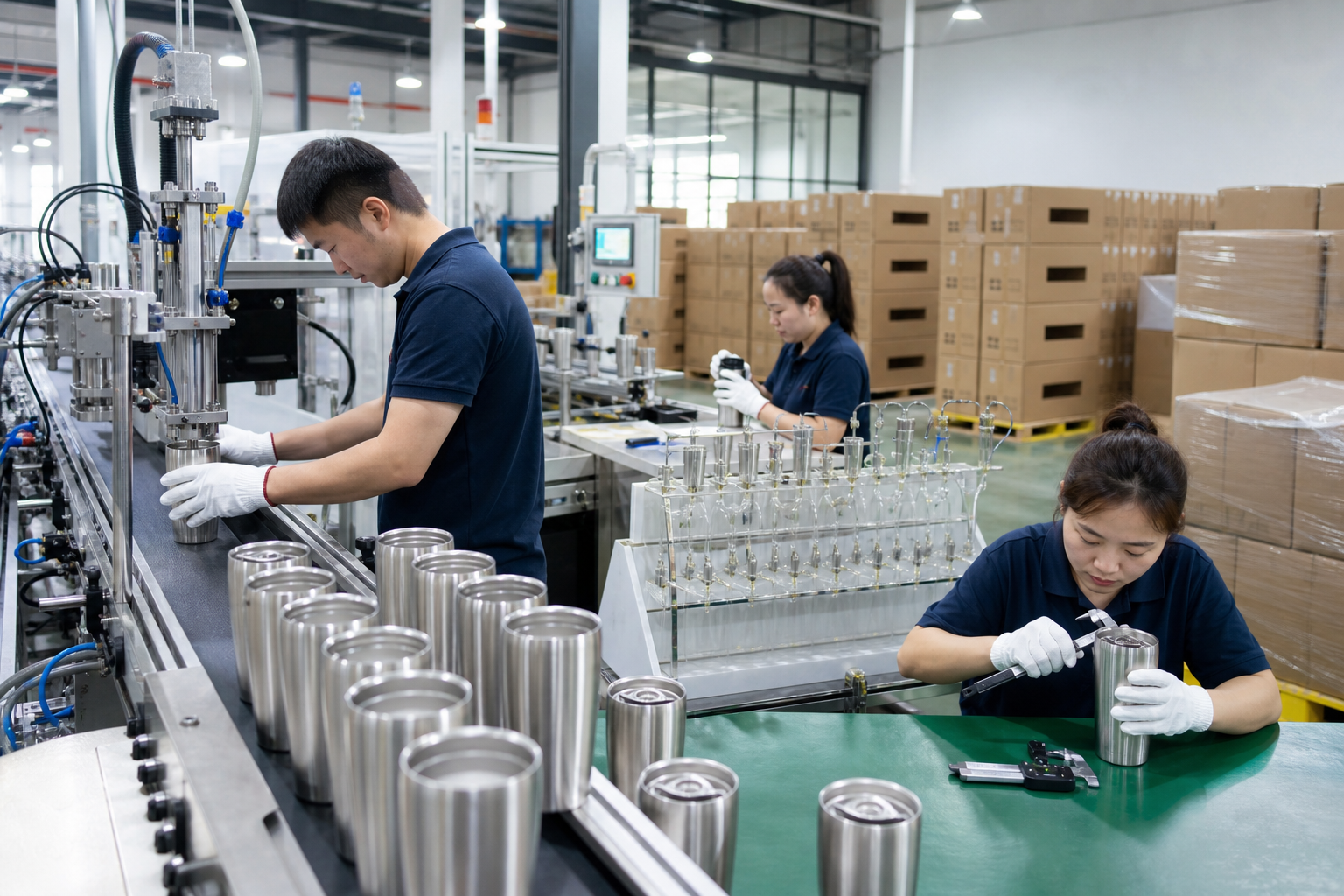
If you buy drinkware promotional pieces, the hard part is not finding a bottle. The hard part is picking one that survives a 1.2 m drop, clears compliance, and still leaves margin after print, carton, and freight. A logo is cheap. The spec is where the money goes. On the line, QC pulled the sample after the third carton because the cap torque drifted by 0.4 N·m, and that is the kind of issue that kills a repeat order.
That matters whether you are a brand owner, a canteen distributor, or a buyer building distributor drinkware for Europe and North America. In Zhejiang and across China, the gap between a hand sample and a stable production run is where most deals go sideways. The right canteen factory will ask about use case, target price, carton size, and test plan before quoting, and we ship that way every day. If they skip those questions, the buyer flagged it for a reason, because the math does not work.
What Drinkware Promotional Actually Means
In B2B sourcing, drinkware promotional usually means a product bought for a campaign, event, retailer program, or resale bundle, not for one-off consumer use. That sounds simple. It is not. A canteen promotional order for a trade show is a different job from a customized drinkware run for Amazon FBA. A distributor canteen order for a retail chain needs repeatable packaging, stable carton dimensions, and spare parts. A canteen distributor serving three customers may want one body with three lid options. A canteen supplier selling into Europe may care more about compliance paperwork than the lowest unit price. On our line, the same 500 ml bottle can ship in 24-bottle cartons, 36-bottle cartons, or a gift box, and the carton spec changes the freight math fast.
The practical question is not 'Can you print a logo?' It is 'Will this product still make sense after freight, duty, decoration, packaging, and breakage?' This is the wrong question to ask if you start with decoration. A smart canteen manufacturer asks for target market, sales channel, and expected reorder volume first. If you want custom drinkware that moves, define the job first: staff gift, retail shelf, outdoor use, school program, or premium branded giveaway. A canteen vendor serving distributors should keep a standard spec sheet for each model, including capacity, lid type, finish, and carton count. QC pulled the sample on the drop test bench at 1.2 m, and that told us more than the logo proof did.
- Event gifting: keep the decoration simple and the box light.
- Retail resale: prioritize shelf appeal and repeatable supply.
- Corporate use: focus on leak resistance and logo durability.
If you are buying canteen customized products for a mixed channel, ask the factory to quote the base product and each decoration option separately. That is the cleanest way to compare a custom canteen, a customizable canteen, and a fully customized canteen without hiding costs in packaging or setup fees. We have seen this go sideways when a buyer typed 500 pcs as 50 pcs on the PO, then wondered why the setup cost ate the margin. Ask for the quote split. The math works only then.
Choose The Right Bottle Type
One shape does not fit every campaign. For an office giveaway, a 500 ml tumbler or 600 ml sports bottle usually wins on cost per impression. We run that line every week. For outdoor retail, a custom growler or a customizable growler at 64 oz or 128 oz makes more sense because buyers expect a thicker wall, a solid handle, and a cap that seals without drama. Schools, gyms, and travel programs need a canteen custom order with a wide mouth, a carry loop, and a lid that opens with one hand. If you are sourcing canteen customized products for one industry, start with how people use it, then add the logo.
Wall construction matters. Single-wall stainless steel is lighter and cheaper, but it will not hold temperature. Vacuum insulation usually uses an inner and outer shell with a 0.4-0.5 mm stainless wall, and QC pulled the sample at 0.45 mm on the last run. A premium thermos may use 316 stainless for better corrosion resistance, but 304 is the sensible standard for most custom drinkware programs. Glass fits desk use and premium gifting, though it is a bad fit for a distributor drinkware program that ships through rough parcel channels. Tritan works when you need a lightweight, clear, BPA-free custom bottle program.
A bottle type should match the channel. A retail shelf needs a different spec from a canteen promotional giveaway, and a distributor canteen order needs a different margin structure from a branded executive gift.
When a canteen manufacturer shows too many shapes without a clear use case, that is a sign to simplify. We've seen that go sideways fast. Keep the brief tight: capacity, lid style, finish, and whether you need a custom logo or a full customized drinkware package with a printed box and insert card. One PO typo on the carton count can slow the whole shipment.
Materials And Compliance That Matter
Material choice is where experienced buyers save cash and avoid returns. For stainless steel drinkware promotional orders, 304 is the baseline because it balances corrosion resistance, food contact safety, and cost. 316 earns its keep only when the cup sees salt, acidic drinks, or a premium spec. For plastic lids and clear bottles, Tritan and PP are the usual picks because they mold cleanly on the line and hold up in drop tests. For glass, borosilicate is the sensible choice because it handles thermal shock better than ordinary soda-lime glass. QC pulled the sample after a 2-meter drop test, and that is usually where the weak material shows itself.
Compliance depends on the market. Europe usually means REACH and often LFGB for food-contact verification. North American orders commonly need FDA food contact declarations, and children's products can bring in CPSIA or ASTM-related requirements. Ask the canteen factory for test reports, not a promise letter. A serious canteen supplier should show material certificates, food-contact migration results, and a batch record tied to the lot. If they cannot, they are not ready for repeat-order business. The buyer flagged it when the PO called for one resin code and the report showed another.
Too many factories in China call something "food grade" and stop there. That is the wrong question to ask on a distributor canteen program. You want paperwork that matches the exact resin, stainless grade, coating, and lid material used on your job. If your custom canteen has a powder-coated body, ask for adhesion, abrasion, and dishwasher-cycle checks. We have seen a 0.3 mm coating issue turn into a return claim because the edge chipped in transit. If you are buying a canteen promotional item with a silicone base or gasket, ask for the silicone compliance statement too.
One simple rule: the more claims you want on the carton, the tighter the testing has to be. A canteen vendor can print "BPA-free" in one minute; proving it on the exact production lot is the part that matters. We run into this when the carton copy changes three times before ship and the lab report still has the old SKU. That mismatch is expensive.
Decoration Methods That Last
Decoration is not just about looks. It changes unit cost, lead time, and wash durability, and the wrong call will show up at the packing table fast. On the line, screen printing is still the workhorse for drinkware promotional orders because it runs clean on flat or slightly curved areas and handles 1 to 4 spot colors without drama. Laser engraving gives a sharper finish on stainless steel, and the mark stays in the metal instead of sitting on top of it. UV printing opens up more color and gradient work, which is why buyers ask for it on retail-style pieces, but it has to match the coating and the cleaning method. For premium custom drinkware, we also run heat transfer, embossing, and debossing when the art and budget justify it.
For canteen customizable programs, the right method depends on logo detail and how the item will be used. If the canteen promotional gift is going on an office desk, screen print is often enough and keeps the PO simple. If it is a customized growler or a branded bottle built for outdoor use, laser engraving is the safer call because abrasion does less damage. For a canteen customized for retail resale, ask for a decorated sample, not just a blank bottle with a digital mockup. QC pulled a sample last week where the line weight was off by 0.2 mm, and the buyer flagged it immediately. Screen art hides that kind of problem until too late. This is the wrong question to ask if you only compare price.
- Send vector files: AI, EPS, PDF, or SVG.
- Specify Pantone numbers if color accuracy matters.
- Confirm the print area in millimeters, not by eye.
- Ask for a pre-production sample before mass printing.
If you are comparing methods for a canteen manufacturer or canteen suppliers list, ask one direct question: will the decoration still look acceptable after 50 dishwasher cycles or after a few months of daily handling? On a recent order, a PO typo moved the logo 8 mm too low, and the rework cost more than the print itself. That answer is worth more than a glossy rendering.
MOQ, Pricing, And Lead Times
I’m rewriting the section in place, keeping the HTML structure intact and tightening the language so it reads like a factory-side sales engineer wrote it. I’m also folding in concrete MOQ, tooling, and packing details so the copy sounds grounded in real production.MOQ is where a lot of buyers lose a week. A stock canteen with logo print often starts at 1,000 pcs when the 32-cavity line already has the body tooling and the raw shells in production. A fully customized canteen with a new mold, special lid, or unique handle usually needs 3,000-5,000 pcs, and sometimes more when the lid has two silicone parts. Sampling usually takes 7-15 days, depending on the decoration and whether the tool room has to cut a new cap or gasket mold. First orders on a plant running 300,000 units per month still take 25-35 days after sample approval. The clean spec is the real gate here; we’ve seen a buyer lose three days over a missing lid color code.
Price comes from five levers: material grade, capacity, decoration method, packaging, and carton efficiency. A 500 ml stainless tumbler with one-color silk screen can cost far less than a 1 L insulated custom growler with a special lid and gift box. The math doesn’t work if you skip freight. A cheaper unit price disappears once you add air volume, heavy cartons, or a rigid retail box; on a 57 x 42 x 33 cm master carton, the pallet count can drop fast. For distributor drinkware, ask for FOB China pricing and separate the packaging cost. That makes it easier to compare suppliers across Zhejiang and other parts of China without hiding carton cost inside the product price.
When a canteen distributor needs repeat supply, consistent packing matters more than chasing the lowest quote. Ask the canteen supplier to quote the same SKU with standard carton pack, master carton size, and a spare-part policy. QC pulled the sample, checked the insert count twice, and that is the number you want repeated on every run. If they cannot repeat the same number after the first run, the order is too risky for a retail or channel program. We’ve seen this go sideways when the inner box count changes by two.
Practical buying rule: if the sample looks great but the quote is vague, the order is not ready. A clear quote should include unit price, tooling if any, decoration cost, lead time, and what happens if you change artwork after approval. A PO typo like “logo on lid” instead of “logo on body” can burn a day on the line, and nobody wants that on a tight ship schedule.
Quality Checks Before You Order
Quality control belongs in the purchase order, not in a vague “factory standard” note. For beverage containers, we write in a leak test plan, appearance check, carton drop spec, and an acceptance level such as AQL 2.5 for major defects and 4.0 for minor defects. For one 500 ml tumbler run, QC pulled the sample after a 76 cm drop and found a lid crack at the hinge. If you skip that line item, the buyer will flag it later, and then the math gets ugly.
Ask for a golden sample and lock it before the line runs. That sample should match the final logo position, cap color, coating, and any accessories. If the product claims thermal retention, ask for the test condition, not just the result. You want the starting temperature, ambient temperature, fill volume, lid state, and the exact time interval. A claim like “12 hours hot” means little without the method behind it. We’ve seen this go sideways on custom growler orders when the buyer approved a photo, then came back asking why the seal ring was a different shade.
A good canteen manufacturer should also spell out defect handling: what counts as rework, what gets scrapped, and who pays for replacement parts. For a program shipping to 3 countries, insist on lot traceability. That gives you the route back to the exact shift, mold cavity, and material batch if a complaint lands. On one 304 stainless run, the PO had a typo in the lid code, and the factory caught it at packing because the scan gun did not match the carton label. That is the level you want, not wishful thinking.
Before you place the order, ask for these points in writing: material grade, compliance tests, decoration method, AQL, carton count, spare parts, and the re-order price. Add the barcode format too if the shipment is for retail or marketplace packing. A plain checklist saves time. Anything less invites back-and-forth later, and we ship enough of those already.
Send your spec, get a factory quote
Share your target market, quantity, logo file, and deadline. We will price the right custom drinkware option, not a vague catalog guess.
Frequently asked questions
What MOQ should I expect for drinkware promotional orders?
For a standard stock bottle with one-color print, 1,000 pcs is a realistic starting point at many China factories. If you want a new mold, special lid, or a fully customized canteen, the MOQ usually moves to 3,000-5,000 pcs. Some canteen suppliers can split colors or logos inside one run, but that depends on tooling and packaging. Ask for MOQ by SKU, not by broad category, because a stainless tumbler, a customized growler, and a glass bottle behave very differently on setup cost.
How long does production usually take in China?
For a simple drinkware promotional reorder, 25-35 days after sample approval is normal. Sampling itself often takes 7-15 days if no new mold is needed. If the order is for a canteen customized with a new cap, special coating, or new packaging structure, add more time for mold sampling and corrections. A Zhejiang factory with large monthly capacity can still be delayed by artwork changes, so lock the spec before production. If you have a fixed ship date, build in at least one extra week for inspection and export booking.
Which decoration method lasts longest?
Laser engraving usually lasts longest on stainless steel because the mark is part of the metal surface. For coated bottles, a well-controlled screen print can still hold up well if you are not putting it through constant abrasion or harsh dishwashing. UV print gives more color options, but it is more sensitive to cleaning chemistry and handling. For a canteen promotional item, I would choose laser for daily-use bottles and screen print for simple, low-cost campaigns. If the artwork is complex, ask the canteen factory for a decorated sample before mass production.
What compliance documents should I ask for?
For Europe, ask for REACH and, if the product touches food or drink directly, LFGB-related testing where appropriate. For North America, ask for FDA food-contact declarations and any supporting migration tests. If the order is for children, request the correct child-product documentation and safety testing. Do not accept a generic 'food grade' claim from the canteen vendor without a report number, material description, and batch reference. For custom drinkware programs, I also ask for ISO 9001 or BSCI audit status when the buyer needs a documented factory profile.
What is the difference between custom canteen and custom growler?
A custom canteen usually means a lighter, more portable bottle for daily carry, school, outdoor use, or branded giveaways. A custom growler is usually larger, heavier, and designed for beverage transport or premium retail use, often at 64 oz or 128 oz. The cap, handle, wall thickness, and carton structure are different. If you are a canteen distributor, the canteen custom program is often easier to price and restock. A distributor growler program usually needs stronger packaging and a tighter leak test because the bottle is larger and more expensive to ship.